


Most people don’t “decide” to become SEO experts – they sort of grow into it. Maybe it starts with a blog that needs traffic, a business that stalls out online, or a job that suddenly involves fixing rankings. What follows is usually a mix of trial, error, curiosity, and hours inside spreadsheets and audit tools.
The good news? SEO isn’t magic, and it’s not gatekept. It’s a stack of real skills you can learn, test, and improve over time. Some parts are creative, others are deeply technical, and the rest lives in how well you can communicate what works – and why it matters.
Why SEO Still Moves the Needle in 2026
A lot has changed, but this hasn’t: people still search when they want something. That moment – when someone types in a need, a question, or a pain point – is still one of the most valuable chances a business has to show up and earn trust. That’s why SEO isn’t just relevant – it’s foundational. Not flashy, not trending, but still quietly powering around 45-53% of the traffic on many sites, depending on the industry.
And it’s not just about rankings anymore. Good SEO connects the dots between visibility, conversion, and actual business results. It sharpens your messaging, aligns your content with intent, and makes sure the right people find you at the right time. Whether you’re a founder, a marketer, or someone figuring it out as you go, knowing how SEO works means you’re not guessing. You’re building with purpose – and you can measure the impact.
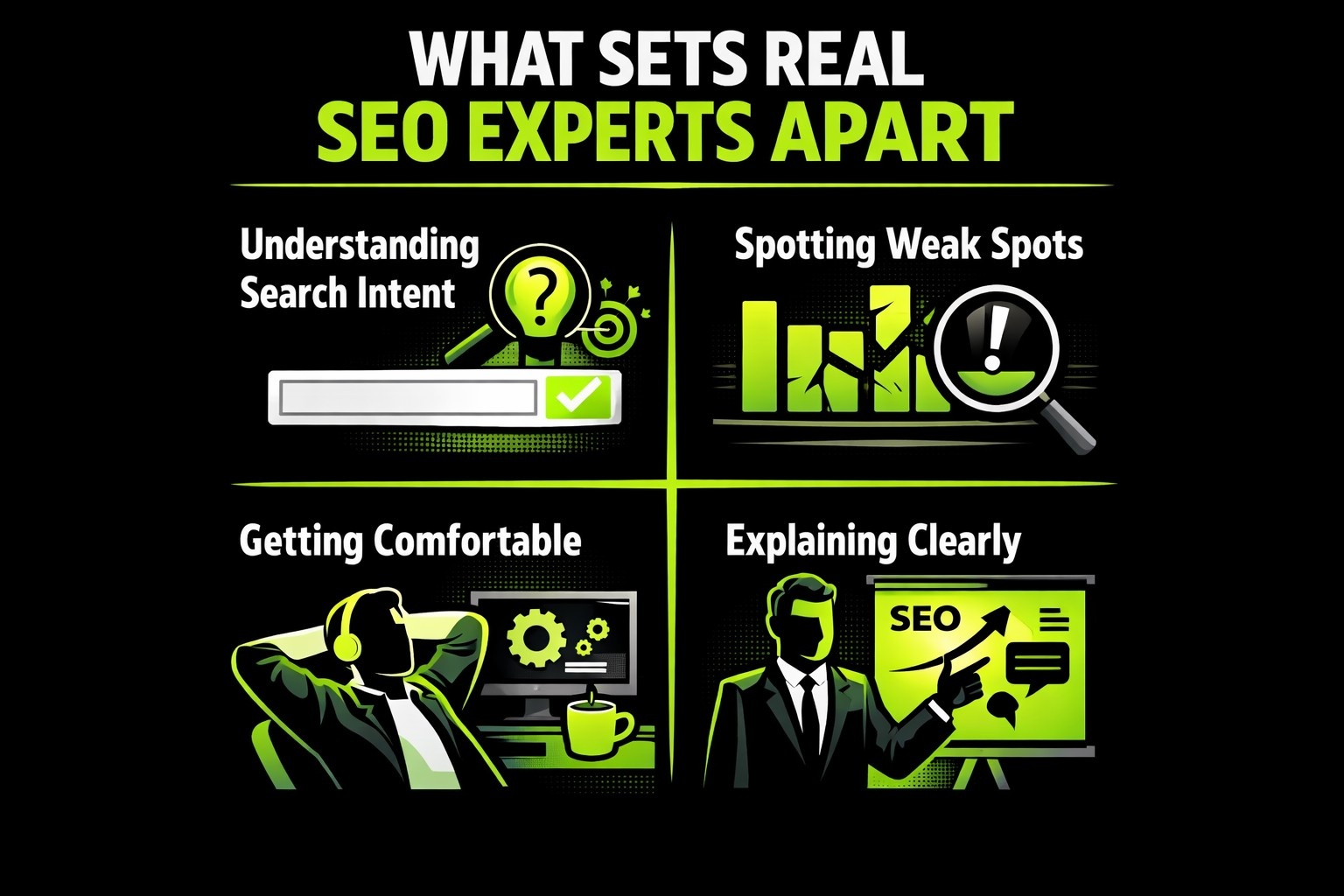
What Sets Real SEO Experts Apart
Knowing how to pull keywords is useful. But it’s not what makes someone an expert. The people who actually drive results see SEO as a system. They’re not chasing checklists – they’re building momentum. Here’s what they tend to focus on:
- Understanding search intent: Not just what people are typing, but why they’re searching and what kind of answer they’re really looking for
- Spotting weak spots quickly: Broken internal links, thin content, messy architecture – they recognize the patterns and know how to fix them without overcomplicating things
- Getting comfortable with data: Whether it’s GA4 metrics or content mapping, they use numbers to guide decisions, not just fill reports
- Explaining things clearly: No fluff, no jargon walls – just real explanations that help teams or clients actually act on the insights
- Thinking beyond rankings: They care about conversions, leads, revenue – not just position #3 on a page that gets no clicks
That’s the difference. Real SEO experts don’t just optimize websites – they create systems that move the needle.
Lengreo: Where SEO Isn’t Just Strategy, It’s Execution
At Lengreo, we don’t do one-size-fits-all. When we work on SEO, we build around what your business actually needs – not just keywords and audits, but the kind of infrastructure that drives long-term visibility. Whether it’s local SEO for niche markets, technical site improvements, or content strategies built for high-intent leads, we take full ownership of performance.
We don’t just consult – we integrate. That means joining your team’s rhythm, aligning with your sales process, and making sure marketing isn’t just traffic-focused but revenue-aware. If you’re still figuring out your SEO direction, you’re welcome to explore how we work by reviewing our client results or following us on LinkedIn and Instagram. We’re open about what we do and how we do it.
And if you’re someone learning SEO by watching how agencies move – pay attention to how we position strategy, not just tactics. We share real-world outcomes, not generic benchmarks. That’s how we work: precise, accountable, and always tied to business impact.
Learn the Pieces That Actually Make SEO Work
Nobody becomes an SEO expert by reading definitions. The fundamentals matter – but only when they’re tied to outcomes. You don’t need to memorize every Google update. You need to understand how websites earn trust, how search engines read structure, and how users behave. Here’s where to start.
1. Keyword Research: Stop Guessing, Start Mapping
Keyword research isn’t about stuffing terms into a blog post. It’s about figuring out what people actually care about, how they search for it, and what language they use. Good SEO starts with intent, not volume. Use tools like Semrush, Ahrefs, or even Google Suggest to:
- Identify patterns in how people search
- Cluster related keywords around topics (not just phrases)
- Map keywords to real business goals, not vanity traffic
The real skill? Knowing which terms are worth pursuing – and which ones lead nowhere.
2. On-Page SEO: Make It Make Sense (to Humans and Crawlers)
This is where most of the heavy lifting happens. You’re aligning content structure, intent, and technical signals so that both search engines and people get it – fast. What to focus on:
- Titles and meta descriptions that actually reflect what’s on the page
- Clear, readable structure (H1, H2, H3 – not just for design)
- Internal linking that helps both navigation and indexation
- Content that answers the question, not just dances around it
Good on-page work is invisible. It feels obvious – which usually means it’s working.
3. Technical SEO: Don’t Let the Site Get in Its Own Way
You don’t need to be a full-stack dev, but you do need to know when your site is silently killing its own visibility. Things to keep an eye on:
- Crawlability (robots.txt, noindex issues, sitemap clarity)
- Speed and Core Web Vitals (because yes, people bounce fast)
- Mobile responsiveness (most of your traffic probably isn’t desktop anymore)
- Duplicate content and broken pages (fix them before Google notices)
Tools like Google Search Console, Screaming Frog, or Sitebulb can surface problems you’d never spot manually.
4. Off-Page SEO: Build Authority That Actually Helps
Links still matter. Not in the “swap directories” way – but in the sense that search engines trust sites that other trusted sites mention. It’s reputation, not magic. Best moves:
- Targeted outreach (guest posts, interviews, partnerships)
- Digital PR with something real to say
- Link-worthy content that actually gets shared
If your content can’t earn a link, it probably can’t earn a ranking either.
5. Analytics: Know What’s Working (and What’s Wasting Time)
You won’t know if your SEO is any good unless you track it. That means setting up goals, reviewing search data regularly, and actually making decisions based on what you see. Start by getting fluent in:
- Google Analytics (engagement, conversion paths, bounce rates)
- Google Search Console (impressions, clicks, CTR)
- Keyword tracking tools (to monitor movement and trends)
Don’t track everything. Track what connects to business outcomes. The rest is noise.
You don’t need to master all of this on day one. But if you can get comfortable with these pieces – and how they connect – you’ll stop guessing. You’ll start making moves that actually change how a site performs. That’s when things get interesting.
Learn by Doing – It’s the Only Way That Sticks
You can’t become an SEO expert just by reading articles. At some point, you’ve got to touch the work – and preferably mess a few things up. That’s where the learning happens. Building a site from scratch, running a real campaign, or digging through analytics for something that matters – those are the reps that separate theory from skill.
Start with something you control. A personal site, a side project, a blog about something you actually care about. That’s where you get to experiment without pressure. Break things, test things, learn what actually moves the needle – not what just sounds good on paper.
You can also speed things up by helping someone else. Small businesses, nonprofits, early-stage startups – they often need SEO help and can’t afford agencies. Offer to support them. Or look for internships on teams that already run campaigns at scale. The key is this: real projects, real stakes, real data. That’s how you get past beginner mode and start thinking like someone who owns results.

Use the Right Tools Without Getting Buried in Them
You don’t need twenty tabs open and five dashboards running to do good SEO. But you do need the right tools – and a clear idea of what each one is actually for. The goal isn’t to automate thinking. It’s to cut through noise and act faster. Here’s what should probably be in your stack:
- For keyword research: Semrush, Ahrefs, or even Google’s Keyword Planner. These help you see how people search, what questions they’re asking, and where the real opportunity is. Don’t just chase search volume – look for patterns.
- For site audits and technical health: Screaming Frog, Sitebulb, and Google Search Console. These are your diagnostics. They tell you what’s broken, what’s blocking crawlers, and where your structure is quietly holding you back.
- For backlink analysis: Use tools like Ahrefs or Semrush’s Link Building Tool to understand who’s linking to you, why it matters, and where you’ve got gaps. Link quality beats link quantity, every time.
- For performance tracking: GA4 and Search Console are your go-to. Set up real goals. Track actual behavior. Don’t just screenshot rankings – understand what’s converting and what’s bouncing.
- For competitive insights: Use Semrush Domain Overview or Similarweb to keep an eye on what others are doing. Not to copy – but to spot moves, gaps, and shifts early.
You don’t need to master them all at once. Start with what helps you make decisions today. The rest can wait. Overcomplicating your toolset is just another way to procrastinate.
Stay Informed Without Losing Your Mind
Keeping up with SEO news can feel like trying to drink from a firehose. Algorithm updates, new tools, changing best practices – it never stops. But here’s the truth: you don’t need to follow everything. You just need a system that keeps you sharp without burning you out.
Pick two or three sources you trust. Maybe it’s Search Engine Land, Semrush’s blog, or someone on LinkedIn who consistently shares useful insights. Set aside ten minutes a few times a week. Skim, save what matters, ignore the rest. You’re not trying to be first – you’re trying to stay relevant.
Also, talk to real people. Join one or two communities where people share what’s actually working – not just theory. Could be a Slack group, a private Discord, or even a low-noise LinkedIn group. The point is: don’t do it alone. And definitely don’t doomscroll updates you don’t plan to act on.
Certifications and Community: Where They Actually Matter
Getting certified won’t make you an expert overnight – but it can move the needle in the right context. Especially if you’re switching industries, applying for roles, or trying to land freelance clients who don’t know you yet. Think of it less as a stamp of mastery and more like a credibility shortcut.
When to Get Certified (And When It’s Just Busywork)
Certifications are useful when:
- You’re early in your career and need proof you’ve done the homework
- You’re working inside a company that values badges and formal training
- You’re positioning yourself for freelance or agency work and need that extra trust signal
Go for respected programs – like Google Skillshop, Semrush Academy, or BrightEdge’s certifications if you’re aiming enterprise-side. Avoid pay-to-print fluff. If it doesn’t teach you something real or connect to how you work, skip it.
Community: The Shortcut to Staying Sharp
The fastest way to level up isn’t solo – it’s through people already doing the work. Join a few curated spaces: Slack groups, niche LinkedIn circles, invite-only Discords. Don’t just lurk. Ask questions. Offer help. Share what you’re testing.
This is where the real insights live. Not in blog roundups – but in quiet side chats between operators who are building stuff that actually works. Surround yourself with people who ask good questions and challenge shallow answers. That’s how you grow past the surface level.
Conclusion
Becoming an SEO expert isn’t a title you claim. It’s something that builds slowly – through small wins, real feedback, and a lot of adjusting as you go. You don’t need to know everything. You just need to care about how things work, stay curious, and keep learning in public.
The truth is, the internet is full of people doing the same thing you are: trying to figure it out, trying to make it better. That’s the real advantage – not just the tools or the frameworks, but the willingness to stay in it. If you’re already asking how to get better, you’re on the right track. Just keep going.