


Asking how much to spend on SEO sounds simple. It never is.
Search has changed. Buyers research longer, AI answers sit above classic results, and most clicks don’t happen the way they used to. Yet SEO pricing advice still swings between two extremes: bargain packages that promise the world, and enterprise numbers that feel disconnected from reality.
The truth sits somewhere in the middle. How much SEO should cost depends less on “industry averages” and more on what you’re trying to achieve, how competitive your space is, and how fast you expect results. This guide breaks down what a realistic SEO budget looks like today, without hype, fear tactics, or vague ranges that don’t help anyone decide.
Why SEO Pricing Feels So Confusing in 2026
SEO pricing has always been messy, but in 2026 the gap between low-cost and high-end SEO has widened even more.
On one end, you have automated packages that cost less than a software subscription. On the other, you have advanced SEO programs that rival the budget of a small sales team. Both are called “SEO.” Both promise growth. Only one tends to work in competitive markets.
The confusion comes from three main shifts.
First, SEO now includes more than Google rankings. Visibility means appearing in classic search results, local packs, featured snippets, and increasingly inside AI-generated answers from tools like ChatGPT, Gemini, and Perplexity. That requires better structure, clearer topical authority, and stronger signals of trust than basic keyword optimization ever did.
Second, content volume has lost its power. Publishing more pages is no longer a shortcut. Strategy, expertise, and relevance matter more than output. That changes how time and money are spent.
Third, competition has professionalized. Many of your competitors are no longer experimenting with SEO. They are running it like a system, with dedicated teams, tools, and long-term budgets.
All of this means SEO pricing in 2026 reflects effort, expertise, and scope far more than checklists.
How Lengreo Turns SEO Budgets Into Measurable Growth
SEO pricing feels confusing because too often it is disconnected from outcomes. That is exactly what we try to avoid. At Lengreo, SEO is never sold as a fixed package or a generic monthly task list. We look at where a business is today, how competitive its market really is, and what kind of growth is actually realistic before talking numbers. That context is what turns SEO from an expense into a lever.
Our experience across B2B, SaaS, software development, cybersecurity, biotech, and even highly competitive niches like adult and gambling has shown us the same pattern again and again. SEO only works when effort matches ambition. When businesses want SEO to drive qualified leads, support sales, and compound over time, the investment has to reflect that. That is why we focus on strategy first, then execution, then scale. Not the other way around.
We also believe pricing should feel transparent, not abstract. When clients work with us, they understand what is being prioritized, why it matters now, and how success is measured beyond surface-level metrics. That mindset is what helped us increase acquired clients by 400 percent for software companies, reduce cost per lead by more than six times, and generate hundreds of qualified opportunities through search-led growth. SEO pricing makes sense when it is tied to real business outcomes, and that is the standard we hold ourselves to.
The Real Question You Should Ask Before Talking About Money
Before discussing numbers, there is one question that matters more than any price range.
What role do you want SEO to play in your business? Not what you hope it will do. What you actually expect from it.
Some businesses want SEO to generate a few extra leads on autopilot. Others rely on organic search as their main acquisition channel. Some need SEO to support sales by educating buyers and building trust. Others want visibility inside AI answers to protect brand presence.
Those are very different goals, and they demand very different budgets. If SEO is a side experiment, your spend should reflect that. If SEO is expected to replace or outperform paid ads, it needs to be funded like a growth engine, not a test. Most frustration around SEO costs comes from a mismatch between expectations and investment.
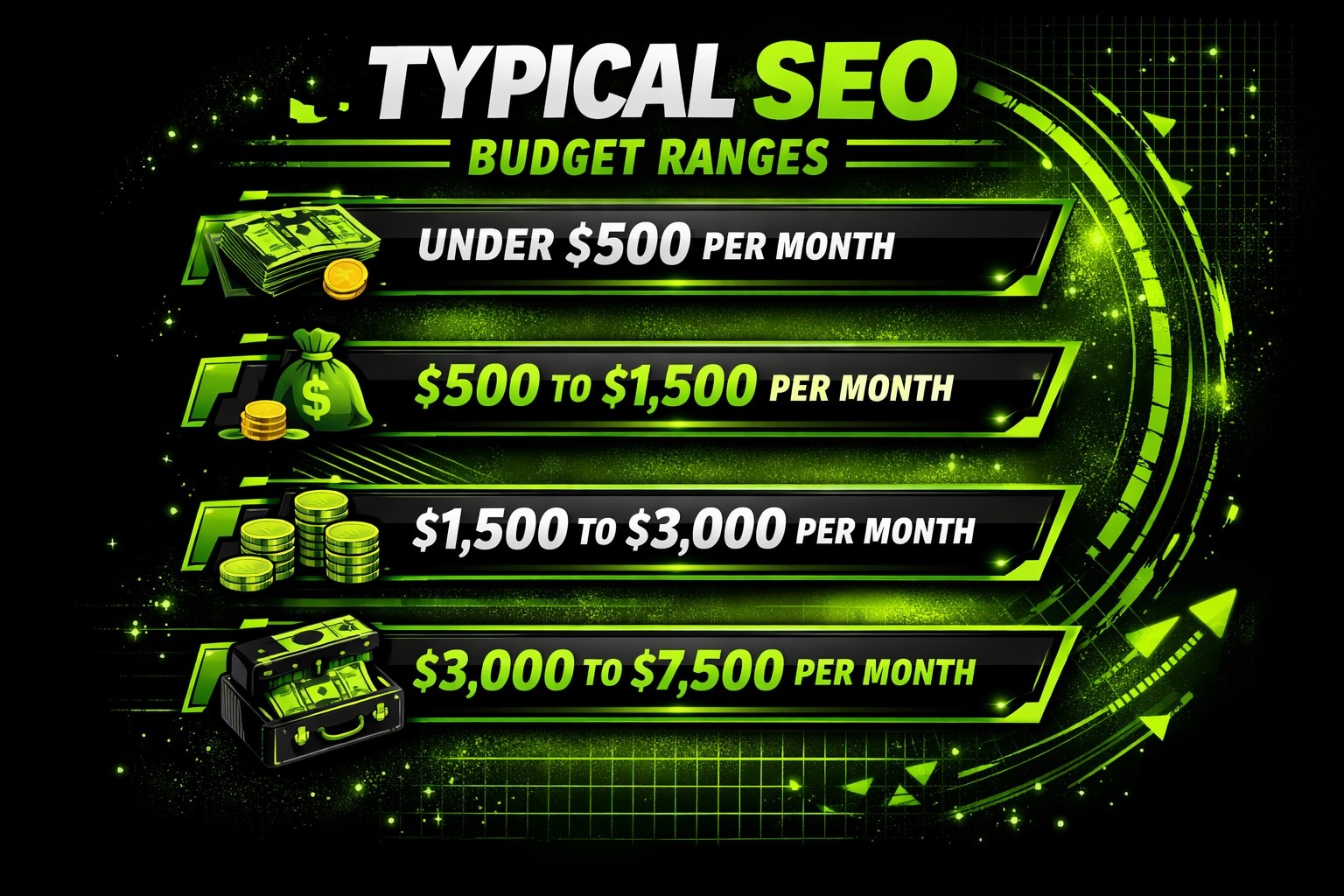
Typical SEO Budget Ranges in 2026 and What They Actually Mean
Instead of pretending there is one “right” price, it is more useful to look at ranges and understand what each level realistically delivers.
Under $500 Per Month: Automation and Maintenance at Best
SEO budgets in this range usually rely on automation, templated reports, and minimal human input.
You might get:
- Basic on-page tweaks
- Automated audits
- Occasional content updates
- Rank tracking without interpretation
This level can work for very small businesses in low-competition markets or as a temporary maintenance layer. It will not move the needle in competitive niches, and it will not build long-term authority.
The risk here is not just slow results. It is false confidence. Activity looks like progress, but little actually compounds.
$500 to $1,500 Per Month: Foundational SEO
This range often includes freelancers or lean consultants who focus on core tasks.
You might get:
- Keyword research tied to specific pages
- On-page optimization
- Some content creation or editing
- Basic technical fixes
- Monthly check-ins
For local businesses or niche services, this can be enough to generate steady growth. For national or B2B markets, it usually establishes a foundation but hits a ceiling.
This level works best when expectations are realistic and timelines are long.
$1,500 to $3,000 Per Month: Serious Small to Mid-Sized Growth
This is where SEO starts to behave like a system rather than a checklist.
Budgets in this range often support:
- Ongoing content strategy and production
- Technical SEO improvements beyond basics
- Intent-focused keyword clustering
- Internal linking strategy
- Some form of authority building
- Regular reporting tied to business goals
For many small and mid-sized companies, this is the minimum level where SEO can reliably drive leads and revenue, not just traffic.
It is also where patience starts to pay off. Results compound over six to twelve months instead of resetting every quarter.
$3,000 to $7,500 Per Month: Competitive Markets and Scale
At this level, SEO is treated as a growth channel, not a support function.
You are paying for:
- Deep strategy and prioritization
- Consistent, high-quality content
- Advanced technical optimization
- Active link and authority building
- Ongoing experimentation
- Clear attribution and performance analysis
This is common for SaaS, eCommerce, B2B services, and any industry where multiple competitors are investing heavily in organic visibility.
The difference here is not just more work. It is a better decision. Fewer wasted efforts. Faster learning cycles.
$10,000+ Per Month: SEO as Infrastructure
Enterprise-level SEO budgets exist for a reason.
They support:
- Large-scale content ecosystems
- Programmatic SEO
- Multi-market or multi-language strategies
- Continuous technical development
- Dedicated strategists
- Integration with product, sales, and PR teams
This level only makes sense when organic search is mission-critical and the upside justifies the spend. When it does, SEO often becomes one of the highest ROI channels in the business.
What Actually Drives SEO Costs in 2026
SEO pricing is not arbitrary. Several factors consistently push budgets up or down.
Competition Intensity
Ranking in a quiet niche is fundamentally different from competing in legal, fintech, SaaS, healthcare, or eCommerce.
The more competitors invest in SEO, the more effort is required to outperform them. That effort costs time, expertise, and resources.
Site Size and Complexity
A 20-page website is easier to optimize than a 5,000-page platform.
Large sites require more technical oversight, stronger structure, and more content coordination. They also take longer to move.
Content Expectations
In 2026, thin content rarely works. High-performing pages tend to be well-structured, genuinely useful, and updated regularly.
That takes skilled writing, editing, and subject knowledge. AI can assist, but it cannot replace expertise without losing credibility.
Authority and Trust Gaps
If your site lacks backlinks, mentions, or brand recognition, closing that gap requires sustained effort. Authority building is one of the most expensive and most misunderstood parts of SEO.
Speed Expectations
SEO is still a long-term channel, but urgency changes cost. Faster progress requires more parallel work, which increases spend.
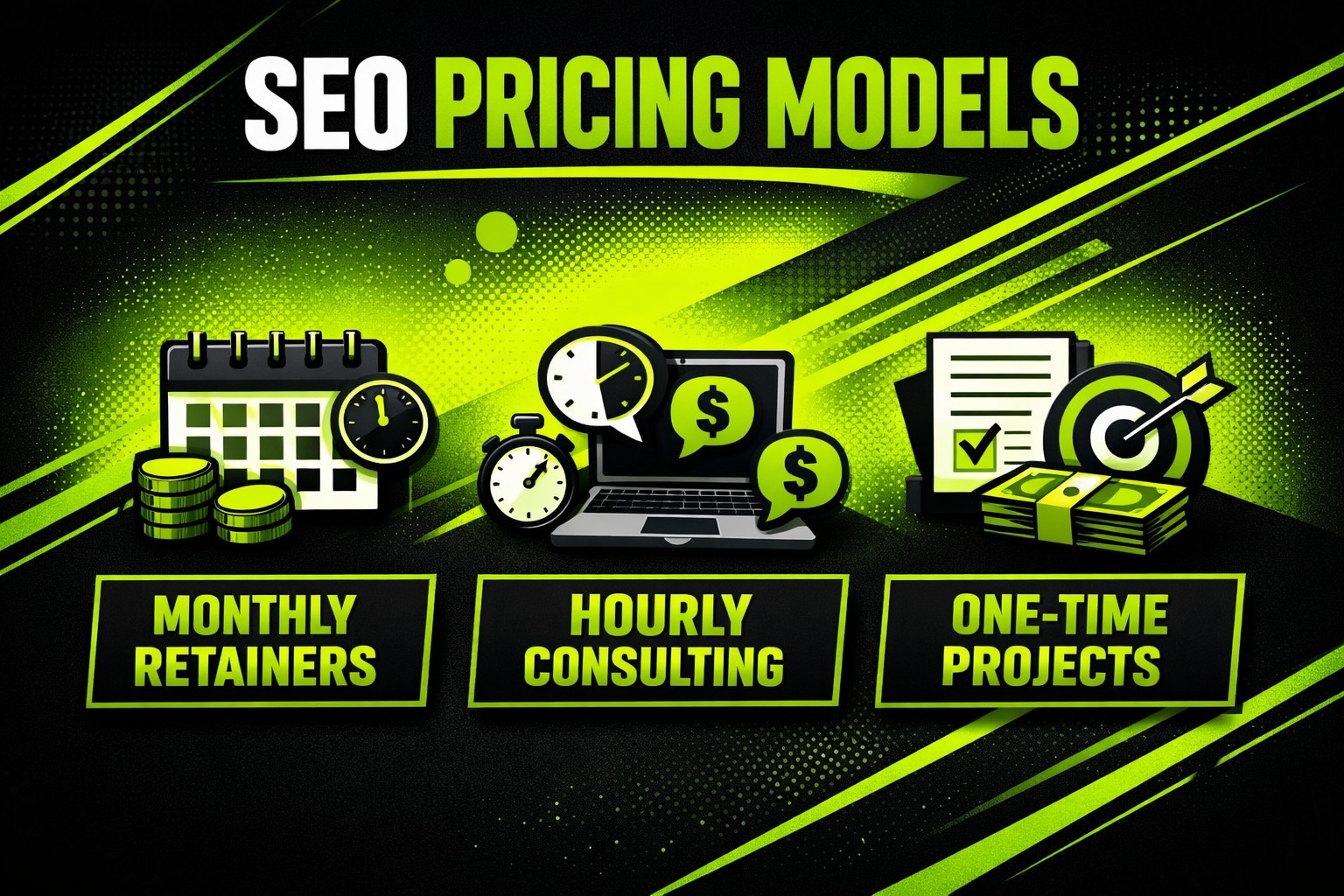
SEO Pricing Models and What to Watch Out For
How you are charged matters just as much as how much you pay. Two companies can invest the same amount in SEO and see very different outcomes simply because the pricing model shapes how the work is done and how decisions are made.
SEO is not just labor. It is prioritization, timing, and follow-through. The wrong model can turn a reasonable budget into wasted motion.
Monthly Retainers
Monthly retainers are the most common SEO pricing model and, in most cases, the most effective for steady growth.
SEO builds over time. Rankings improve gradually, authority compounds, and visibility expands as content, links, and technical signals accumulate. A retainer supports that reality. It allows work to continue month after month without resetting priorities or renegotiating scope every time something new is discovered.
The real value of a retainer is not the number of hours or tasks completed. It is continuity. Strategy can evolve based on what is working, what is stalling, and what competitors are doing. Adjustments happen naturally instead of waiting for a new contract or project approval.
The main thing to watch out for with retainers is lack of clarity. If the work feels repetitive, reports focus only on activity, or progress is difficult to connect to real business goals, the model stops working. A healthy retainer always has direction, even when results take time to materialize.
Hourly Consulting
Hourly SEO consulting works best when you need expertise, not execution.
This model is well suited for audits, technical problem-solving, strategy development, or situations where something clearly is not working and you need an experienced perspective. You are paying for judgment and insight rather than ongoing production.
Hourly consulting often makes sense when you already have an internal team or trusted partners who can implement recommendations. In those cases, it can be very efficient. You get clarity without committing to a full monthly engagement.
Where hourly consulting tends to fall short is when it is expected to drive growth on its own. Advice without action rarely compounds. Even excellent recommendations lose value if no one is responsible for turning them into consistent execution. Without follow-through, progress slows and momentum fades.
One-Time Projects
One-time SEO projects usually cover audits, site migrations, technical cleanups, or initial optimization work.
These projects can be extremely valuable at the right moment. A proper audit can uncover structural issues that block growth. A well-managed migration can prevent traffic loss. Foundational optimization can prepare a site for future performance.
The limitation is that SEO does not stand still. Algorithms change, competitors publish, and user behavior shifts. Without ongoing work, the benefits of a one-time project gradually erode.
One-time SEO should be treated as a starting point, not a finish line. It works best when it feeds into a longer-term plan, even if that plan is lighter or partially handled in-house. SEO rarely delivers lasting results when it is approached as something you do once and then move on from.
The Hidden Cost of Underfunding SEO
Cheap SEO is rarely just ineffective. More often, it creates problems that surface later, when fixing them is slower and more expensive than doing the work properly in the first place.
Low-quality content almost always needs to be rewritten once it fails to rank or convert. Poor link building leaves behind toxic signals that have to be identified and removed. Half-built strategies collapse under even moderate competition, forcing teams to start over instead of building forward. In the meantime, momentum is lost, and search visibility drifts while competitors keep moving.
What looks like savings on paper often turns into delayed costs. Time is wasted managing work that does not compound. Opportunities are missed while rankings stagnate. Recovery efforts take priority over growth, and progress feels harder than it should.
In 2026, the risk is even higher. Search engines and AI-driven systems are increasingly sensitive to trust, consistency, and real expertise. Shortcuts are easier to spot and less forgiving than they used to be. Underfunding SEO today does not just slow results. It raises the cost of success tomorrow.
How to Decide What You Should Spend, Practically
Instead of starting with a number, start with answers to a few questions.
- How important is organic search to revenue?
- How competitive is your market?
- What happens if SEO works well for you?
- What happens if it does not?
Then work backward.
If one new customer is worth $5,000, and SEO can realistically bring ten new customers per month at scale, a $3,000 SEO budget suddenly looks conservative.
If SEO is expected to support brand credibility and long sales cycles, patience and consistency matter more than chasing cheap wins.
SEO as an Investment, Not an Expense
The most successful companies in search treat SEO less like marketing spend and more like infrastructure.
Paid ads stop when you stop paying. SEO builds assets. Pages rank, links compound, authority grows. The returns are delayed, but they stack.
That is why the question is not “What is the cheapest SEO I can buy?” but “What level of investment makes SEO meaningful for my business?”
In 2026, that mindset matters more than ever.
Final Thoughts
There is no universal SEO budget that works for everyone. Anyone who claims otherwise is simplifying a complex system.
What is clear is this: SEO still works, but it rewards seriousness. The more intentional your investment, the more predictable the outcome.
Spend too little, and SEO becomes noise. Spend wisely, and it becomes one of the few channels that keeps paying you back long after the work is done.
If you want SEO to matter in 2026, fund it like it matters.