


Pricing SEO is one of the hardest parts of the job, not because the work is unclear, but because the market sends mixed signals. One client expects a $300 monthly plan. Another assumes anything under $5,000 isn’t serious. Both think they’re being reasonable.
The truth is, SEO pricing only makes sense when it’s tied to what kind of work you’re actually doing. Not hours. Not packages. Not what competitors list on their websites. But the level of responsibility, expertise, and business impact involved.
This article breaks down how to think about SEO pricing in a way that’s realistic, defensible, and aligned with how SEO actually works in 2026, especially if you don’t want to race to the bottom or oversell retainers that don’t need to exist.
Why SEO Pricing Feels Broken in the First Place
Most SEO pricing models were not designed for clients. They were designed for agencies.
Monthly retainers make revenue predictable. Packages make sales easier. Hourly rates feel familiar. None of these automatically reflect the value of the work being done. That mismatch is why pricing often feels disconnected from results.
On one end of the spectrum, SEO is sold as a commodity. Fixed-price packages promise rankings, links, and content volume. On the other end, SEO is framed as an endless process that requires months of monitoring, reporting, and activity regardless of whether meaningful changes are still being made.
Both approaches miss the point.
SEO is not a checklist. It is not a subscription product by default. And it is not a junior task that can be handed off cheaply without consequence. SEO is a strategic discipline that touches site structure, content, UX, authority, and increasingly AI-driven visibility.
The work is often concentrated. The impact compounds over time. The results lag the implementation. When pricing ignores that reality, frustration follows.
What You Are Actually Charging For in SEO
Before discussing numbers, it helps to clarify what clients are really paying for.
They are not paying for keywords, audits, tools, or reports. Those are inputs. Clients pay for judgment.
Good SEO work answers questions like:
- What actually matters on this site right now?
- What is broken versus what is just noisy?
- Where will effort produce compounding returns?
- What can be safely ignored?
That judgment comes from experience. It is what separates someone who exports tool reports from someone who can diagnose a visibility problem in an afternoon.
When you price SEO, you are pricing responsibility. You are taking ownership over decisions that affect traffic, leads, and revenue. That responsibility does not scale linearly with hours worked. This is why two hours of the right work can outperform six months of activity.
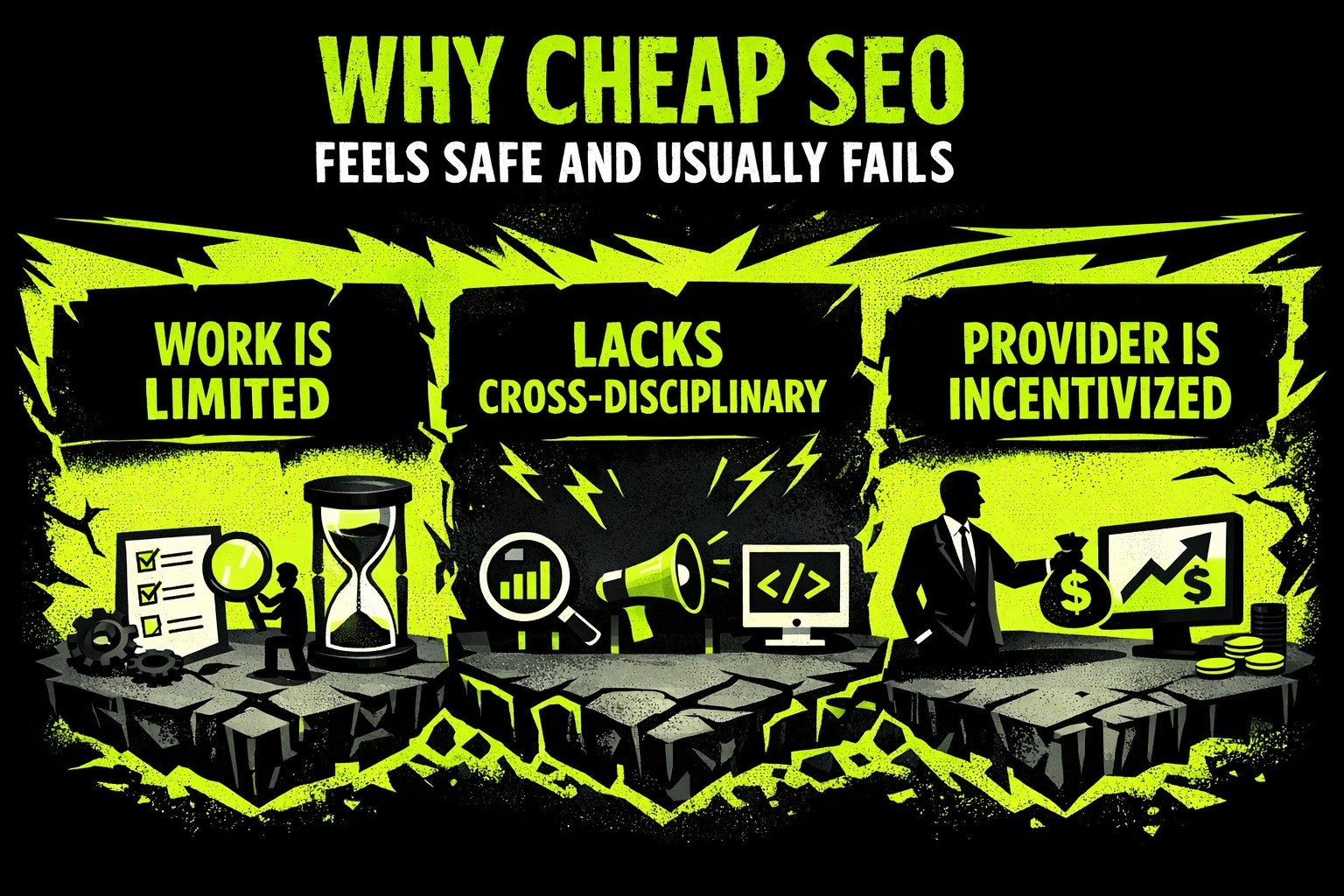
Why Cheap SEO Feels Safe and Usually Fails
Low pricing feels safe to many clients. It feels like a way to test SEO without risk. In practice, it usually creates more risk.
Cheap SEO almost always means one of three things:
- The work is limited to surface-level tasks
- The person delivering it lacks cross-disciplinary experience
- The provider is incentivized to fill time rather than solve problems
SEO at low hourly rates tends to turn into administrative work. Uploading content. Tweaking meta tags. Running outreach templates. None of this is harmful on its own, but none of it fixes strategic issues.
The problem is not that beginners exist. The problem is expecting expert outcomes at entry-level pricing. Businesses would not expect a senior accountant, lawyer, or developer to work at commodity rates. SEO increasingly sits in the same category of risk and impact, and pricing should reflect that.
Why Retainers Are Often Oversold
At the opposite end, many SEO providers default to monthly retainers even when the work does not require them.
Retainers make sense when there is genuine ongoing complexity: large sites, national markets, constant content production, or SEO that must stay tightly aligned with other teams. In those cases, continuous oversight matters.
But for many small and midsize businesses, the bulk of SEO value comes from fixing foundational issues and setting direction. Once that work is done, there is often far less to actively implement than the retainer implies.
This is where pricing disconnects from value. Clients end up paying for reports, light content, and monitoring because something has to justify the monthly fee. Over time, trust erodes. SEO becomes something they tolerate rather than believe in.
The issue is not retainers themselves. It is selling them by default.
Lengreo as a True Marketing and Tech Partner
At Lengreo, we see the same situation often. Companies try different marketing tactics that look good on paper but do not deliver real results. Growth slows, leads dry up, and it becomes hard to see what actually needs fixing. That is why we do not start with ready-made solutions. We start by finding where growth is blocked and what will make the biggest difference.
Our work is focused on ownership and results. Sometimes that means going deep on SEO. Other times it means combining SEO with demand generation, paid campaigns, or outbound to speed things up. We choose channels based on how they support each other, always with qualified leads and revenue in mind.
We work as a marketing and tech partner, not just a service provider. We integrate with our clients’ teams, understand how their sales process works, and take responsibility for the decisions that affect performance. When a channel makes sense, we commit to it. When it does not, we say so. This keeps execution focused and results easy to measure.
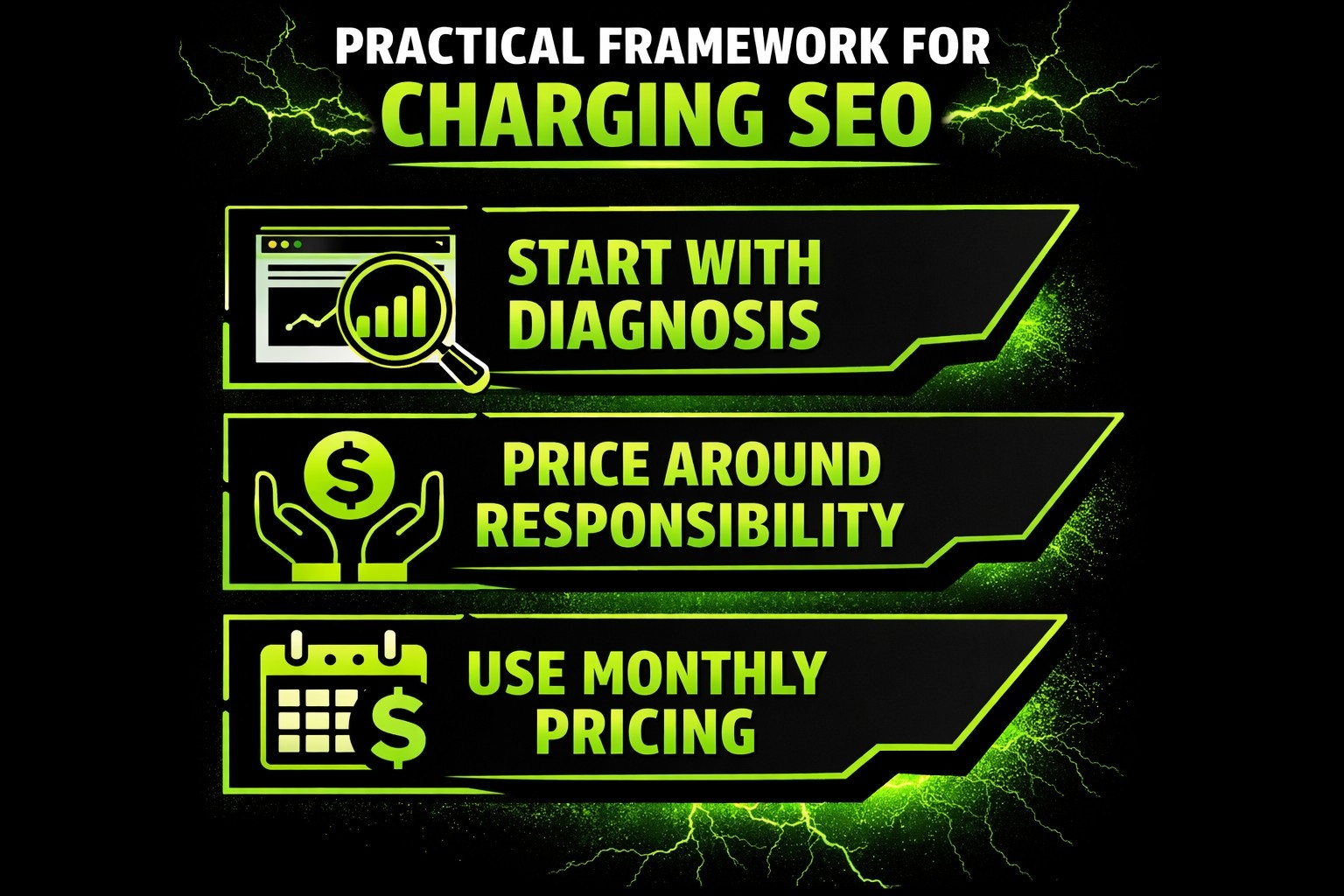
A Practical Framework for Charging SEO That Actually Works
Instead of starting with a pricing model, start with how SEO work realistically unfolds.
Most businesses benefit from SEO in stages, not subscriptions. A healthier pricing approach follows the work itself.
1. Start With Diagnosis, Not Deliverables
A proper SEO engagement often begins with clarity, not execution.
Charging for SEO Consultations
Consultations are often undervalued, but they are one of the most effective pricing formats for both sides.
A consultation is not a discovery call. It is paid problem-solving. In a few hours, an experienced SEO can identify structural issues, flag wasted effort, prioritize fixes, and prevent months of misaligned work.
This is where senior expertise shines. Charging hourly for consults makes sense because the value is concentrated. Clients are not paying for time. They are paying to avoid expensive mistakes.
Many businesses only need this level of help a few times a year.
2. Price Projects Around Responsibility, Not Hours
Project-based pricing works when the outcome is clear.
Examples include technical cleanups, content framework builds, recovery after traffic drops, or site migrations. The key is that the project has a defined start and finish.
Pricing here should reflect the scope of responsibility, the complexity of the site, the risk involved, and the depth of expertise required. Projects are often underpriced when SEO is treated as labor instead of accountability.
Clients generally prefer projects because they understand what they are paying for. Providers benefit because they can focus on impact instead of maintaining activity.
3. Use Monthly Pricing Only When the Work Demands It
Monthly SEO pricing works when there is genuine ongoing work: continuous content tied to demand generation, active authority building, large or frequently changing sites, or highly competitive markets.
In these cases, SEO becomes part of the operating rhythm of the business. The mistake is assuming every client fits this model.
A simple test helps here. If meaningful SEO work would naturally slow down after three months, the retainer probably should too.
How Experience, Market, and Tools Should Influence Pricing
One of the hardest parts of SEO pricing is reconciling confidence with experience.
If you are early in your career, you should not charge senior rates. But you should also not anchor yourself to the bottom of the market. Experience is not measured in years alone. It is measured in exposure.
Have you handled migrations? Fixed traffic drops? Worked across technical, content, and UX decisions? Tied SEO work directly to leads or revenue?
The more responsibility you can handle independently, the more your pricing should move away from task-based logic.
Geography matters too. SEO pricing varies by region, but the pattern is consistent. Rates tend to be higher where businesses are more competitive and where decision-makers understand opportunity cost. The mistake is copying prices from markets that do not match your clients.
Tools play a role, but they should never justify pricing on their own. Clients are not paying for software access. They are paying for interpretation. If your pricing collapses without tools, it was never grounded in expertise.
How to Talk to Clients About SEO Pricing Without Friction
The Problem Is Usually Framing, Not the Price
Most pricing objections do not come from the number itself. They come from confusion. When clients do not understand what they are paying for, even a reasonable fee feels risky. Clear framing removes that tension before it turns into negotiation.
Stop Selling Effort and Start Selling Judgment
SEO should not be positioned as hours, tasks, or activity. Selling effort invites comparison. Selling judgment sets you apart. Explain that the value lies in knowing what matters, what does not, and what order things should happen in.
Define Responsibility Before Discussing Cost
Before you talk about price, be explicit about what you are responsible for. Are you diagnosing issues, making strategic decisions, implementing changes, or guiding internal teams? When responsibility is clear, pricing feels grounded instead of arbitrary.
Make It Clear What You Are Not Charging For
Clients are more comfortable paying higher fees when they understand what is excluded. Point out the busywork, unnecessary content, and low-impact tasks you are intentionally avoiding. This reframes the price as focus, not excess.
Transparency Builds Trust, Overpromising Breaks It
Be honest about what SEO can and cannot do. Explain timelines, limits, and uncertainty without softening the message. Clients trust clarity more than optimism. When expectations are realistic, pricing feels fair and relationships last longer.
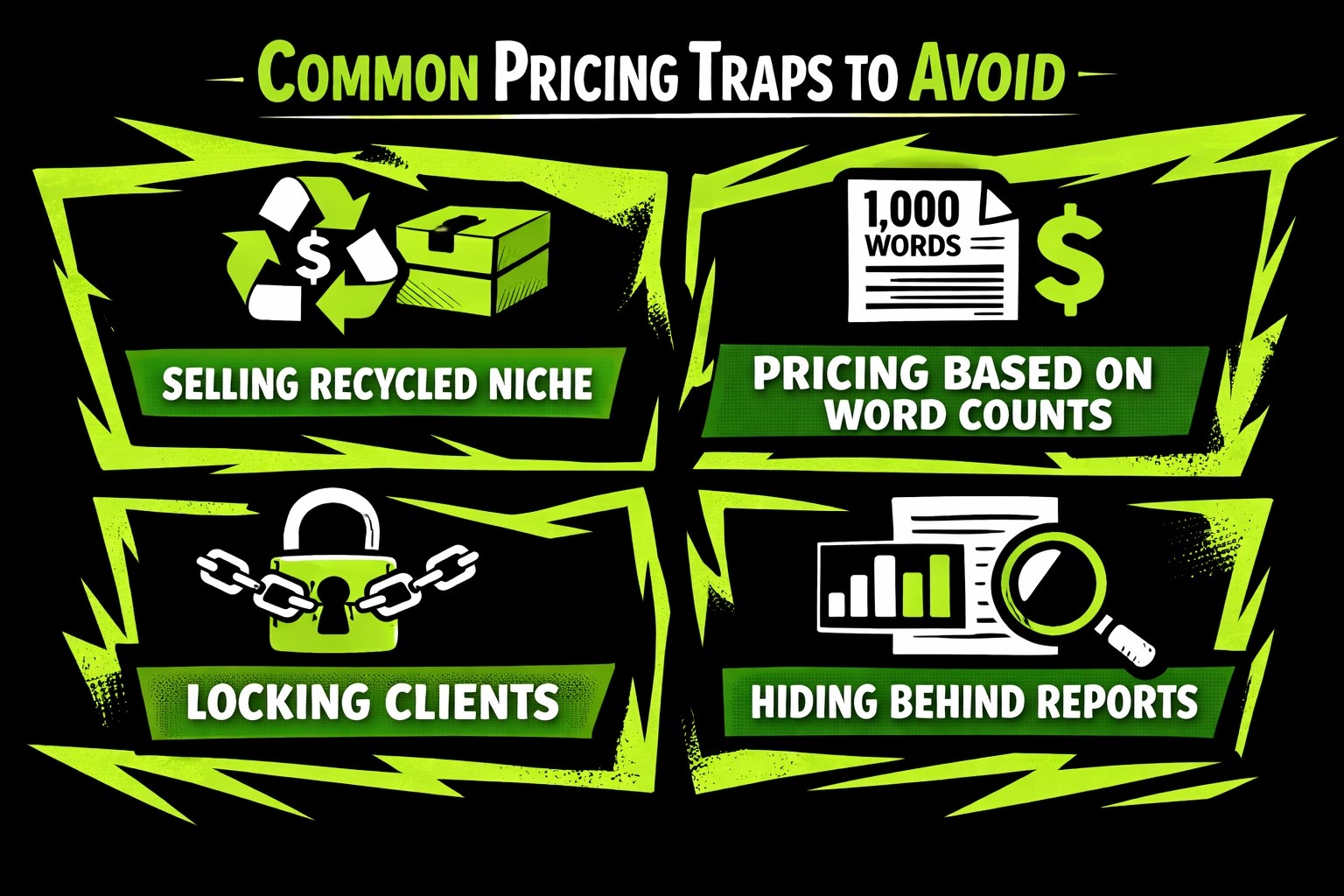
Common Pricing Traps to Avoid
Some pricing mistakes show up again and again, even among experienced SEO providers. They often look harmless at first, but they quietly undermine trust and long-term results.
- Selling Recycled Niche SEO Packages. Industry-specific packages often reuse the same playbook with minor tweaks. Clients end up paying for generic content, predictable links, and reports that look tailored but are not. Over time, results stall and confidence drops.
- Pricing Based on Word Counts or Link Quantities. Charging by volume shifts focus away from impact. More words or more links do not automatically mean better rankings or better business outcomes. This model encourages output instead of judgment.
- Locking Clients Into Long Contracts Without Justification. Long-term commitments make sense only when the scope truly requires ongoing work. When contracts exist mainly to protect revenue, clients feel trapped rather than supported.
- Hiding Behind Reports Instead of Outcomes. Reports should explain progress, not replace it. When pricing is justified by dashboards and activity logs rather than tangible change, SEO starts to feel abstract and disconnected from the business.
These approaches may create short-term revenue, but they do so at the expense of credibility, trust, and durable relationships.
The Bottom Line
There is no correct number to charge for SEO.
There is only appropriate pricing based on the level of responsibility you take on, the complexity of the problem, and the business impact of your decisions.
If you charge too little, you will be forced into volume and busywork. If you charge without clarity, clients will disengage.
The strongest SEO practitioners do not win by being the cheapest or the loudest. They win by being precise.
Charge for expertise. Structure work around impact. Price SEO in a way that respects both your skill and your client’s reality.
That is what makes it sustainable.