


If you’ve searched for SEO pricing, you’ve probably noticed one frustrating thing: the numbers are all over the place. One agency quotes $800 a month, another asks for $8,000, and both promise “great results.”
So how much does SEO actually cost? The honest answer is that SEO pricing depends on what you’re trying to achieve, how competitive your market is, and how much work it takes to move the needle. In this guide, we’ll break down real SEO cost ranges, what affects pricing, and how to tell whether an SEO investment makes sense for your business, without sales talk or unrealistic promises.
The Short Answer: Typical SEO Cost Ranges
Let’s start with realistic numbers before going deeper.
Most businesses that take SEO seriously spend somewhere between $1,000 and $5,000 per month. That range covers the majority of small to mid-sized companies operating in moderately competitive markets.
Here is how SEO pricing typically breaks down:
- $500 or less per month: very limited SEO, usually local or advisory
- $500 to $1,000 per month: basic SEO for small businesses
- $1,000 to $2,500 per month: the most common and balanced range
- $2,500 to $5,000 per month: competitive industries and faster growth
- $5,000+ per month: enterprise, national, or global SEO campaigns
You will also see hourly rates, project-based fees, and one-time audits. We will cover those later. For now, understand this: SEO pricing reflects effort, expertise, and time. There is no shortcut around that.
Why SEO Prices Vary So Much
If SEO were just a checklist, pricing would be simple. But SEO is shaped by dozens of variables, and small differences can drastically change the amount of work required.
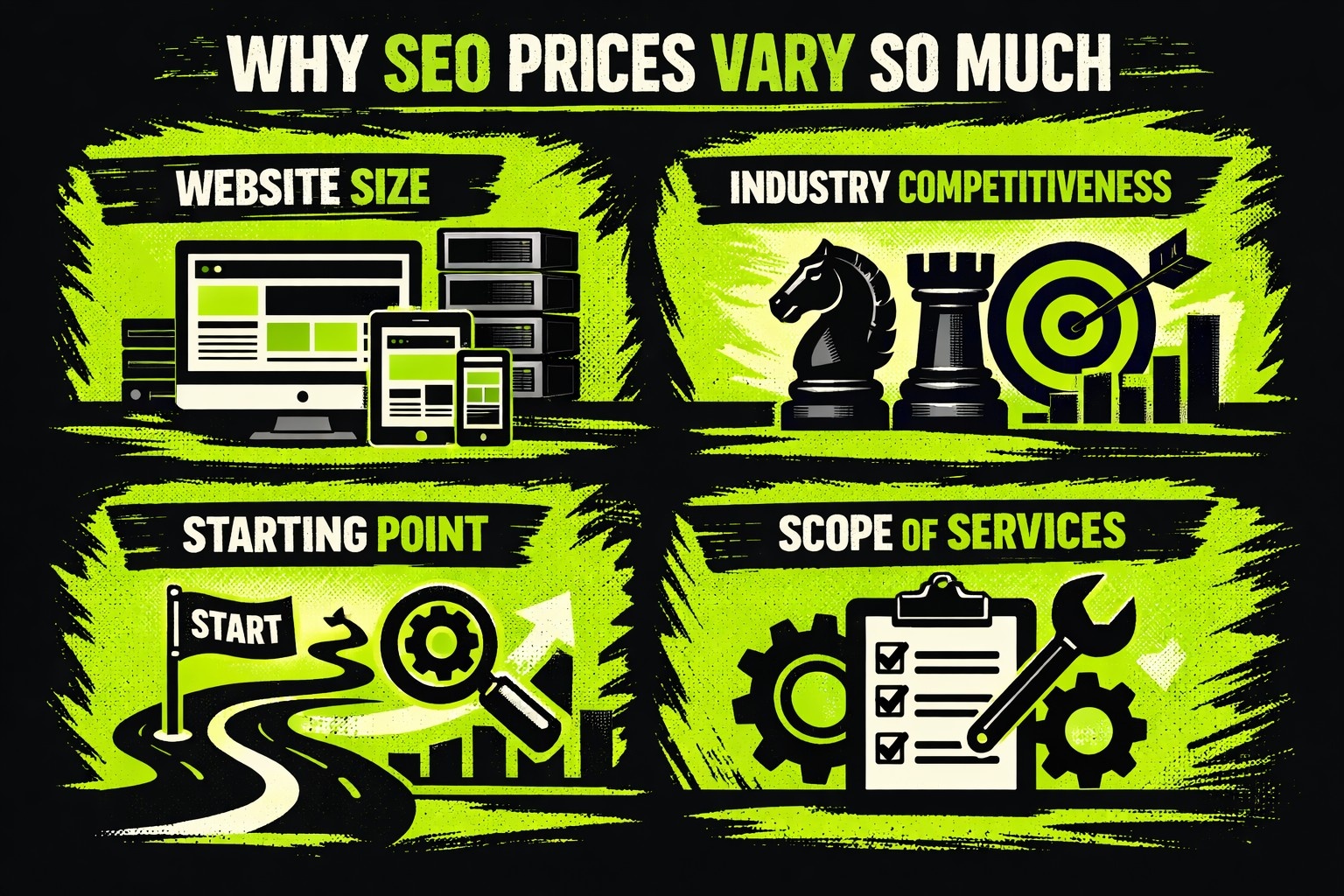
Website Size and Complexity
A ten-page service website and a 5,000-page ecommerce store are not even in the same universe. Larger websites require:
- Deeper technical audits
- More crawl and index management
- More internal linking strategy
- More content optimization work
The more pages you have, the more SEO work exists by default.
Industry Competitiveness
Some industries are brutally competitive. Legal services, finance, insurance, SaaS, and health-related niches are expensive because ranking requires:
- Stronger content
- Higher authority backlinks
- Longer timelines
- More advanced technical execution
A local cleaning business and a national fintech startup may both want SEO, but their cost structures will never be the same.
Starting Point of Your Website
Websites with years of technical debt, poor structure, thin content, or past penalties require more upfront work. SEO for a neglected site often starts slower and costs more early on.
By contrast, a website with a solid foundation can see faster results with less corrective work.
Scope of Services
SEO is rarely limited to just one task. In practice, it usually involves a combination of activities that work together to improve visibility and performance. This can include researching and mapping keywords to the right pages, fixing technical issues that affect how search engines crawl and index a website, and optimizing existing content or creating new content that better matches search intent. It often also covers acquiring quality backlinks to build authority, improving local SEO signals for businesses that target specific locations, and regularly tracking results through reporting and analysis. As more of these elements are included in the strategy, the amount of work increases, and so does the overall cost.
Provider Experience and Location
Experienced SEO professionals charge more because they usually get results faster and avoid costly mistakes. Location also matters. Providers based in North America, the UK, or Western Europe typically charge more than those in emerging markets.
How We Approach SEO Pricing at Lengreo
At Lengreo, we see SEO pricing as a reflection of real work, not packaged promises. When businesses ask how much SEO costs, our answer always starts with context. Different goals, industries, and starting points require different levels of effort. That is why we never offer one-size-fits-all SEO pricing. Instead, we look at what will actually move the business forward, whether that means fixing technical foundations, building authority in a competitive niche, or turning organic traffic into qualified leads. The cost follows the strategy, not the other way around.
We also believe SEO should justify its price in business terms, not vanity metrics. Our focus is on long-term value: sustainable traffic growth, lower cost per lead, and conversions that support revenue goals. That approach shapes how we scope SEO work and how we price it. Sometimes that means a smaller, focused SEO engagement. Other times it means a broader investment that combines SEO with content, lead generation, or paid channels. In all cases, the goal is the same: make sure the SEO cost makes sense for where the business is now and where it wants to go next.
Monthly SEO Pricing: What You Actually Get
Monthly retainers are the most common pricing model because SEO requires consistent work over time. But not all retainers deliver the same value.
Under $500 Per Month
At this level, SEO is usually limited to:
- Basic on-page fixes
- Simple local SEO tasks
- High-level advice rather than execution
This can work for very small local businesses in low-competition areas. For anything beyond that, expectations should be modest.
$500 to $1,000 Per Month
This range often includes:
- Initial keyword research
- Basic technical fixes
- Optimization of key pages
- Light reporting
Execution is limited by time. You are often getting 10 to 15 hours of work per month. Progress tends to be slow, but some improvement is possible if competition is low.
$1,000 to $2,500 Per Month
This is the most common SEO investment level and for good reason. It allows for:
- Regular technical optimization
- Content planning and optimization
- Ongoing keyword tracking
- Some link acquisition or authority building
- Strategic flexibility month to month
For many businesses, this is where SEO starts to feel like a real growth channel rather than an experiment.
$2,500 to $5,000 Per Month
At this level, SEO becomes more aggressive and more strategic. You can expect:
- Dedicated specialists
- Stronger content execution
- Active link building
- Deeper competitive analysis
- Faster iteration and testing
This range is typical for competitive niches or businesses where organic traffic directly impacts revenue.
$5,000+ Per Month
Enterprise SEO budgets support:
- Large teams and multiple specialists
- International or multi-location SEO
- Advanced technical implementations
- High-volume content production
- Custom strategies and reporting
These campaigns are complex and resource-intensive, but they also deliver the highest long-term returns when executed well.
Hourly and Project-Based SEO Pricing: When Each Makes Sense
Not every SEO task requires a long-term monthly commitment. In some situations, hourly or project-based pricing can be a better fit, as long as the scope is clear and expectations are realistic.
Hourly SEO Rates
Hourly SEO pricing typically falls between $50 and $150 per hour, depending on the specialist’s experience and location. This model works best when you have a specific issue that needs expert input, rather than ongoing execution. For example, hourly SEO is often used for technical audits, strategy consultations, troubleshooting ranking or indexing problems, or handling one-off fixes.
The downside is that hourly work is hard to scale. Costs can become unpredictable, and without consistent follow-through, progress often slows or stops. That is why hourly SEO is usually most effective when you know exactly what problem you need to solve and want targeted guidance without committing to a retainer.
Project-Based SEO Pricing
Project-based SEO is designed for clearly defined deliverables with a beginning and an end. Common examples include technical SEO audits, website migrations, keyword research and mapping, or focused content optimization projects. Pricing for these projects usually ranges from $1,000 to $5,000, with more complex work costing more.
The main advantage of project-based SEO is clarity. You know what is being done and how much it will cost upfront. The limitation is that SEO does not stop once the project is finished. Without ongoing optimization and maintenance, results can level off or gradually decline. For that reason, project-based SEO works best as a starting point or a complement to a longer-term strategy, not a replacement for it.
What Drives SEO Costs the Most
While many factors influence pricing, a few have the biggest impact.
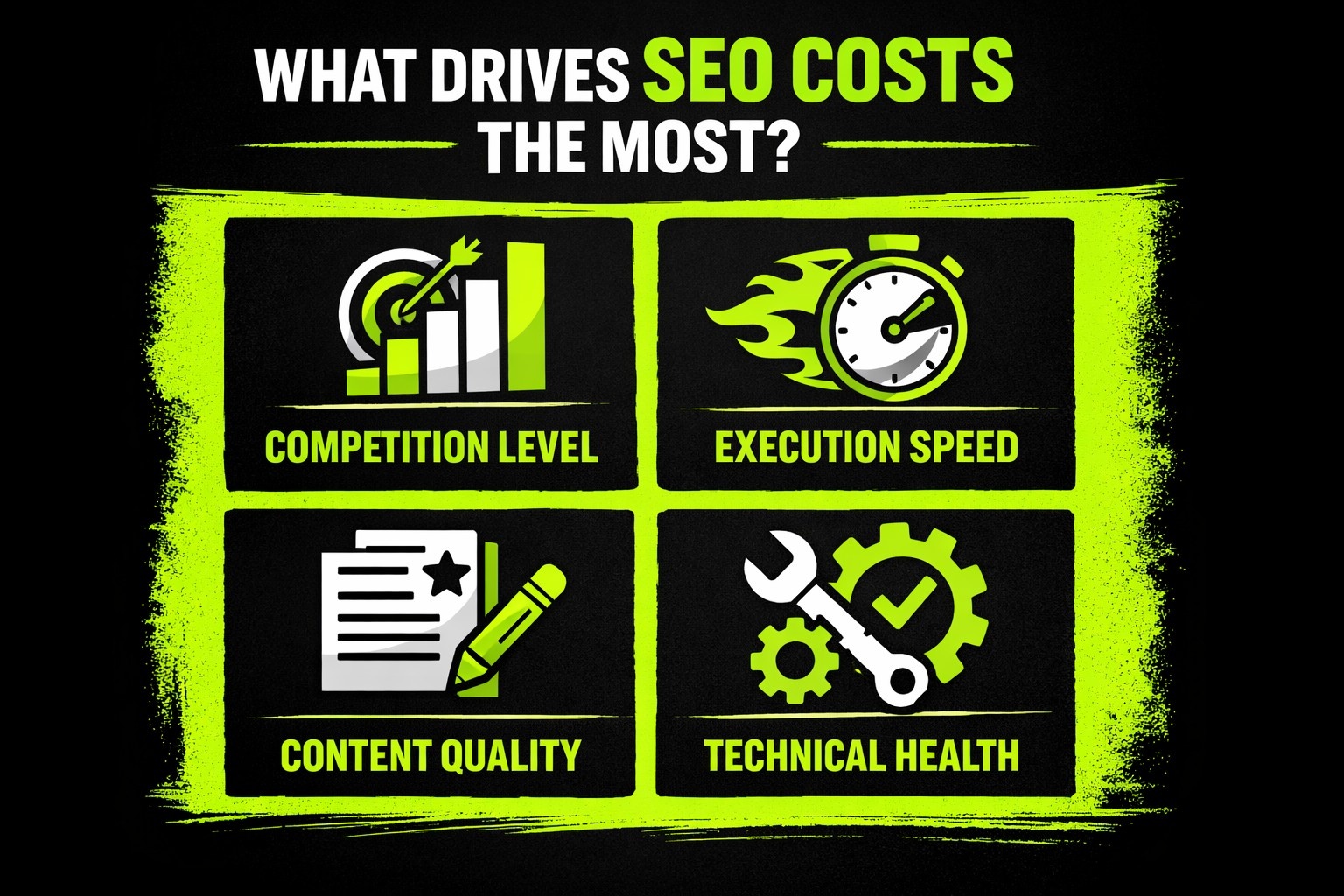
Competition Level
The harder it is to rank, the more effort is required. Competitive markets demand better content, stronger links, and longer timelines.
Execution Speed
SEO is not just about ideas. It is about implementation. Faster execution requires more resources, which increases cost.
Content Quality
Modern SEO relies heavily on high-quality, useful content. Producing content that actually deserves to rank takes time, research, and expertise.
Technical Health
Websites with serious technical issues slow everything down. Fixing them properly often requires collaboration between SEO specialists and developers.
Hidden Costs Most Businesses Overlook
SEO pricing does not always tell the full story. There are indirect costs that matter just as much.
Content Creation
Not all SEO packages include content writing. If you need blog posts, landing pages, or product descriptions, that may be an additional cost.
Development Resources
Many SEO recommendations require developer support. If your SEO provider does not handle implementation, your internal team or contractors will need to.
Time and Communication
SEO requires input from your side. Approvals, strategy discussions, and feedback all take time. Businesses that delay implementation often delay results.
Tools and Software
Enterprise-level SEO tools are expensive. Agencies absorb these costs, but they influence pricing indirectly.
How to Decide If SEO Is Worth the Investment
Before judging SEO by its price tag, it is far more useful to evaluate whether it makes sense for your specific business. The real question is not whether SEO is expensive, but whether it can deliver value that justifies the cost over time.
Evaluating SEO Value and ROI
To understand whether SEO is a smart investment, start by looking at your business fundamentals. Consider how much a single conversion or customer is worth to you, how much you currently spend on paid advertising to generate leads or sales, and whether your potential customers actively search online before making a purchase. It also helps to think long term. SEO tends to perform best for businesses that plan to grow and operate for years rather than months.
A simple way to estimate potential return is to calculate the value of organic traffic. You can do this by multiplying your expected monthly organic visits by your average conversion rate and then by your average order value. If this projected revenue can realistically exceed your ongoing SEO costs, SEO is likely a worthwhile investment.
SEO Pricing Red Flags to Watch Out For
At the same time, it is important to evaluate who you are paying for SEO. Certain pricing signals should raise immediate concerns. Be cautious of providers who guarantee specific rankings, promise extremely fast results in highly competitive markets, or avoid explaining how they achieve results. Unusually low prices paired with broad or vague promises are another warning sign.
Reliable SEO is built on transparency, clear goals, and measurable progress. If a provider cannot explain their approach or set realistic expectations, the investment is unlikely to pay off, regardless of how attractive the price may seem.
Final Thoughts
SEO pricing feels confusing because SEO itself is not simple. It is not a product you buy once and forget about. It is a process that grows, changes, and compounds over time. That is why two businesses can both be doing SEO and paying very different amounts, and both can still be making the right decision.
What matters most is not finding the lowest price, but understanding what you are actually paying for. When SEO is done properly, it becomes a long-term asset. Traffic builds gradually, trust with search engines increases, and results tend to stick. Businesses that get the most value from SEO are usually the ones that treat it as a steady investment, not a quick experiment. If you align your budget with your goals and give the process enough time, the cost of SEO often makes sense once the results start adding up.