


At a Glance: In 2026, the old rule of counting keywords per page is obsolete. Modern SEO focuses on one primary keyword supported by semantically related terms, emphasizing topical depth and user intent over rigid keyword density formulas. Search engines now prioritize context, entity understanding, and content quality—not arbitrary keyword counts.
Trying to figure out how many keywords belong on a single page feels like chasing a moving target. The frustrating truth? There’s no magic number.
That might sound evasive, but it’s honest. The entire premise of the question—”how many keywords per page”—belongs to an outdated era when search engines counted words like accountants tallying receipts.
Google’s algorithms in 2026 work nothing like they did in 2011. Keyword density was thought to be important for ranking. Now, search engines parse context, understand entities, and evaluate whether content genuinely satisfies user intent.
So if the old rules don’t apply, what does? The answer lies in building keyword ecosystems around topical authority, not stuffing pages with term variations.
Why the Old Keyword Density Formula Became Obsolete
Back in the early 2000s, SEO was straightforward math. Keyword density was thought to be important for ranking, and search engines simply counted how often a term appeared and assumed frequency indicated relevance.
That system was easy to game. Content farms churned out thin articles packed with exact-match keywords, and for a while, it worked. Google’s Panda update was launched in 2011 to target low-quality content, but it was the RankBrain (2015) and later BERT (2019) updates that specifically shifted the focus to machine learning, semantic context, and understanding user intent at a conversational level.
According to Moz forum discussions, keyword density is described as “an outdated concept from the paleolithic era of search engines.” The recommendation? Add the keyword to the title, headline, and meta tags, then move on to more impactful tasks like schema markup, internal linking, and site performance.
Modern algorithms don’t just count words. They analyze semantic relationships, understand synonyms, recognize entities, and evaluate whether content comprehensively covers a topic. A page obsessed with hitting exact density percentages often reads unnaturally—and both users and algorithms notice.
Stop Guessing Your Keyword Strategy, Get a Clear SEO Plan
If you need help implementing keyword strategies that actually move the needle in 2026, consider working with a specialist. Lengreo offers focused SEO services that cover deep keyword research, competitor analysis, on-page and technical optimization, content guidance, and link building to increase organic visibility and conversions. Their B2B SEO support is built around finding the right terms for your audience and helping your site rank for them over time, rather than chasing outdated density targets.
👉 Ready to get actionable recommendations for your pages and keywords? Contact Lengreo for a free SEO consultation and practical next steps tailored to your content goals.
The Modern Keyword Strategy: Primary + Semantic Clusters
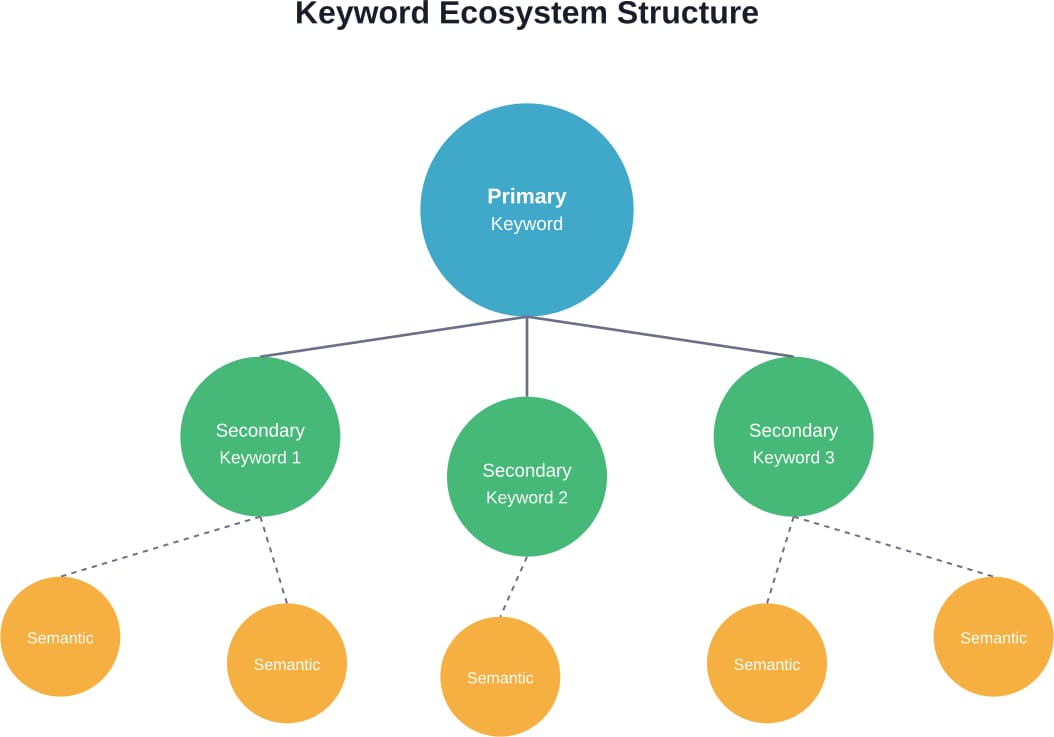
Here’s what actually works in 2026: focus on one primary keyword per page, then surround it with a cluster of semantically related terms.
This approach builds topical authority. Instead of repeating the same phrase mechanically, the content explores related concepts, answers adjacent questions, and demonstrates deep understanding of the subject.
What Is a Primary Keyword?
The primary keyword represents the core topic—the main search query the page targets. It should appear in strategic locations: the title tag, H1 heading, URL slug, meta description, and naturally throughout the opening paragraphs.
But here’s the shift: after establishing the primary keyword in those key locations, the focus moves to comprehensive topic coverage rather than repetitive keyword insertion.
Secondary and Semantic Keywords
Secondary keywords are related subtopics and variations that support the primary term. Semantic keywords include synonyms, related concepts, and terms that commonly appear in high-ranking content for the target topic.
For a page targeting “best CRM for small business,” secondary keywords might include:
- CRM software features
- Customer relationship management tools
- Small business sales tracking
- Affordable CRM solutions
- CRM integration options
These terms don’t need forced insertion. They emerge naturally when content thoroughly explores the topic.
How Many Keywords Should Actually Appear on a Page?
Real talk: the exact count matters far less than strategic placement and natural integration.
That said, pages typically include:
- 1 primary keyword: The main target term
- Secondary keywords: Related subtopics and variations
- Semantic terms: Synonyms, related concepts, and contextually relevant phrases
For content length, guidelines suggest varying keyword distribution by article depth, though exact ratios vary based on topic complexity.
These aren’t rigid rules. They’re guardrails. Content that flows naturally while comprehensively covering a topic will hit these ranges organically.
Keyword Density in 2026: Still Relevant?
Keyword density as a ranking factor? No. As a quality check? Maybe.
Keyword density that emerges naturally from comprehensive content typically falls within a reasonable range without conscious targeting of specific percentages.
But density should never drive writing decisions. It’s a diagnostic metric, not a target.
Where Keywords Actually Matter: Strategic Placement
Location beats frequency. The primary keyword should appear in these high-value locations:
| Importance | Best Practice |
|---|---|---|
| Title Tag | Critical | Include primary keyword near the beginning, keep under 60 characters |
| H1 Heading | Critical | Should contain primary keyword naturally, one H1 per page |
| URL Slug | High | Short, keyword-focused, use hyphens between words |
| Meta Description | Moderate | Include primary keyword, write for click-through, 150-160 characters |
| First Paragraph | High | Introduce primary keyword within first 100 words naturally |
| H2/H3 Subheadings | Moderate | Use secondary keywords and variations in some subheadings |
| Image Alt Text | Moderate | Describe images accurately, include keywords when relevant |
| Conclusion | Low |
|
After hitting these strategic locations, the focus shifts to comprehensive topic coverage. Forcing additional keyword mentions into body paragraphs rarely helps and often hurts readability.
Understanding Search Intent: The Real Ranking Factor
Keywords are signposts. Search intent is the destination.
Google’s algorithms have evolved to understand what users actually want when they type a query. A search for “best laptops” signals buying intent—users want product comparisons and recommendations. A search for “how to clean laptop keyboard” signals informational intent—users need step-by-step instructions.
According to Ahrefs research, Google rewrites meta descriptions 70% of the time (or 62.7% for desktop results specifically, based on older data).
The lesson? Match content format and depth to what users actually need, not just what keywords suggest.
The Four Types of Search Intent
Here they are:
- Navigational: Users want a specific website or page (“Facebook login,” “YouTube”). Keyword optimization matters less than brand recognition.
- Informational: Users seek knowledge (“how to tie a tie,” “what is SEO”). Content should thoroughly answer the question with clear explanations.
- Commercial investigation: Users research before buying (“best running shoes,” “CRM software comparison”). Content should compare options, highlight features, and build trust.
- Transactional: Users are ready to act (“buy iPhone 15 Pro,” “hire SEO consultant”). Content should facilitate conversion with clear calls-to-action.
Keyword research tools often categorize search intent, but the most reliable method is examining current top-ranking results. What format dominates the first page? How deep does the content go? That reveals what Google believes satisfies the query.
The Shift from Keywords to Topics: Building Topical Authority
Search engines don’t rank pages in isolation anymore. They evaluate whether an entire website demonstrates expertise on a subject.
This is topical authority—the concept that comprehensive, interconnected content on related subjects builds trust and ranking potential across all pages in that topic cluster.
A single perfectly optimized page targeting “email marketing best practices” will struggle to outrank competitors if the rest of the site has no related content. But when surrounded by supporting pages on email deliverability, subject line testing, segmentation strategies, and automation workflows, that core page gains authority.
Building Keyword Clusters for Topical Depth
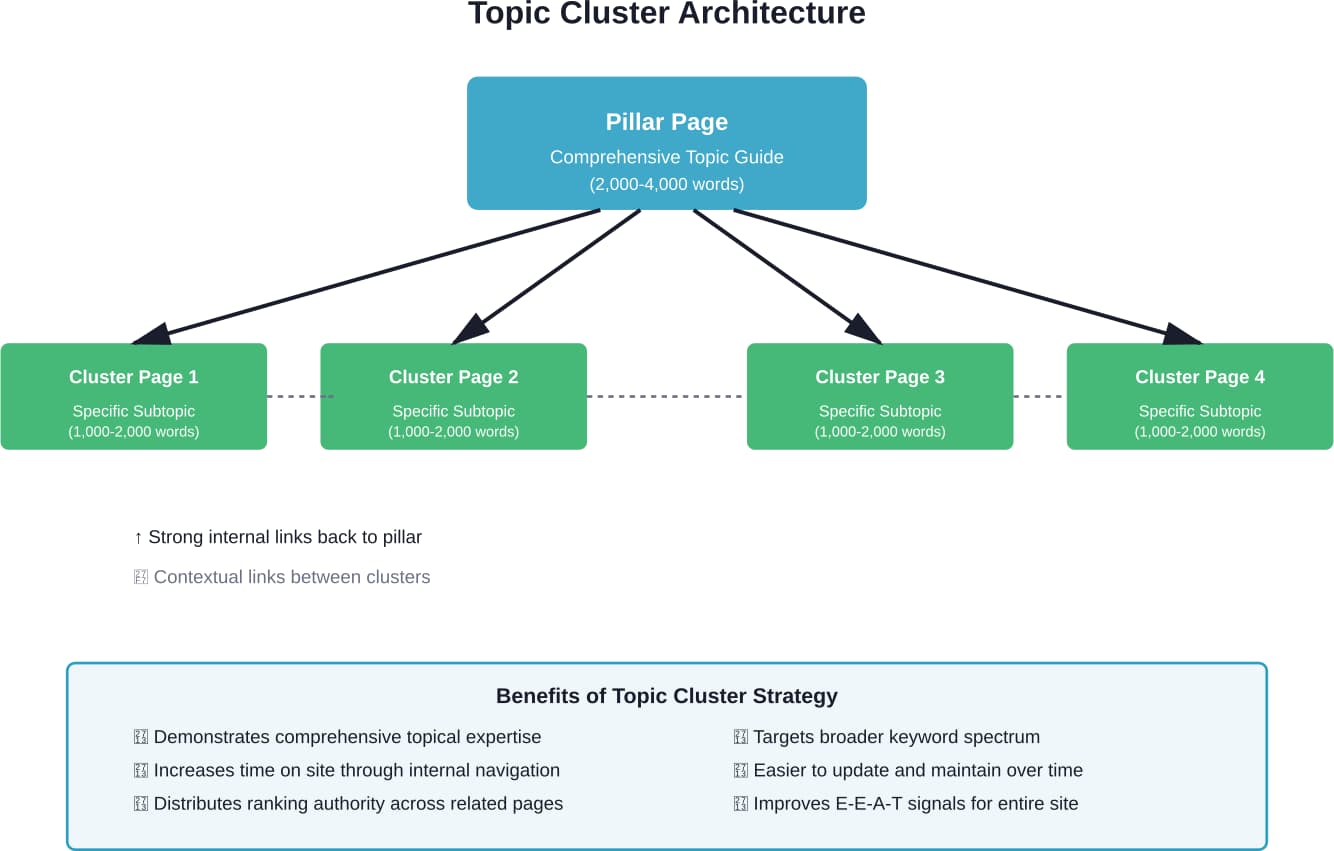
Instead of targeting isolated keywords, modern SEO builds topic clusters:
- Pillar content: A comprehensive guide covering the broad topic (2,000-4,000 words)
- Cluster pages: In-depth articles on specific subtopics (1,000-2,000 words each)
- Internal linking: Connect cluster pages to the pillar and to each other
For a pillar page on “content marketing,” cluster pages might cover:
- Blog writing best practices
- Video content strategy
- Content distribution channels
- Content calendar planning
- Measuring content ROI
Each cluster page targets specific secondary keywords while linking back to the pillar page. This structure signals comprehensive topic coverage to search engines.
AI Search and Generative Engines: The New Keyword Landscape
Search behavior is fragmenting. Users now bounce between Google, ChatGPT, Perplexity, Claude, and AI assistants before reaching a website.
According to Google’s own data, nearly 40% of Gen Z users prefer using platforms like TikTok or Instagram for search instead of Google, and visual search (including Google Lens) accounts for over 10 billion searches a month, but the ‘1 in 10’ statistic for Gen Z specifically is not supported by official reporting.
This shift requires rethinking how keywords work. AI engines don’t rank pages—they reference sources. Getting cited in AI-generated answers depends on different factors than traditional SEO.
What Makes Content Citation-Worthy for AI?
Community discussions suggest AI models prioritize content that’s:
- Structurally clear: Well-formatted with descriptive headings and logical hierarchy
- Definitively stated: Direct answers without hedging or excessive qualification
- Contextually specific: Focused expertise rather than broad generalization
- Comparatively unique: Original insights, not rehashed common knowledge
Keyword optimization for AI search (sometimes called GEO or AEO) emphasizes being quotable. Short, clear statements that directly answer questions get pulled into AI responses more often than lengthy explanations.
But the foundational principle remains: comprehensive content that demonstrates expertise. AI models reference sources that appear authoritative and thorough.
Tools and Techniques for Modern Keyword Research
Keyword research in 2026 isn’t about finding high-volume terms. It’s about understanding the full topic landscape and identifying content gaps.
Effective Research Workflow
You should:
- Start with seed keywords: Identify 3-5 core terms related to the topic.
- Analyze search intent: Search each term and examine the top 10 results. What format dominates? How deep is the content? This reveals what Google considers relevant.
- Map semantic relationships: Use tools like Ahrefs Keywords Explorer or Semrush to find related terms, questions, and long-tail variations.
- Identify content gaps: Look for questions asked in forums, Reddit threads, and “People Also Ask” boxes that existing content doesn’t fully address.
- Prioritize by opportunity: Balance search volume, competition, and topical fit. Sometimes lower-volume terms with clear intent outperform high-volume generic searches.
Content Optimization Tools
Content optimization tools like Surfer SEO, Clearscope, and Frase analyze top-ranking content to suggest relevant terms and assess topic coverage depth.
These tools help identify semantic keywords that naturally appear in high-ranking content. But they’re not magic formulas. Research on content scores found weak correlations with rankings. While weak correlations can contribute to ranking improvements when combined with other factors, optimization scores alone are not determinative.
Use optimization tools as guides, not mandates. If a suggested term doesn’t fit naturally or doesn’t add value for readers, skip it.
Common Keyword Mistakes That Still Hurt Rankings
Some outdated practices refuse to die. Here’s what actually damages SEO performance in 2026:
Keyword Stuffing
Forcing keywords into every paragraph makes content unreadable. Modern algorithms easily detect unnatural keyword repetition and penalize it.
Warning signs: sentences that sound robotic, awkward phrasing to insert exact-match terms, repetitive anchor text in internal links.
Keyword Cannibalization
Multiple pages targeting the same keyword compete against each other, diluting ranking potential. Search engines struggle to determine which page should rank, often resulting in neither ranking well.
Solution: Consolidate thin content targeting the same keyword into one comprehensive resource, or differentiate pages by focusing on distinct aspects of the topic.
Ignoring Search Intent
Creating informational content for commercial keywords (or vice versa) wastes effort. If users searching “buy running shoes” see an article about the history of footwear, they’ll bounce immediately.
Always match content format to the dominant intent revealed in search results.
Over-Optimizing Anchor Text
Internal links crammed with exact-match keywords look manipulative. Natural anchor text uses varied phrases: “learn more about topic,” “comprehensive guide,” or even generic “click here” when context makes the destination clear.
Neglecting Semantic Variations
Fixating on one exact phrase while ignoring synonyms and related terms limits topic coverage. Search engines understand variations—use them naturally.
Measuring Keyword Performance Beyond Rankings
Traditional rank tracking still matters, but it’s not the complete picture. Modern measurement focuses on user behavior and conversion metrics.
| What It Reveals | Where to Track |
|---|---|---|
| Impressions | How often the page appears in search results | Google Search Console |
| Click-Through Rate | Whether title/description compel clicks | Google Search Console |
| Average Position | Ranking trends over time | Google Search Console, rank trackers |
| Organic Sessions | Actual traffic volume from search | Google Analytics |
| Bounce Rate | Whether content matches user intent | Google Analytics |
| Time on Page | Content engagement and depth | Google Analytics |
| Conversion Rate | Whether traffic achieves business goals | Google Analytics, CRM |
| AI Citation Rate | Mentions in AI-generated responses |
|
A page ranking #5 with 8% CTR and strong conversion often outperforms a #2 ranking with 3% CTR and weak engagement. Obsessing over position alone misses what actually drives business results.
Google Search Console Insights
The Performance report reveals which queries drive impressions and clicks. Look for:
- High impressions, low clicks: Optimize title/description for better CTR
- Positions 8-15: Small improvements could push into top results
- Unexpected ranking keywords: Opportunities to expand content on related topics
- Declining queries: Content may need updating or topic refresh
The Role of Technical SEO in Keyword Performance
Even perfectly optimized content fails without solid technical foundations. Keywords don’t exist in isolation from site performance.
While historically cited as having over 200 ranking factors, Google representatives (like Gary Illyes and John Mueller) have stated that the actual number is not a fixed ‘200’ and the system is more fluid, consisting of thousands of sub-signals and machine learning models like RankBrain.
Technical Factors That Amplify Keyword Effectiveness
They are:
- Page Speed: Slow-loading pages lose users before content even renders. Core Web Vitals (LCP, FID, CLS) directly impact rankings.
- Mobile Optimization: Mobile-first indexing means Google primarily evaluates the mobile version. Desktop-only optimization no longer suffices.
- Schema Markup: Structured data helps search engines understand content context, increasing chances of rich results.
- Internal Linking: Logical site architecture distributes ranking authority and helps search engines discover content.
- HTTPS: Security remains a ranking signal. Non-secure sites face disadvantages.
- Crawlability: If search engines can’t access content due to robots.txt blocks, JavaScript rendering issues, or broken links, optimization becomes irrelevant.
Moz forum discussions emphasize that after handling basic keyword placement, focus should shift to technical elements like schema, internal linking, site performance, and link-building—these move the needle more than obsessing over keyword density.
Content Quality Signals That Matter More Than Keyword Counts
Search engines evaluate content quality through multiple signals that extend far beyond keyword optimization.
E-E-A-T: Experience, Expertise, Authoritativeness, Trust
Google’s Quality Rater Guidelines emphasize E-E-A-T, particularly for YMYL (Your Money, Your Life) topics affecting health, finance, or safety:
- Experience: First-hand knowledge demonstrated through specific details, personal insights, and practical examples.
- Expertise: Credentials, qualifications, and demonstrated mastery of the subject.
- Authoritativeness: Recognition within the field through citations, mentions, and backlinks from reputable sources.
- Trust: Accuracy, transparency, clear sourcing, and positive reputation.
According to Search Engine Journal analysis of the December 2025 core update, sites that improved emphasized trust signals and content quality improvements.
User Engagement Metrics
Search engines measure how users interact with content:
- Time spent on page
- Scroll depth
- Click-through to other pages
- Return visits
- Social sharing
- Direct traffic growth
Strong engagement signals content quality better than any on-page optimization metric.
Freshness and Updates
For query types that demand current information, content freshness matters significantly. Regularly updated pages that reflect current best practices, recent data, and evolving industry standards maintain ranking strength.
But freshness doesn’t mean changing publish dates without updating content. Search engines detect superficial changes. Meaningful updates that add new information, refine explanations, or incorporate recent developments earn freshness credit.
Practical Checklist: Optimizing Keywords for a New Page
Here’s a practical workflow for keyword optimization when creating new content:
- Identify primary keyword through research balancing search volume, competition, and business relevance
- Analyze search intent by examining top 10 results for content format, depth, and angle
- Map secondary keywords (3-5 related subtopics) using keyword tools and SERP analysis
- Identify semantic terms (8-15 variations, synonyms, related concepts) that appear in high-ranking content
- Create content outline covering topic comprehensively without forcing keyword placement
- Write naturally focusing on user value, letting keywords emerge organically
- Optimize strategic elements: title tag, H1, URL, meta description, opening paragraph
- Add structured data appropriate to content type (Article, FAQPage, HowTo, etc.)
- Include internal links to related content using natural anchor text
- Optimize images with descriptive alt text and compressed file sizes
- Review readability ensuring short paragraphs, clear subheadings, and logical flow
- Check technical elements: mobile responsiveness, page speed, HTTPS
- Publish and monitor performance through Search Console and Analytics
Notice keyword density doesn’t appear anywhere in this workflow. That’s intentional.
The Bottom Line: Quality Over Quantity, Always
The question “how many SEO keywords per page” reflects outdated thinking from an era when search engines counted words like machines.
They don’t anymore.
Modern algorithms understand context, recognize entities, evaluate expertise, and measure whether content satisfies user intent. Keyword optimization hasn’t become irrelevant—it’s become more sophisticated.
The winning strategy in 2026: focus on one primary keyword per page, support it with a cluster of semantically related terms, and prioritize comprehensive topic coverage over mechanical keyword insertion. Strategic placement in title tags, headings, and opening paragraphs matters more than arbitrary density percentages.
Build topical authority through interconnected content clusters. Optimize for AI search by making content clear, quotable, and definitively helpful. Measure success through user engagement and conversion, not just rankings.
And most importantly, write for humans first. Search engines reward content that genuinely helps users, not content engineered to game algorithms.
Stop counting keywords. Start creating value.
Ready to build content that actually ranks? Focus on depth over density, intent over insertion, and expertise over optimization tricks. The algorithms have evolved—make sure the strategy evolves with them.