

SEO is one of those things that tests your patience. You publish the pages, fix the issues, do everything “by the book” – and then… nothing happens. At least not right away.
That delay doesn’t mean SEO failed or that you did something wrong. It’s how organic search actually works. Search engines move carefully, and they rarely reward new or updated sites overnight. Progress comes in phases, often quietly at first, before it becomes visible.
This article breaks down what that timeline usually looks like, why SEO takes as long as it does, and how to tell the difference between normal waiting and real problems.
The Short Answer Most People Avoid
Most websites start seeing meaningful SEO movement somewhere between three and six months. That does not mean top rankings or massive revenue. It means early traction. Visibility increases. Impressions rise. A few pages begin to climb.
For competitive spaces, new domains, or complex websites, six to twelve months is a more realistic horizon for stable results.
Anything faster than that is either an exception, a very narrow keyword win, or a situation where the site already had trust and authority before optimization started.
SEO is slow by design. Search engines are careful because they have to be. If rankings changed instantly, results would be easy to manipulate and unreliable for users.
How We Approach SEO Timelines at Lengreo
At Lengreo, we never sell SEO as a waiting game without structure. Our focus is on shortening the time between effort and impact by fixing what actually slows progress. That usually means starting with fundamentals many teams skip or postpone – technical clarity, intent driven content, and a realistic keyword strategy that matches where the business is today, not where it hopes to be in a year.
We work closely with clients to understand what kind of results matter first. For some, it’s visibility and qualified traffic. For others, it’s leads tied to specific services or regions. That context shapes how we prioritize pages, which keywords we target early, and how aggressively we move. Instead of spreading effort thin, we concentrate on areas that can realistically gain traction faster, then build from there as authority grows.
What sets our approach apart is integration. We do not operate SEO in isolation. Our strategies connect SEO with content, outreach, demand generation, and conversion optimization so progress compounds instead of stalling. The result is not overnight rankings, but a clear, measurable path from groundwork to momentum – and a timeline clients can actually trust rather than guess at.
Why SEO Feels Slow Even When It Is Working
One of the biggest misconceptions is that SEO progress should be linear. In reality, it rarely is.
Search engines do not reward effort. They reward performance signals over time. Before a page settles into a position, it often goes through testing phases. Rankings move up, then down, then sideways. Traffic flickers. Visibility increases without clicks. This is normal.
Another reason SEO feels slow is that the most important work often happens before anything visible changes. Fixing crawl issues, improving internal linking, cleaning up thin pages, or aligning content with intent does not always produce immediate ranking shifts. It produces eligibility. Without that, rankings cannot happen at all.
In other words, SEO work often pays off later than the moment it is done.
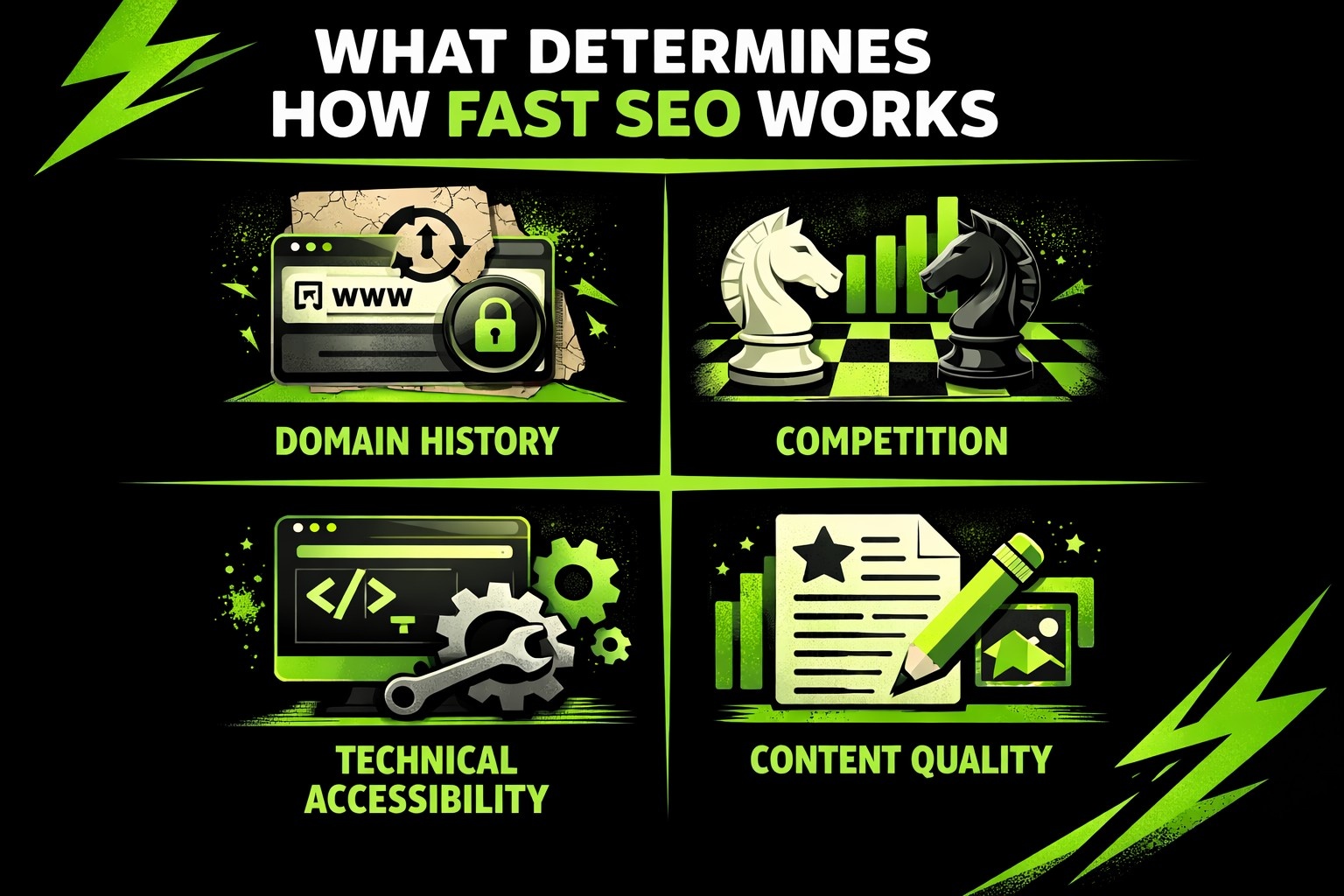
What Actually Determines How Fast SEO Works
There is no universal SEO clock. Timelines are shaped by a combination of factors that interact with each other.
Domain History and Trust
Older domains tend to move faster, not because age itself is a ranking factor, but because time usually brings backlinks, mentions, and behavioral signals. A brand new site has to earn all of that from scratch.
New domains can rank, but they often experience a longer evaluation phase while search engines assess credibility and intent alignment.
Competition in The Niche
Ranking speed is relative. If you are targeting keywords dominated by established brands with years of authority, progress will take longer. If you focus on specific, intent driven queries with weaker competition, movement can happen much faster.
SEO timelines are always shaped by who you are competing against, not just what you are doing.
Technical Accessibility
If search engines cannot crawl, render, or index your pages properly, SEO progress slows down regardless of content quality.
Issues like blocked resources, broken internal links, poor mobile usability, or JavaScript rendering problems delay everything else. Fixing these issues does not create instant wins, but it removes barriers that otherwise stall growth.
Content Quality and Intent Match
Publishing more content does not speed up SEO. Publishing content that clearly satisfies search intent does.
Pages that answer the right question, in the right format, with clarity and depth tend to stabilize faster. Thin content, vague pages, or keyword driven text without substance takes longer to earn trust, if it earns it at all.
Backlinks and External Signals
Links are still one of the strongest trust signals search engines use. A site with strong, relevant backlinks usually sees faster SEO traction than a site with none.
That does not mean link building should be rushed. Low quality or artificial links often slow progress instead of accelerating it.
Month 1: Foundation, Not Results
The first month of SEO is about preparation. This is where most of the invisible work happens.
Typical focus areas include technical audits, analytics setup, crawl and index reviews, keyword research, and content planning. Structural issues get identified. Pages are mapped to intent. Priorities are set.
What usually does not happen in month one is ranking growth. And that is fine.
If rankings jump during this phase, it is usually coincidence or the result of changes made before the SEO process officially started.
The real value of month one is removing friction and creating clarity.
Month 2: Fixes and Early Signals
In the second month, changes start going live. Technical fixes are implemented. Internal linking improves. Pages are optimized or rewritten. New content may begin publishing.
Search engines start crawling these changes, but they do not immediately trust them. Indexation improves. Coverage issues decrease. Crawl frequency often increases.
You may see early signs like more impressions in search console or slight ranking movement for low competition queries. Traffic usually remains modest.
This stage is about making the site easier to understand and evaluate.
Month 3: Visibility Without Stability
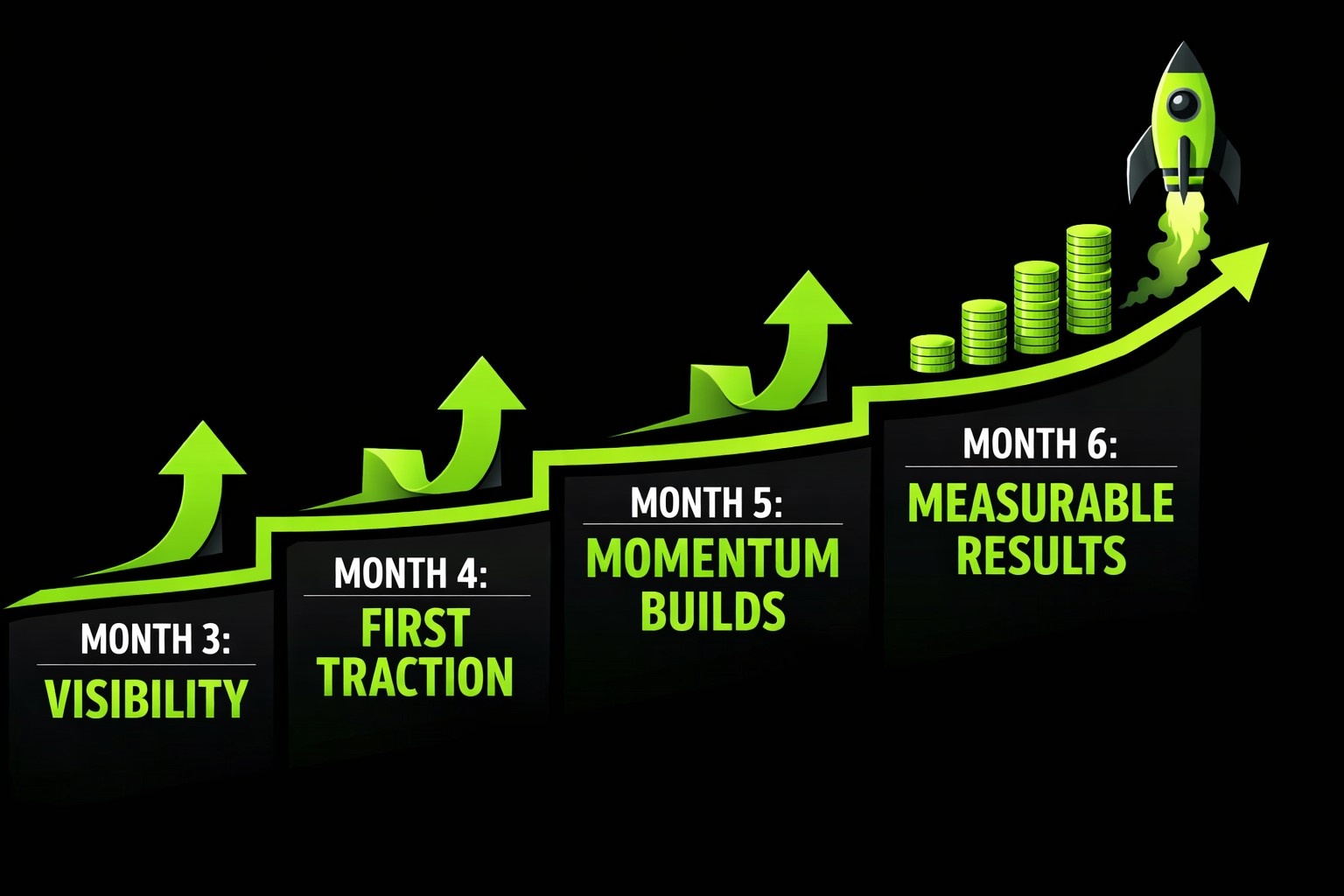
Month three is where many people get confused. Pages start appearing more often in search results. Rankings move, but they rarely hold.
This volatility is not failure. It is testing.
Search engines observe how users interact with updated pages. They compare engagement, relevance, and consistency against competitors. Rankings may jump, dip, and jump again.
At this stage, impressions often rise faster than clicks. That is a good sign. It means visibility is expanding, even if traffic has not caught up yet.
Month 4: First Real Traction
By the fourth month, patterns start forming. Some pages stabilize on page two or the bottom of page one. Low competition keywords may break through. Long tail queries often perform first.
Content published earlier begins to age. Internal links start passing value. Search engines gain confidence in site structure and topical focus.
This is also where early backlinks or brand mentions can amplify progress. Growth is still uneven, but it is no longer random.
Month 5: Momentum Builds
Month five is where SEO starts to feel real. Organic traffic trends upward more consistently. A few pages may drive meaningful visits. Conversion tracking becomes more useful.
Search engines are no longer just testing pages. They are comparing them more confidently against alternatives.
This is often the point where people realize SEO is working, even if it has not yet reached its full potential.
Month 6: Measurable Results
For many sites, month six marks the transition from experimentation to performance.
Rankings stabilize for mid competition keywords. Traffic becomes predictable enough to analyze patterns. SEO driven conversions begin contributing to revenue in a visible way.
This does not mean the work is done. It means the system is now compounding.
If there are no meaningful improvements by month six, it is time to investigate. That does not automatically mean failure, but it does mean something needs adjustment.
What Happens After Six Months
SEO beyond six months becomes less about waiting and more about refinement.
Content clusters mature. Internal authority strengthens. New pages rank faster because the site already has topical credibility. Older pages lift newer ones through internal links.
At this stage, SEO becomes an asset rather than an experiment. Growth is rarely explosive, but it is steady.
The sites that win long term are the ones that continue improving content, maintaining technical health, and earning trust externally.
How To Measure Progress Before Rankings Settle
One of the biggest mistakes is judging SEO only by top positions. Rankings are often the last thing to stabilize, not the first thing to improve.
In the early months, search engines are still testing your pages. That means real progress often shows up in quieter signals long before you see consistent page one placements. If you know where to look, these indicators can tell you whether your strategy is working or drifting off course.
Useful signals include:
- Increased impressions in search results. Your pages are appearing more often for relevant queries. This usually means indexing, relevance, and keyword alignment are improving, even if clicks have not caught up yet.
- Higher crawl frequency. Search engines are visiting your site more often, which is a sign that they consider it worth monitoring. This often follows technical fixes, better internal linking, or consistent publishing.
- More indexed pages. A growing number of pages being indexed suggests that technical barriers have been removed and search engines can properly access your content.
- Improving click through rates. Even small gains here matter. Better titles, clearer descriptions, and stronger intent matching can increase clicks without any ranking changes.
- Better engagement metrics on optimized pages. Longer time on page, deeper scrolls, or lower bounce rates signal that users are finding what they expected, which supports ranking stability over time.
- Growth in long tail keyword visibility. Early traction often starts with specific, lower competition queries. These wins are a strong sign that broader visibility will follow.
Together, these signals show that search engines are paying attention and that your site is moving in the right direction, even if rankings have not fully settled yet.
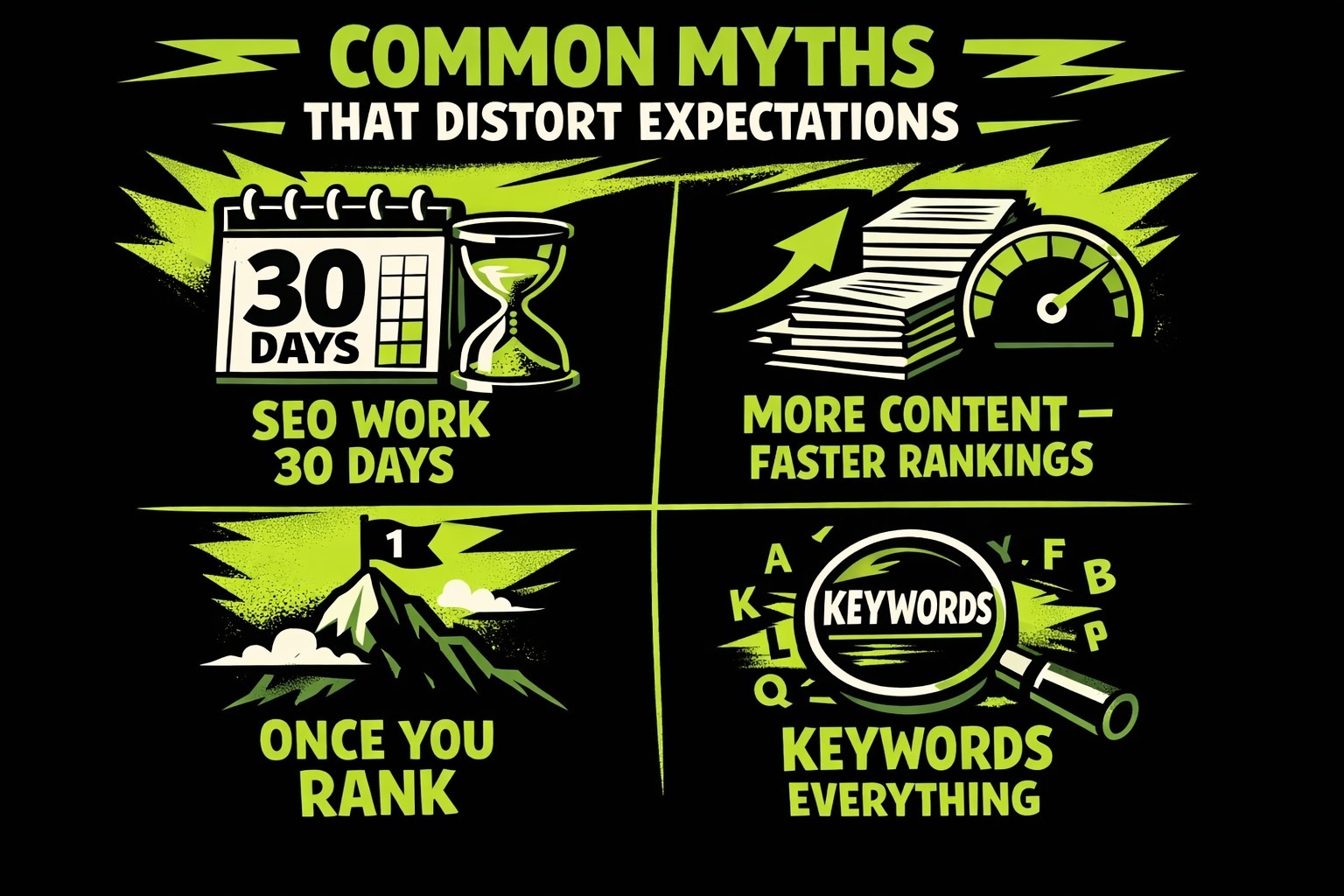
Common Myths That Distort Expectations
SEO Should Work in 30 Days
Short term changes can happen, but stable results rarely do. A page might jump quickly after an update, especially for low competition queries, but that movement is often part of a testing phase. Rankings that appear fast can disappear just as quickly once search engines collect more data. Real SEO gains usually take longer because trust is built through repeated signals, not single changes.
More Content Means Faster Rankings
Unfocused content often slows progress rather than speeding it up. Publishing large volumes of thin or overlapping pages can dilute topical clarity and create internal competition. Strategic content aligned to intent, supported by internal links, tends to move faster because search engines can clearly understand what each page is meant to rank for.
Once You Rank, You Stay There
SEO is not permanent. Rankings shift as competitors update their content, earn new links, or better match user intent. Search behavior also changes over time. Pages that perform well today can slip tomorrow if they are not maintained. Consistent review and updates are part of staying visible, not a sign that something went wrong.
Keywords Are Everything
Modern SEO is about topics, intent, and usefulness, not just keyword placement. Keywords help search engines understand relevance, but they do not guarantee performance on their own. Pages rank because they solve a problem clearly and completely. Keywords are signals, not the strategy itself.
When SEO Timelines Stretch Longer Than Expected
Some situations naturally extend SEO timelines, even when the work is done correctly. In these cases, slower progress does not mean the strategy is failing. It means the environment is tougher.
Common factors include:
- Highly competitive industries. Markets with strong, established players require more time to challenge. Competing against brands with years of authority, content depth, and backlinks means progress is incremental, not immediate.
- New domains with no authority. Fresh sites start with zero trust. Search engines need time to evaluate credibility, consistency, and relevance before ranking pages confidently.
- Sites with major technical debt. Deep structural issues, legacy code, broken internal links, or poor mobile performance can delay progress while foundational fixes are made. These fixes are necessary, but they rarely produce instant visible gains.
- Businesses targeting broad, high intent keywords too early. Going after competitive, high volume terms before earning topical authority often leads to stalled rankings. Narrower, intent driven queries usually perform better first.
- Limited resources or inconsistent execution. SEO depends on momentum. Sporadic updates, long publishing gaps, or half implemented fixes make it harder for search engines to build confidence in the site.
Long timelines are not always a sign of bad SEO. More often, they reflect the level of competition, the starting point of the site, and the reality of how search engines build trust over time.
How To Speed Up SEO Without Breaking It
There is no shortcut that replaces time, but there are ways to avoid unnecessary delays.
Focus on fixing crawl and index issues early. Improve existing pages before publishing dozens of new ones. Target achievable keywords first. Build internal links intentionally. Leverage real relationships for mentions and links instead of chasing volume.
Most importantly, stay consistent. SEO rewards steady effort far more than bursts of activity.
The Honest Takeaway
SEO does not fail because it takes time. It fails because people give up before momentum builds.
A realistic SEO timeline is measured in months, not weeks. Progress often shows up quietly before it becomes obvious. And once it starts compounding, it is one of the most durable growth channels a business can have.
If you understand the timeline, you stop waiting impatiently and start building deliberately. That shift alone makes SEO feel a lot less frustrating and a lot more predictable.