

Quick Summary: Guaranteed SEO services that promise specific rankings or instant results are typically scams. According to Google’s ranking systems documentation, no one can guarantee specific positions in search results. The only legitimate SEO guarantee is a performance-based refund policy tied to measurable improvements in traffic, conversions, or technical optimizations—not rankings.
The phrase “guaranteed SEO services” triggers alarm bells for anyone familiar with how search engines actually work. Yet agencies continue making bold promises about first-page rankings, instant traffic, and guaranteed ROI.
Here’s the uncomfortable truth: Most guarantees in SEO are either misleading, manipulative, or outright fraudulent. But that doesn’t mean all SEO guarantees are scams.
This article breaks down why traditional SEO guarantees fail, what legitimate service providers can actually promise, and how to distinguish between ethical agencies and opportunistic fraudsters.
Why Most SEO Guarantees Are Fundamentally Impossible
Search engine optimization isn’t like running paid ads. With paid advertising, spending more pushes the ad higher in search results instantly. SEO doesn’t work that way.
According to Google’s documentation on ranking systems, Google uses “automated ranking systems that look at many factors and signals about hundreds of billions of web pages” to determine search results. These systems are complex, constantly evolving, and outside anyone’s direct control.
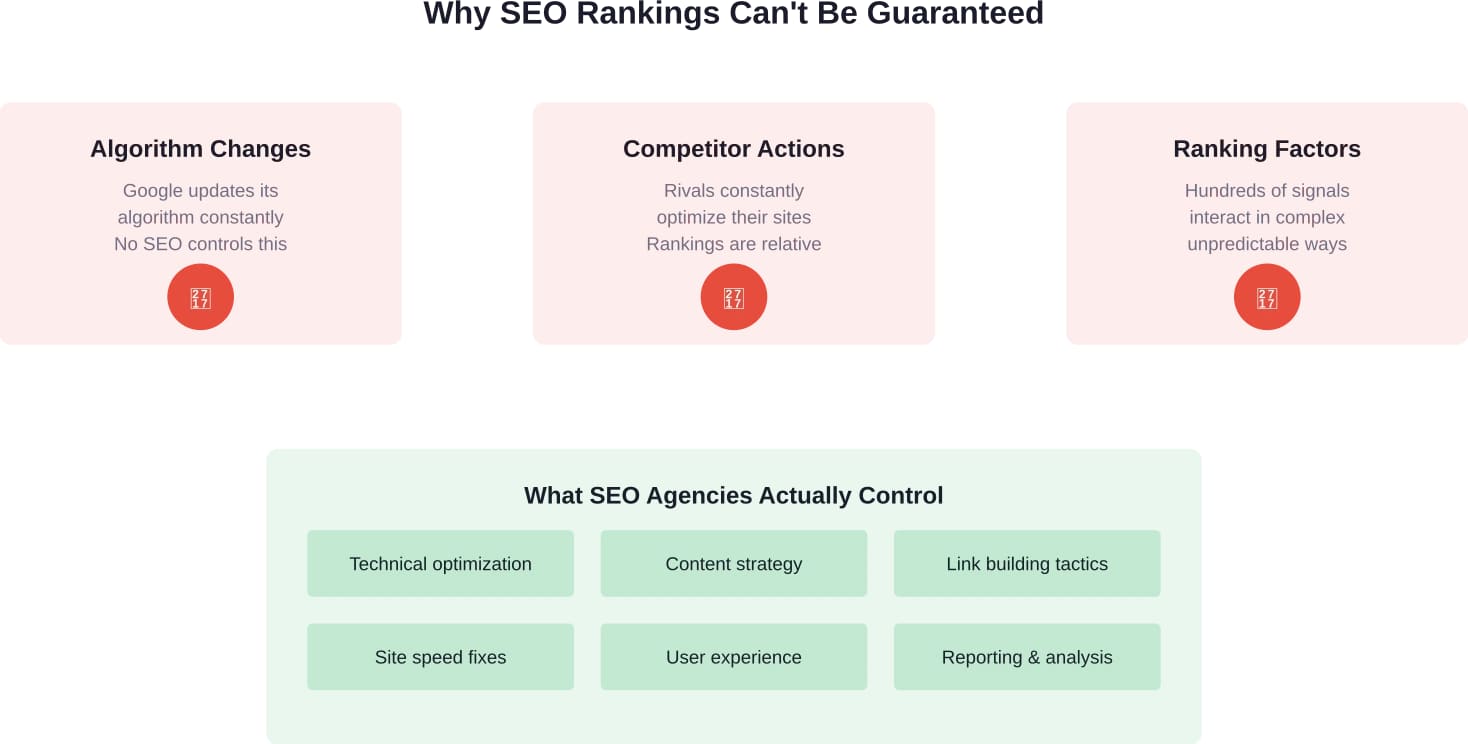
No SEO professional—no matter how experienced—can control Google’s algorithms. Rankings are earned through sustained effort over time, not purchased or guaranteed.
What Cannot Be Controlled Cannot Be Guaranteed
Think about what guarantees actually mean in business. A plumber guarantees their work because they control the pipes, tools, and installation process. A caterer guarantees food quality because they control ingredients, preparation, and delivery.
SEO agencies control optimization strategies, content creation, and technical implementations. They don’t control Google’s algorithm updates, competitor actions, or how search engines interpret and rank content.
When someone promises “guaranteed first-page rankings,” they’re promising control over systems they fundamentally don’t control.
Google Explicitly Warns Against These Promises
Google’s Search Central documentation repeatedly emphasizes that no one can guarantee specific rankings. The search engine’s guidelines on spam policies specifically call out misleading promises as red flags.
Google’s documentation on helpful content states that ranking systems are “designed” to surface “useful, reliable, people-first content” rather than content created specifically to manipulate rankings.
Agencies that guarantee rankings either don’t understand how modern search works or are deliberately misleading potential clients.
Common Guaranteed SEO Scams to Avoid
Not all guaranteed SEO services are created equal. Some are merely optimistic. Others are deliberately deceptive. Here are the most common red flags.
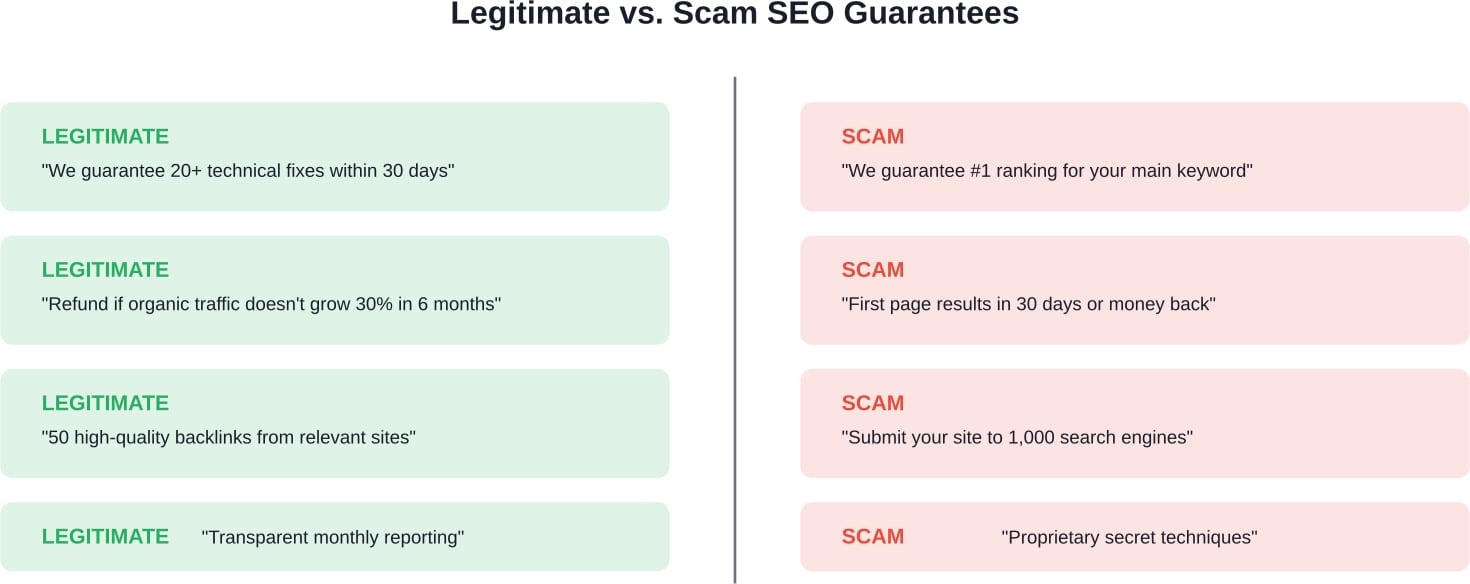
The “First Page in 30 Days” Promise
This guarantee typically involves targeting low-competition, irrelevant keywords that generate zero actual business value. An agency might rank a site for “best artisanal coffee roasters in rural Montana established 2019” when the business is actually a general coffee shop in Seattle.
Technically, they delivered first-page rankings. Practically, they delivered nothing of value.
The “Submit to 1,000 Search Engines” Scheme
This decades-old scam still circulates. Agencies promise to submit websites to thousands of search engines and directories for a flat fee.
Reality check: Google and Bing account for over 90% of search traffic in most markets. The other “998 search engines” are either defunct, irrelevant, or spam directories that can actually harm SEO performance.
The Black Hat Guarantee
Some agencies guarantee results because they plan to use aggressive spam techniques that violate Google’s spam policies. These tactics might include automatically-generated content, cloaking, or scraped content from other websites.
According to Google’s guidance on pure spam manual actions, these techniques can result in severe penalties that “significantly impact” a site’s visibility in search results. Recovering from such penalties requires extensive cleanup work and offers no guarantee of restoration.
Short-term gains from black hat tactics inevitably lead to long-term damage.
The Hostage Situation
Some SEO service providers guarantee results but maintain complete ownership of all optimization work, content, and even domain configurations. If the client tries to leave, they lose everything.
This isn’t a guarantee—it’s a trap.
| What It Looks Like | Why It’s Dangerous |
|---|---|---|
| Specific ranking promises | “#1 ranking guaranteed” or “First page in 60 days” | No one controls Google’s algorithm |
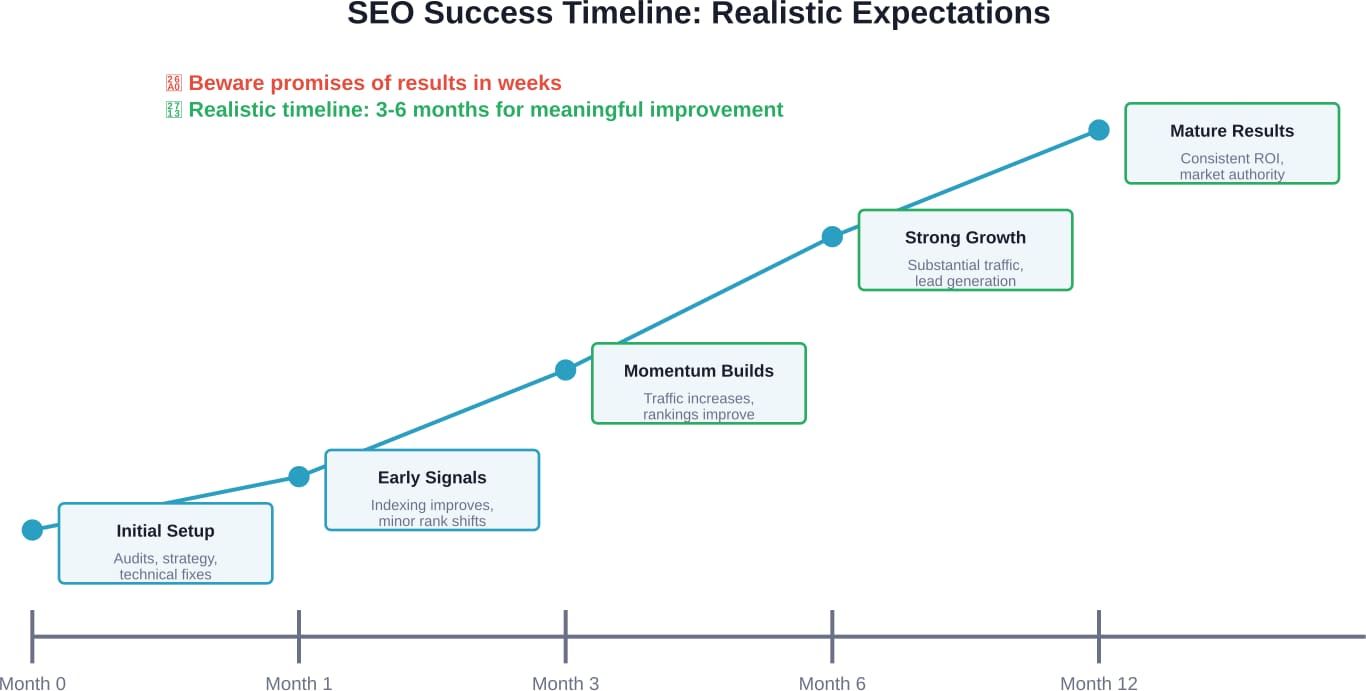
| Unrealistic timelines | Promising major results in weeks | SEO typically takes 3-6 months minimum |
| Vague keyword targeting | Won’t specify which keywords they’ll target | Likely targeting irrelevant low-competition terms |
| No contract transparency | Refusing to explain tactics or provide reporting | Probably using black hat techniques |
| Ownership retention | Agency keeps all content, links, and configurations | Client loses all value if relationship ends |
| Directory submission focus | Emphasizing submission to hundreds of directories | Outdated tactic with minimal value |
The Only Legitimate SEO Guarantee That Exists
So if rankings can’t be guaranteed, what can?
The answer is simpler than most people expect: performance-based guarantees tied to controllable outcomes and measurable improvements.
Process and Deliverable Guarantees
Reputable SEO agencies guarantee the work they’ll do, not the results Google will deliver.
This includes:
- Technical audits identifying specific optimization opportunities
- Content creation meeting defined quality and publishing standards
- Link acquisition efforts with transparent reporting
- Site speed improvements measured by Core Web Vitals
- Regular reporting with clear metrics and progress tracking
These guarantees focus on inputs and activities—things the agency actually controls.
The ROI-Based Guarantee
Some agencies structure guarantees around return on investment rather than rankings. If SEO spend doesn’t generate measurable returns within a defined period, clients receive partial or full refunds.
This model aligns incentives properly. The agency succeeds when the client’s business grows, not when arbitrary ranking targets are hit.
The guarantee isn’t “we’ll rank you #1 for coffee beans.” It’s “if we don’t improve organic revenue by X% within Y months, we’ll refund your investment.”
Traffic and Engagement Guarantees
Another legitimate guarantee focuses on organic traffic growth and user engagement metrics.
Agencies commit to increasing:
- Organic traffic volume by a specific percentage
- Pages receiving consistent impressions in search results
- Average session duration and pages per session
- Conversion rate optimization through better targeting
Marketing claims from service providers reference high retention rates from satisfied clients.
These metrics are more meaningful than rankings because they tie directly to business objectives.
How to Evaluate SEO Service Providers Without Getting Scammed
Choosing an SEO agency requires more diligence than most businesses realize. Here’s how to separate legitimate providers from opportunistic fraudsters.
Demand Complete Transparency
According to best practices discussed across SEO communities, agencies should provide 100% transparency about tactics, timelines, and expected outcomes. If an agency refuses to explain their methodology or claims “proprietary secret techniques,” that’s a massive red flag.
Legitimate SEO isn’t secret. It’s based on publicly available best practices from Google’s Search Central documentation and established industry standards.
Ask About White Hat vs. Black Hat Tactics
Directly ask potential agencies whether they use techniques that comply with Google’s spam policies. Request specific examples of their approach to:
- Content creation (original vs. scraped or spun)
- Link building (earned links vs. purchased or manipulative schemes)
- Technical optimization (legitimate improvements vs. cloaking or manipulation)
Agencies using questionable tactics will either dodge these questions or provide vague reassurances. Ethical agencies will eagerly explain their white-hat methodology.
Review Case Studies and References
Legitimate SEO agencies have documented success stories with verifiable results.
Request case studies showing:
- Starting point metrics and goals
- Strategies implemented over time
- Results achieved with specific timelines
- How success was measured (traffic, conversions, revenue)
Contact references directly. Ask about communication quality, transparency, and whether promised deliverables were actually delivered.
Verify Ownership and Portability
Before signing any contract, clarify who owns the optimization work.
If the relationship ends, the client should retain:
- All content created during the engagement
- Technical improvements made to the website
- Access to all accounts (Analytics, Search Console, etc.)
- Documentation of strategies and implementations
According to link building service guidance from Search Engine Land, building partnerships requires long-term thinking—74.5% of links were lost in the previous nine-year period, requiring ongoing maintenance and cooperation.
But cooperation doesn’t mean hostage situations. Clients should always maintain ownership of their assets.
Understand Realistic Timelines
SEO is not an overnight process. According to analysis from multiple agencies, most substantial improvements require 3-6 months of sustained effort. Some claim visibility improvements “in less than 60 days,” but even optimistic projections acknowledge that sustained growth takes time.
Agencies promising immediate results are either lying or planning to use manipulative tactics that will eventually backfire.
| Red Flag Answer | Good Answer |
|---|---|---|
| What results can you guarantee? | “We guarantee #1 rankings” | “We guarantee specific deliverables and improvements in traffic/conversions” |
| How long until we see results? | “Rankings in 2-4 weeks” | “Initial improvements in 2-3 months, substantial growth by 6 months” |
| What tactics do you use? | “Proprietary secret methods” | “Content optimization, technical SEO, white-hat link building—here are specifics…” |
| Who owns the content and work? | “We retain ownership for quality control” | “You own everything we create—it’s your asset” |
| How do you report progress? | “We’ll send rankings updates” | “Monthly reports covering traffic, conversions, technical health, and competitive analysis” |
| What if results don’t meet expectations? | “That won’t happen” or vague reassurances | “Here’s our refund policy based on measurable performance metrics” |
What Search Engines Actually Reward (According to Google)
Understanding what Google values helps clarify why guarantees are problematic in the first place.
Google’s documentation on helpful, reliable, people-first content emphasizes that ranking systems are designed to surface content that benefits users—not content created specifically to manipulate search engines.
Page Experience Matters
According to Google’s guidance on page experience, core ranking systems “look to reward content that provides a good page experience.” But the documentation explicitly states that site owners “should not focus on only one or two aspects of page experience.”
Instead, Google recommends providing “an overall great page experience across many aspects.” This holistic approach makes guarantees more complex—optimizing one factor doesn’t guarantee ranking improvements if others remain weak.
Technical SEO Is Table Stakes
Google’s SEO guide for web developers emphasizes making content “search-friendly” so that “relevant users” can discover it. The guide notes that “if Google Search has trouble understanding your page, you’re possibly missing out on an important source of traffic.”
Technical optimization removes barriers to indexing and ranking. But technical perfection doesn’t guarantee high rankings—it simply ensures the site can compete.
E-E-A-T and Content Quality
Google’s systems evaluate Experience, Expertise, Authoritativeness, and Trustworthiness (E-E-A-T) when assessing content quality. These qualities can’t be faked or purchased—they’re demonstrated through consistent, valuable content creation over time.
No agency can guarantee that Google will perceive content as authoritative. They can create high-quality content and build genuine expertise signals, but the final evaluation remains with Google’s systems.
The Evolution of SEO: Why the Zero-Click Era Changes Everything
Traditional SEO focused almost exclusively on rankings and clicks. But the search landscape is shifting dramatically.
According to search industry analysis, AI search tools earned approximately 8.2% of search traffic in August 2025. While that percentage seems small, it represents a fundamental shift in how users interact with search results.
Featured snippets, AI overviews, and answer boxes increasingly provide information directly in search results without requiring clicks to websites. This trend may reshape what “success” in SEO means over time.
Visibility vs. Traffic
Search Engine Land’s reporting on zero-click search explains that “old SEO tactics built for rankings and clicks don’t work in AI Overviews and zero-click SERPs.” The article recommends adapting with “visibility-first SEO, entity optimization, and answer-ready content.”
This makes ranking guarantees even less meaningful. A site might rank #1 but generate minimal traffic if Google surfaces the answer directly in results.
Agentic AI and the Future of Search
According to Search Engine Land’s analysis published in February 2026, agentic AI is “entering executive conversations” and changing how ecommerce brands think about search optimization.
As AI systems become more sophisticated at synthesizing information from multiple sources, traditional ranking-focused SEO becomes less relevant. The focus shifts toward being the authoritative source that AI systems reference and cite.
No agency can guarantee how AI systems will use or reference content. The best approach involves creating genuinely valuable, authoritative information that naturally becomes reference material.
AI Governance and Automation in Modern SEO
The integration of AI into SEO workflows introduces new considerations around guarantees and expectations.
According to HubSpot’s AI trends data cited in Search Engine Land, 67% of marketers are increasing investment in automation and 66% of companies are building internal AI tools for marketing.
But automation doesn’t eliminate the unpredictability of search rankings. If anything, it makes the ecosystem more complex as more players use sophisticated tools to compete for visibility.
Quality Over Quantity at Scale
AI enables content creation at unprecedented scale. But Google’s spam policies specifically address “scaled content abuse”—using automation to generate content primarily for search engine manipulation.
Agencies promising guaranteed rankings through high-volume content generation may be setting clients up for future penalties. Quality remains paramount, even when AI assists in production.
The Human Element Still Matters
According to the AI governance analysis, successful SEO requires “balancing automation & oversight.” AI tools can enhance efficiency, but human judgment, strategy, and creativity remain irreplaceable.
Guarantees that rely purely on automated processes ignore the strategic thinking and adaptation required for sustained SEO success.
Real vs. Fake SEO Performance Metrics
Part of evaluating guaranteed SEO services involves understanding which metrics actually matter.
Metrics That Matter
Legitimate performance measurement focuses on business outcomes:
- Organic traffic growth: Increasing visitors from search engines
- Qualified lead generation: Traffic that converts into business opportunities
- Revenue attribution: Organic search contribution to actual sales
- Brand visibility: Impressions for relevant queries even without clicks
- Engagement quality: Time on site, pages per session, conversion rates
These metrics tie SEO performance to business objectives rather than arbitrary ranking targets.
Vanity Metrics to Ignore
Some metrics sound impressive but provide minimal business value:
- Rankings for irrelevant keywords: Being #1 for terms no one searches
- Total indexed pages: Quantity doesn’t equal quality or visibility
- Directory submissions: Being listed in hundreds of obscure directories
- Social signals: Likes and shares that don’t translate to search visibility
- Domain authority scores: Third-party metrics that don’t directly influence Google rankings
Agencies emphasizing these metrics may be distracting from actual performance failures.
Building a Sustainable SEO Strategy (With or Without Guarantees)
Whether working with an agency or managing SEO internally, the principles of sustainable optimization remain constant.
Focus on Fundamentals First
Before worrying about advanced tactics, ensure the basics are solid:
- Site speed: Core Web Vitals meeting Google’s thresholds
- Mobile optimization: Responsive design that works across devices
- Technical health: Proper indexing, clean crawl errors, structured data
- Content quality: Original, valuable information addressing user needs
- User experience: Intuitive navigation and clear conversion paths
According to Google’s technical SEO guidance, over 60% of internet users worldwide use mobile devices to access the internet, making mobile optimization essential rather than optional.
Invest in Long-Term Content Strategy
Quick wins rarely last. Sustainable SEO success comes from consistent, high-quality content creation aligned with business objectives and audience needs.
This means:
- Comprehensive topic coverage establishing topical authority
- Regular publishing cadence maintaining freshness signals
- Content formats addressing different user intents (informational, transactional, navigational)
- Multimedia elements enhancing engagement and understanding
Content strategy can’t be guaranteed to produce specific rankings, but it reliably builds authority and relevance over time.
Build Genuine Relationships for Link Acquisition
According to Search Engine Land’s guidance on link building services, digital marketing requires “more than just a one-and-done process.” The article notes that agencies and clients “will likely need to cooperate for years—links die, and websites need ongoing link maintenance.”
The data shows that “74.5% of links were lost in the previous nine-year period” in one analysis, highlighting the importance of sustained link-building efforts rather than one-time campaigns.
Legitimate link building focuses on:
- Creating linkable assets worth citing naturally
- Digital PR generating earned media coverage
- Industry relationships leading to collaborative opportunities
- Content promotion reaching relevant audiences
Agencies promising specific numbers of links within tight timelines may be purchasing links or using manipulative tactics that violate Google’s guidelines.
Monitor, Measure, and Adapt
SEO requires continuous monitoring and adaptation. What works today may not work after the next algorithm update.
Effective measurement includes:
- Regular audits identifying technical issues and opportunities
- Competitive analysis tracking market changes
- Performance reporting showing progress against business objectives
- User behavior analysis informing content and UX improvements
Agencies offering transparent reporting and regular strategic reviews provide more value than those making empty guarantees.
Don’t Pay for SEO Promises You Can’t Verify
If you’re seeing “guaranteed rankings” in an SEO offer, it’s worth slowing down. Lengreo lays out why guarantees don’t really hold up in search (algorithms shift, competitors react, and “guarantees” often come with fine print), and what’s more useful instead – a clear scope, realistic timeline, and tracking you can verify.
Ready to Replace Promises With a Clear SEO Scope?
Talk with Lengreo to:
- review what a “guarantee” is actually promising (keywords, timeframe, conditions).
- get a simple monthly scope: what gets fixed, what gets built, and what gets measured.
- anchor the conversation to real numbers using their monthly budget brackets.
👉 Start with a free consultation from Lengreo and ask for a short, written scope based on your site and goals.
When Guarantees Might Make Sense (With Caveats)
There are limited scenarios where specific guarantees can be legitimate—but only with proper structure and realistic expectations.
Technical Audit Guarantees
Agencies can legitimately guarantee to identify a specific number of technical issues or optimization opportunities. For example: “We guarantee to identify at least 20 technical SEO improvements within 30 days.”
This guarantee focuses on deliverables the agency controls. Whether implementing those fixes improves rankings remains unpredictable, but identifying issues is achievable.
Content Production Guarantees
Agencies can guarantee content quantity and quality: “We guarantee 12 thoroughly researched, 2,000+ word articles per quarter, each targeting specific keyword opportunities.”
Again, this focuses on controllable outputs. The content’s ranking performance depends on many factors outside the agency’s control, but the production and quality standards are measurable.
Conditional Performance Guarantees
Some agencies offer refunds or discounts if specific traffic or conversion thresholds aren’t met—but with important conditions:
- Minimum engagement period (typically 6-12 months)
- Client compliance with recommendations
- Exclusions for external factors (algorithm updates, competitor actions, seasonal fluctuations)
- Clear measurement methodology agreed upon upfront
These guarantees align incentives while acknowledging the complexity and unpredictability of SEO.
Conclusion: The Real Value of SEO Services
The uncomfortable truth about guaranteed SEO services is that most guarantees are either meaningless or misleading. Rankings can’t be guaranteed because they depend on systems no one controls.
But that doesn’t mean SEO services lack value. Far from it.
Legitimate SEO agencies provide strategic guidance, technical expertise, content capabilities, and sustained optimization efforts that reliably improve organic visibility and business outcomes over time. The value lies in the process, expertise, and consistent execution—not in impossible guarantees about specific rankings.
When evaluating SEO service providers, focus on:
- Transparency about tactics and realistic expectations
- Track records with verifiable case studies and references
- Clear ownership of deliverables and assets
- Performance-based guarantees tied to controllable outcomes
- White-hat methodology complying with Google’s guidelines
- Regular reporting and strategic adaptation
The best SEO relationships are partnerships built on trust, transparency, and shared commitment to long-term success. Agencies making grandiose guarantees are either inexperienced or unethical. Those providing realistic expectations and proven methodologies deliver actual value.
Ready to invest in legitimate SEO services? Start by auditing the current state of the website’s technical health, content quality, and competitive positioning. Identify specific business objectives SEO should support. Then evaluate potential partners based on their ability to execute against those objectives—not their promises about rankings no one can control.
The right SEO strategy won’t guarantee first-page rankings. It will guarantee the systematic improvements and sustained efforts that make first-page rankings increasingly likely over time. That’s the only guarantee worth having.