

Brief Overview: Ecommerce SEO optimizes online stores to rank higher in search engines like Google. It combines technical optimization (site speed, structured data), keyword research for product pages, on-page SEO (compelling titles, descriptions), and content marketing to drive organic traffic and sales without relying solely on paid ads.
Every online store owner faces the same challenge: getting discovered by shoppers actively searching for products. Paid ads deliver quick traffic, but the costs add up fast. Organic search, though? That’s sustainable growth.
Ecommerce SEO drives consistent, high-intent traffic without the ongoing ad spend. Stores like Ruggable have built massive audiences—over a million monthly visitors—primarily through organic search. The right SEO strategy doesn’t just bring visitors. It brings shoppers ready to buy.
This guide covers the essential strategies that make ecommerce SEO work: technical foundations, keyword research tailored for product catalogs, on-page optimization that converts browsers into buyers, and content marketing that builds authority. Real talk: it’s not quick, but the payoff is worth it.
What Makes Ecommerce SEO Different
Ecommerce SEO operates under unique constraints. Online stores manage hundreds or thousands of product pages, each competing for visibility. Unlike blogs or service sites, ecommerce platforms deal with inventory fluctuations, duplicate content risks across similar products, and the constant challenge of thin content on product pages.
Product pages need to rank for transactional keywords—searches where buyers are ready to purchase. Category pages must capture broader terms while guiding shoppers through inventory. And the site architecture? It has to support both search engines crawling efficiently and customers finding products intuitively.
According to Google Search Central, structured data plays a critical role in ecommerce. Product markup helps search engines understand pricing, availability, and reviews, which can surface directly in search results. This visibility matters: according to a recent Semrush study, when AI Overviews appear, organic clicks drop by as much as 64%, and the top organic position sees its click-through rate fall from 20%-30% to just 15%-19%.
Here’s the thing though—ecommerce sites can’t just optimize once and forget it. Inventory changes, seasonal products come and go, and competitors constantly adjust their strategies. The stores that win at SEO treat it as an ongoing process, not a one-time project.
Why Organic Search Matters for Online Stores
The math is straightforward. Paid advertising costs compound with every click. Organic traffic, once established, continues flowing without per-click costs. That doesn’t mean it’s free—SEO requires time, expertise, and consistent effort—but the economics favor organic for long-term growth.
Shoppers trust organic results more than ads. Research from Backlinko found that only 0.63% of searchers click on websites listed on page two of Google search results. If the store doesn’t rank on page one for relevant product searches, it’s essentially invisible to most potential customers.
Organic search also captures shoppers at different stages. Someone searching for “waterproof hiking boots” is exploring options. Someone searching for “Danner Mountain 600 size 11 black” is ready to buy. Ecommerce SEO strategies need to address both scenarios.
And there’s the compound effect. Each optimized product page, each piece of helpful content, each quality backlink builds on previous efforts. Over months and years, this creates a traffic foundation that paid ads simply can’t match for ROI.
Technical SEO Foundations
Technical optimization ensures search engines can crawl, index, and understand the store properly. Without solid technical foundations, even brilliant content and perfect keywords won’t deliver results.
Site Speed and Performance
Page speed directly impacts rankings and conversions. Slow-loading pages frustrate shoppers and send negative signals to search engines. Google’s algorithms factor speed into rankings, particularly for mobile searches.
For ecommerce sites, image optimization is critical. Product photos often represent the largest page weight. Compress images without sacrificing quality, use modern formats like WebP, and implement lazy loading so images below the fold only load when needed.
Server response time matters too. Quality hosting—not the cheapest shared plan—makes a measurable difference. Stores doing significant traffic should invest in quality hosting (at least $50/month) that can handle the load without slowdowns during peak traffic.
Mobile Optimization
Mobile-first indexing means Google predominantly uses the mobile version of pages for ranking and indexing. If the mobile experience is poor, rankings suffer across all devices.
Product pages need to work flawlessly on smartphones: readable text without zooming, tap targets sized appropriately, images that load quickly on cellular connections. Test the entire purchase flow on mobile devices regularly. Checkout friction on mobile kills conversions and sends bounce signals that hurt SEO.
Structured Data Implementation
Structured data helps search engines understand product information explicitly. According to Google Search Central documentation, structured data can improve the accuracy of Google’s understanding of ecommerce content and enable rich results that show pricing, availability, and ratings directly in search listings.
Product structured data should include:
- Product name and description
- Price and currency
- Availability status (in stock, out of stock, preorder)
- Review ratings and count
- Brand and SKU identifiers
- Images
Google provides testing tools to validate structured data implementation. Errors in markup prevent rich results from appearing, so validation is essential. According to Google Search Central data, Rakuten found that users spend 1.5 times more time on pages with structured data compared to pages without it, and engagement rates on AMP pages with structured data formats are 3.6 times higher.

URL Structure Best Practices
According to Google Search Central documentation on ecommerce URL structure, well-designed URLs help Google locate and crawl pages more efficiently. Poor URL structure creates indexation problems that directly harm rankings.
Clean, descriptive URLs work best:
- Good: /mens-hiking-boots/danner-mountain-600
- Bad: /product.php?id=8472&cat=12&color=blk
Include category structure in URLs when it adds clarity, but keep the hierarchy shallow. Deep nesting (five or more levels) makes crawling less efficient and creates unnecessarily long URLs.
Handle parameters carefully. Filtering options (size, color, price range) often create duplicate content issues. Use canonical tags to point variant URLs back to the main product page, or configure parameter handling in Google Search Console to tell Google which parameters to ignore.
Managing Duplicate Content
Ecommerce sites face duplicate content challenges constantly. Product variants create multiple URLs with similar content. Manufacturer descriptions appear across competing sites. Pagination generates multiple pages with overlapping product lists.
Canonical tags tell search engines which version is primary. Every variant page should have a canonical tag pointing to the main product URL. Filtered category pages should canonicalize to the unfiltered version unless the filtered view targets a distinctly different keyword.
For pagination, ensure a clean crawl path and use self-referencing canonicals or robots meta tags if needed.
Site Architecture and Navigation
Site structure impacts both user experience and crawlability. A well-organized architecture helps shoppers find products intuitively while ensuring search engines can discover and index all important pages efficiently.
Flat Architecture Wins
Flat site architecture minimizes clicks from the homepage to any product page. The general rule: keep products within three clicks of the homepage. This ensures important pages receive sufficient crawl budget and link equity flows efficiently throughout the site.
Deep hierarchies dilute authority. A product buried six levels deep receives minimal link equity from the homepage and might not get crawled regularly, especially on larger sites where Googlebot allocates limited crawl budget.
Category Page Strategy
Category pages serve dual purposes: they’re landing pages for broader keywords and navigation hubs for shoppers. Optimize them accordingly.
Add unique descriptive content to category pages—not just product grids. A paragraph or two explaining the category, highlighting use cases, and naturally incorporating keywords helps rankings while providing value to shoppers.
Subcategories should make logical sense both for SEO and users. Group products by attributes shoppers actually search for: product type, use case, brand, or price tier. Forced categorization that only benefits keyword targeting confuses visitors and increases bounce rates.
Internal Linking
Strategic internal links distribute authority and guide both users and crawlers through the site. Product pages should link to related products. Category pages should link to relevant subcategories. Blog content should link to related product pages where contextually appropriate.
Anchor text matters. Use descriptive text that includes target keywords naturally rather than generic “click here” links. But don’t over-optimize—forced exact-match anchors look manipulative.
Breadcrumb navigation helps both usability and SEO. It shows users where they are in the site hierarchy and provides internal links that help search engines understand site structure. Implement breadcrumb structured data so they appear in search results.
Keyword Research for Product Catalogs
Effective ecommerce keyword research differs from content site strategies. The focus is on transactional intent: searches that indicate buying readiness rather than casual browsing.
Product-Specific Keywords
Product pages should target specific, high-intent keywords.
These include:
- Exact product names with modifiers (brand + model + key feature)
- Product type + specific attributes (“waterproof trail running shoes”)
- Buying intent modifiers (“buy,” “price,” “for sale”)
The specificity matters. “Boots” is too broad and competitive. “Waterproof hiking boots” narrows it down. “Waterproof hiking boots for wide feet” targets a specific need with clearer intent.
Category and Collection Keywords
Category pages target broader terms that encompass multiple products. These searches represent earlier funnel stages where shoppers are comparing options.
Research what searchers actually type. Don’t assume internal category names match customer language. Use keyword tools to find search volume and related terms, but also review Search Console data to see what queries already drive impressions.
Long-Tail Opportunities
Long-tail keywords represent specific searches with lower volume but higher conversion rates. Someone searching “best running shoes for plantar fasciitis under $100” has clear intent and specific needs.
These keywords often face less competition and convert better because they match precise customer problems. Build content and product collections around these specific use cases.
Competitor Keyword Analysis
Analyze what keywords drive traffic to competitor product pages. Tools like Ahrefs or Semrush reveal which terms competitors rank for and estimate the traffic those rankings generate.
Look for gaps: keywords where competitors rank but the store doesn’t. Also identify opportunities where competitors rank poorly for valuable terms—these represent easier wins than going after their strongest keywords.
| Example | Search Intent | Target Page Type |
|---|---|---|---|
| Branded Product | “Nike Air Max 270 black” | High – Ready to buy specific item | Product page |
| Product Category | “men’s running shoes” | Medium – Comparing options | Category page |
| Use Case | “shoes for marathon training” | Medium – Researching solutions | Collection or content page |
| Long-Tail Specific | “lightweight hiking boots for women size 8” | High – Very specific need | Product or filtered category |
| Informational | “how to choose running shoes” | Low – Early research stage | Blog content with product links |
Product Page Optimization
Product pages convert browsers into buyers. Optimization balances SEO requirements with persuasive copywriting that drives conversions.
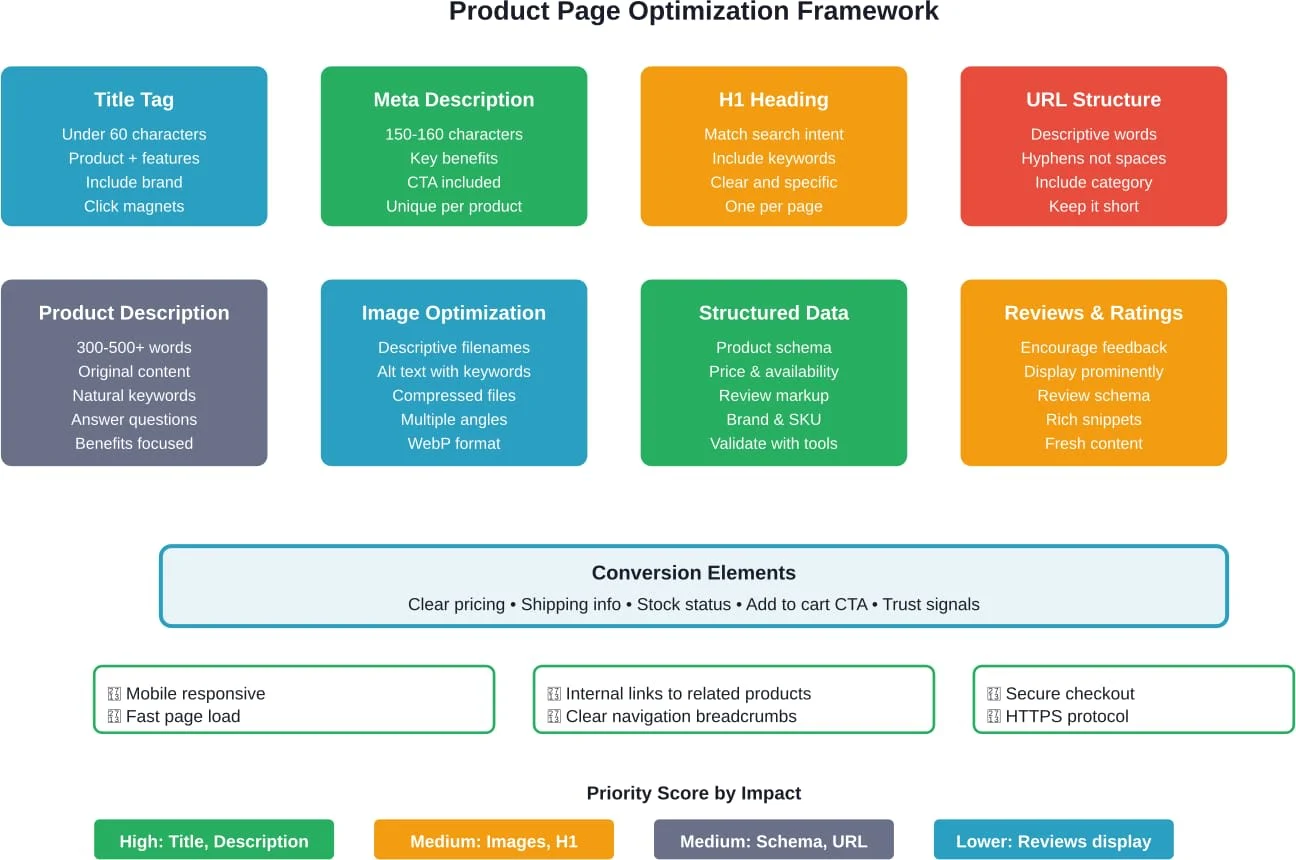
Title Tags That Drive Clicks
Title tags should be descriptive, include key product attributes, and stay under 60 characters. Google might truncate longer titles in search results.
Effective product title structure:
- Product Name | Key Feature | Brand | Site Name
- Brand + Model + Specific Attribute + Size/Color (if critical)
According to competitor analysis, strong product titles include specific details: “Danner Mountain 600 Waterproof Hiking Boots – Men’s Black Size 11” performs better than generic “Mountain Boots.”
Include “Click Magnet Words” when relevant:
- Discount indicators (“25% Off,” “Sale”)
- Shipping benefits (“Free Shipping”)
- Guarantees (“Lifetime Guarantee”)
- Availability signals (“In Stock,” “Ships Today”)
Meta Descriptions That Sell
Meta descriptions don’t directly impact rankings but significantly influence click-through rates. Write compelling descriptions between 150-160 characters that summarize key benefits and include a subtle call to action.
Weak: “These are nice boots for any occasion. Great quality and comfort.”
Strong: “Danner Mountain 600 boots combine waterproof protection with all-day comfort. Vibram outsoles, 100% leather. Free shipping on orders over $50. Shop now.”
Include specific product benefits, differentiation factors, and practical purchase information (shipping, guarantees, pricing hints). Generic descriptions waste valuable real estate in search results.
Product Descriptions That Rank and Convert
Manufacturer descriptions create duplicate content problems—dozens or hundreds of sites use identical text. Write original descriptions that incorporate target keywords naturally while addressing customer questions and concerns.
Minimum recommended length: 300-500 words for major products. This provides enough content for search engines to understand relevance while covering key features, benefits, and use cases.
Structure descriptions for scannability:
- Opening paragraph summarizing core benefits
- Bullet points for key features and specifications
- Detailed paragraphs expanding on important attributes
- Use case scenarios helping shoppers visualize the product
Address common questions directly in product descriptions. If shoppers frequently ask about sizing, care instructions, or compatibility, answer these questions prominently. This improves user experience and reduces bounce rates.
Image Optimization
Google Images represents the world’s second-largest search engine. Properly optimized product images drive significant traffic.
Use descriptive, keyword-rich filenames: “danner-mountain-600-waterproof-hiking-boot.jpg” instead of “IMG_8472.jpg.” Alt text should describe what’s in the image clearly and include relevant keywords naturally: “Danner Mountain 600 waterproof hiking boot in black leather shown from side angle.”
Compress images to reduce file size without quality loss. Large images slow page loads, hurting both user experience and rankings. Use modern formats like WebP when browser support allows.
Multiple product images improve conversions and SEO. Show products from various angles, demonstrate use cases, and include lifestyle imagery alongside product-only shots.
Customer Reviews
Reviews generate fresh, unique content that naturally incorporates long-tail keywords. They also influence rankings through increased engagement signals and provide structured data opportunities.
Implement review structured data so star ratings appear in search results. These rich snippets improve click-through rates significantly—products with visible ratings stand out from competitors.
Encourage reviews actively. Send follow-up emails post-purchase, offer small incentives for verified reviews, and make the review process frictionless. More reviews mean more unique content and better conversion rates.
Content Marketing for Ecommerce
Content marketing builds authority, captures informational searches, and supports product pages through strategic internal linking. It addresses a fundamental limitation of product pages: they don’t rank well for informational queries.
Blog Content Strategy
Create content that addresses customer questions throughout the buying journey. Early-stage content targets broad educational topics. Mid-funnel content compares options and explains selection criteria. Bottom-funnel content addresses specific use cases and buying concerns.
Examples by funnel stage:
- Top: “Complete Guide to Hiking Boots: Types and Features”
- Middle: “How to Choose Hiking Boots for Different Terrains”
- Bottom: “Best Waterproof Hiking Boots Under $200 [2026 Review]”
Each piece should link naturally to relevant product and category pages. Don’t force links, but when discussing specific product features or comparisons, linking to actual products makes sense and drives conversions.
Buying Guides and Comparison Content
Buyers researching purchases consume comparison content voraciously. Articles like “X vs. Y: Which Is Better?” or “Best [Product Type] for [Specific Use]” capture high-intent traffic.
These articles can rank for valuable keywords while naturally featuring store products. Structure them to be genuinely helpful, not just promotional. Objective comparisons build trust even when recommending store products.
User-Generated Content
Customer photos, detailed reviews, and Q&A sections generate unique content automatically. Encourage customers to share product photos on social media and feature them on product pages with permission.
Q&A sections address common questions while creating keyword-rich content. Questions like “Is this waterproof?” or “What size should I order?” appear repeatedly and represent actual search queries.
Video Content
Product videos improve engagement metrics and can rank in both Google search and YouTube. Create unboxing videos, demonstration videos showing products in use, and comparison videos.
Embed videos on product pages with full transcripts. The transcript provides text content for search engines while the video improves user experience. Optimize video titles and descriptions for relevant keywords.
Link Building for Online Stores
Backlinks remain a critical ranking factor. Quality links from relevant, authoritative sites signal trust and relevance to search engines.
Earn Links Through Content
The best link building happens naturally when content deserves links. Comprehensive guides, original research, useful tools, and genuinely helpful resources attract links from bloggers, journalists, and industry sites.
Create linkable assets: industry reports, detailed tutorials, free tools or calculators relevant to the niche, infographics summarizing useful data. Promote these assets to relevant audiences who might link to them.
Supplier and Brand Relationships
Manufacturers and suppliers often link to authorized retailers. If the store carries specific brands, ensure it’s listed on brand websites as an official retailer.
Partner pages, dealer locators, and “where to buy” sections on manufacturer sites provide valuable links and drive direct traffic from shoppers researching specific brands.
Digital PR
Newsworthy angles get media coverage and links. Launch unique products, share industry insights, or create research that journalists can reference. HARO (Help A Reporter Out) connects sources with journalists seeking expert quotes.
Local media works for stores with physical locations. Local news sites, chambers of commerce, and business directories provide geographically relevant links.
Competitor Backlink Analysis
Analyze competitor backlink profiles to identify link opportunities. Which sites link to multiple competitors but not the target store? Those sites clearly link to businesses in this space and represent realistic targets.
Don’t just replicate competitor links—identify gaps and opportunities they’ve missed. Look for broken links on competitor sites that could be replaced with working links to similar content on the target site.
Monitoring Performance
Tracking results shows what’s working and where to focus optimization efforts. Google Search Console and analytics platforms provide essential performance data.
Key Metrics to Track
According to Google Search Console documentation, key performance metrics include:
- Organic traffic volume and trends
- Keyword rankings for target terms
- Click-through rates from search results
- Pages receiving the most traffic
- Conversion rates from organic traffic
- Revenue attributed to organic search
Don’t obsess over individual keyword rankings. Focus on aggregate traffic trends and business outcomes. A slight ranking drop doesn’t matter if overall traffic and revenue increase.
Search Console Insights
Search Console shows which queries drive impressions and clicks, what pages rank, and technical issues affecting indexing. Review this data regularly to identify opportunities.
Look for queries where the site has high impressions but low clicks—these represent opportunities to improve titles and descriptions. Queries with decent rankings (positions 5-15) are candidates for optimization pushes to reach top positions.
Technical Monitoring
Regular technical audits identify issues before they impact rankings. Monitor:
- Crawl errors and indexing issues
- Page speed metrics
- Mobile usability problems
- Broken internal and external links
- Duplicate content issues
- Structured data errors
Many issues emerge gradually—products go out of stock and remain indexed, site updates break internal links, server configuration changes affect crawlability. Proactive monitoring catches problems early.
Metric | Where to Track | What It Tells You | Action Threshold |
|---|---|---|---|
| Organic Traffic | Google Analytics | Overall SEO performance trend | 10%+ drop month-over-month |
| Click-Through Rate | Search Console | How compelling titles/descriptions are | Below 2% for top positions |
| Keyword Rankings | Rank tracking tool | Competitive position for target terms | Drop of 5+ positions |
| Conversion Rate | Analytics + CRM | Traffic quality and page effectiveness | Significantly below site average |
| Page Speed | PageSpeed Insights | Technical performance issues | Score below 70 |
| Index Coverage | Search Console | Crawling and indexing problems | Growing error count |
A Real SEO Plan for Your Store from Lengreo
If you run an online store, the SEO work that drives sales usually comes down to unglamorous fundamentals: clean technical setup, category and product pages that can rank, and a content plan that matches how people actually search before they buy. Lengreo positions ecommerce SEO as a dedicated track (including AI search optimization for ecommerce) and frames it around shopping discovery and product visibility, not just blog traffic.
Ready to Turn “SEO strategy” Into a Real Monthly Plan?
Talk with Lengreo to:
- audit the store for technical blockers that hurt crawling, indexing, and page speed.
- prioritize what to fix first: templates, categories, product pages, internal links, and structured data.
- get a monthly scope and cost range that matches your budget bracket (so you can compare providers on the same footing).
👉 Start with a free consultation from Lengreo and request a short scope for your store.
Common Ecommerce SEO Mistakes
Certain mistakes plague ecommerce sites repeatedly. Avoiding these issues prevents wasted effort and ranking problems.
Thin Product Descriptions
Short, generic descriptions hurt rankings. Product pages with 50-100 words of manufacturer-supplied text don’t provide enough unique content for search engines to understand relevance or differentiate the page from dozens of competitors selling the same product.
The fix: write substantial, original descriptions. Target 300+ words for important products, incorporate target keywords naturally, and address customer questions proactively.
Ignoring Out-of-Stock Products
Temporarily out-of-stock products should remain indexed if they’ll return. Deleting pages loses accumulated authority and rankings. Instead, maintain the page with clear “currently unavailable” messaging and expected restock dates.
For permanently discontinued products, implement 301 redirects to similar current products or relevant category pages rather than serving 404 errors.
Neglecting Category Pages
Many stores treat category pages as pure navigation, missing significant ranking opportunities. Category pages can rank for valuable short-tail keywords if optimized properly.
Add unique descriptive content to category pages. A few paragraphs of helpful information above or below product grids dramatically improves rankings without harming user experience.
Over-Optimization
Keyword stuffing, forced exact-match anchors, and unnatural optimization patterns trigger penalties. Write for humans first, search engines second. Keywords should fit naturally in content that genuinely helps customers.
Ignoring Mobile Experience
With mobile-first indexing, the mobile version determines rankings. A poor mobile experience directly hurts SEO regardless of desktop performance. Test the entire shopping experience on smartphones regularly—navigation, product pages, checkout flow.
Forgetting Internal Linking
Product and category pages often exist in isolation, connected only through top navigation. Strategic internal links distribute authority, help search engines understand site structure, and improve rankings across the board.
Related product links, “customers also viewed” sections, and contextual links from blog content all contribute to stronger internal linking.
Advanced Strategies
Once fundamentals are solid, advanced tactics can provide additional competitive advantages.
International SEO
Stores serving multiple countries need proper international SEO implementation. Use hreflang tags to indicate language and regional versions of pages, preventing duplicate content issues across country-specific domains or subdirectories.
Create country-specific content addressing local preferences, pricing in local currencies, and region-relevant shipping information. Generic international content underperforms localized versions.
Voice Search Optimization
Voice searches tend to be longer and more conversational. Optimize for natural language queries and question-based searches. FAQ sections naturally capture voice search traffic.
Featured snippets appear prominently in voice search results. Structure content to answer specific questions concisely—often the first paragraph following a question-format subheading.
Local SEO for Physical Stores
Stores with physical locations should optimize for local search. Claim and optimize Google Business Profiles, ensure NAP (Name, Address, Phone) consistency across directories, and encourage customer reviews on Google.
Local inventory ads and local SEO landing pages help capture “near me” searches and drive foot traffic to physical locations.
Seasonal Optimization
Plan content and optimization around seasonal trends. Create gift guides before holiday seasons, optimize for seasonal products well in advance, and target seasonal keywords when search volume begins rising.
Historical Search Console data reveals when seasonal queries begin trending. Start optimization 2-3 months before peak season to build rankings before demand surges.
Tools for Ecommerce SEO
The right tools make SEO management significantly more efficient. While it’s possible to do SEO manually, tools provide data, automation, and insights that would take enormous time to gather otherwise.
Essential Free Tools
Google Search Console is non-negotiable. It shows how Google sees the site, what queries drive traffic, indexing issues, and technical problems. Check it weekly at minimum.
Google Analytics tracks traffic sources, user behavior, and conversions. Ecommerce tracking reveals which products and categories drive revenue from organic search.
Google PageSpeed Insights identifies performance issues affecting rankings and user experience. Test major templates and high-traffic pages regularly.
Paid SEO Platforms
Comprehensive platforms like Ahrefs, Semrush, or Moz provide keyword research, rank tracking, competitor analysis, and backlink monitoring in one place. Pricing varies—check official sites for current plans—but the investment pays off through efficiency and insights.
These tools reveal competitor strategies, identify ranking opportunities, and track progress across hundreds or thousands of keywords automatically.
Ecommerce-Specific Tools
Screaming Frog crawls sites like search engines do, identifying technical issues, duplicate content, broken links, and missing metadata. The desktop version crawls up to 500 URLs free, with unlimited crawling in the paid version.
Schema markup generators simplify implementing structured data. While platforms like Shopify include some schema automatically, custom implementation often requires additional tools or plugins.
Putting It All Together
Ecommerce SEO isn’t a one-time project. It’s an ongoing process of optimization, content creation, technical maintenance, and authority building. The stores that succeed treat SEO as a core marketing channel deserving consistent investment.
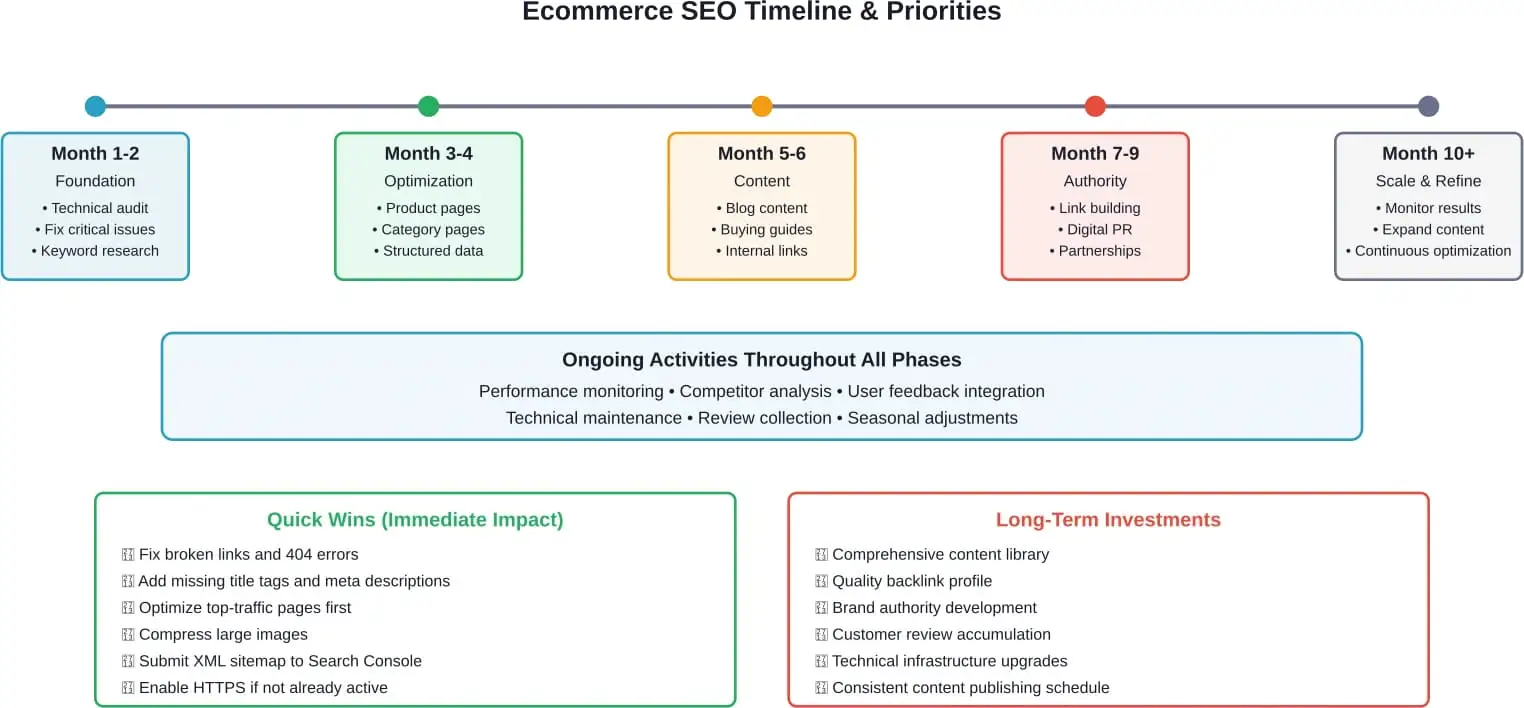
Start with fundamentals: fix technical issues, optimize product pages, implement structured data, and build logical site architecture. These foundations enable everything else.
Then layer on content marketing and link building. Create genuinely helpful resources that answer customer questions throughout the buying journey. Earn links through valuable content rather than manipulative tactics.
Monitor results consistently. Track what’s working, double down on successful strategies, and adjust approaches that underperform. SEO is iterative—small improvements compound into significant competitive advantages.
The economic reality favors organic search for long-term growth. While paid advertising delivers immediate traffic, SEO builds sustainable competitive moats. Sites ranking organically for hundreds of relevant keywords have traffic sources that competitors can’t easily replicate.
That said, SEO works best alongside other channels, not in isolation. Combine organic search with paid advertising, email marketing, social media, and conversion optimization for maximum growth. Each channel reinforces the others.
Ready to drive more organic traffic to your online store? Start with a technical audit identifying quick wins. Fix critical issues, optimize high-value pages first, and build from there. Consistent effort produces results—not overnight, but definitely over time. The stores dominating search results today invested months or years of sustained optimization to get there. That investment continues paying dividends long after the initial work.