Meta keywords had their moment. Back when search engines were simpler, adding a few strategic words behind the scenes could nudge your site up the rankings. But that era ended a long time ago. If you’re still wondering whether Google pays attention to them in 2026, the short answer is: it doesn’t. But there’s more to the story than just a yes or no. Let’s look at why meta keywords fell out of use – and what to focus on instead if you actually want to rank.
Why Meta Keywords No Longer Matter (At All)
Google hasn’t used meta keywords to rank pages for well over a decade. That’s not a guess – it’s something they’ve confirmed outright, as far back as 2009. The reason is simple: people abused them. Meta keywords became a playground for keyword stuffing and spammy tactics, so Google pulled the plug. Since then, they’ve been ignored entirely by Google’s algorithm.
If you’re still adding them in 2026, it’s not helping your SEO – and it might even signal to search engines that your strategy’s stuck in the past. Some sites still arrive with keyword tags stuffed into their headers like it’s 2007 – a leftover tactic that hasn’t worked in years. It doesn’t hurt rankings, but it definitely doesn’t help. There are better things to focus on if you’re serious about visibility and growth.
Lengreo on Real SEO Priorities (Not Legacy Tags)
At Lengreo, we stopped using meta keywords a long time ago. They’re irrelevant to how Google ranks content today. Our focus is on signals that actually drive growth – search intent, page experience, and technical clarity. SEO isn’t about box-ticking. It’s about helping the right people find the right content at the right time.
When we work with clients, we go beyond surface-level tweaks. We build content clusters that support real business objectives, improve site architecture, and strengthen authority around key topics. That means tighter internal linking, structured data where it counts, and content built to convert – not just rank.
If you want to see how that looks in action, check out our latest projects or follow us on Instagram and LinkedIn. We share real examples, client stories, and the thinking behind the strategies that get results.
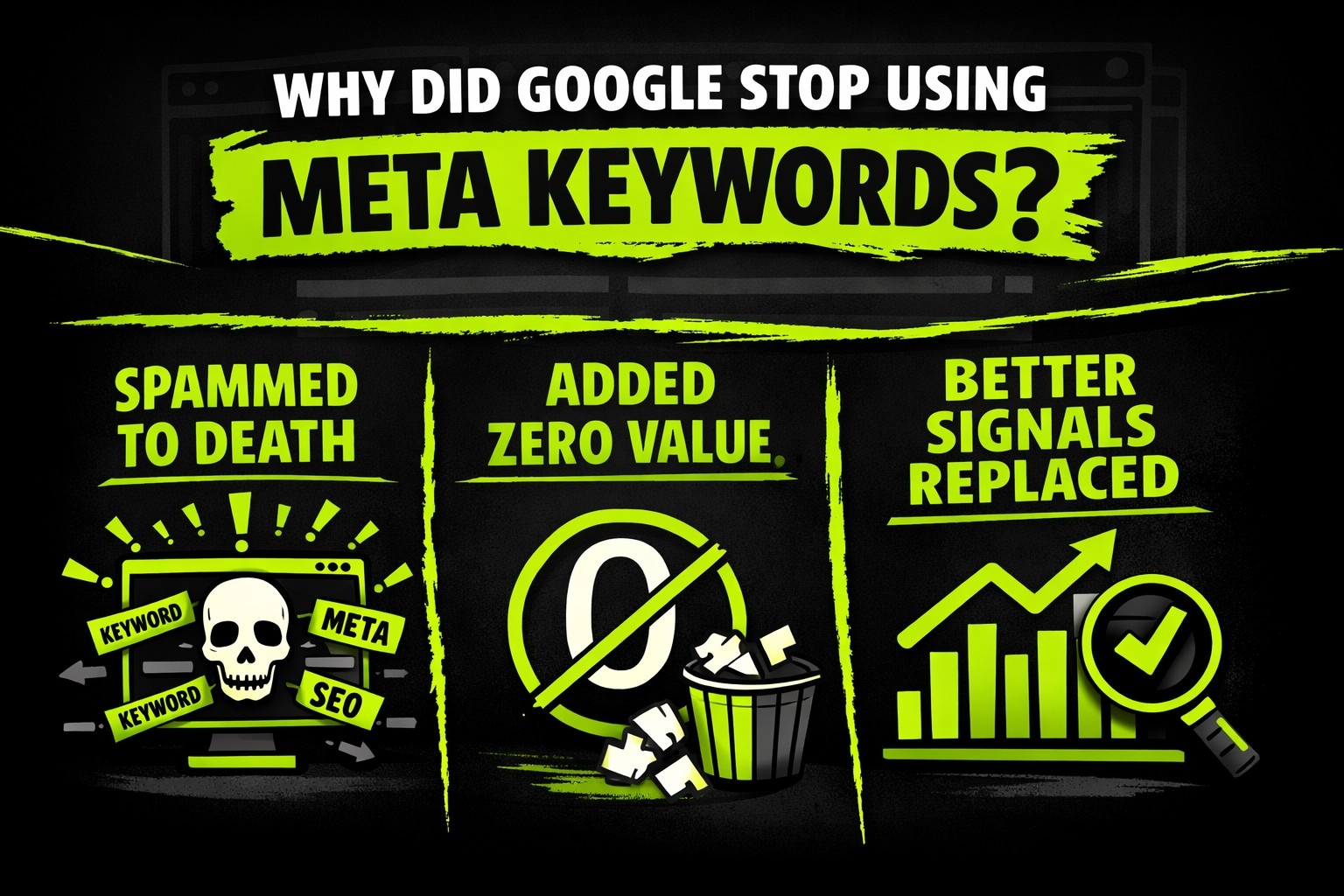
Why Did Google Stop Using Meta Keywords?
It wasn’t a sudden decision. Google phased out meta keywords for a reason – and honestly, it was long overdue. Here’s what pushed them out of the picture:
- They got spammed to death: Once marketers realized they could load meta tags with high-volume keywords (relevant or not), it became a mess. Pages were ranking based on what was hidden in the code, not what users actually saw or needed.
- They added zero value for users: Meta keywords never showed up on the page. You could write anything in there and hope for the best. From Google’s point of view, that’s not a trustworthy signal.
- Better signals replaced them: As Google’s algorithm got smarter, it started reading actual page content, user behavior, and context. Meta keywords just couldn’t keep up. They became a weak, outdated signal in a much more complex ranking system.
At this point, meta keywords are just digital leftovers. If they’re still on your site, they’re not doing harm – but they’re definitely not pulling their weight either.
Do Other Search Engines Still Care About Meta Keywords?
Short answer: not really. Outside of Google, there are a few exceptions – but nothing that justifies investing time into them.
Bing: Recognizes Them, Barely Uses Them
Bing technically still reads the meta keywords tag – but that’s about it. It’s a signal buried under dozens of far more important ones, like page content, backlinks, and user engagement. Meta keywords have never shown any measurable impact on Bing rankings in any case they’ve reviewed. If they’re there, fine. If not, don’t sweat it. It’s just not a lever worth pulling.
Baidu: A Niche Use Case
Baidu, China’s leading search engine, has been slower to phase out old SEO signals. Meta keywords might still register, especially on older domains. That said, Baidu’s algorithm has matured, and like Google, it increasingly prioritizes real content quality, mobile usability, and speed. If your business isn’t actively targeting a Chinese audience, you can safely skip this altogether.
Internal Search: A Small Exception
Some internal search tools – like those in enterprise CMS platforms or knowledge base systems – still index meta keywords to help users find relevant pages faster. In those edge cases, they serve more like content tags than SEO tools. This can be useful for internal navigation or large documentation sets, but it has nothing to do with your position in Google or Bing.
If your SEO strategy involves more than just checking boxes, meta keywords probably aren’t part of the picture. There are smarter, faster ways to improve your visibility – and that’s where your time is better spent.
Do You Need to Remove Meta Keywords from Your Website?
There’s no official rule that says meta keywords must be removed – but if they’re still sitting in a website’s code, they’re not doing anything useful either. Google ignores them, and modern SEO tools don’t rely on them, so leaving them in place is more about aesthetics than performance.
For most businesses, the real question is whether the cleanup is worth the effort. If removing meta keywords takes five minutes during a routine update, go ahead and clear them out. But if it involves combing through hundreds of templates or older CMS setups, the return on that time is minimal. That energy is better spent on technical fixes that actually impact rankings – site speed, mobile optimization, structured data, and so on.
At this point, meta keywords are more of a historical artifact than an active problem. They won’t help, but they won’t hurt either. Just don’t make the mistake of thinking they’re still part of a real SEO strategy.
How to Spot If Your Site Still Uses Meta Keywords
On most modern websites, meta keywords have been phased out for years. But in older templates, legacy CMS setups, or projects that haven’t been audited in a while, they can still show up. The easiest way to check? Open any page, right-click, and view the source code. If you spot something like <meta name=”keywords” content=”…”>, that’s it. That tag is exactly what Google now skips over.
If you’re working with a larger site and don’t feel like checking every page manually, use a crawler like Screaming Frog SEO Spider or Sitebulb. These tools can scan your entire site and flag any pages still using that tag. You can also use a basic “site:” search in Google and review cached versions of your pages if you want a quick look without logging into the backend.
In most cases, spotting them is the easy part. The harder part is deciding whether they’re worth cleaning up – which depends more on your workflow than your SEO strategy. But either way, knowing what’s under the hood is step one.

Why Meta Keywords Still Sneak Into New Builds
It’s easy to assume meta keywords are a thing of the past, but they still show up in freshly launched projects more often than most teams would like to admit. Not because someone’s intentionally optimizing with them – usually, it’s just outdated defaults slipping through unnoticed. Here’s where they tend to creep in:
- Legacy templates or theme packs: Many pre-built WordPress themes or HTML templates still include a <meta name=”keywords”> tag by default. It sits there doing nothing, but looks “official,” so nobody questions it.
- Old plugins and SEO tools: Some lightweight SEO plugins – especially free or abandoned ones – still prompt users to fill in meta keywords. Clients follow instructions, unaware it hasn’t mattered since 2009.
- Copy-pasted boilerplate code: Developers reusing previous project scaffolding often carry old meta tag structures forward without reviewing each one. It’s not sabotage – it’s just habit.
- Poor handoffs between marketing and dev: When SEO isn’t embedded into the project flow, developers may rely on outdated specs or assumptions. And no one checks the meta tags until it’s too late.
What does this mean in practice? It’s not a critical error – but it is a red flag. If a new build includes meta keywords, it usually points to a wider issue: outdated processes, misalignment between teams, or a lack of SEO oversight during development. And that’s worth fixing.
What Actually Improves Rankings (Instead of Meta Keywords)
Meta keywords don’t move the dial. These things do – and they’re where smart teams are putting their attention in 2026.
1. Search Intent > Keywords
Chasing keywords without understanding why someone is searching doesn’t work anymore. Google wants to match content to purpose, not just phrasing. That means thinking like a user – not an algorithm.
- Understand what the searcher actually needs
- Write for clarity and usefulness, not for bots
- Map intent types: informational, commercial, navigational, etc.
- Don’t just match the keyword – solve the problem
2. Topical Authority
It’s not about having a single great article. It’s about showing depth and consistency in a subject area. That’s what builds trust, both with Google and with actual visitors.
- Build content clusters around key themes
- Link related pages internally with intent
- Cover topics from multiple angles – not just obvious ones
- Keep articles fresh with updated data, trends, or use cases
3. Page Speed and UX (Core Web Vitals)
If a page takes forever to load or jumps around when people try to scroll, it’s not going to rank – or convert. Google’s now judging experience just as much as content.
- Optimize image sizes and use next-gen formats
- Use a CDN and proper caching setup
- Eliminate layout shifts and excessive JavaScript
- Test real-world performance, not just lab metrics
4. Structured Data (Schema Markup)
Schema isn’t just about fancy search results – it helps Google understand what the content is. That context can be the difference between ranking and disappearing.
- Add product, FAQ, article, or review schema where relevant
- Use tools like Google’s Rich Results Test to validate markup
- Don’t overdo it – use schema to clarify, not to manipulate
- For dynamic sites, automate it properly at scale
5. Content That’s Actually Worth Reading
Not longer. Not stuffed. Just better. If the content feels like it was written to check boxes, it’s not going to hold attention – or earn links.
- Lead with insight, not filler
- Use real examples, original takes, or useful data
- Trim the fluff – say things once, clearly
- Mix short and long sentences for natural rhythm
SEO has evolved past shortcuts. The sites that perform well now are the ones that think bigger than just tags and keywords. They answer questions better, load faster, and prove they know what they’re talking about. Everything else fades into the background.
What SEOs Should Say to Clients Asking About Meta Keywords
At some point, a client’s going to ask why their old agency added dozens of keywords to the meta tags, or why their dev team is still using them in templates. And as tempting as it is to roll your eyes, this is where clear communication matters more than cleverness.
The honest answer? Meta keywords haven’t been part of Google’s ranking algorithm since 2009. They were abused, they lost their value, and Google moved on. Adding them today doesn’t hurt anything – but it doesn’t help either. It’s like putting a cassette player in a Tesla. Not dangerous, just… completely out of sync.
Good SEOs don’t just know what works – they know how to explain what doesn’t without making clients feel behind. Frame it as a harmless leftover. Then shift the conversation toward where time and budget can actually create impact: content clarity, speed, structure, authority. That’s the work that moves rankings now. Not legacy tags no one reads.
Conclusion
If you’re still holding onto meta keywords as part of your SEO stack, it’s time to let them go. They had their place – briefly. Now, they’re just outdated code taking up space and distracting from what actually drives results.
Modern SEO isn’t about ticking off invisible tags. It’s about relevance, clarity, experience, and structure. The teams that win today are the ones that align with user intent, move fast, and don’t waste time chasing signals that no longer matter. So if meta keywords are still floating around in your CMS, it’s not the end of the world. But it is a sign to recheck what else might be stuck in the past.