Search results used to be simple: title, URL, a short description. Now they’re full of extras – stars, prices, FAQs, product stock levels. These details aren’t just visual noise. They come from rich snippets, and they’ve become a familiar part of the way we browse. The real question is whether they actually help with SEO, or just dress things up. The answer’s a bit more layered than it looks. Let’s break it down.

What Are Rich Snippets and How Do They Work?
If you’ve ever searched for a product and seen ratings, stock info, or even shipping times right under a link that’s a rich snippet. It’s not a gimmick. It’s structured data doing its job. Here’s how it works, step by step:
- Rich snippets are enhanced search results: They show extra context like reviews, prices, event dates, or recipe details directly in Google’s listings.
- They rely on structured data (Schema markup): That’s code added to your site that tells Google what your content actually means, not just what it says.
- When Google crawls your page, it reads this data: If everything’s clean and relevant, it can use that data to add extra info to your snippet in the search result.
- The result is a listing that looks sharper and tells more: Instead of just hoping someone clicks, you’re giving them a reason to.
- It doesn’t guarantee higher rankings but it does help visibility: And more visibility, if paired with strong content, usually leads to better engagement and CTR.
Rich snippets don’t rewrite the rules of SEO, but they definitely change how people interact with your search listings. In competitive spaces, that edge matters.
How Lengreo Approaches Structured Data and SEO Optimization
At Lengreo, we treat structured data as part of a broader SEO strategy not an afterthought. It’s not about chasing snippets for the sake of it. It’s about clarity. When search engines understand your content better, your visibility improves. And when users see accurate, useful info before they click, trust builds faster. That’s the layer structured data adds.
We integrate schema markup directly into our technical SEO audits and site architecture plans. Whether we’re working on white-label SEO for an agency partner or rebuilding an on-site content structure from the ground up, we make sure the structured data actually reflects what’s on the page. No shortcuts, no inflated markup, just real information that supports discoverability.
You’ll see us talk about this often on Instagram and LinkedIn where we share what’s working, what’s shifting, and how our clients stay visible as search evolves. Schema might be behind the scenes, but it plays a bigger role than most people realize and we’ve seen the difference when it’s done right.
Do Rich Snippets Improve SEO Performance? Let’s Be Honest About It
Rich snippets look great in search results but looks alone don’t guarantee results. The question isn’t whether they appear useful, but whether they actually change how your site performs. The answer is somewhere in the middle.
No, They Don’t Boost Rankings Directly
Let’s get this part out of the way. Google has confirmed that rich snippets aren’t a direct ranking factor. Just adding structured data won’t suddenly lift your page to the top.
If the content underneath isn’t solid, the markup won’t save it. Rich snippets aren’t a cheat code they’re an enhancement.
But They Do Affect Clicks A Lot
When your listing shows more information star ratings, price, availability, or clear answers it catches the eye. It builds trust before the user even visits your site. That often leads to a higher click-through rate (CTR).
Some pages see modest bumps, others see major jumps anywhere from 10% to over 80%, depending on the niche and search intent.
That Extra Engagement? It Counts
The more accurate the preview, the better the post-click experience tends to be. People stay longer. They bounce less. They interact more. These are behavioral signals that search engines do pay attention to.
So while rich snippets themselves don’t increase rankings, they often set off a chain of improvements that support long-term SEO growth.
Rich snippets won’t fix weak content. They won’t override poor UX. But when implemented well, they create a better search experience and in most cases, that leads to better performance. Not a shortcut. Not a guaranteed win. Just one of those quiet improvements that stack up over time.
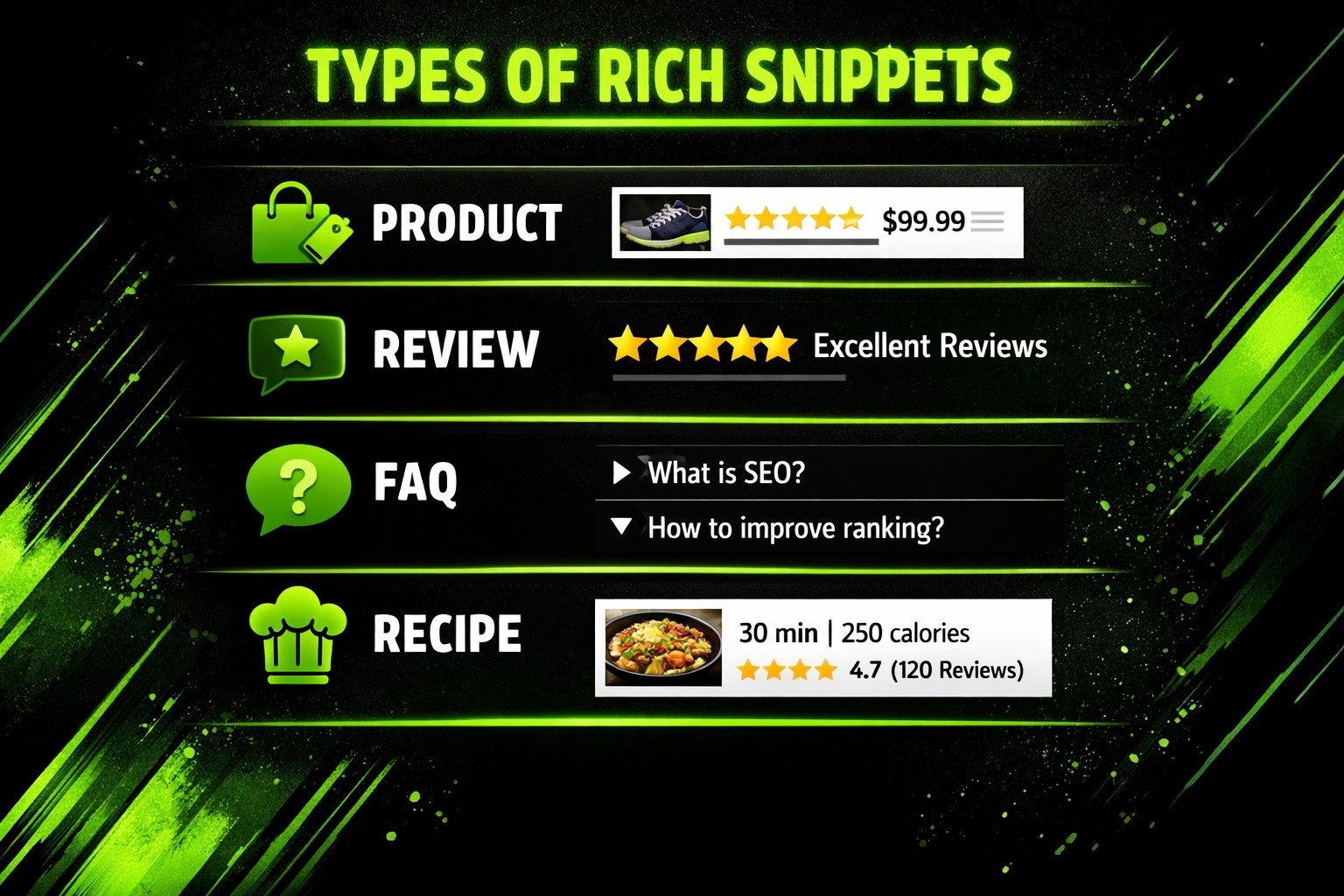
Types of Rich Snippets That Drive Engagement
Not all rich snippets are created equal. Some catch attention instantly, others quietly build trust. The key is knowing which formats actually add value for your audience and which just take up space. Here are the ones that consistently drive clicks, context, and engagement:
1. Product Snippets
Ideal for ecommerce, but also useful for digital goods and tools. They show things like:
- Price
- Stock availability
- Star ratings
- Product description or size
When someone’s comparing options, seeing this info upfront can be the nudge that gets the click especially if your offer’s clear and competitive.
2. Review Snippets
These show average ratings or pulled-in reviews for products, services, books, courses you name it. They’re helpful for:
- Building trust at a glance
- Letting users see social proof before visiting your site
- Standing out in review-heavy SERPs
Also: they break up the visual monotony of blue links and plain text. That alone makes them worth considering.
3. FAQ Snippets
Expandable answers shown right under the search result. These can:
- Address objections or common questions early
- Make your listing look larger on the page
- Give users a sense that your content is comprehensive
The trick is to keep the questions real. Don’t stuff it with filler just to “look smart.” Users can tell when it’s bloated.
4. Recipe Snippets
For food-related content, this format is practically required. They show:
- Cooking/prep time
- Star rating
- Calories and serving size
- An image of the finished dish
If you’ve got recipes and you’re not using structured data, you’re leaving traffic on the table. These snippets make a massive difference in that niche.
5. Event Snippets
Useful for webinars, concerts, conferences, and more. They can show:
- Dates and start times
- Location (physical or virtual)
- Ticket info or registration links
They work especially well for time-sensitive searches where users are skimming quickly to find availability.
6. Course Snippets
Growing fast thanks to online education. These can include:
- Instructor name
- Price
- Course length
- Ratings
Not every course platform supports them well out of the box, but if you can implement them cleanly, they’re great for filtering out unqualified clicks and attracting the right learners.
Each snippet type serves a different intent. The real strategy is matching the format to the searcher’s mindset. If they’re looking to compare, give them data. If they’re looking to understand, give them clarity. Either way, rich snippets give you the space to do both without making them dig.

How to Implement Schema Markup the Right Way
Structured data isn’t complicated until you skip steps or cut corners. Schema markup works best when it’s clean, relevant, and aligned with what’s actually on the page. Here’s how to handle it properly without turning it into a messy side project.
Step 1: Pick the Right Snippet Type
Start with what makes sense for the page.
Don’t try to force “Review” markup on a generic landing page or tag your About page as a Product. That’s how you end up with broken previews or worse, nothing showing up at all. Use the official Schema.org library to find the correct type:
- Product
- Recipe
- FAQ
- Event
- Course
- Article
Step 2: Use Google’s Structured Data Markup Helper
Unless you’re manually writing JSON-LD (which you can do if you’re comfortable), the easiest way to start is with Google’s free helper tool.
- Plug in your page URL
- Choose the type of markup you want to add
- Highlight the relevant info (like name, price, duration, etc.)
- Export the code in JSON-LD format
- Paste it into the <head> or directly in the HTML of your page
Done right, this should take minutes not hours.
Step 3: Test It
Before you hit publish, run your page through Google’s Rich Results Test. This tells you two things:
- Whether your page is eligible for rich snippets
- Whether you’ve made any critical errors
It also shows you a preview of what the result might look like, which is useful for sanity checks.
Step 4: Keep It Updated
Structured data can go stale. Pricing changes, course details evolve, event dates pass. If your Schema markup doesn’t reflect the current state of the page, it can be flagged or ignored altogether.
Set a reminder to review your markup regularly, especially on dynamic pages tied to products, reviews, or content feeds.
Step 5: Don’t Overdo It
One of the fastest ways to lose eligibility is to tag everything just because you can. Schema is about clarity, not decoration. Only mark up what’s actually visible on the page and don’t make claims the content can’t back up.
That’s where most of the bad examples fall apart.
Clean markup doesn’t need to be flashy. It just needs to be accurate, relevant, and helpful for users and search engines. Get that right, and the rich snippets will follow.
Monitoring and Measuring Impact
Adding structured data is only the first half of the job. Once rich snippets are live, the next step is to track what they’re actually doing because if they’re not pulling clicks, something’s off. Google Search Console is your go-to here. Under “Performance,” apply the Search Appearance filter to see how specific rich results are showing up, what they’re ranking for, and how users are responding. It’s not just about impressions look at CTR and average position too. That’s where the real signals hide.
You’ll also want to check the “Enhancements” section in Search Console. This shows you whether Google has picked up your structured data properly or if it’s flagged errors that might be holding things back. If there’s a drop in visibility or a sudden spike in warnings, don’t ignore it. Structured data needs maintenance. Pages change, content shifts, and outdated markup can quietly kill performance if no one’s watching. Keep the loop tight: monitor, test, adjust, repeat.
Rich Snippets and the Future of Search
Search is changing and not in a slow, predictable way. With AI reshaping how information gets delivered, structured data is becoming less of a nice-to-have and more of a core requirement. Rich snippets aren’t just there to “look good” anymore. They’re becoming part of how search engines interpret relevance, authority, and context, especially as engines shift toward entity-based and conversational search models.
Voice search, AI summaries, and personalized results are already pulling from structured sources to shape what users see even when no one clicks. That means if your data isn’t clear, clean, and well-structured, you’re not just invisible you’re unusable to the systems deciding what gets surfaced. Whether it’s an LLM pulling course data, or a smart assistant reading out product specs, your schema needs to hold up.
What worked five years ago won’t hold up in the next two. The edge now comes from precision, structure, and clarity not fluff. Rich snippets are just the visible piece of that shift. What sits underneath is what search is quietly rewarding next.
Conclusion
Rich snippets don’t promise overnight wins and that’s a good thing. They’re not some SEO trick; they’re a functional upgrade. One that helps people actually understand what your page offers before they click. In a landscape where attention is short and results all look the same, that extra context can be the difference between getting ignored and getting traffic.
Are they a ranking factor? No. But they improve visibility, lift CTR, and support better engagement and all of that feeds back into your broader SEO performance over time. Treat them like you would any smart optimization: strategic, measured, and built around actual content value. That’s where the payoff lives.