Highlights: Choosing the right keywords for SEO requires identifying search terms your target audience uses, evaluating metrics like search volume and difficulty, analyzing search intent, and assessing business value. The process involves gathering seed keywords, using research tools to expand your list, filtering by metrics, checking SERP competition, and strategically implementing keywords in your content for maximum visibility.
Keywords remain the foundation of every successful SEO strategy. They’re the bridge connecting what people search for and the content websites create.
But here’s the thing—not all keywords deserve attention. Some drive floods of relevant traffic. Others waste months of effort with zero returns.
The difference? Knowing how to choose keywords that align with actual search behavior, match business goals, and sit within reach of current domain authority.
According to Google’s own documentation on how Search works, their automated systems process hundreds of billions of pages to match queries with relevant content. Google’s helpful content guidance emphasizes creating material that benefits people rather than manipulating rankings. That means keyword selection isn’t about gaming algorithms—it’s about understanding what information searchers need and delivering it better than competitors.
This guide breaks down the exact process for selecting keywords that actually move the needle. No fluff, no outdated tactics. Just the seven steps that separate guesswork from strategy.
Why Keyword Selection Makes or Breaks SEO Campaigns
Choosing wrong keywords costs more than time. It drains budgets, demoralizes teams, and hands competitors market share on a platter.
Target keywords with zero business value? Traffic arrives but conversions don’t. Chase terms beyond current authority levels? Content languishes on page five, invisible to everyone. Miss search intent? Bounce rates spike as visitors realize the content doesn’t match their needs.
Real talk: keyword research determines which battles are worth fighting. It identifies opportunities where content can realistically rank and where rankings translate into business outcomes.
Google’s March 2024 core update reduced unhelpful content in Search by 45%, according to Google’s official announcement. The algorithm increasingly rewards content that demonstrates genuine expertise and satisfies user intent. That shift makes strategic keyword selection more critical than ever.
Sound keyword choices balance three elements: search demand (is anyone looking?), ranking difficulty (can we compete?), and business alignment (does it matter if we rank?).
Step 1: Generate Seed Keywords From Core Topics
Seed keywords are the starting point. They’re broad terms describing products, services, or topics that matter to the business.
For an email marketing platform, seed keywords might include “email marketing,” “newsletter software,” “email automation,” and “marketing campaigns.” For a local bakery, seeds could be “sourdough bread,” “wedding cakes,” “gluten-free bakery,” and “custom desserts.”
These foundation terms won’t be final targets—they’re too competitive and vague. But they unlock thousands of related keyword ideas through research tools.
How to Identify Seed Keywords
Start by listing 5-10 core topics the business addresses. What problems get solved? What products get sold? What questions come up repeatedly in sales conversations?
Check existing content that already performs well. Analytics platforms reveal which terms currently drive traffic. Those successful keywords suggest related topics worth exploring.
Look at competitor websites, particularly their main navigation menus and category pages. These high-level sections typically target seed keywords in their focus areas.
Customer language matters more than industry jargon. People search using their own vocabulary, not technical terms from product specifications. Sales teams and support staff hear this language daily—tap into those insights.
Step 2: Expand Keywords Using Research Tools
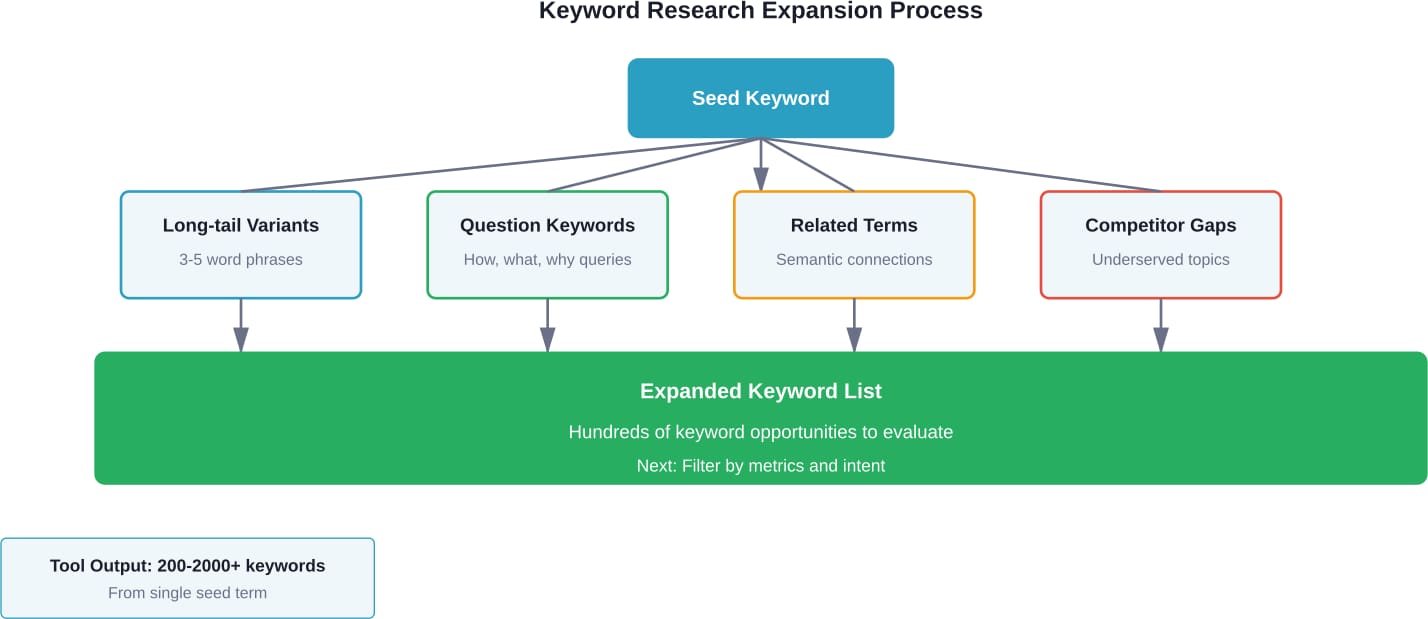
Seed keywords become keyword lists through expansion tools. These platforms reveal related terms, questions, and variations that searchers actually use.
Multiple keyword research tools exist, each with different data sources and features. Popular keyword research tools include Semrush’s Keyword Magic Tool, Moz’s Keyword Explorer, and Ahrefs’ Keywords Explorer.
Enter seed keywords into these tools and they generate hundreds or thousands of related suggestions. The tools pull data from actual search queries, showing monthly search volumes, related phrases, and question-based searches.
What to Look for During Expansion
Long-tail keywords—phrases of three or more words—often provide better opportunities than broad terms. They’re more specific, face less competition, and indicate clearer intent.
Someone searching “shoes” could want anything. Someone searching “waterproof trail running shoes women size 9” knows exactly what they need and sits closer to a purchase decision.
Question keywords reveal information gaps. Terms starting with “how,” “what,” “why,” “when,” and “where” signal users seeking answers. Content that directly addresses these questions tends to satisfy search intent effectively.
Tools also surface related keywords—semantically connected terms Google associates with the main topic. Including these naturally in content helps search engines understand topical relevance and depth.
Step 3: Evaluate Search Volume and Trends
Not all keywords with search volume deserve pursuit. The number of monthly searches matters, but context matters more.
Search volume indicates demand—how many times users enter that query each month. Semrush’s keyword volume tool provides monthly averages based on historical data and proprietary algorithms, while Google Keyword Planner shows exact search volume to active advertisers and ranges to non-paying users.
But raw numbers mislead without context. A keyword with 50,000 monthly searches sounds attractive until discovering those searches concentrate in an irrelevant geographic market or demographic.
Understanding Volume Thresholds
Higher search volume doesn’t automatically mean better opportunity. Competition typically scales with popularity. Terms with 100,000 monthly searches attract established sites with massive authority—making ranking nearly impossible for newer domains.
Lower-volume keywords often convert better because they’re more specific. A local service business might find more value in “emergency plumber Boston downtown” (150 searches/month) than “plumber” (200,000 searches/month).
Reasonable volume thresholds depend on business size and goals. Small businesses might target keywords with 100-1,000 monthly searches. Larger companies could focus on 1,000-10,000 range. Enterprise sites might compete for 10,000+ searches.
Trend Analysis Reveals Sustainability
Consistent search volume indicates stable demand. Seasonal keywords spike during specific periods but drop to near-zero otherwise. That’s fine if the business model accommodates seasonality—but problematic if year-round traffic is needed.
Growing trends signal emerging opportunities. Keywords showing steady increases over 12-24 months suggest topics gaining mainstream attention. Getting in early on these trends builds authority before competition intensifies.
Declining trends warrant caution. Falling search interest might indicate fading relevance, changing terminology, or problems with how the topic meets user needs.
Step 4: Assess Keyword Difficulty and Competition
Keyword difficulty scores estimate ranking feasibility. These metrics analyze the strength of pages currently ranking on the first page for that term.
According to Moz’s difficulty documentation, their Keyword Difficulty score takes into account the Page Authority (PA) and Domain Authority (DA) scores of results ranking on the first page of Google for a given query, intelligently modified for the projected click-through-rate (CTR) of a given page. Semrush uses a 0-100 scale estimating how hard it would be to reach the first page.
Higher difficulty scores mean tougher competition. Lower scores suggest more accessible ranking opportunities.
How Difficulty Scores Work
These scores aggregate multiple ranking factors into a single number. They examine backlink profiles, domain authority, content quality signals, and page-level optimization of current top-ranking pages.
A keyword difficulty of 85-100 typically indicates extremely competitive terms dominated by major brands and authoritative sites. Scores of 50-70 suggest moderate competition requiring solid content and some authority. Scores below 30 represent lower-competition opportunities more accessible to newer sites.
But difficulty scores aren’t absolute. Semrush allows entering specific domains to receive customized difficulty assessments based on that site’s current authority. A keyword showing 85% general difficulty might drop to 45% difficulty for an established domain in that niche.
Manual SERP Analysis Beats Automated Scores
Tools provide helpful starting points, but manual review reveals nuances automated metrics miss.
Search for the target keyword and examine the first page results. Who’s ranking? Major brands with enormous budgets, or smaller niche sites? What’s the content quality? Are current top results genuinely comprehensive and helpful, or could better content outperform them?
Check the domain authority of ranking pages using tools like Moz or Ahrefs. How does it compare to current site authority? If ranking pages have Domain Authority scores of 75-90 and the target site sits at 25, that keyword likely exceeds current reach.
Look at backlink profiles for top-ranking pages. Do they have hundreds of linking domains, or just a handful? Massive link requirements signal difficulty that might not justify the investment.
| Competition Level | Site Requirements | Content Strategy |
|---|---|---|---|
| 0-30 | Low | New sites, minimal authority | Quality content with basic optimization |
| 31-50 | Medium | Established presence, some backlinks | Comprehensive content, strategic internal linking |
| 51-70 | High | Strong domain authority, quality backlink profile | In-depth content, external link building required |
| 71-100 | Very High | Major authority, extensive backlinks | Exceptional content, significant link acquisition |
Step 5: Match Keywords to Search Intent
Search intent—the reason behind a query—determines whether content satisfies user needs. Ranking for keywords misaligned with actual intent generates traffic that bounces immediately.
Google’s ranking systems prioritize content that matches what users actually want, according to their guidance on creating helpful content. The algorithm evaluates whether searchers find results useful based on engagement signals.
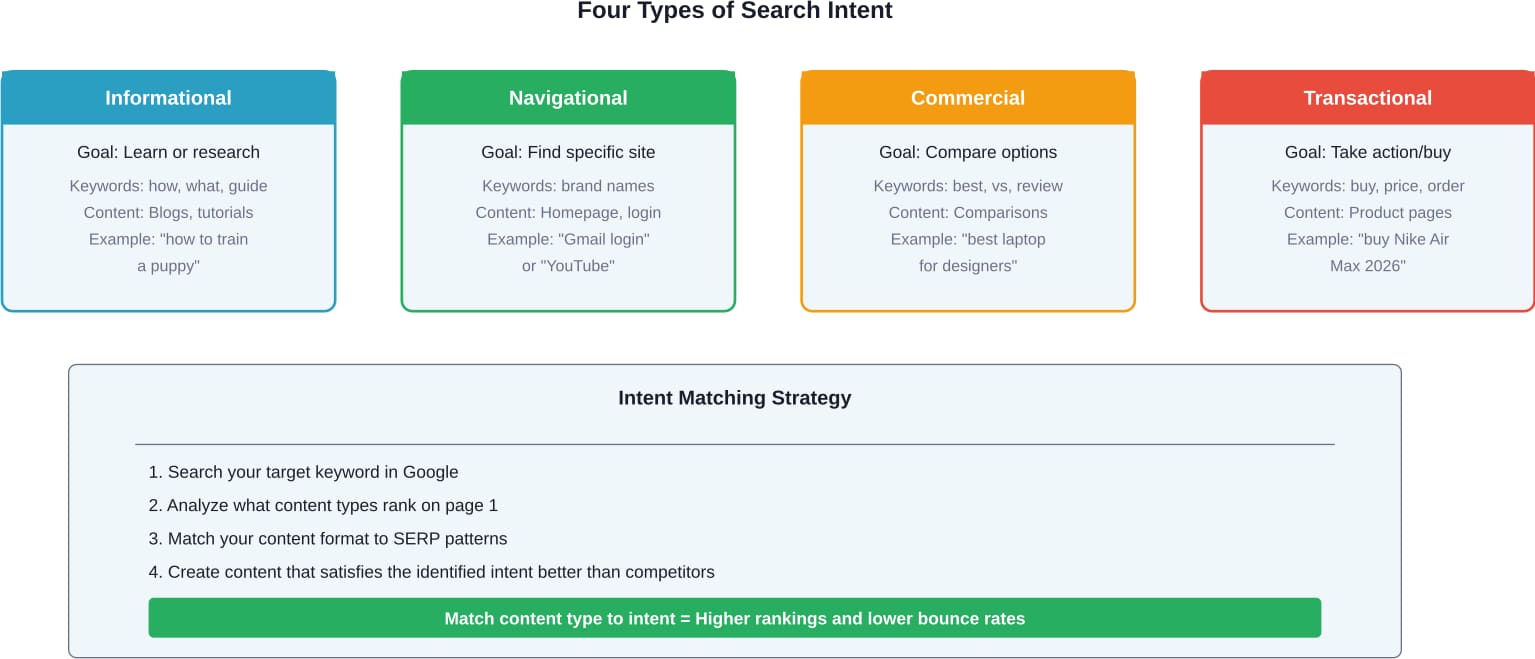
Four primary intent types exist: informational, navigational, commercial, and transactional.
Informational Intent
Users want to learn something or find an answer. They’re not ready to buy—they’re researching, exploring, or solving a problem.
Keywords like “how to bake sourdough bread,” “what is keyword research,” or “best practices for email marketing” signal informational intent. These searchers need guides, tutorials, explanations, or educational content.
Content types that satisfy informational intent include blog posts, how-to guides, tutorials, definitions, and comparison articles.
Navigational Intent
Searchers want to reach a specific website or page. They’re using search as navigation rather than discovery.
Queries like “Facebook login,” “Gmail,” or “Moz keyword tool” show navigational intent. Users already know where they want to go—they’re just using search to get there faster than typing a URL.
Ranking for navigational queries only makes sense if the target site is the destination users seek. Otherwise, these keywords waste resources.
Commercial Intent
Users are considering a purchase but haven’t decided yet. They’re comparing options, reading reviews, and evaluating features.
Terms like “best project management software,” “iPhone vs Samsung,” or “top-rated running shoes” indicate commercial research. These searchers sit in the consideration phase of the buying journey.
Content that serves commercial intent includes product comparisons, reviews, buyer’s guides, and “best of” lists with detailed evaluations.
Transactional Intent
Searchers are ready to complete an action—usually a purchase. They’ve decided what they want and seek where to get it.
Keywords containing “buy,” “price,” “coupon,” “order,” or specific product models signal transactional intent. “Buy iPhone 15 Pro Max,” “pizza delivery near me,” or “sign up for HubSpot” show users ready to convert.
Product pages, service landing pages, pricing pages, and sign-up forms satisfy transactional intent.
Verifying Intent Through SERP Analysis
The search results page reveals Google’s interpretation of intent. What types of content rank on page one?
If blog posts and guides dominate, Google determined informational intent. If product pages and e-commerce sites fill results, transactional intent is clear. If comparison sites and review platforms rank highest, commercial research intent is likely.
Community discussions note that matching content type to the SERP is critical. Creating a product page for an informational keyword, or a blog post for a transactional keyword, rarely succeeds because it conflicts with what Google already determined users want.
Step 6: Determine Business Value and Conversion Potential
Rankings don’t pay bills. Conversions do.
Keywords must connect to business outcomes. Traffic from terms that never convert wastes resources better spent on keywords that drive revenue.
Business value varies by keyword intent and position in the customer journey. Transactional keywords typically offer higher immediate value because searchers are ready to act. Informational keywords might generate lower direct conversions but build awareness and authority that produces sales over time.
Evaluating Commercial Value
Some keywords correlate more strongly with purchases than others. “Best email marketing software” shows higher purchase intent than “what is email marketing.” The first indicates active shopping, while the second suggests early-stage learning.
Consider whether the keyword topic connects to products or services offered. A keyword driving floods of traffic but for topics outside business offerings creates vanity metrics without returns.
Semrush provides CPC (cost-per-click) data for keywords, showing what advertisers pay for paid search traffic. Higher CPC values often indicate greater commercial value—advertisers invest more when keywords drive conversions.
Customer Journey Alignment
Map keywords to different funnel stages. Top-of-funnel keywords (informational) build awareness. Middle-of-funnel terms (commercial) nurture consideration. Bottom-of-funnel keywords (transactional) capture ready buyers.
Balanced keyword portfolios include all stages. Focusing only on transactional keywords limits reach to small audiences already shopping. Targeting only informational terms generates awareness without conversions.
Small businesses with limited resources should prioritize bottom and middle-funnel keywords that convert faster. Larger organizations with longer sales cycles can invest in top-funnel content that builds long-term authority.
Step 7: Prioritize and Create a Keyword Implementation Plan
Research produces overwhelming keyword lists. Hundreds or thousands of possibilities emerge from steps 1-6. Implementation requires prioritization.
Creating a keyword prioritization framework helps identify which terms deserve attention first.
Scoring Keywords for Priority
Build a simple scoring system evaluating each keyword across key dimensions:
- Search volume: Higher volume scores higher, but weight it appropriately. A keyword with 5,000 monthly searches might be more valuable than one with 50,000 if it’s highly targeted.
- Keyword difficulty: Lower difficulty scores higher. Prioritize winnable battles over aspirational targets.
- Business value: Rate how directly the keyword connects to revenue. Transactional terms score high. Tangentially related informational keywords score lower.
- Current ranking position: Keywords where the site already ranks positions 11-30 offer quick wins. Small improvements move them to page one.
- Intent match: Keywords where current capabilities align with searcher intent score higher. Don’t prioritize terms requiring content types or features the site can’t deliver.
- Assign numerical scores to each dimension (1-10 scale works well), then calculate total scores. Sort keywords by total score to identify top priorities.
Grouping Keywords by Topic
Related keywords should target the same page rather than creating separate content for each variant. Keyword clustering groups similar terms together.
For example, “how to choose keywords,” “keyword selection guide,” and “selecting SEO keywords” all address the same topic. One comprehensive page targeting all three variations performs better than three thin pages each targeting one term.
Tools like Semrush’s Keyword Strategy Builder help identify these clusters automatically. Manual grouping works by examining search results—if the same pages rank for multiple keywords, those terms cluster naturally.
Creating the Content Calendar
Transform prioritized keyword lists into production schedules. Assign target keywords to specific content pieces with realistic publication dates.
Quick wins—lower difficulty keywords where rankings already exist—should come first. These generate momentum and demonstrate ROI faster than long-shot competitive terms.
Balance content types across the plan. Include informational content, commercial comparisons, and transactional pages according to business needs and customer journey stages.
Set realistic production volumes. One exceptional piece weekly beats three mediocre posts. Google’s helpful content guidance emphasizes quality over quantity.
| Characteristics | Timeline | Resource Allocation |
|---|---|---|---|
| High Priority | Low-medium difficulty, high business value, strong intent match | Next 1-3 months | Best writers, maximum promotion |
| Medium Priority | Moderate difficulty, good volume, medium business value | 3-6 months | Standard production resources |
| Low Priority | High difficulty or low value, exploratory topics | 6-12 months | Minimal resources, test and learn |
| Watch List | Emerging trends, future opportunities, currently out of reach | 12+ months | Monitor only, revisit quarterly |
Strategic Keyword Placement in Content
Selecting the right keywords matters little if implementation is poor. Strategic placement helps search engines understand topical relevance without over-optimization.
Google’s ranking systems evaluate content comprehensively, according to their search ranking documentation. The algorithm assesses how well pages match query intent through semantic understanding, not just exact phrase matching.
Primary Keyword Placement
Include the main target keyword in these critical locations:
- Title tag: Place the keyword near the beginning of the page title. This carries strong ranking weight and affects click-through rates from search results.
- URL slug: Use the keyword in the page URL when possible. Keep it concise and readable.
- H1 heading: The main page heading should include the target keyword naturally.
- First 100 words: Introduce the topic using the keyword early in the opening paragraph.
- Subheadings: Include the keyword or close variations in some H2 and H3 headings where it fits naturally.
- Image alt text: Describe images using the keyword when relevant to the visual content.
- Meta description: While not a direct ranking factor, including the keyword here improves relevance in search snippets.
Natural Keyword Density
Forget rigid density formulas. Modern SEO focuses on natural language that serves readers first.
Use the primary keyword enough times that the topic is clear, but not so frequently that it disrupts reading flow. Generally speaking, 1-2% density works for most content—but natural writing matters more than hitting specific percentages.
Incorporate variations and related terms liberally. Semantic search means Google understands synonyms and related concepts. “Keyword research,” “keyword selection,” “choosing keywords,” and “finding keywords” all reinforce the same topic.
Avoiding Over-Optimization
Keyword stuffing—unnaturally cramming terms into content—triggers quality filters. Google’s spam update documentation notes that manipulative tactics face penalties.
Content should read naturally when spoken aloud. If keyword placement feels forced or repetitive, it probably crosses into over-optimization territory.
Focus on comprehensive topic coverage rather than keyword repetition. Content that thoroughly addresses user questions ranks better than thin content with perfect keyword placement.
Pick Keywords That Bring Buyers, Not Just Clicks
Keyword research is where SEO budgets get wasted fast – usually on terms that look good in a tool but don’t match how customers actually search. Lengreo publishes practical keyword guides focused on intent, long-tail terms, and mapping keywords to the right page type (category vs product vs blog), which is exactly what most sites need in 2026.
Ready to Turn Keyword Ideas Into a Simple Plan?
Talk with Lengreo to:
- build a keyword list based on intent (what people search before they buy, not just “high volume”).
- group keywords into topics and map them to the pages that should rank (service pages, categories, product pages, guides).
- set realistic priorities so you know what to target first and what can wait.
👉 Start with a free consultation from Lengreo and get a quick keyword scope: priorities, target pages, and a monthly cost range.
Common Keyword Selection Mistakes to Avoid
Even experienced SEO practitioners make keyword selection errors that undermine campaigns.
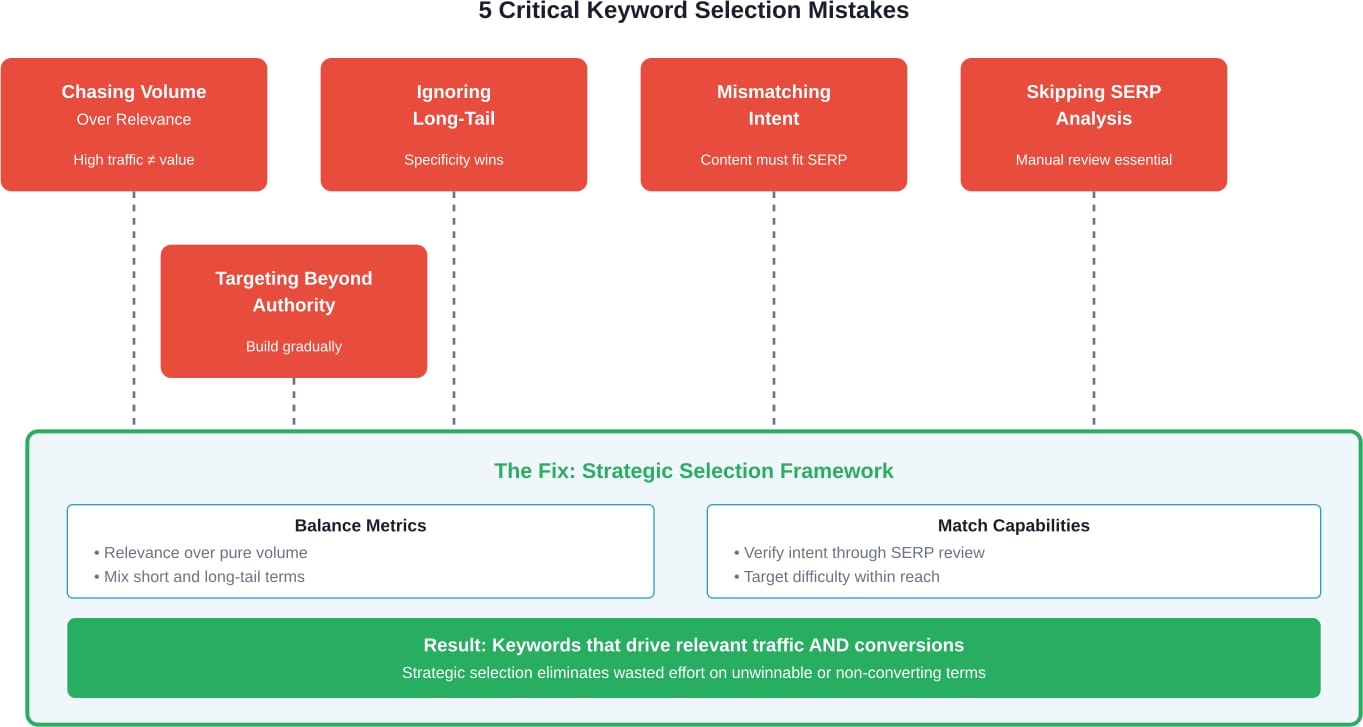
Chasing Volume Over Relevance
High search volume tempts keyword selection, but traffic without conversions wastes effort. A keyword with 100,000 monthly searches means nothing if visitors bounce immediately because content doesn’t match their needs.
Relevance beats volume. Target terms that align with offerings and audiences rather than chasing popular keywords loosely connected to the business.
Ignoring Long-Tail Opportunities
Broad single-word keywords face massive competition and vague intent. Long-tail phrases—three or more words—offer better opportunities for most sites.
Long-tail keywords collectively drive substantial traffic. According to Moz research on keyword metrics, many low-volume keywords together often generate more total traffic than a few high-volume terms—and convert better due to specificity.
Mismatching Content to Intent
Creating blog posts for transactional keywords, or product pages for informational searches, guarantees failure. The SERP reveals what Google determined users want—contradicting that interpretation rarely succeeds.
Always verify intent before committing resources to content creation.
Neglecting Competitive Analysis
Keyword difficulty scores provide estimates, but manual competitive review reveals whether ranking is feasible. Some low-difficulty keywords still prove impossible to rank for when examining actual competitor authority and content quality.
Check who’s ranking, evaluate their resources, and honestly assess whether creating better content is realistic.
Targeting Keywords Beyond Current Authority
New sites can’t immediately compete for highly competitive terms. Build authority gradually by ranking for easier keywords first, then expand to more difficult targets as domain strength grows.
Set realistic keyword targets matching current site authority. Aspirational goals waste resources that could win achievable battles.
Tools for Effective Keyword Research
Manual keyword research is practically impossible at scale. Tools accelerate the process by surfacing data and opportunities human analysis would miss.
Comprehensive Research Platforms
- Semrush offers extensive keyword databases covering 142 Google search engines according to their Keyword Explorer documentation. The platform provides search volume, keyword difficulty, CPC data, and intent classification. Pricing varies—check their official site for current plans.
- Ahrefs includes powerful keyword research through Keywords Explorer, showing search volumes, difficulty scores, and related keyword suggestions. The tool also provides click-through rate estimates showing what percentage of searches result in clicks.
- Moz Keyword Explorer features 1.25 billion keyword suggestions and 180 million ranking keywords according to their tool documentation. Moz offers both free limited access and paid plans.
Free Keyword Research Options
- Google Keyword Planner provides search volume data directly from Google, though it shows ranges rather than exact numbers for users without active ad campaigns. It’s free but requires a Google Ads account.
- Google Search Console reveals keywords already driving traffic to existing content. The Performance report shows which queries trigger impressions and clicks, identifying opportunities to optimize current rankings.
- Answer the Public visualizes question-based searches around topics. It’s useful for identifying informational content opportunities.
Specialized Research Tools
For YouTube SEO, standard keyword tools provide limited value since search patterns differ between YouTube and Google. Specialized YouTube keyword tools like Keyword Analytics for YouTube are designed for video search optimization.
For local businesses, tools incorporating location-based search data matter more than global volumes. Most major platforms allow filtering by geographic regions.
Monitoring and Refining Keyword Strategy
Keyword selection isn’t a one-time task. Search behavior evolves, competition changes, and algorithm updates shift ranking possibilities.
Regular monitoring identifies what’s working and what needs adjustment.
Tracking Keyword Rankings
Monitor positions for target keywords weekly or monthly. Ranking improvements indicate successful optimization. Declining positions signal increased competition or algorithm changes requiring response.
Most SEO platforms include rank tracking features. Google Search Console provides basic ranking data through average position metrics.
Track more than just positions—monitor impressions, clicks, and click-through rates. A keyword ranking position 5 with 2% CTR underperforms compared to position 7 with 5% CTR due to compelling title and meta description.
Analyzing Traffic and Conversions
Rankings without conversions indicate misalignment somewhere in the funnel. Review landing pages for keywords driving traffic but not converting. Does the content satisfy intent? Is the conversion path clear?
High bounce rates on keyword landing pages suggest intent mismatch or poor content quality. Low time-on-page indicates visitors aren’t finding value.
Conversion tracking reveals which keywords drive business outcomes. Prioritize continued investment in high-converting terms while reconsidering keywords that generate traffic without results.
Refreshing Keyword Lists
Revisit keyword research quarterly. New opportunities emerge as topics trend, competition shifts, and site authority grows.
Previously unattainable high-difficulty keywords become possible targets as domain authority increases. Regularly reassess aspirational terms to identify when they enter realistic range.
Search trends change over time. Research on keyword metrics shows that approximately 10% of keywords studied had total click-through rates under 20%, meaning the vast majority of people clicked on nothing for those searches.
Monitor for these shifts and adjust strategy accordingly. Some keywords lose value even if rankings hold steady.
Conclusion: Strategic Keyword Selection Drives SEO Success
Choosing keywords isn’t about guessing what might work. It’s systematic analysis balancing search demand, competition reality, intent alignment, and business value.
The seven-step process outlined here—generating seeds, expanding with tools, evaluating metrics, assessing difficulty, matching intent, determining value, and prioritizing—creates keyword strategies grounded in data rather than hope.
Most SEO failures trace back to keyword selection errors. Targeting terms beyond current authority, chasing volume over relevance, or mismatching content to intent wastes resources that could win achievable battles.
Google’s ranking systems, as documented in their search guidance, prioritize helpful content created for people rather than algorithms. That means keyword selection must start with understanding what information target audiences need, then identifying terms they use when seeking it.
Start keyword research today using the framework outlined here. Generate seed keywords, expand them through research tools, filter by metrics, verify intent through SERP analysis, and build a prioritized implementation plan. Each piece of content created around well-selected keywords moves closer to rankings that drive measurable business outcomes.
The difference between SEO success and failure often comes down to choosing the right battles. Select keywords strategically, and everything else becomes easier.