


Brand marketing is the disciplined process of shaping how target audiences perceive and connect with a company over time. Unlike product-focused campaigns, it promotes the entire identity: values, personality, and promise. When executed consistently, it creates measurable advantages in customer loyalty, pricing power, and market position.
Why Brand Marketing Still Matters in Digital Channels
Most buying decisions begin with familiarity and trust rather than feature comparison. Consistent brand exposure across channels reduces perceived risk and shortens sales cycles. Companies that invest systematically in brand-building activities typically see higher long-term returns than those relying only on performance marketing.
How Lengreo Applies Brand Marketing Strategies in Practice
At Lengreo, we see brand marketing not as a separate exercise but as the foundation that amplifies every other tactic we deploy for clients. Over the years, we’ve helped companies across tech, architecture, and biotech sectors build identities that resonate deeply with B2B decision-makers. This starts with auditing their current brand perception and crafting strategies that align purpose with market positioning, ensuring that every SEO campaign, paid ad, or outreach effort reinforces a consistent story. For instance, when we partner with a software development firm, we don’t just optimize keywords; we weave their core values into content that positions them as the reliable innovator in a crowded field.
Our approach emphasizes integration: brand strategies become the guardrails for demand generation and social media efforts, turning one-off leads into loyal advocates. We’ve seen this play out in real campaigns. It’s straightforward work, but it requires listening closely to what makes a brand tick, then scaling that authenticity across channels without losing the human edge. In our experience, brands that invest here early avoid the trap of generic messaging and start seeing compounding returns in trust and conversions.
Step 1 – Establish Clear Brand Foundations
No brand marketing strategy survives contact with reality unless the internal foundation is rock solid. Teams waste months and budgets when leadership has not agreed on who the company actually is and why it matters. The first step is therefore non-negotiable internal work that produces four deliverables every organization must own.
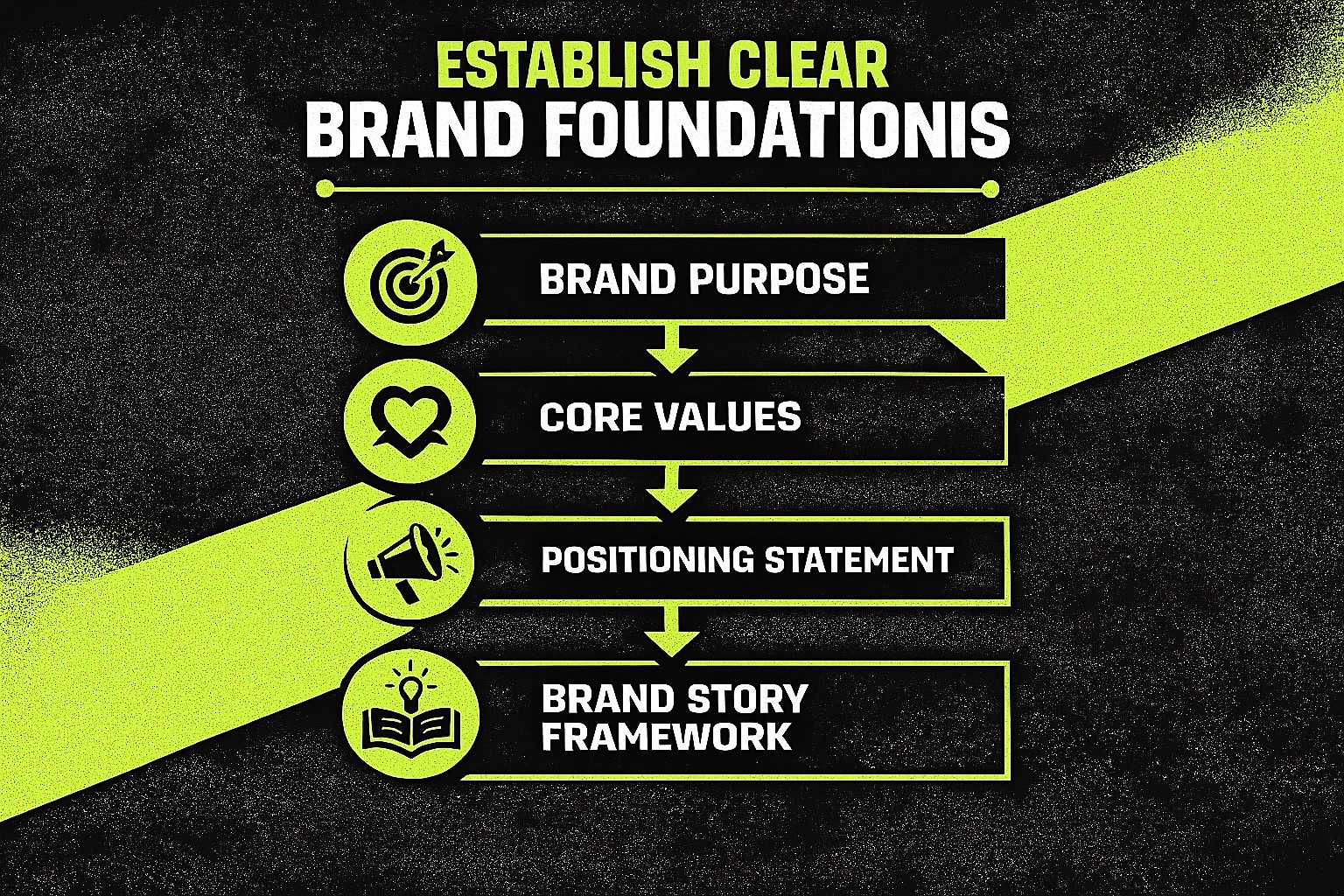
Brand Purpose and Mission
Purpose answers the question of why the company should exist in the world beyond making money. It is the single sentence that survives every board meeting, product pivot, and market crash. A strong purpose connects customer needs with the company’s deeper capability and gives every employee a decision filter. Companies that skip this step end up with interchangeable messaging that competes on price alone.
Core Values and Personality
Values are the short list of principles the company refuses to compromise on, even when it costs revenue in the short term. They show up in hiring criteria, vendor selection, and crisis response. Personality translates those values into a recognizable human tone: professional yet approachable, bold and irreverent, minimalist and precise, or any other consistent character. Without documented personality attributes, copywriters and designers guess, and the brand voice drifts within weeks.
Positioning Statement
The positioning statement is an internal one- or two-sentence declaration that defines the target customer, the category the company competes in, the primary benefit delivered, and the proof or reason to believe. It never appears verbatim in advertising, but every piece of communication must pass the test of supporting it. Strong positioning prevents feature creep in campaigns and keeps the company from chasing every trending channel.
Brand Story Framework
A coherent brand story contains origin moments, obstacles overcome, guiding beliefs, and the future the company wants to create for customers. The framework is built in layers: a 15-second elevator version, a one-minute video version, a full about-page version, and an extensible campaign version. When the story framework exists, new content creators do not invent conflicting narratives and the brand accumulates meaning over time instead of starting from zero with every launch.
Step 2 – Deep Audience Understanding
Targeting everyone guarantees connection with no one. The second step moves from internal alignment to external precision by building a research-backed view of the people the brand actually serves.
Primary and Secondary Personas
Primary personas represent the core revenue-generating segments. Each persona document lists job titles, daily pressures, success metrics, information sources, and decision triggers. Secondary personas cover adjacent groups such as influencers, referral partners, or future growth segments. These documents become the single source of truth for creative briefs and media plans.
Customer Journey Mapping per Segment
Different personas travel different paths to discovery, consideration, purchase, and advocacy. Mapping reveals which touchpoints carry the heaviest brand-building load. For one segment the decisive moment may be a technical whitepaper, for another it is a peer recommendation on a niche community. The map dictates budget allocation far better than average industry benchmarks.
Voice-of-Customer Research Integration
Direct customer language beats invented marketing copy every time. Ongoing interviews, post-purchase surveys, support ticket analysis, and review mining produce a living library of phrases customers already use to describe their problems and aspirations. Creative teams reference this library to craft messages that feel familiar rather than salesy. The result is higher relevance from the first exposure and faster trust accumulation.
Step 3 – Build the Visual and Verbal Identity System
Recognition is built through repetition of the same signals. The moment a customer sees an asset and instantly knows which brand it belongs to, the identity system is doing its job. A fragmented visual or verbal approach forces the audience to relearn the brand with every exposure and destroys equity.
Visual Identity Components
The visual system must work flawlessly from favicon size to billboard. Every element is specified so that internal teams and external agencies produce consistent output without constant supervision.
- Logo variations and clear space rules: primary mark, secondary mark, monochrome versions, minimum size, exclusion zones
- Color palette with primary, secondary, and accent codes: exact Pantone, CMYK, RGB, and HEX values plus accessibility contrasts
- Typography hierarchy for digital and print: headline, subhead, body, caption, and UI font pairings with weights and usage rules
- Photographic style and illustration guidelines: direction, cropping, color treatment, subject matter dos and donts
- Iconography and graphic element library: stroke weights, corner radius, grid system, and approved supporting graphics
Verbal Identity Components
Verbal identity prevents tone drift and ensures the brand sounds like one coherent entity across website copy, social captions, customer support scripts, and paid ads.
- Tone of voice descriptors and examples: three to five adjectives with positive and negative reference sentences
- Key messaging pillars: core statements that must appear in major communications
- Approved taglines and boilerplate copy: exact phrasing for different contexts and lengths
- Common phrases to avoid: overused industry jargon, competitor language, or expressions that clash with personality
The complete system lives in an accessible brand portal or living style guide that receives version control and automatic update notifications. New team members and agency partners receive access on day one.
Step 4 – Develop the Long-Term Brand Marketing Strategy
Short-term campaign thinking produces spikes followed by silence. Sustainable brand growth requires a multi-year backbone that gives every tactical activation a larger context.
Multi-Year Brand Platform
The platform is a single creative idea strong enough to generate multiple campaigns yet narrow enough to remain ownable. It functions as the red thread that connects seasonal work, product launches, and crisis response without feeling repetitive. Companies that change platforms every year restart equity accumulation from zero.
Channel Mix and Role Definition
Not every channel needs to carry the same message or KPI. The strategy explicitly assigns roles: some channels exist for reach and familiarity, others for consideration depth, and a few focus purely on loyalty reinforcement. Budget follows role instead of chasing whichever channel shows the lowest cost per click this quarter.
Campaign Types in the Mix
A balanced portfolio contains several repeating formats that compound over time:
- Always-on brand presence layers: signature content series, profile optimization, and baseline paid support
- Seasonal platform extensions: expected moments where the brand shows up with refreshed execution of the core idea
- Cultural moment activations: fast-turnaround responses that stay within platform boundaries
- Partnership and co-branding initiatives: collaborations that extend reach while protecting identity
- Community and ownership-building programs: initiatives that turn customers into active participants rather than passive viewers
This structure creates rhythm: the audience knows when to expect signature work while still encountering surprise within familiar boundaries. The result is faster recognition and stronger association strength year after year.
Step 5 – Execution Tactics That Scale Recognition
Strategy without disciplined execution remains theoretical. The following tactics are the ones that actually move brand metrics when maintained over multiple years.
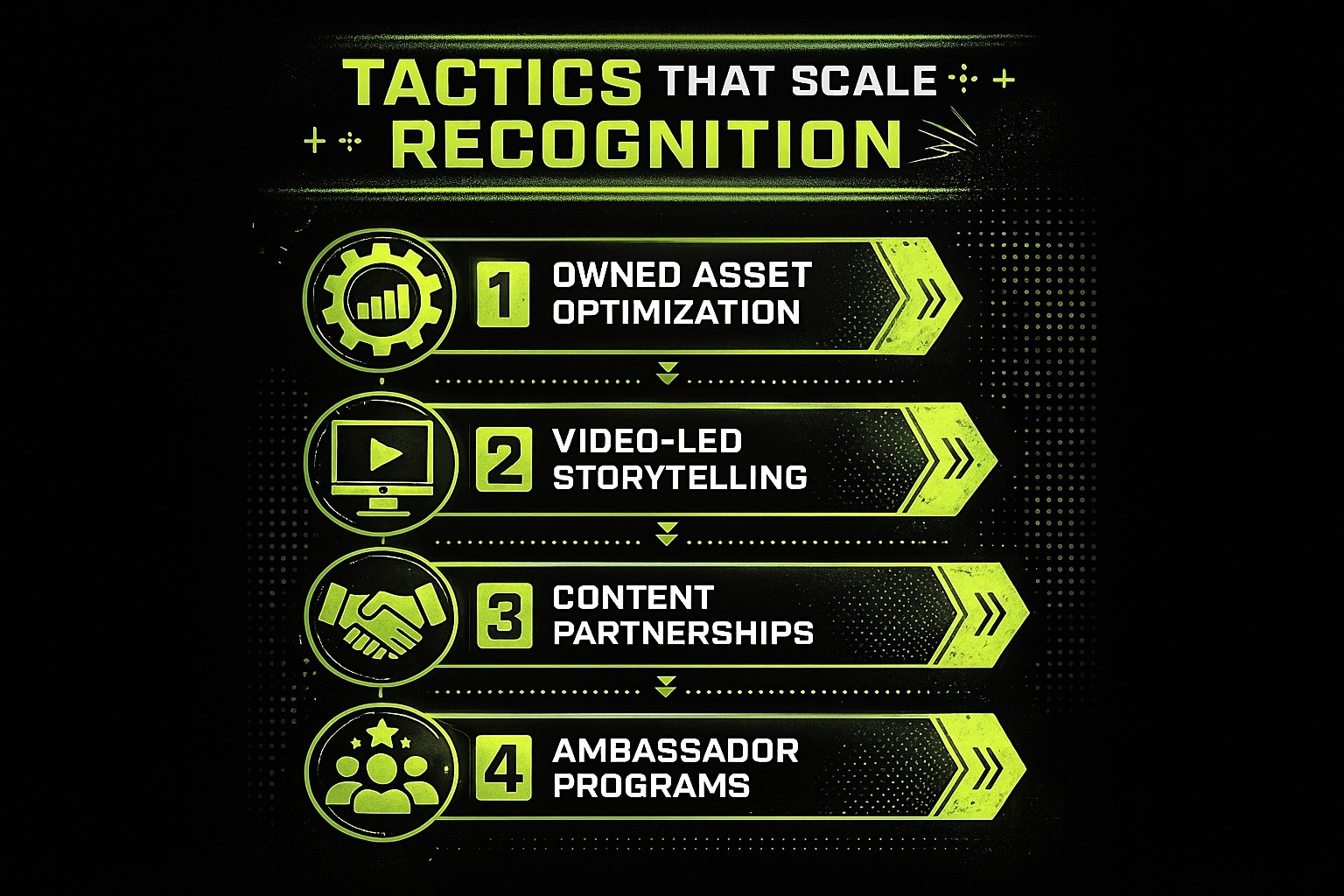
Owned Asset Optimization
Owned properties are the only channels where the brand controls every pixel and word. The homepage, career page, resource library, and social profiles function as permanent brand assets. Regular content updates, technical SEO maintenance, and internal linking structures keep these assets ranking and converting passively. Companies that treat owned channels as set-and-forget lose ground to competitors who refresh signature content quarterly.
Video-Led Brand Storytelling
Video remains the highest-impact format for emotional connection and message retention. A structured video program contains three layers: short vertical assets for daily presence, mid-length explanatory pieces that live on YouTube and the resource center, and long-form documentary-style content for deeper consideration stages. Distribution combines owned uploads, targeted paid social promotion, and selective partner channel placements. The same core platform idea runs through every format so that even a six-second clip reinforces the larger brand narrative.
Strategic Content Partnerships
Earned placements in industry publications, podcasts, and third-party video channels deliver credibility that paid media cannot buy. The approach requires a clear partnership brief that specifies acceptable topics, tone boundaries, and visual requirements. Each placement is treated as an extension of the owned content program rather than one-off exposure. Over time, these contributions build a visible trail of authority that search engines and human audiences both reward.
Influencer and Ambassador Programs
Third-party voices accelerate trust transfer. The most efficient programs focus on micro-influencers and existing customers who already use and understand the brand. Contracts emphasize creative freedom within defined brand safety rails rather than scripted talking points. User-generated content from these relationships is repurposed across owned channels, creating a flywheel where authentic advocacy feeds the main brand narrative at lower cost than produced advertising.
Conclusion
Brand marketing strategies require upfront investment in identity and research, followed by disciplined execution across years. The payoff appears in sustained customer preference, reduced acquisition costs, and resilience during market downturns. Companies that treat brand building as a core business process rather than occasional campaign activity consistently outperform those focused solely on short-term conversion.