


B2B SEO isn’t about chasing clicks for the sake of it. When you’re trying to reach decision-makers, what matters isn’t volume – it’s intent, timing, and trust. A good B2B SEO strategy does more than boost rankings. It attracts the right people at the right stage of their journey and helps sales start warmer.
In this guide, we’ll walk through practical, step-by-step strategies that are grounded in how B2B buyers actually behave online. You won’t find vague theories or fluff, just the things that move the needle when your goal is leads, not likes.
Why Most B2B SEO Efforts Underperform
Before getting into strategy, it helps to understand why so many B2B SEO initiatives stall.
The most common problems are not technical. They are strategic.
Many teams copy B2C playbooks and expect them to work in a B2B context. Others chase high-volume keywords that look impressive but attract the wrong audience. Some publish content regularly but never connect it to how buyers actually make decisions.
A few patterns show up again and again:
- SEO goals are disconnected from sales goals.
- Keyword research ignores buyer intent and funnel stage.
- Content explains features instead of solving business problems.
- Technical SEO is treated as a one-time checklist.
- Performance is measured in traffic, not lead quality or revenue.
B2B SEO works best when it is treated as a growth system, not a publishing schedule or a ranking contest.
What Makes B2B SEO Different in Practice
On paper, search engines do not treat B2B and B2C sites differently. The algorithm does not know if you sell sneakers or enterprise software.
In practice, everything else is different.
B2B buyers are researching on behalf of organizations. They are cautious. They are comparing options. They often need internal approval. They care about credibility and proof more than excitement.
This reality shapes every part of a B2B SEO strategy.
In B2B SEO, search intent is usually driven by problems that need solving, not quick or emotional decisions. The keywords people use tend to be more specific and often come with lower search volume, but much higher intent. Content also has to work harder – it needs real depth, clear explanations, and enough authority to earn trust.
On top of that, sales cycles are typically longer and rarely follow a straight line, which changes how you think about timing and touchpoints. And instead of pushing for instant purchases, most conversions start as conversations that develop over time.
If your SEO does not account for these differences, it will struggle to produce meaningful results.
How We Approach B2B SEO in Real Client Work at Lengreo
At Lengreo, we see B2B SEO as part of a bigger system, not a standalone tactic. Search visibility only matters if it supports lead quality, sales conversations, and long-term growth. That is why our work usually starts with understanding how a client actually wins deals – who is involved in decisions, how long the sales cycle is, and what questions buyers ask before they ever reach out. SEO, for us, is built around those answers, not around generic keyword lists or traffic goals.
Our B2B SEO process is tightly connected to strategy, content, and demand generation. We focus on finding search opportunities with real commercial intent, often in less crowded niches, and then support them with content that explains, compares, and clarifies rather than oversells.
This includes in-depth keyword research, structured content planning, technical optimization, and link building that makes sense for specific industries like SaaS, software development, biotech, or cybersecurity. The goal is always the same – attract people who are actively researching solutions and help them move one step closer to a decision.
How to Build a B2B SEO Strategy That Actually Works
Let’s be honest: most B2B SEO guides either overcomplicate the process or skim over the parts that actually matter. What you need is a clear roadmap built around how your buyers think, search, and make decisions. It’s not about pumping out blog posts or stuffing keywords onto your homepage. It’s about showing up where your prospects are looking and giving them what they need to move forward.
Below is a practical breakdown of the essential steps for creating an SEO strategy that’s worth your team’s time and that actually leads to results.
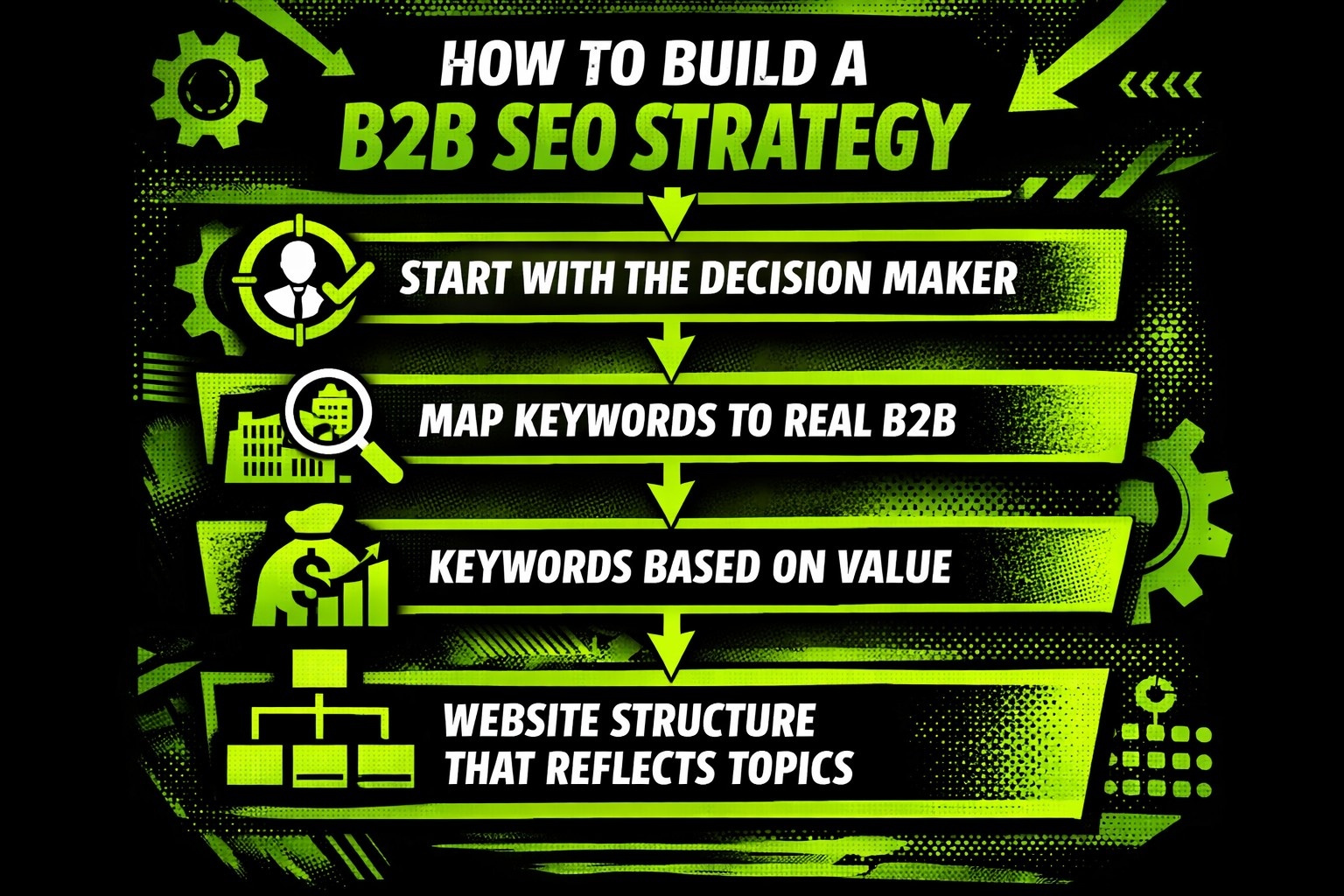
Step 1: Start With the Decision Maker, Not the Keyword
B2B SEO starts with people, not tools.
Before researching keywords, you need to understand who is actually involved in buying what you sell. In many B2B businesses, there is more than one decision maker. There may be a technical evaluator, a financial approver, and an operational user.
Each of these roles searches differently.
A technical lead may search for implementation details. A founder may search for outcomes and ROI. A manager may search for comparisons or alternatives.
Instead of creating one generic persona, map out the key roles involved and answer a few practical questions for each:
- What problem are they responsible for solving?
- What risks are they trying to avoid?
- What language do they use when researching?
- What information would help them justify a decision internally?
This exercise keeps your SEO grounded in reality and prevents you from optimizing for keywords no real buyer uses.
Step 2: Map Keywords to the Real B2B Buying Journey
One of the biggest mistakes in B2B SEO is treating all keywords the same.
In reality, keywords reflect stages of awareness and intent. A person searching for a definition is in a very different mindset than someone searching for pricing or comparisons.
A simple way to structure this is to group keywords into three stages.
Awareness Stage
At this point, people aren’t searching for a solution yet. They’re trying to understand a problem or confirm that one even exists. You’ll see searches like how to reduce operational costs, signs of poor data security, or why customer churn increases. These keywords usually don’t convert right away, but they’re important because they help you show up early, earn trust, and start the conversation before competitors enter the picture.
Consideration Stage
Now the buyer knows what kind of issue they’re facing, and they’re weighing their options. This is when queries get more specific and centered around solutions. People might be looking into CRM software for mid-size companies, comparing cloud vs on-premise security options, or reading up on different marketing automation tools. Content that explains, compares, or breaks down trade-offs tends to work best here, especially when it helps the reader feel more confident about moving forward.
Decision Stage
Here’s where intent becomes unmistakable. The searcher is ready to act and just needs clarity on pricing, fit, or final features. You’ll find queries like [product] pricing, [product] vs [competitor], or something direct like enterprise SEO agency cost. This is where your landing pages need to do the heavy lifting with tight messaging, clear calls to action, and zero fluff. The goal is to make it easy for someone to say, “Yep, this is what I need.”
A strong B2B SEO strategy covers all three stages and connects them logically through internal linking and content flow.
Step 3: Choose Keywords Based on Value, Not Volume
In B2B SEO, search volume is often misleading.
Many high-value B2B keywords receive limited monthly searches. That does not make them unimportant. It often makes them more valuable.
A keyword searched by 30 people a month can outperform a keyword searched by 3,000 if those 30 people are qualified buyers.
When evaluating keywords, prioritize:
- Clear relevance to what you sell.
- Specific language that signals intent.
- Commercial value reflected in CPC or competition.
- Fit with your expertise and offering.
Volume matters only after relevance and intent are established.
Step 4: Build a Website Structure That Reflects Topics, Not Pages
B2B websites often grow organically over time. New pages are added for campaigns, features, or announcements. Without structure, the site becomes hard to navigate for both users and search engines.
A more effective approach is topic-based structure.
Instead of isolated pages, organize content into clusters built around core themes. Each cluster includes one primary pillar page covering the main topic, supporting pages that explore subtopics in depth, and clear internal links connecting everything logically.
This structure helps search engines understand topical authority and helps users find related information without friction.
It also makes ongoing content creation easier, since every new piece has a clear place in the system.
Step 5: Create Content That Earns Trust, Not Just Clicks
Content is where B2B SEO succeeds or fails.
Publishing regularly is not enough. The content needs to reflect how B2B buyers think and what they need to move forward.
High-performing B2B content tends to share a few traits.
It Goes Deep
Surface-level explanations rarely work in B2B. Buyers want detail, context, and nuance. They want to understand tradeoffs, limitations, and real-world implications.
Depth builds confidence.
It Focuses on Problems Before Products
Feature-first content reads like a sales pitch. Problem-first content reads like guidance.
Explain the issue. Show the consequences. Then introduce solutions naturally.
It Matches the Buyer Stage
An awareness-stage reader does not want a demo pitch. A decision-stage reader does not want a broad overview.
Tailor tone, depth, and CTAs accordingly.
It Sounds Human
Professional does not mean stiff. Clear, conversational writing builds more trust than formal jargon-heavy language.
Good B2B content feels like advice from someone who understands the problem, not marketing copy.
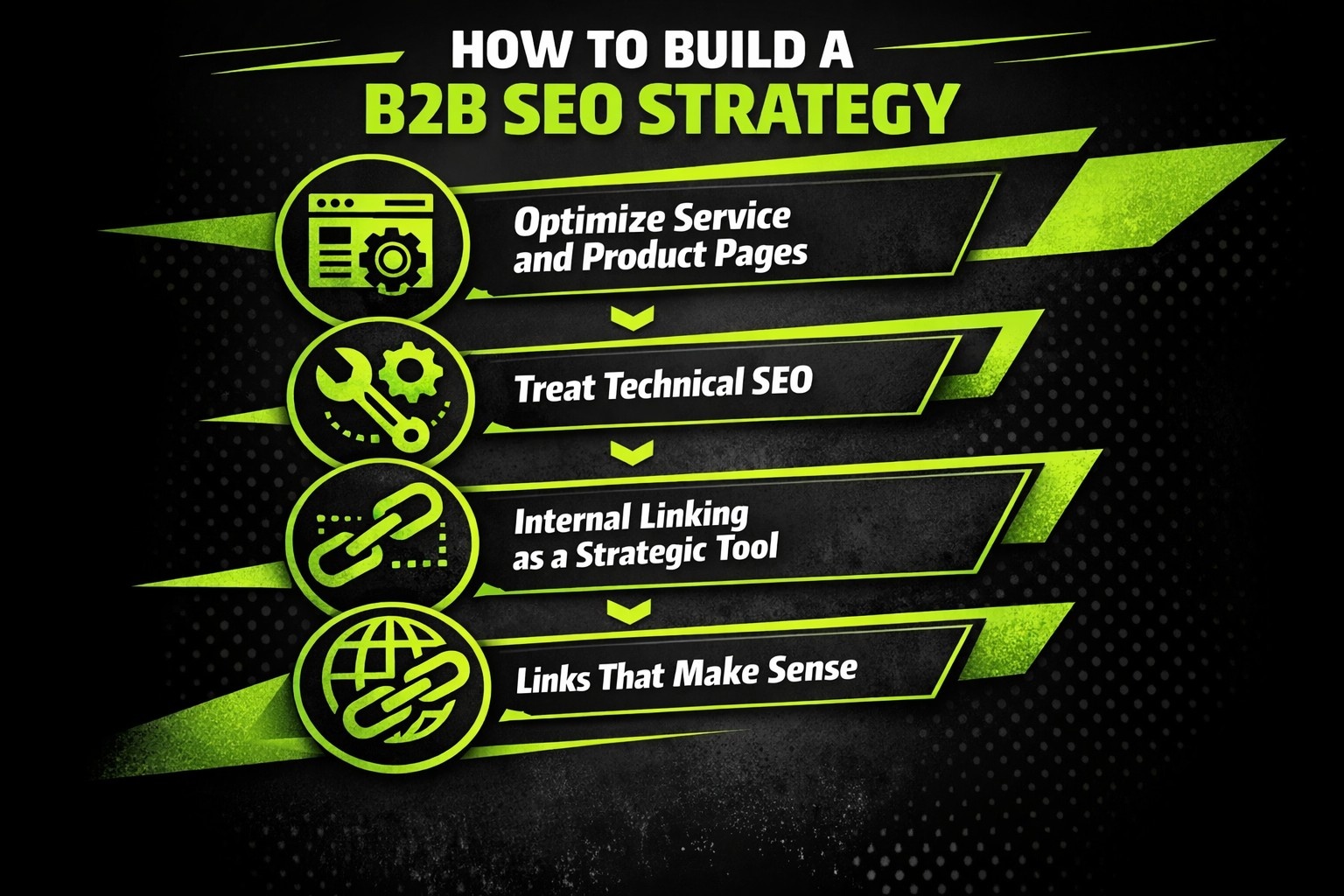
Step 6: Optimize Service and Product Pages for Real Intent
B2B service pages are often under-optimized or over-designed.
Some are too thin to rank. Others are visually impressive but vague. The goal is balance.
Effective B2B landing pages typically include:
- A clear explanation of who the service is for.
- The problems it solves and outcomes it delivers.
- How it works in practical terms.
- Proof points such as examples, results, or testimonials.
- Clear next steps for different readiness levels.
From an SEO perspective, each page should focus on one primary intent-driven keyword and support it with related terms naturally.
Avoid keyword stuffing. Clarity always wins.
Step 7: Treat Technical SEO as Ongoing Maintenance
Technical SEO is not a one-time project. Especially for B2B sites, it requires regular attention.
Complex navigation, gated content, resource libraries, and international pages all introduce technical challenges.
Key areas to monitor consistently include:
- Crawlability and indexation.
- Page speed and core web vitals.
- Mobile usability.
- Duplicate or thin content.
- Redirects and broken links.
Technical issues rarely kill SEO overnight, but they quietly limit performance over time if ignored.
Step 8: Use Internal Linking as a Strategic Tool
Internal linking is one of the most overlooked levers in B2B SEO.
Done well, it serves three purposes. Firstly, it helps users navigate complex information. Secondly, it signals priority pages to search engines. Thirdly, it moves authority toward high-value pages.
Link intentionally. Connect blog content to service pages where relevant. Reinforce pillar pages through consistent internal references.
Avoid random links. Every link should have a reason.
Step 9: Build Links That Make Sense for B2B
B2B link building is not about volume. It is about relevance and credibility.
The most effective B2B backlinks usually come from:
- Industry publications and niche blogs.
- Partners and integrations.
- Original research or data assets.
- Tools, calculators, or frameworks.
- Earned media and expert commentary.
Links that reflect real relationships and expertise tend to be more durable and more valuable than mass outreach links.
Step 10: Measure What Actually Matters
B2B SEO performance should be evaluated through a business lens, not just an SEO dashboard.
Rankings and traffic are signals. They are not outcomes.
Metrics that matter more include organic leads generated, lead quality and sales qualification, contribution to pipeline and revenue, cost per acquisition compared to other channels, and engagement with high-intent pages.
Connecting SEO data with CRM and sales insights closes the loop and keeps strategy grounded in results.
How to Keep B2B SEO From Becoming Busywork
The biggest risk in B2B SEO is losing focus.
When teams chase every trend, publish without purpose, or optimize without strategy, progress slows.
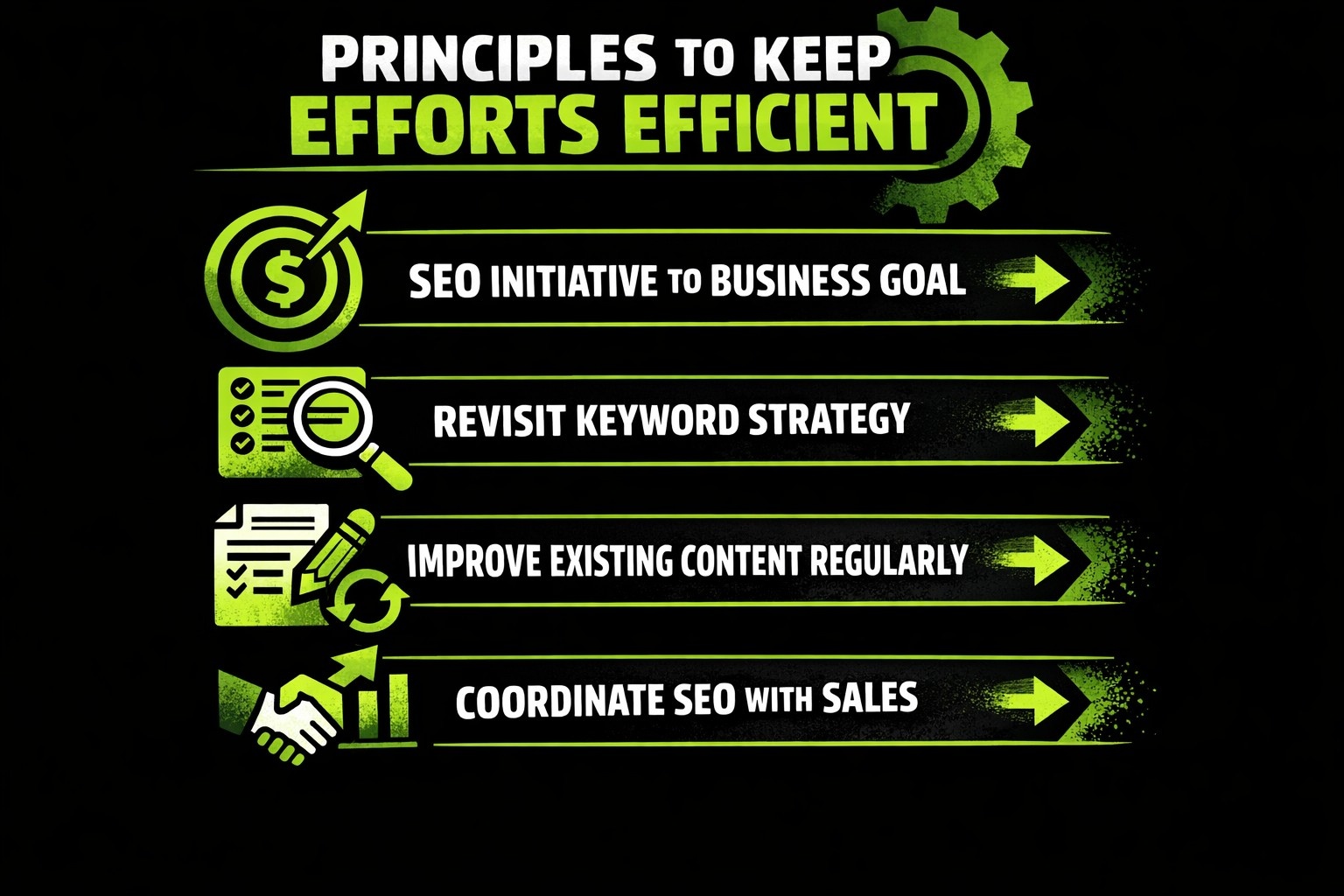
A few principles help keep efforts efficient:
- Tie every SEO initiative to a business goal.
- Revisit keyword strategy as the market evolves.
- Update and improve existing content regularly.
- Coordinate SEO with sales and demand generation.
- Be patient, but not passive.
B2B SEO rewards consistency, clarity, and relevance. It punishes shortcuts and noise.
Final Thoughts
B2B SEO does not need to be complicated, but it does need to be intentional.
When done right, it becomes one of the most reliable sources of qualified demand a business can build. It supports sales, strengthens brand authority, and compounds over time.
The strategies outlined here focus on what actually works in B2B environments. They prioritize decision makers, intent, and trust over vanity metrics and busy activity.
If your SEO strategy respects how B2B buyers think and buy, it will not waste your time.