


Overview: Links remain a critical ranking factor in 2026, with 96% of Google’s top 10 results having 1,000+ backlinks from unique domains. While Google’s algorithms increasingly prioritize content quality and user experience, links still signal authority, help discovery, and drive rankings—especially when combined with strong content strategies.
Every few months, someone declares that links are dead. Backlinks don’t matter anymore, they say. Content is king now. Google’s gotten too smart for links.
But here’s the thing—the data tells a completely different story.
According to a study published by Search Engine Land in June 2024, over 96% of websites ranking in Google’s top 10 positions have more than 1,000 backlinks from unique domains. Only 0.3% had less than 100 backlinks, and none had 50 links or less. That’s not a marginal difference. That’s overwhelming evidence that links still drive rankings.
Google’s own documentation confirms that their automated ranking systems look at “many factors and signals” to rank content, and links have been fundamental to those systems since Google’s PageRank algorithm concept was documented in patents dating back to 1998-2005. While algorithms evolve, the core principle remains: links represent votes of confidence from one site to another.
So why the confusion? Because Google has gotten better at identifying quality. Low-quality link schemes don’t work anymore. But high-quality, relevant links? They’re more valuable than ever.
Why Links Continue to Dominate as a Ranking Factor
Links aren’t just another ranking signal. They’re foundational to how search engines work.
When Google’s PageRank algorithm concept was documented in patents dating back to 1998-2005, it introduced a revolutionary concept: the importance of a document could be calculated from the ranks of documents citing it. This wasn’t arbitrary—it was mathematical, inspired by academic citation networks.
That core principle hasn’t disappeared. It’s been refined, sure. Google now evaluates link quality, relevance, and context far more sophisticatedly than in 1998. But the fundamental truth remains unchanged: links help search engines determine which pages deserve to rank.
According to industry surveys cited by Another Concept, 82% of SEOs believe that links have a positive effect on rankings. That’s not speculation—that’s based on real campaign results across thousands of websites.
What Makes a Link Valuable in 2026
Not all links carry equal weight. Google’s systems evaluate multiple properties to determine link value:
| Link Property | Impact on Value | Why It Matters |
|---|---|---|
| Source Authority | High | Links from established, trusted domains pass more ranking power |
| Relevance | High | Links from topically related sites signal contextual authority |
| Anchor Text | Medium | Descriptive anchor text helps search engines understand page topics |
| Link Placement | Medium | Editorial links within content carry more weight than footer/sidebar links |
| NoFollow Attribute | Variable | NoFollow links don’t pass ranking signals, though Google may still use them for discovery |
According to Moz research, approximately 3% of all links on the web are nofollowed, with more than half of these nofollowed links appearing on internal rather than external links. These links tell search engines not to pass editorial endorsements or ranking signals—though they may still drive traffic and visibility.
How Links Help Search Engines Discover and Index Content
Before a page can rank, it needs to be discovered. And links are the primary mechanism for that discovery.
Google’s crawlers follow links from page to page, building a massive index of the web. When a new page gets linked from an existing indexed page, crawlers find it faster. Pages buried deep in a site’s architecture without strong internal or external links may never get crawled at all.
This is why new websites struggle initially. Without an established link profile, crawlers visit less frequently. Building even a modest set of quality backlinks accelerates this discovery process significantly.
Google’s documentation on ranking systems emphasizes that their automated systems look at “hundreds of billions of web pages” to present relevant results. Links are the connective tissue that makes this massive index navigable.
Strengthen Your Link Strategy With Clear Priorities
Links remain a ranking factor, but quality and relevance matter more than volume. Lengreo evaluates your backlink profile and identifies gaps compared to competitors. The focus is on sustainable link acquisition and risk management. This helps improve authority without penalties.
Ready to Improve Your Link Building Strategy?
Talk with Lengreo to:
- audit your current backlink profile
- identify safe link building opportunities
- build a long term authority plan
👉 Request an SEO strategy review from Lengreo.
The Relationship Between Links and Content Quality
Here’s where things get interesting. Community discussions often frame this as “links versus content,” as if they’re competing strategies.
They’re not. They’re complementary.
Google’s March 2024 core update focused on reducing content that “seems to have been made to attract clicks” while elevating content that people find genuinely useful. The August 2024 core update continued this emphasis on helpful, original content.
But high-quality content without links struggles to rank for competitive terms. According to the Majestic Blog, in a test on one client where content was refreshed across several pages, the refreshed URLs that had relatively new links outperformed the URLs with no traceable links by 20 percentage points.
Think about what this means: same quality content, better links, significantly better rankings.
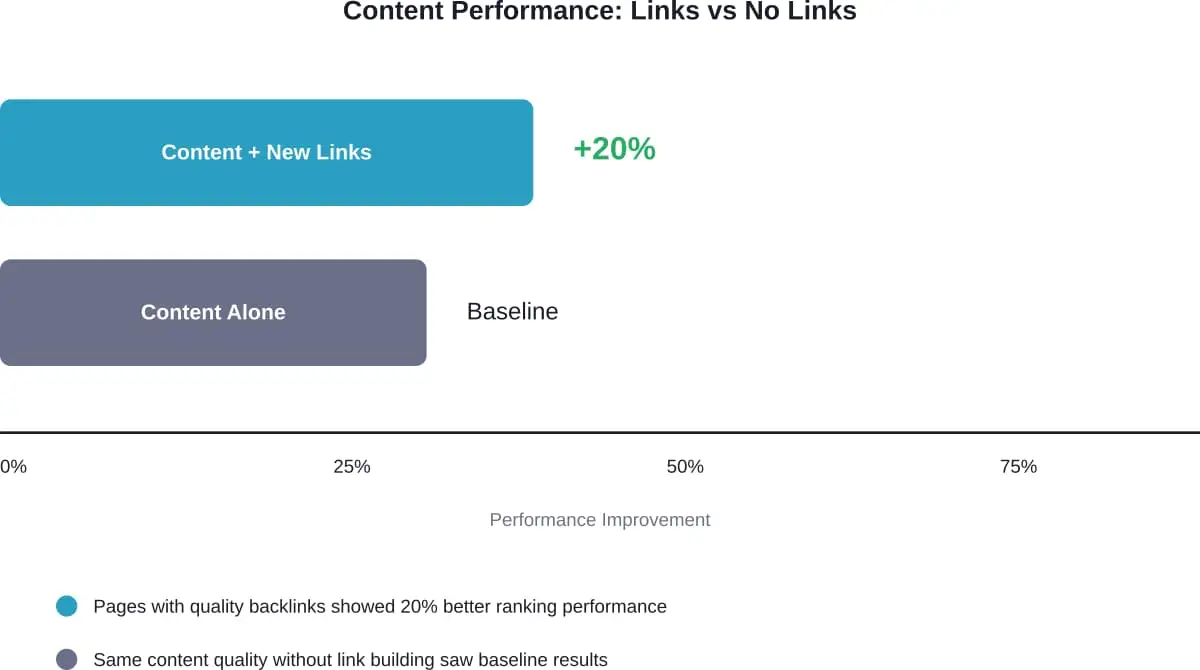
The strongest SEO strategies combine both. Create content so valuable that it naturally attracts links, then amplify that effect through strategic outreach and relationship building.
Internal Links: The Often-Overlooked Ranking Factor
While external backlinks get most of the attention, internal links deserve serious consideration too.
Internal linking helps search engines understand site structure and page relationships. When important pages receive more internal links with relevant anchor text, it signals their importance within the site hierarchy.
This matters for several reasons:
- Internal links distribute ranking power throughout a site
- They help crawlers discover and index deep pages faster
- They improve user navigation and time on site
- They establish topical authority by connecting related content
Many websites have strong external backlink profiles but weak internal linking structures. Fixing this imbalance often produces immediate ranking improvements for key pages.
Types of Links and Their Relative Impact
Understanding link types helps prioritize link building efforts effectively.
| Link Type | SEO Value | Best Use Case |
|---|---|---|
| Editorial Links | Very High | Natural mentions in content from relevant, authoritative sites |
| Guest Post Links | Medium-High | Author bio or contextual links in contributed content |
| Directory Links | Low-Medium | Industry-specific directories with editorial standards |
| Forum/Comment Links | Low | Engagement and traffic, minimal ranking impact |
| Internal Links | Medium-High | Distributing authority and establishing site structure |
| NoFollow Links | Minimal | Traffic and brand awareness, not ranking signals |
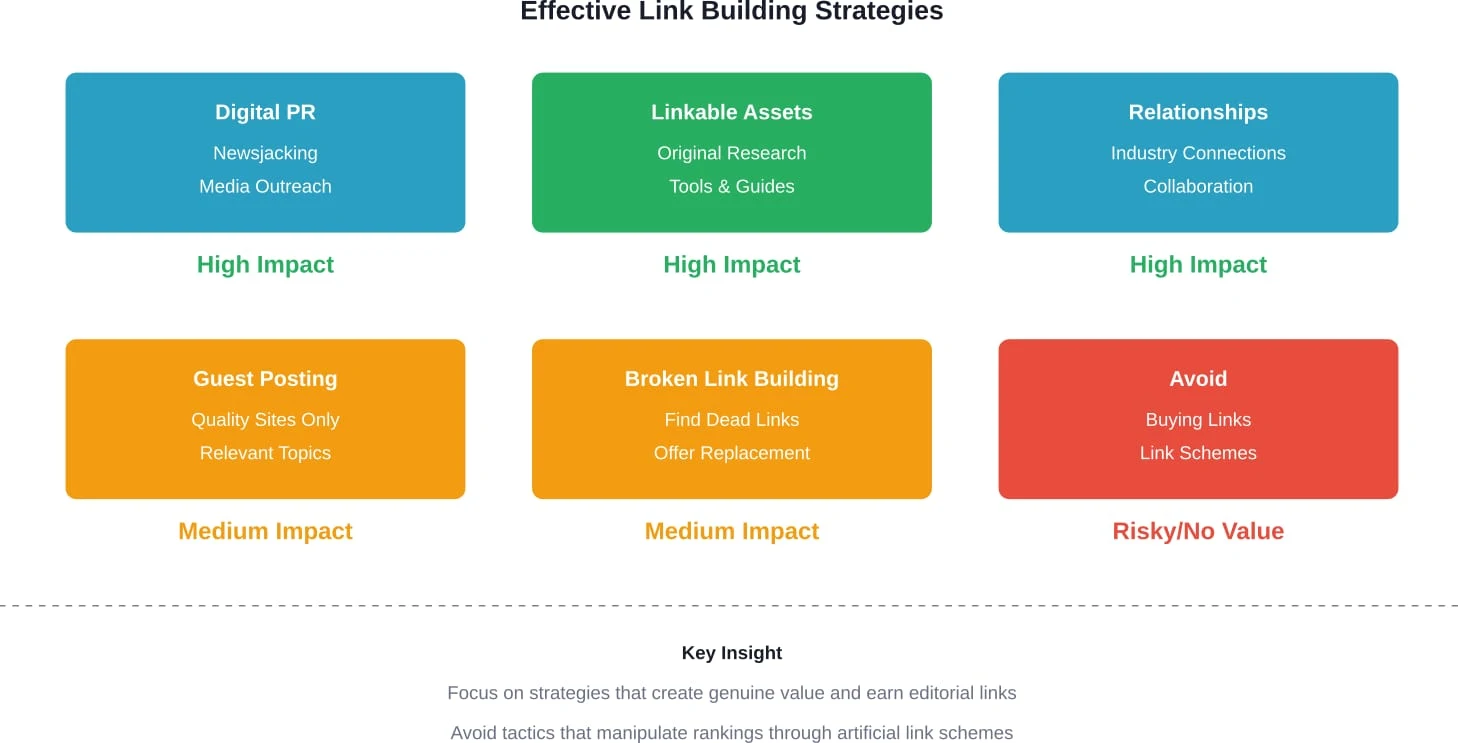
Editorial links—those earned naturally through quality content, digital PR, or relationship building—remain the gold standard. These links typically come from relevant sites in editorial contexts, making them the most valuable for rankings.
The Problem With Low-Quality Link Building
Google has gotten significantly better at identifying and devaluing manipulative link schemes.
According to Google’s patent on systems for using link graphs to demote low-quality webpages, their algorithms analyze link patterns to identify and reduce the ranking impact of links to pages that human labelers consider low-quality.
This means link building tactics that worked years ago—buying links in bulk, participating in link exchanges, or using private blog networks—now carry serious risks. Google’s systems can detect these patterns and either ignore the links entirely or apply ranking penalties.
The focus has shifted entirely to quality over quantity. One high-quality editorial link from a relevant authority can outweigh dozens of low-quality directory or forum links.
How to Build Links That Actually Move Rankings in 2026
So what works now? Based on industry data and real campaign results, several approaches consistently deliver results.
Digital PR and Newsjacking
Creating newsworthy content and pitching it to journalists remains one of the most effective link building strategies. When publications cover a story or study, they typically link to the source.
According to Search Engine Land, 87% of earned media clients align with the assessment that links are not dead and continue to invest significantly in digital PR and backlinking campaigns as part of their earned media strategy. That’s because it works.
Creating Linkable Assets
Some content formats naturally attract more links than others. Original research, comprehensive guides, tools, calculators, and visual resources consistently earn more backlinks than standard blog posts.
The investment in creating these assets pays off over time as they continue attracting links months or years after publication.
Strategic Relationship Building
Building genuine relationships with other site owners, industry influencers, and journalists creates long-term link opportunities.
This isn’t about transactional link exchanges. It’s about creating mutual value—sharing each other’s content, collaborating on projects, or contributing expertise to their audience.
Common Link Building Mistakes to Avoid
Even well-intentioned link building efforts can backfire. Here are the most common pitfalls:
- Prioritizing quantity over quality. Acquiring 100 low-quality links won’t move rankings. Five high-quality, relevant links will.
- Ignoring relevance. A link from a high-authority site in an unrelated industry carries less weight than a link from a moderately authoritative site in the same niche.
- Using exact-match anchor text excessively. Natural link profiles include varied anchor text—branded, generic, and descriptive. Over-optimized anchor text patterns trigger algorithmic filters.
- Building links too quickly. Acquiring dozens of backlinks overnight looks unnatural. Steady, consistent link growth appears more organic.
- Neglecting internal linking. External links get all the attention, but internal linking structure significantly impacts how ranking power flows through a site.
What Google’s Latest Updates Tell Us About Links
Google’s core updates in 2024 provided valuable signals about where search ranking is headed.
The March 2024 core update explicitly targeted low-quality content created primarily to attract clicks while elevating content that provides genuine value. The August 2024 update continued refining these systems to better identify helpful, original content.
But notice what didn’t change: the fundamental role of links in determining authority and relevance.
Google’s documentation on ranking systems emphasizes that their algorithms consider “many factors and signals.” Links remain among those signals—particularly for determining which sites have established authority in their field.
What has changed is how Google evaluates link quality. Systems now better identify manipulative patterns, assess topical relevance, and weight links based on the authority and trustworthiness of the source.
The Future of Links in SEO
So where are links headed? Will they eventually become obsolete?
Based on current evidence, that seems unlikely. Here’s why:
Links solve a fundamental problem: determining which sources are authoritative and trustworthy. Alternative signals like user behavior metrics, content quality assessments, and entity recognition complement links but don’t replace them entirely.
Google continues to refine how they use links—weighing quality over quantity, considering context and relevance, and filtering out manipulative patterns. But the core concept remains valuable.
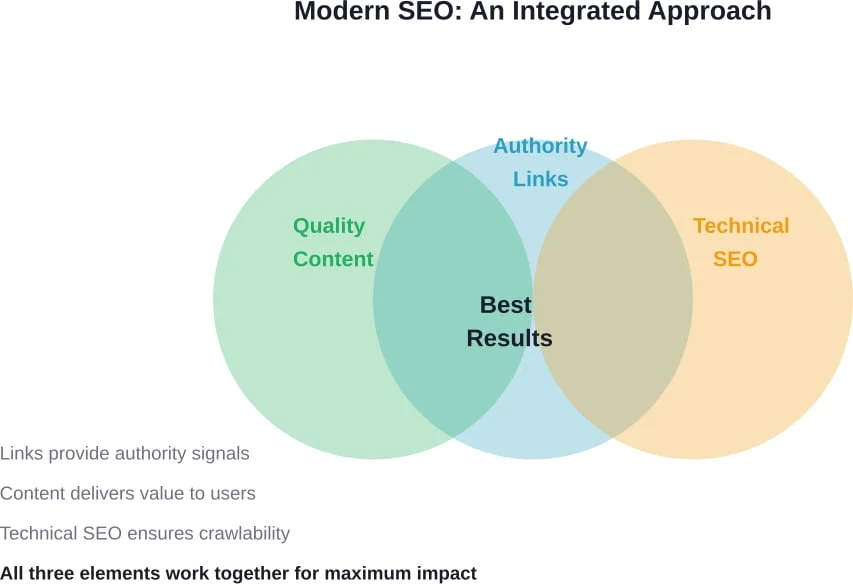
The bigger shift is toward integrated strategies. Links work best when combined with exceptional content, strong user experience, technical excellence, and genuine brand building.
Measuring Link Building Success
How do you know if link building efforts are working? Focus on these metrics:
- Referring domains. The number of unique domains linking to a site matters more than total backlink count. Diversity signals broader recognition.
- Domain authority of linking sites. Links from high-authority sites typically correlate with better ranking improvements.
- Organic traffic growth. Ultimately, links should contribute to increased visibility and traffic from search engines.
- Keyword rankings. Track whether target keywords improve after acquiring relevant links.
- Link placement and context. Evaluate whether links appear in editorial content on relevant pages, not just site-wide footers or sidebars.
Tools like Google Search Console show which sites link to yours and how much traffic those links drive. Third-party tools can estimate link quality and track competitor backlink profiles.
Real Talk: Do Links Still Work?
Let’s address the skepticism directly. Community discussions frequently question whether links still deliver results.
The answer depends entirely on execution. Low-quality link building doesn’t work—and may never have worked as well as people believed.
But strategic, quality-focused link building? Absolutely still works.
Sites that build authority through earned editorial links consistently outrank competitors with similar content but weaker link profiles. The Search Engine Land study showing 96% of top 10 results have 1,000+ backlinks isn’t an accident or coincidence.
The shift is away from thinking of links as a standalone tactic and toward integrating them into a comprehensive strategy focused on building genuine authority.
Taking Action: Building Links That Move the Needle
So what’s the takeaway? Links aren’t dead—they’ve evolved.
The tactics that worked a decade ago don’t work anymore. Buying links in bulk, participating in link schemes, and prioritizing quantity over quality now carry more risk than reward.
But strategic link building focused on earning editorial mentions from relevant, authoritative sources? That delivers results in 2026 just as it did in years past.
The most effective approach integrates link building with content creation, digital PR, and genuine relationship building. Create resources worth linking to. Build connections with others in the industry. Earn mentions through newsworthy content and original insights.
When done properly, links amplify everything else in an SEO strategy—helping quality content get discovered, signaling authority to search engines, and driving both rankings and direct traffic.
Ready to build a link strategy that actually works? Start by auditing current backlinks, identifying high-value link opportunities in your niche, and creating linkable assets that provide genuine value to your audience. The sites dominating search results aren’t there by accident—they’re there because they’ve built authority through quality content and strategic link acquisition.