


You’ve probably heard that links matter for SEO, but what about the ones that send people away from your site? It feels a bit counterintuitive – why help someone leave? But the truth is, external links aren’t just polite nods to your sources. They play a real role in how search engines understand, trust, and rank your content.
Still, not every link is a good one, and too many in the wrong place can do more harm than good. In this article, we’ll unpack how external links work, why Google cares about them (even if they don’t say it out loud), and what smart linking actually looks like in 2026.
What Counts as an External Link?
An external link is a hyperlink that points to a domain other than your own. If you’re linking out to Google’s SEO Starter Guide or citing a statistic from the CDC, that’s an external link.
There are two main types. Outbound links are links from your site to someone else’s. Inbound links (backlinks) are links from someone else’s site to yours.
This article is focused on outbound links and what they do for your SEO.
Why Use External Links at All?
It’s a fair question. After all, you worked hard to get someone to your site. Why would you want to send them elsewhere?
Because linking out to the right places does a few useful things:
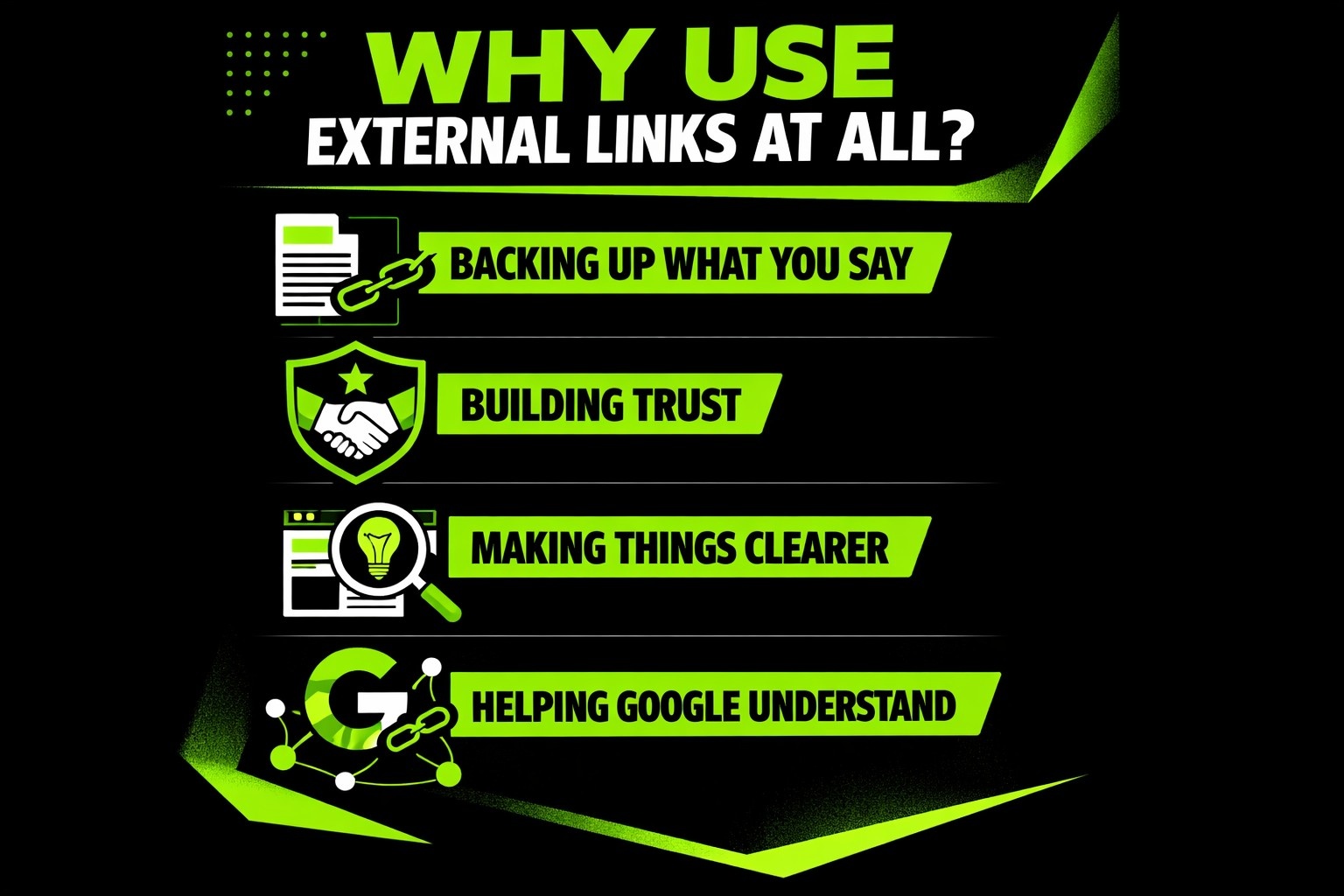
You’re Backing Up What You Say
When you link to solid, credible sources, you’re showing that your content isn’t just opinion – it’s supported by real information. It tells readers (and search engines) that you’ve done your research and know what you’re talking about.
You’re Building Trust
External links give your content weight. When people see that you’re referencing reliable sources, they’re more likely to trust you. And search engines pick up on that too, especially when those links point to reputable domains.
You’re Making Things Clearer
Let’s be honest, not every topic needs a deep dive. Sometimes, linking to a detailed guide or data source is better than trying to oversimplify it yourself. Good links can fill in the gaps without overwhelming your readers.
You’re Helping Google Understand the Big Picture
Search engines rely on context, and external links help provide it. When you point to other trustworthy pages in your niche, it gives Google a better sense of what your content is about and where it fits in the wider web.
Our View on External Links at Lengreo
At Lengreo, we take a strategic, outcome-driven approach to SEO. Our services go beyond surface-level optimization – we provide content strategy and link building for businesses in B2B, software, biotech, cybersecurity, and other complex industries. As part of this, we treat every part of a page’s structure seriously, including how external links are used.
We understand that outbound links are more than just add-ons. When used properly, they can enhance the credibility of content and support a stronger contextual signal to both users and search engines. That’s why our SEO strategies, particularly those involving content creation and authority building, focus on aligning with trusted sources and reinforcing relevance within the target niche.
From lead generation to content marketing, everything we do is built around transparency, performance, and long-term impact. That mindset carries through in how we approach link building – responsibly and with purpose.
Do External Links Directly Affect Rankings?
This is where things get a bit more nuanced.
Google has publicly stated that outbound links are not a direct ranking factor. Adding a link to a reputable site won’t suddenly boost your page’s position in search results.
But that doesn’t mean they’re irrelevant.
External links can indirectly support elements that influence SEO, including:
- Content quality signals: Linking to authoritative sources can enhance how trustworthy and well-researched your content appears, especially for topics that require accuracy.
- User experience: Helpful outbound links reduce friction by allowing users to explore supporting material, which may keep them more engaged overall.
- Contextual clarity: Search engines use external links to better understand the subject matter and how your page fits into the broader content ecosystem.
So while external links alone won’t move your rankings, they can contribute to a stronger overall SEO foundation when used strategically and in context.
How Search Engines View External Links
Search engines view the web as a vast network of interconnected pages. Each page is a node, and every hyperlink represents a connection. External links help search engine crawlers:
- Discover related content across domains.
- Understand topical associations between pages.
- Establish broader context around your content.
While external links don’t signal endorsement or trust in a technical sense, linking to reputable, topic-relevant sources can help search engines recognize what niche your content belongs to.
This becomes even more important in the context of semantic SEO. Modern search algorithms go beyond keyword matching – they aim to understand intent and meaning. Linking to well-respected, subject-specific pages can strengthen those semantic connections and contribute to how your content is understood and categorized.
What Makes an External Link Valuable?
Not all external links are good links. Some help. Some hurt. And some do nothing at all.
Here’s what separates a high-value link from a weak one:
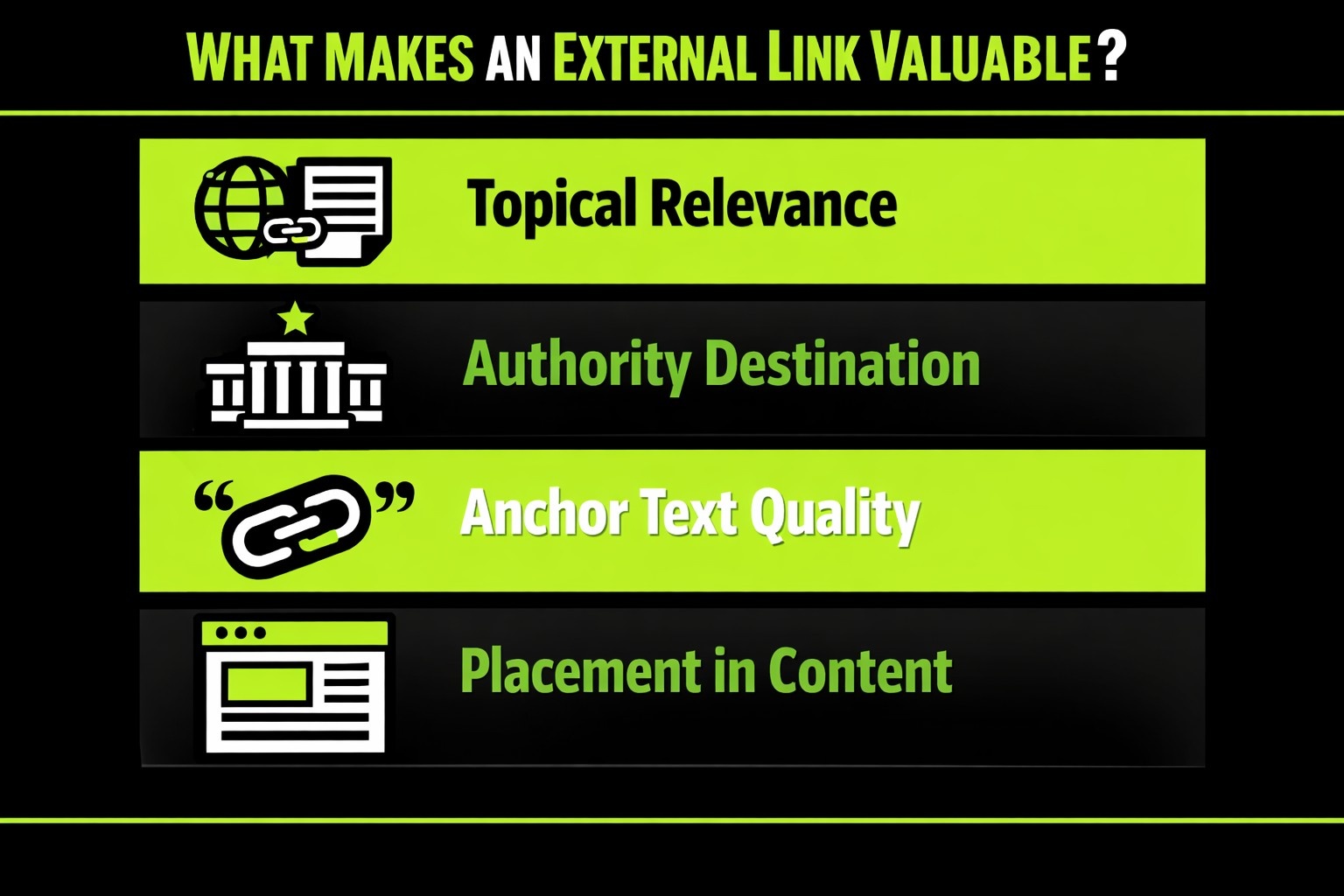
- Topical relevance: A link to a government health site on a medical blog? Good. A link to a casino on a tax guide? Confusing.
- Authority of the destination: Is the site respected? Is the content trustworthy? Does it come from a .gov, .edu, or an established brand in the space?
- Anchor text quality: The words you use for the link should describe what the user will find if they click. “Learn about 2025 SEO trends” is better than “click here.”
- Placement in content: Links placed in the body of your article are more useful than ones buried in footers or sidebars.
- Reason for linking: Are you linking because the source supports your point, or just to throw in a reference?
Bad links can drag your content down. Think spammy domains, outdated studies, or pages loaded with pop-ups. Avoid linking to low-quality or misleading content at all costs.
How Many External Links Is Too Many?
There’s no hard limit. It depends on the content.
If you’re writing a 500-word news update, maybe two links are plenty. If it’s a 3000-word research guide, a dozen well-placed links could make sense.
Rather than counting, ask yourself several questions. Does this link help explain or support something? Is it the best available resource on the topic? Would I still keep this link if SEO didn’t exist?
If a link adds clarity, usefulness, or trust, it probably belongs. If it’s there just for SEO or because you’re trying to impress a search engine, skip it.
Should You Use Nofollow, Sponsored, or UGC Tags?
External links can come with HTML attributes that tell search engines how to treat them. Here’s a quick breakdown:
- rel=”nofollow”: Tells Google not to pass SEO value through this link. Use it for untrusted sources or when you’re not endorsing the content.
- rel=”sponsored”: For paid placements like ads, affiliate links, or any promotional content.
- rel=”ugc”: User-generated content, such as blog comments or forum posts.
Avoid applying nofollow to every external link by default. If a link points to a trustworthy, relevant source and adds value for users, it can remain followed.
Common Mistakes to Avoid
Let’s make this practical. If you’re adding outbound links to your content, avoid these traps:
- Overlinking: Stuffing a page with unnecessary links makes it feel spammy and hard to read.
- Vague anchor text: “Here” or “this article” doesn’t help the user or the search engine.
- Linking to low-quality sites: If the page is riddled with ads, out of date, or not trustworthy, don’t link to it.
- Relying on aggregators: Always link to the original source when referencing stats or quotes.
- Ignoring maintenance: External links can break. Run regular audits to fix or replace them.
External Links and AI Search Engines
As AI-driven search continues to evolve, the structure and quality of your content may influence how it’s surfaced in tools like Google AI Overviews, ChatGPT, or Perplexity.
While there’s no official confirmation that outbound links directly affect inclusion in AI-generated results, well-organized pages that reference reputable third-party sources tend to perform better in these contexts. Clear formatting, reliable citations, and topic relevance all contribute to content that is easier for AI systems to interpret and summarize.
So although external links alone may not guarantee visibility in AI summaries, thoughtful linking can support the kind of clarity and credibility that these models look for.
How External Links Fit Into a Healthy SEO Strategy
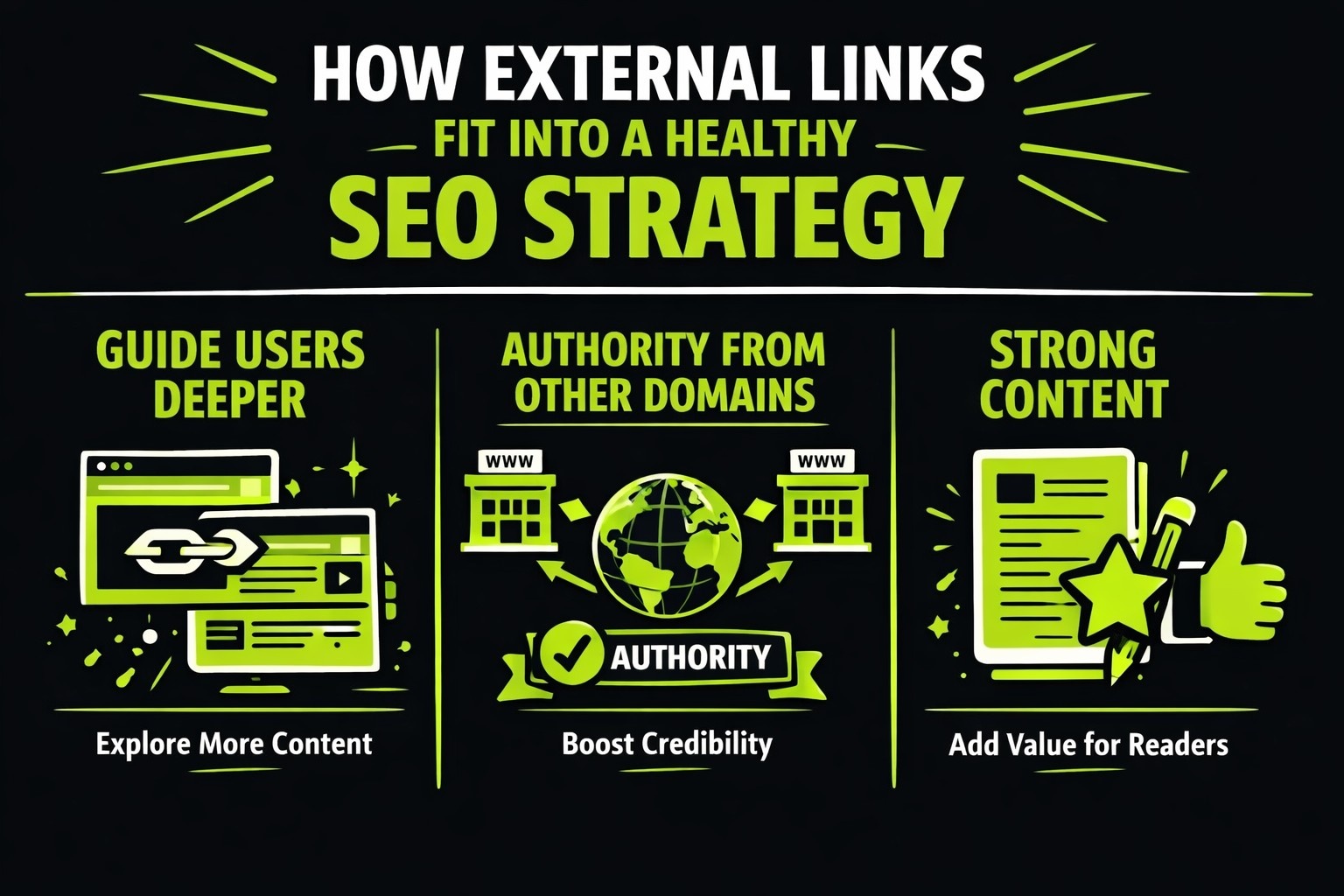
A good SEO strategy doesn’t treat external links as an isolated tactic. They’re just one piece of a larger puzzle that includes:
- Internal links that guide users deeper into your site.
- Backlinks that bring authority from other domains to yours.
- Strong content that people actually want to read and share.
External links help reinforce all of that. They build trust. They position you within a network of related information. And they show that you’re not just here to hoard traffic, but to provide value.
If you’re building thought leadership or aiming for long-term visibility, you can’t afford to ignore them.
Quick Checklist: Before You Add an External Link
Ask yourself:
- Is this link topically relevant?
- Does the source have strong authority or trust?
- Does the anchor text clearly describe what’s being linked?
- Will the user find this link genuinely helpful?
- Is the link placed naturally within the flow of the content?
- Have I verified the information on the destination page?
- Does the destination have a clean, non-spammy layout?
- Should I use nofollow, sponsored, or ugc?
If most of these check out, go ahead and include it.
Final Thoughts
So, are external links good for SEO?
They are when you use them right. They won’t directly boost your rankings overnight, but they help shape how people and search engines see your content. They build credibility, improve clarity, and support context in a way no amount of keyword stuffing ever could.
Think of external links as a way to be a good digital neighbor. Point your readers to the best info, even if it’s not yours. Do that consistently, and you’ll build a site people (and algorithms) trust.
And that’s what good SEO is really about.