


Artificial intelligence has quietly become the new backbone of digital marketing. It is not a futuristic idea anymore. It is a practical toolkit that marketers are already using every day, whether they realize it or not. From content to email to ads to customer retention, AI is now woven into almost every part of the customer journey. And the shift is only accelerating.
If you look closely at how the leaders in marketing operate today, you will notice a pattern: they are not just experimenting with AI. They are building strategies around it. They use AI as a co-pilot for decisions, creativity, analysis, and optimization. And the businesses that adapt to this model early consistently outperform those that do not.
This article explores AI-driven marketing strategies that work right now. The focus is practical: what these strategies do, why they matter, and how to use them without turning your marketing team into a research lab. My goal is to help you understand where AI gives you a real advantage and where human judgment still leads the way.
Let’s get into it.
Why AI Is a Game-Changer (Not Just a Trend)
Marketing today moves fast. Consumer expectations rise, data volumes explode, and personalization has become the norm. For businesses that want growth, speed and human-only workflows are starting to show their limits. AI enters here – not to replace marketers, but to amplify what’s already working.
AI allows you to analyze customer behaviour, forecast outcomes, personalize content or offers, and optimize campaigns – often in real time. In other words: you get smarter decisions, faster execution, and better results. Agencies and companies that integrate AI into their marketing stack now are already seeing wins in efficiency and conversion rates. Those who wait risk falling behind.
But AI works only when combined with clean data, clear goals, and human judgment. Without those, even the most advanced tools deliver little more than noise.
How We Apply AI-Driven Marketing at Lengreo
At Lengreo, we use AI to strengthen every part of our marketing strategy. It helps us analyze audiences faster, spot real opportunities, and remove the guesswork from decisions. Instead of relying on assumptions, we work with clear data and AI insights that show us what drives conversions and what needs to change.
This approach is one of the reasons we’ve helped clients achieve measurable results, such as a 400 percent increase in annually acquired clients for a US software development company, over 50 qualified opportunities for a UK architecture firm, and a 6x reduction in cost per lead for a Dutch event tech provider. These outcomes were possible because we combine AI tools with hands-on expertise, not because we depend on automation alone.
In SEO, paid ads, and lead generation, AI helps us personalize outreach, refine campaigns in real time, and scale efforts without losing quality. But what truly makes the strategy work is collaboration. We integrate into our clients’ teams, stay transparent in communication, and take responsibility for driving growth. AI gives us speed and accuracy. Our experience ensures the results make sense and push the business forward.
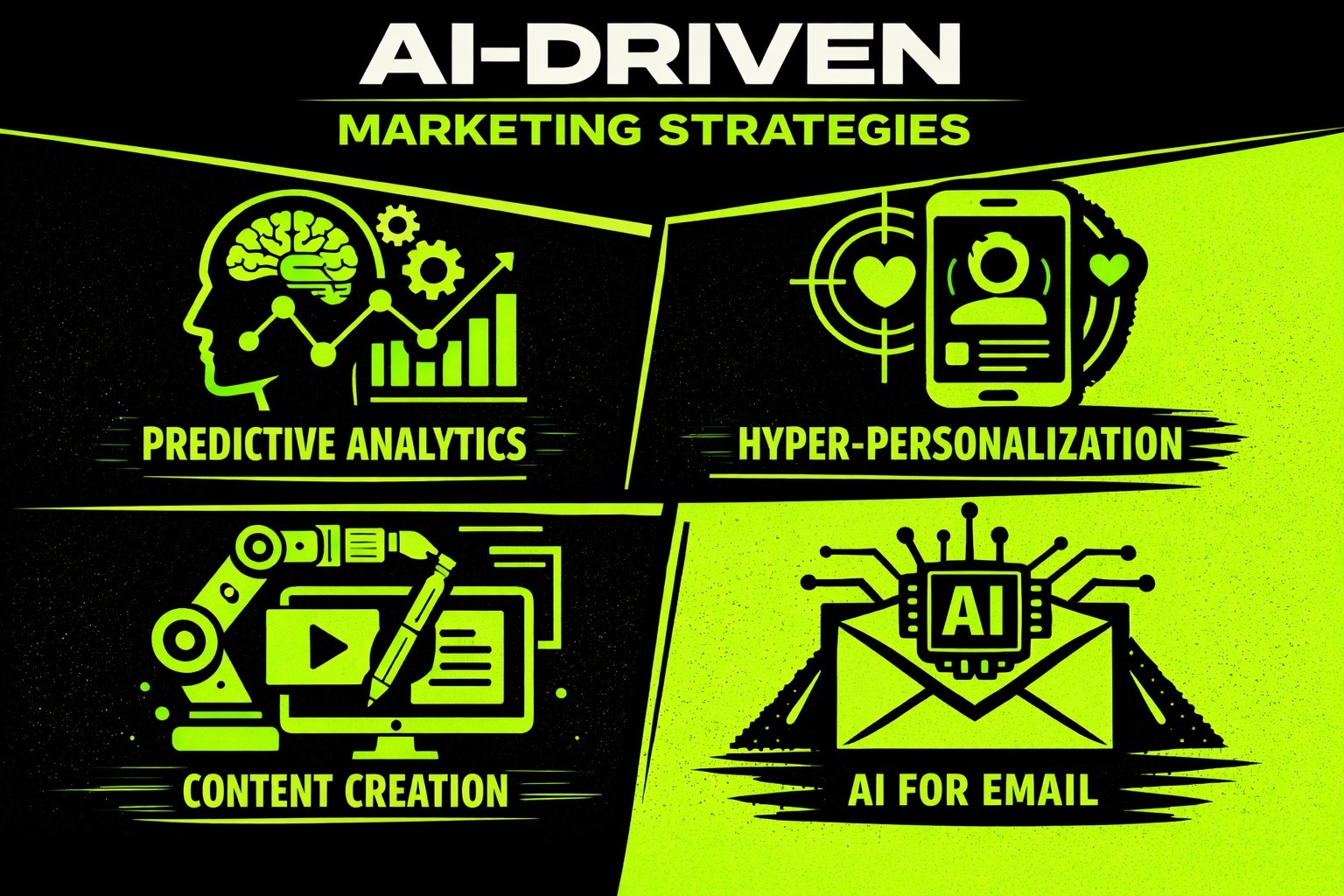
1. Predictive Analytics and AI Forecasting
When you rely on gut feeling to decide which leads to follow up or when to send a campaign, you often waste time and resources. Predictive analytics changes that. It uses historical data: browsing patterns, purchase history, engagement signals – to build models that forecast what a user is likely to do next.
With predictive tools, you can estimate who is ready to buy, who may churn soon, or who needs nurturing. You can prioritize high-potential leads and cut out low-yield ones. This means your sales and marketing teams spend time on the right people, not just whoever showed up first.
Then they forecast outcomes such as:
- who is close to buying
- who is losing interest
- which customers may churn
- what content someone is likely to respond to
- the best time to message each subscriber
Netflix, Starbucks, Amazon, and other leaders rely heavily on this. But smaller businesses can use it too, thanks to accessible tools like Salesforce Einstein, HubSpot AI, and Pecan.ai.
2. Hyper-Personalization Powered by AI
Personalization used to mean changing a name in an email. That era is over. AI personalization uses behavioral, contextual, and predictive data to shape each user’s experience in real time.
This can include:
- Dynamic website content
- Product recommendations
- Individualized emails
- Custom pricing or offers
- Location-specific suggestions
- Messaging that adapts to behavior
Amazon is the classic example, but now e-commerce stores, SaaS tools, and even service providers are using the same approach.
Examples in Action
- A visitor who viewed two pricing pages receives a tailored comparison guide.
- Someone browsing winter jackets sees weather-based recommendations.
- A user who added items to their cart but didn’t buy gets a personal incentive based on predicted sensitivity to discount.
How to Get Started
Focus on one touchpoint:
- homepage
- abandoned cart email
- product recommendations
- dynamic ads
Gradually expand personalization across channels.
3. AI-Powered Content Creation and Optimization
One of the oldest challenges in marketing: keeping up with demand for good content. Blogs, social media posts, product descriptions, ad copy, newsletters – they pile up. AI removes much of that burden. It can draft initial text, suggest improvements, generate variants, and even help optimize for SEO or readability.
Here’s how many modern teams use it: a marketer sets the brief, lets the AI produce a first draft or several variants, then edits and refines. The result? You save hours on routine writing but retain your brand voice and strategic direction. The consistency improves, too – you avoid writer’s burnout, stale copy, and mismatched tone.
For example, a brand might use AI to rewrite hundreds of product descriptions in a day or generate dozens of social captions from a single blog post. Or it might let AI analyze which articles perform best and then use that insight to plan future content. This shifts content planning from guesswork into data-driven optimization.
What to Watch Out For
AI content still needs:
- human editing
- brand voice refinement
- fact checking
The goal is not to automate creativity. The goal is to automate everything around creativity.
4. AI for Email Marketing Optimization
Email remains one of the most reliable channels for ROI. AI makes it even stronger. Thanks to predictive analysis and smart segmentation, you can go beyond generic newsletters and send emails tailored to each user’s behaviour and preferences.
The difference shows itself in engagement metrics: open rates go up, click-through rates grow, unsubscribes go down. Emails arrive when the user is most likely to respond, with content and offers relevant to their needs. Over time, you build ongoing relationships – not just one-time conversions.
Moreover, AI can help you segment your entire contact base automatically. It separates your “just browsing” users from “high-potential buyers,” “dormant customers,” or “loyal fans.” That gives you clarity on who to target, when, and with what message. As your contact list grows, this becomes not just helpful – it becomes essential.
Practical Examples
- Knowing who should receive a tutorial email vs. a discount email.
- Sending product updates only to users interested in those features.
- Automatically adjusting frequency for people who open less often.
This is the kind of detail that used to require a huge team. Now AI handles it in the background.
5. Chatbots and Conversational AI
Customers expect instant response. Waiting hours, or even minutes, can cost you a sale. That’s where chatbots and conversational AI shine. Modern bots do much more than answer FAQs: they guide product selection, qualify leads, schedule calls, and sometimes even close smaller transactions without human intervention.
For businesses with high inquiry volume: like SaaS, e-commerce, professional services, real estate, this 24/7 responsiveness offers a clear edge. It reduces bounce rates, captures leads that might slip away, and improves customer experience. Meanwhile, your human team gets to focus on complex tasks instead of repetitive questions.
If you implement chatbots thoughtfully with clear conversation flows and fallback to human agents for complicated cases, they often become the first line of customer service and lead generation. And as they learn over time, their value only increases.
Why Conversational AI Matters
- People expect fast answers. If your competitor replies instantly and you reply in two hours, you lose the opportunity.
- AI does not replace support teams, but it filters repetitive questions so humans can focus on the complex cases.
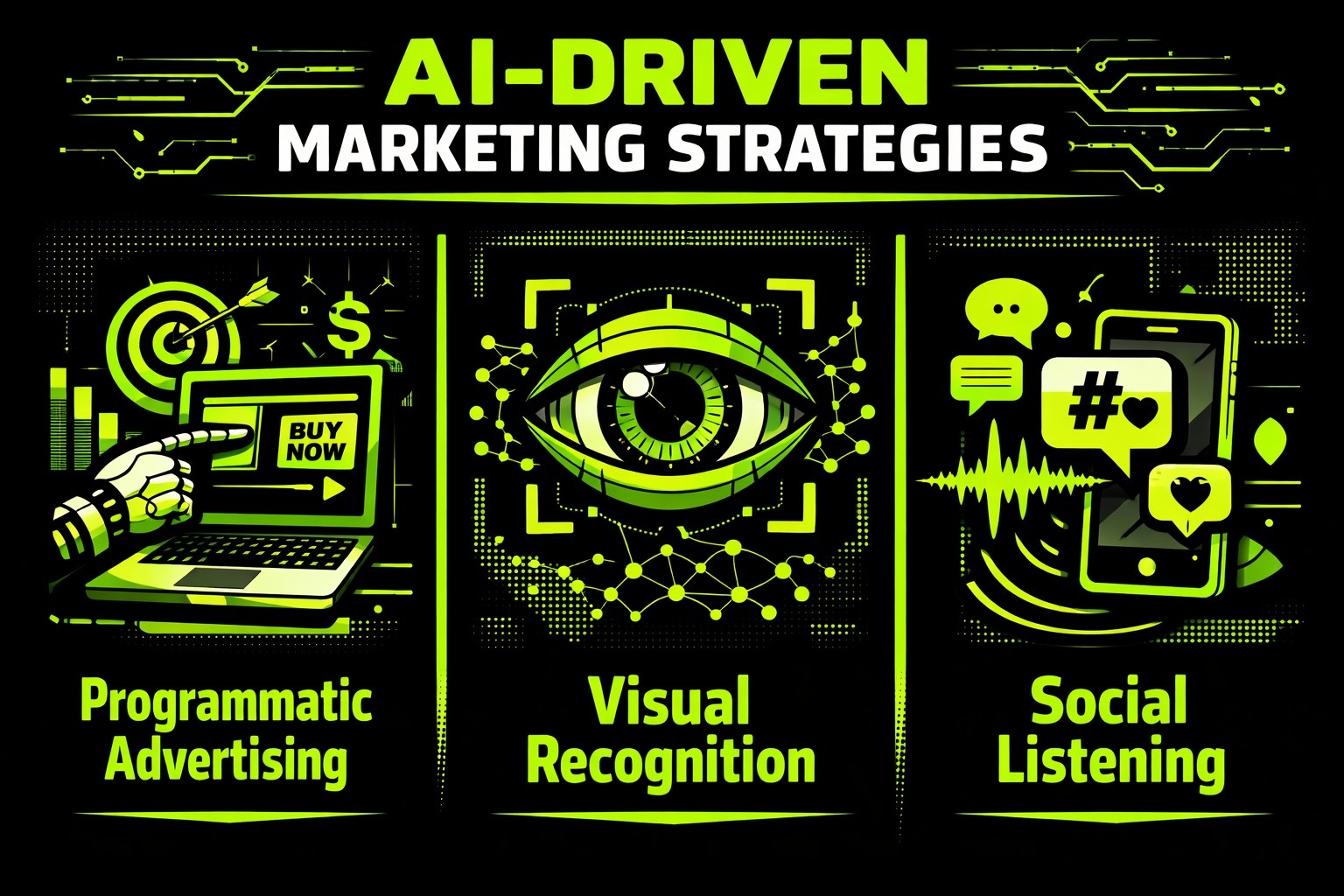
6. Programmatic Advertising and Real-Time Optimization
Advertising platforms today operate on a massive scale. There are millions of signals – audience demographics, browsing history, device type, time of day, engagement patterns, all at once. Trying to analyze that manually is not just difficult; it’s impossible.
AI-driven ad platforms simplify this complexity by handling bidding, creative selection, audience targeting, and optimization in real time. They evaluate performance continuously and adjust budgets or creatives automatically. That leads to more efficient spend, better targeting, and higher ROI.
Brands like The Economist, Adidas, and countless e-commerce companies use programmatic ads to grow without increasing manual workload.
7. Visual Recognition and Image-Based Marketing
As shopping and discovery go ever more visual, AI-based image recognition becomes more relevant. Modern systems can identify products in user-generated photos, recommend similar items, and even power virtual try-ons or augmented reality previews. This doesn’t just help users – it helps marketers understand how people use and share their products.
Brands that adopt image-based marketing early gain an advantage in a world where attention spans are shorter and visual content dominates. It’s a way to meet customers where they already are: scrolling photos, sharing images, discovering through visuals.
L’Oreal, IKEA, Pinterest, and many e-commerce brands use visual recognition to transform how people discover and evaluate products.
Examples
- A customer uploads a photo of a chair and finds similar products instantly.
- A beauty customer tries on makeup virtually.
- A brand monitors social media for product photos even when not tagged.
8. AI Social Listening and Trend Detection
Marketing isn’t just about creating content – it’s also about listening. Social media, forums, reviews, comments, they generate a vast stream of feedback, sentiment, and insight. Without AI, analyzing that manually would be overwhelming. With AI, it becomes actionable data.
AI tools can track brand mentions, identify tone (positive, negative, neutral), detect emerging trends, spot competitor activity, and alert you when something requires attention. That means you can respond to feedback faster, jump on viral trends early, and avoid PR issues before they escalate.
For growth-focused companies, social listening provides two big advantages. First, it helps maintain brand reputation in real time. Second, it reveals new opportunities – unaddressed needs, emerging demands, potential influencers. In short: it turns noise into strategic insight.
Use Cases
- Flagging a negative review before it becomes a problem
- Identifying niche audiences discussing your product
- Discovering influencers automatically
- Planning campaigns based on emerging interests
Building a Reliable AI Marketing Roadmap – Step by Step
The biggest mistake companies make is thinking AI is a magic bullet. Without structure, budget, and data hygiene, it becomes a source of chaos more than advantage. A thoughtful roadmap makes the difference. At LenGreo, we recommend the following approach:
- Audit your data and tools: Start by mapping what customer data you already collect, where it lives, how clean it is, and what gaps you have. Without good data, AI cannot make accurate predictions or personalization decisions.
- Choose one high-impact use case: Don’t try to do everything at once. Start with a well-defined goal – maybe it’s improving email engagement, or reducing acquisition costs via smarter ads, or boosting content output. The narrower the focus, the clearer the results.
- Pick tools that fit your stack and budget: Evaluate available AI tools, check integrations, consider ease of use, and ensure compliance with privacy regulations. The best tool is the one your team will actually use, not the shiniest marketing pitch.
- Run a small pilot: Launch a limited experiment with clear success metrics and a short time frame. Monitor performance, record issues, collect feedback, and learn what works, and what doesn’t.
- Measure, refine, and scale: Use real data to evaluate results: did you improve conversion rate, reduce cost per lead, shorten sales cycles, boost engagement? Based on findings, refine the process, fix weaknesses, then consider a broader roll-out.
This structured approach reduces risk, ensures clarity, and helps you build trust in AI-driven initiatives over time.
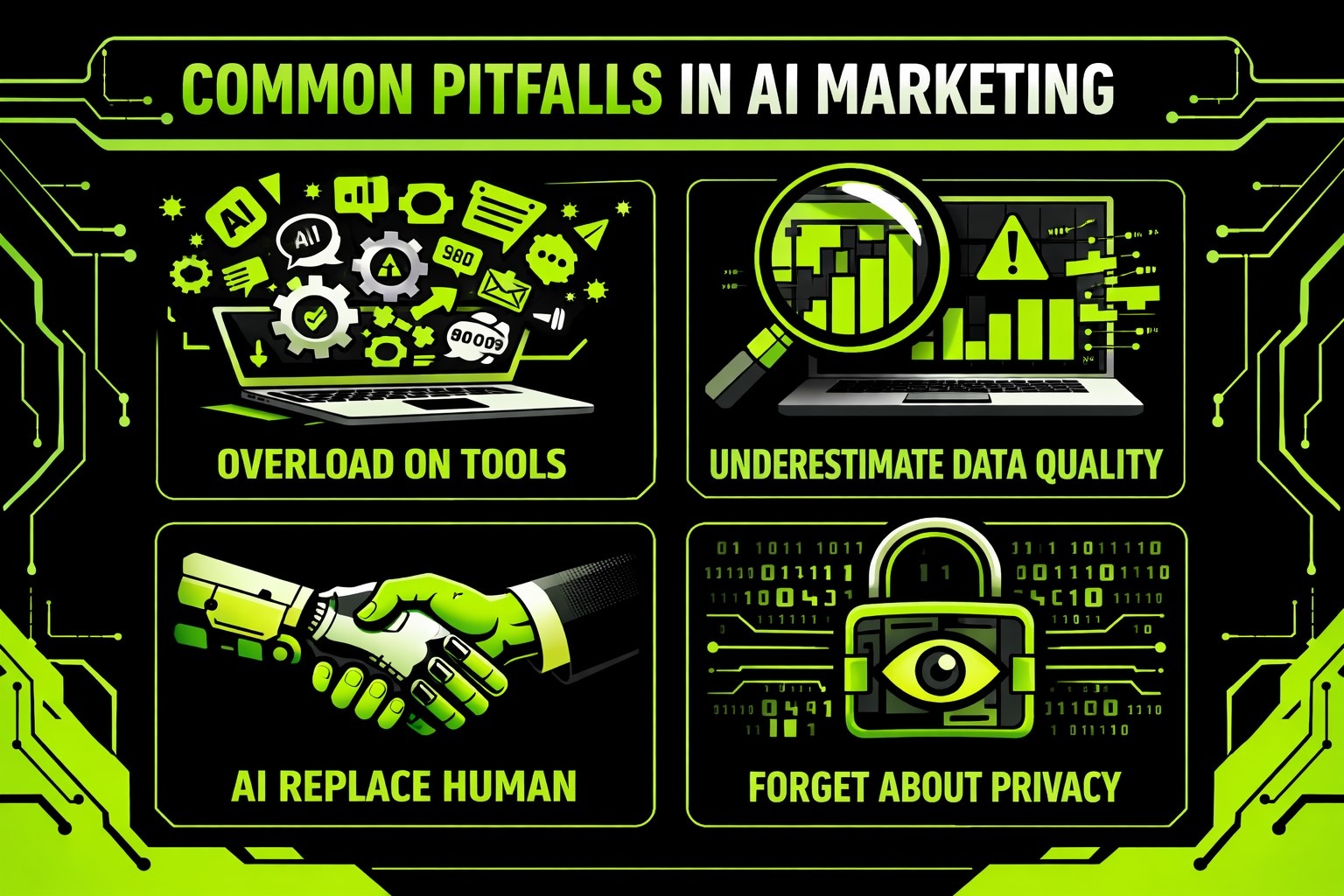
What to Watch for – Common Pitfalls in AI Marketing
Using AI without discipline can lead to wasted budget, poor results, and even reputational risks. Many companies stumble because they:
- Overload on tools and projects too quickly
- Underestimate the importance of data quality
- Think AI will replace human creativity and judgment
- Forget about privacy and transparency
- Publish AI-generated content without review
If you want AI to truly help, not hinder, you have to treat it like any other strategic investment – with planning, standards, oversight, and continuous evaluation.
What the Future Holds – AI + Humans = Growth, Not Replacement
Looking ahead, AI will become even more deeply integrated into marketing operations. Its role will shift from assistant to collaborator. Marketers will continue to lead creative direction, human insight, and brand voice – but AI will help them move faster and smarter.
We’ll see predictive journeys that adapt in real time, content tailored individually, automated yet thoughtful outreach, and campaigns that learn continuously from customer behaviour. Ethical use, transparency, and data governance will become a competitive edge rather than an afterthought.
In the coming years, successful marketing teams will be those that strike the balance: combining data and automation with empathy, creativity, and human judgment.
Final Thoughts
AI-driven marketing is not about replacing marketers. It is about empowering them to operate at a higher level. When AI handles the repetitive and analytical parts, teams can focus on what humans do best: building stories, understanding people, and shaping a brand that resonates.
The companies that combine AI with human creativity, strong data, and clear strategy will be the ones that grow the fastest over the next few years. The ones who ignore it risk being left behind by competitors who simply move faster, understand their audience better, and deliver experiences that feel personal instead of generic.
If you start small and build step by step, AI becomes less intimidating and more of a natural extension of your marketing workflow. And once it is in place, it becomes hard to imagine working without it.