

Quick Summary: Email marketing remains one of the highest-ROI channels for ecommerce businesses, with strategic campaigns recovering abandoned carts, nurturing customer relationships, and driving repeat purchases. The most effective ecommerce email programs combine automated sequences (welcome series, cart recovery, post-purchase flows) with targeted broadcasts (product launches, sales, seasonal campaigns) to engage customers at every stage of their journey. Success requires compliance with regulations like the CAN-SPAM Act, mobile optimization, compelling subject lines, and continuous testing of personalization strategies.
Email marketing isn’t dead. Far from it.
For ecommerce stores, email remains the most direct line to customers who’ve already shown interest in what you’re selling. While social media algorithms change overnight and ad costs climb, email sits in your customer’s inbox—personal, persistent, and ready to convert.
But here’s the thing: generic “newsletter” blasts don’t cut it anymore. Customers expect relevant messages that match where they are in their buying journey. The difference between an email that converts and one that gets deleted often comes down to timing, personalization, and understanding what your customer actually needs right now.
This guide breaks down the essential email marketing campaigns every ecommerce store should implement, along with design best practices, compliance requirements, and real strategies that drive measurable results.
Why Email Marketing Matters for Ecommerce
Before diving into specific campaigns, it’s worth understanding why email remains a cornerstone of ecommerce marketing strategy.
Unlike social platforms you don’t own, your email list is yours. Platform changes, algorithm updates, account suspensions—none of that affects your ability to reach subscribers. That ownership translates into stability and predictable revenue.
Email also allows for precision targeting impossible on most other channels. Segment customers by purchase history, browsing behavior, engagement level, or dozens of other factors. Then send messages tailored to each group’s specific interests and needs.
The numbers back this up. On average, 70% of people abandon their online shopping cart before finishing their purchase. But abandoned cart emails are remarkably effective at recapturing that lost revenue—according to research, abandoned cart emails show strong performance metrics with significant open and click rates, and 50% of those who click end up finishing their purchase.
Real talk: no other marketing channel gives you that kind of second chance at a conversion.
Drive Ecommerce Marketing With Lengreo
Ecommerce businesses need email marketing that connects promotions, product updates, and offers to website and campaign performance. Lengreo integrates email campaigns, website development, SEO, paid ads, content, and tracking into one practical system to ensure email outreach drives meaningful traffic and conversions.
Need Better Email Marketing Results?
Lengreo can help with:
- improving email campaign content and landing pages
- setting up automated email workflows linked to products and promotions
- tracking open rates, clicks, and conversions
- supporting content creation and lead generation workflows
👉 Contact Lengreo to discuss your marketing setup.
Essential Automated Email Sequences
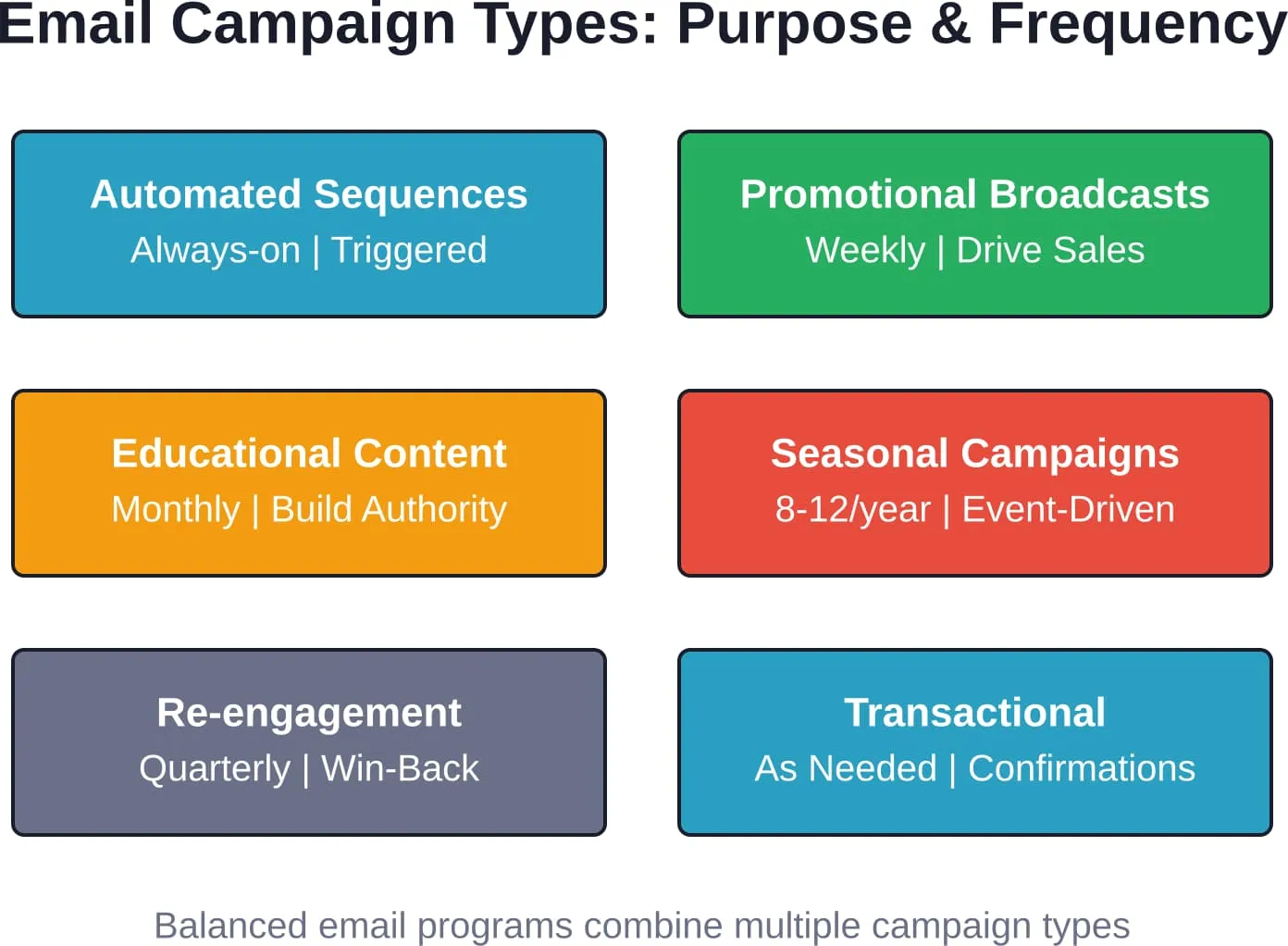
Automated sequences run on autopilot, triggered by specific customer actions or time intervals. These are your always-on revenue generators.
Welcome Email Series
First impressions matter. When someone joins your email list, they’re paying attention. Engagement rates for welcome emails consistently outperform regular campaigns.
A strong welcome series typically includes 3-5 emails over the first week:
- Email 1 (immediate): Thank the subscriber, deliver any promised discount or lead magnet, and set expectations for what they’ll receive
- Email 2 (day 2-3): Share your brand story, values, or founding mission to build emotional connection
- Email 3 (day 4-5): Highlight bestsellers or customer favorites with social proof
- Email 4 (day 7): Educational content—how to use products, styling tips, or buying guides
The goal isn’t just making a sale (though that’s nice). It’s establishing your brand as trustworthy, helpful, and worth opening in a crowded inbox.
Abandoned Cart Recovery Sequence
This is the campaign that pays for your email platform subscription several times over.
When someone adds products to their cart but leaves without purchasing, trigger a sequence to bring them back. Timing matters here—send too fast and you seem desperate; wait too long and they’ve forgotten or bought elsewhere.
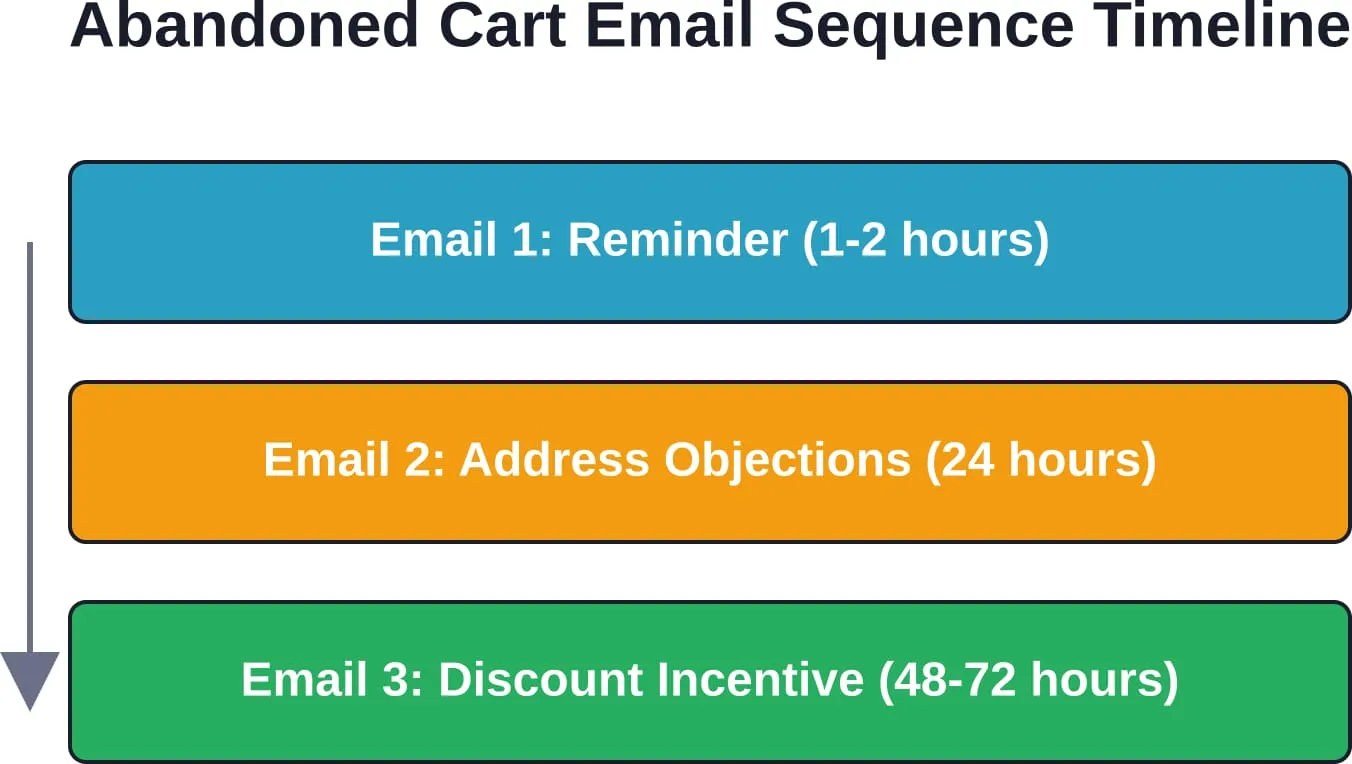
A proven three-email sequence:
- Email 1 (1-2 hours after abandonment): Simple reminder that they left items behind. No discount yet. Subject line: “You left something behind!”
- Email 2 (24 hours): Address common objections like shipping costs, return policies, or product questions. Include customer reviews for social proof
- Email 3 (48-72 hours): Final push with a time-sensitive incentive. For example, a subject line like “You Left Something Behind! Here’s 10% Off” creates urgency while providing value
Keep the call-to-action clear and specific: “Complete Your Purchase” works better than generic “Shop Now” buttons.
Browse Abandonment Emails
Similar to cart abandonment but triggered when someone views products without adding anything to their cart. Browse abandonment emails typically show stronger engagement metrics compared to standard promotional emails.
These work because they show you’re paying attention to customer interests without being pushy. Feature the exact products they viewed, plus similar items they might like based on that browsing behavior.
Post-Purchase Follow-Up Series
The sale isn’t the end—it’s the beginning of a customer relationship. Post-purchase emails build loyalty, encourage reviews, and set up repeat purchases.
A comprehensive post-purchase series includes:
- Order confirmation (immediate): Receipt, shipping timeline, and what to expect next
- Shipping notification (when shipped): Tracking information and estimated delivery
- Delivery confirmation (upon delivery): Confirm receipt and provide support resources
- Usage tips (3-5 days post-delivery): How to get the most from their purchase
- Review request (7-14 days post-delivery): Ask for feedback and product reviews
- Replenishment reminder (timing varies): For consumable products, remind customers when they might need to reorder
Each email serves a specific purpose and moves the customer deeper into your ecosystem.
Win-Back Campaigns for Inactive Customers
Customers go dormant for various reasons. Win-back sequences aim to reactivate them before they’re completely lost.
Trigger these campaigns after a specific period of inactivity (typically 60-90 days for most ecommerce stores, though this varies by industry and typical purchase frequency).
A two-email win-back sequence:
- Email 1: “We miss you” message highlighting new products or changes since their last visit
- Email 2 (one week later): Special comeback offer or exclusive discount to incentivize return
If they don’t engage after this sequence, consider removing them from your main list to maintain healthy deliverability rates.
High-Impact Campaign Ideas for Broadcasts
While automated sequences handle the foundational work, one-off broadcast emails let you respond to opportunities, seasons, and business needs in real-time.
New Product Launch Announcements
When you’ve got something new, email is your megaphone to existing customers.
Build anticipation with a multi-email launch sequence: tease it, announce it, remind stragglers. Create exclusivity by giving email subscribers early access before the general public.
For example, send a teaser email three days before launch with mysterious imagery and “something new is coming” messaging. Then the launch day email with full details, benefits, and a clear call-to-action. Follow up two days later with early results, customer reactions, or limited-stock warnings.
Seasonal and Holiday Campaigns
Retail calendars drive purchasing behavior. Smart ecommerce brands plan email campaigns around major shopping moments.
The key: start earlier than customers expect. For major holidays, begin warming up your audience 2-3 weeks in advance with gift guides, early-bird discounts, and shipping deadline reminders.
Subject lines for holiday emails need urgency. Instead of “Big Sale,” try “24 Hours Only! Don’t Miss Out on 40% Off.” Specificity and time constraints drive action.
Flash Sales and Limited-Time Offers
Flash sales create urgency and can move inventory quickly. But overuse them and customers learn to wait for discounts.
When running a flash sale via email:
- Make the time limit crystal clear in the subject line and email body
- Use countdown timers in the email design to reinforce scarcity
- Segment your list—loyal customers might get early access or deeper discounts
- Send a last-chance email 2-3 hours before the sale ends
The psychology works because humans hate missing out more than they enjoy gaining something of equal value.
Customer Appreciation and Loyalty Campaigns
Not every email needs to sell. Sometimes the goal is simply strengthening the relationship.
Customer appreciation emails might include:
- Birthday or anniversary discounts (anniversary of their first purchase)
- Exclusive content like behind-the-scenes looks at your business
- Early access to sales or new products
- Free gifts or bonus loyalty points
Research indicates that referral customers demonstrate higher retention and that consumers value loyalty programs.
These campaigns build goodwill that pays dividends in customer lifetime value.
Educational Content and Product Guides
Email isn’t just for promotions. Educational content positions your brand as an authority and keeps subscribers engaged even when they’re not ready to buy.
Examples include:
- How-to guides for using your products effectively
- Style or pairing suggestions
- Industry trends and insights
- Customer success stories and case studies
- Maintenance and care instructions
The goal: stay top-of-mind as a helpful resource, so when the customer is ready to purchase, you’re the obvious choice.
Referral and Social Sharing Campaigns
Turn happy customers into your marketing team. Referral campaigns incentivize existing customers to spread the word.
A simple referral email structure:
- Explain the program benefits clearly (what they get, what their friend gets)
- Make sharing effortless with pre-written messages and one-click sharing buttons
- Provide a unique referral link they can track
- Follow up with progress updates and thank-yous when referrals convert
Double-sided incentives (both referrer and referee get rewards) typically perform better than one-sided programs.
Customer Feedback and Survey Requests
Asking for feedback serves dual purposes: it gives you valuable insights for improving your business, and it makes customers feel heard and valued.
Keep surveys short—5-7 questions maximum. Explain how you’ll use the feedback, and consider offering a small incentive (discount, entry into a prize draw) for completion.
Share what you learned and how you’re acting on customer feedback in a follow-up email. This closes the loop and demonstrates that customer voices genuinely matter.
Email Design Best Practices for Ecommerce
Content matters, but design determines whether anyone reads that content. Email design for ecommerce needs to balance aesthetics with functionality.
Subject Lines That Actually Get Opened
Your subject line determines whether the email gets opened or ignored. Arguably the most important element of any email, the subject line has a huge impact on whether the email will be read. In fact, 35% of email recipients open emails based solely on the subject line,
Effective subject line strategies:
- Keep it short: 40-50 characters max ensures mobile visibility
- Create urgency: Limited-time language drives action
- Personalize when relevant: Names, locations, or past purchases
- Ask questions: Engage curiosity
- Use numbers: “5 Ways to…” or “Save 30% on…”
- Avoid spam triggers: Excessive caps, multiple exclamation points, or spammy words like “FREE!!!”
Test different approaches with your audience. What works for a fashion brand might flop for a B2B tool supplier.
Mobile-First Design Is Non-Negotiable
A significant portion of customers open emails on mobile devices. If the email doesn’t render properly on a small screen, they’ll delete it.
Mobile optimization essentials:
- Single-column layouts that stack vertically
- Large, thumb-friendly buttons (minimum 44×44 pixels)
- Readable font sizes (minimum 14px for body text, 22px for headlines)
- Compressed images that load quickly
- Concise copy—mobile readers skim more than desktop readers
Test every email on multiple devices before sending. What looks perfect on desktop might be unusable on mobile.
Clear, Action-Oriented CTAs
Every email needs a clear primary call-to-action. What do you want the reader to do?
Instead of generic buttons like “Shop Now,” try specific, benefit-driven actions such as “Get Your 20% Off Code” or “See What’s New.” The more specific the CTA, the better it tends to perform.
Design tips for CTAs:
- Use contrasting colors that stand out from the rest of the email
- Make buttons big enough to tap easily on mobile
- Place the primary CTA above the fold when possible
- Repeat the CTA if the email is long
- Use button text that creates urgency or emphasizes value
Strategic Use of Images and Visual Hierarchy
Images sell products, but too many images slow load times and trigger spam filters.
Balance is key. Use high-quality product images where they matter, but ensure the email makes sense even if images don’t load. Some email clients block images by default, so include descriptive alt text and don’t rely solely on images to convey your message.
Create visual hierarchy through:
- Size differences (headlines bigger than body text)
- Color contrast (important elements in brand colors)
- White space (don’t cram everything together)
- Directional cues (arrows, eye gaze in photos)
Personalization Beyond First Names
Putting someone’s first name in the subject line is table stakes now. Real personalization goes deeper.
Advanced personalization tactics:
- Product recommendations based on browsing or purchase history
- Location-based content (weather, local events, regional inventory)
- Behavioral triggers (cart value, engagement level, purchase frequency)
- Lifecycle stage (new subscriber vs. loyal customer)
- Dynamic content blocks that change based on recipient data
The more relevant the email feels to the recipient’s specific situation, the higher the engagement.
| Design Element | Best Practice | Common Mistake |
|---|---|---|
| Subject Line | 40-50 characters, create urgency | Generic, too long, or spam triggers |
| Preview Text | Complement subject line, add context | Leaving it blank or duplicating subject |
| Email Width | 600-650 pixels for desktop | Too wide, breaks on mobile |
| Images | Optimized, with alt text, support message | Image-only emails, slow loading |
| CTA Buttons | High contrast, specific action, mobile-friendly | Too many CTAs, vague text, small size |
| Copy Length | Concise, scannable, benefit-focused | Dense paragraphs, feature dumps |
Legal Compliance: CAN-SPAM Act Essentials
Email marketing isn’t just about what works—it’s also about what’s legal. The CAN-SPAM Act sets the rules for commercial email in the United States, and violations carry steep penalties.
According to the Federal Trade Commission, the CAN-SPAM Act establishes requirements for commercial messages, gives recipients the right to have you stop emailing them, and spells out tough penalties for violations. Despite its name, the CAN-SPAM Act doesn’t apply just to bulk email—it covers virtually all commercial email messages.
Core CAN-SPAM Requirements
To stay compliant, every commercial email must:
- Include accurate header information: The “From,” “To,” and routing information must be accurate and identify the business sending the message
- Use truthful subject lines: Subject lines must accurately reflect the email content
- Identify the message as an ad: This can be subtle, but the email must be clearly identifiable as a commercial message
- Include physical address: Every email must contain a valid physical postal address
- Provide opt-out mechanism: A clear and conspicuous way to unsubscribe must be included in every email
- Honor opt-outs promptly: Unsubscribe requests must be processed within 10 business days
The penalties for non-compliance are significant. Each separate email in violation of the CAN-SPAM Act is subject to penalties of up to $53,088, making compliance essential for any business using email marketing.
Transactional vs. Commercial Emails
CAN-SPAM distinguishes between transactional emails (order confirmations, shipping notifications, account updates) and commercial emails (promotional content, sales offers, marketing messages).
Transactional emails have fewer restrictions but can’t contain false or misleading routing information. If a transactional email also includes promotional content, the entire email is subject to CAN-SPAM’s full requirements.
Keep order confirmations purely transactional, or ensure any promotional content added still meets all compliance requirements.
Building and Growing Your Email List
None of these campaigns matter without subscribers. Building a quality email list requires strategy and ongoing effort.
Effective List-Building Tactics
Multiple touchpoints throughout the customer journey should invite email subscriptions:
- Website pop-ups: Time them strategically (exit intent, after 30 seconds, after scrolling 50%)
- Checkout opt-in: Make it easy to subscribe during purchase
- Content upgrades: Offer valuable resources (guides, checklists, templates) in exchange for email addresses
- Social media: Promote email-exclusive perks to followers
- In-store collection: For businesses with physical locations, collect emails at point of sale
- Referral incentives: Reward customers who refer friends who subscribe
The key: offer genuine value in exchange for the email address. Generic “sign up for updates” prompts rarely work. “Get 15% off your first order” or “Download our free buyer’s guide” convert much better.
List Hygiene and Maintenance
A smaller, engaged list outperforms a large, inactive one. Regular list cleaning maintains deliverability and engagement rates.
Best practices for list maintenance:
- Remove hard bounces immediately
- Suppress chronic non-openers after 6-12 months of inactivity
- Monitor spam complaint rates and unsubscribe trends
- Re-engage inactive subscribers before removing them
- Keep bounce rates below 2% by cleaning the email list regularly
Email service providers track sender reputation. High bounce rates, spam complaints, or low engagement can damage that reputation and hurt deliverability across the entire list.
Segmentation Strategies That Improve Results
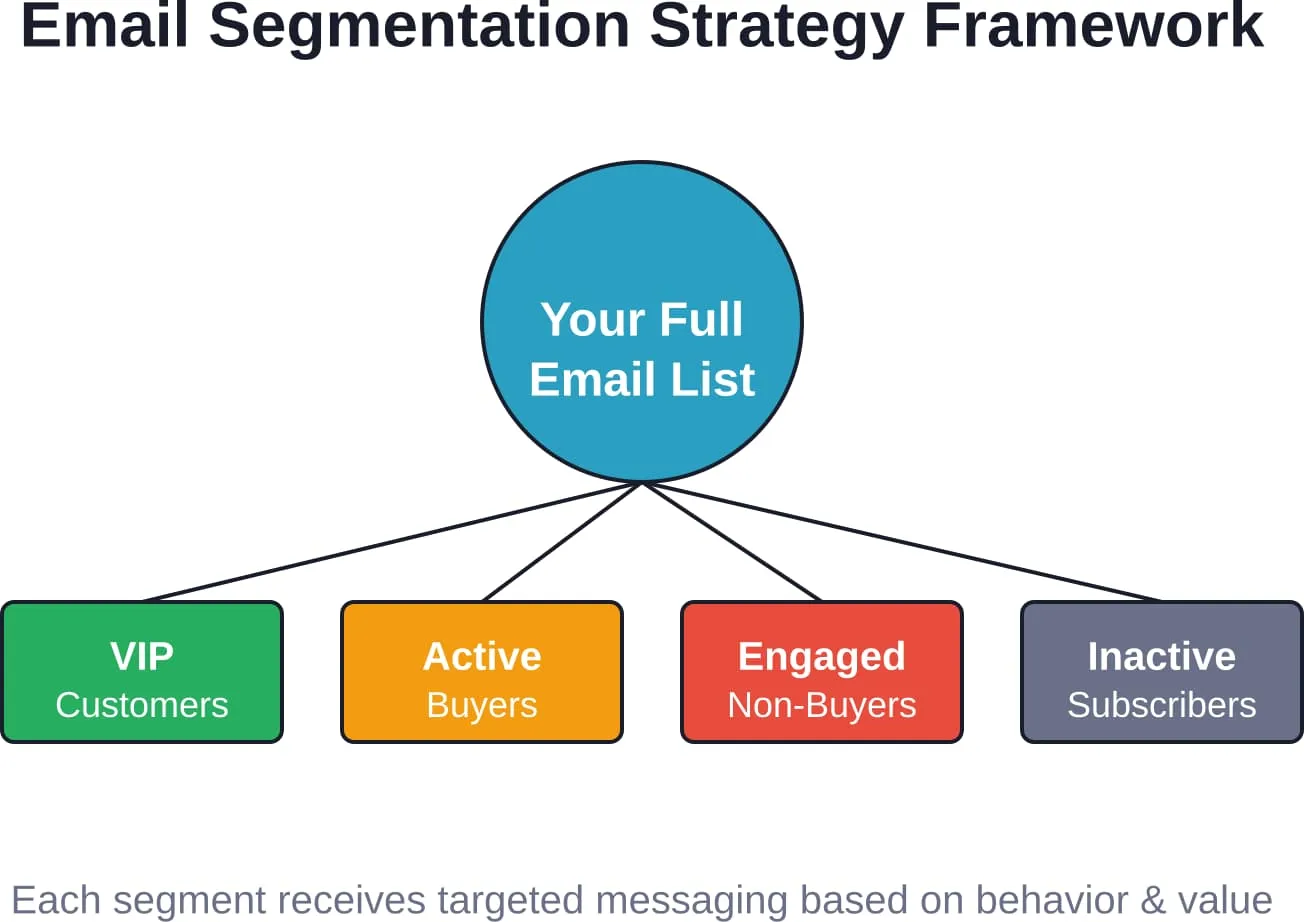
Sending the same message to every subscriber is leaving money on the table. Segmentation allows tailored messaging to specific groups.
Key Segmentation Criteria
Different ecommerce businesses segment differently, but common approaches include:
- Purchase history: First-time buyers vs. repeat customers vs. VIPs
- Engagement level: Highly engaged vs. moderately engaged vs. inactive
- Product interests: Based on browsing behavior or past purchases
- Demographics: Age, location, gender when relevant to product fit
- Lifecycle stage: New subscribers vs. active customers vs. at-risk churners
- Cart value: High-value shoppers might get different offers than discount hunters
Start simple—even basic segmentation (customers vs. non-customers) improves results. Add complexity as data and resources allow.
Dynamic Content Blocks
Advanced email platforms allow dynamic content that changes based on recipient data. One email template can show different products, offers, or messages to different segments.
For example, a single promotional email might show:
- Past customers: products complementary to previous purchases
- Browser but never purchased: their viewed items plus a first-purchase discount
- VIP customers: exclusive early access or free shipping
This efficiency means better relevance without having to build dozens of separate campaigns.
Metrics That Matter: Measuring Email Performance
What gets measured gets improved. Track the right metrics to understand what’s working and what needs adjustment.
Core Email Marketing Metrics
| Metric | What It Measures | Healthy Benchmark |
|---|---|---|
| Open Rate | Percentage of recipients who open the email | 15-25% (varies by industry) |
| Click-Through Rate | Percentage who click a link in the email | 2-5% |
| Conversion Rate | Percentage who complete desired action | 1-5% (highly variable) |
| Bounce Rate | Emails that couldn’t be delivered | Below 2% |
| Unsubscribe Rate | Percentage who opt out after receiving email | Below 0.5% |
| List Growth Rate | Net new subscribers over time | Positive growth month-over-month |
Context matters for all these metrics. A 15% open rate might be concerning for a highly engaged list but excellent for a colder audience. Compare performance against your own historical data rather than obsessing over industry benchmarks.
Revenue Attribution
Ultimately, ecommerce email marketing exists to drive sales. Track revenue metrics:
- Revenue per email: Total revenue divided by number of emails sent
- Revenue per subscriber: Total email revenue divided by list size
- Email-attributed revenue: Sales directly resulting from email campaigns
- Customer lifetime value by acquisition channel: Are email subscribers more valuable long-term?
These financial metrics justify continued investment in email marketing and help prioritize which campaigns deserve more resources.
A/B Testing for Continuous Improvement
Assumptions about what works often prove wrong. Testing removes guesswork.
Elements worth testing:
- Subject lines (by far the most common and impactful test)
- Send times and days
- Sender name (company name vs. founder name vs. team member)
- Email length (short vs. detailed)
- CTA copy and design
- Personalization approaches
- Image usage and placement
- Offer types and discount levels
Run one test at a time with a clear hypothesis. Make sure your sample size is large enough for statistical significance. Implement winners and keep testing.
Advanced Tactics for Scaling Email Success
Once foundational campaigns are running smoothly, these advanced strategies can take results to the next level.
Predictive Analytics and AI Personalization
Modern email platforms increasingly use machine learning to optimize sending. Predictive send time optimization analyzes when each individual subscriber is most likely to engage, then sends at that optimal moment rather than a one-size-fits-all time.
AI-powered product recommendations analyze browsing patterns, purchase history, and similar customer behavior to suggest the most relevant products for each recipient. According to recent analysis, AI presents marketers with opportunities to personalize customer experiences and build technological skills, ultimately driving businesses forward through more relevant and customized marketing.
Behavioral Trigger Sequences
Beyond basic abandoned cart emails, sophisticated behavioral triggers respond to specific customer actions:
- Cross-sell sequences after specific product purchases
- Category-specific browse abandonment
- Price-drop alerts for wishlisted items
- Back-in-stock notifications
- Milestone celebrations (100th purchase, one-year anniversary)
These hyper-relevant messages feel less like marketing and more like helpful service, resulting in stronger engagement.
Integration With Other Marketing Channels
Email doesn’t exist in isolation. Smart integration with other channels amplifies results:
- Retarget email non-openers with social media ads
- Suppress email subscribers from paid acquisition campaigns to avoid wasted ad spend
- Use email to drive SMS opt-ins for time-sensitive promotions
- Coordinate email and direct mail for high-value customer segments
- Build lookalike audiences from top email segments for paid social campaigns
Cross-channel coordination creates a cohesive customer experience and improves overall marketing efficiency.
Common Email Marketing Mistakes to Avoid
Even experienced marketers fall into these traps. Awareness helps avoid them.
Over-Mailing Your List
There’s a sweet spot for email frequency. Too few emails and subscribers forget who you are. Too many and they unsubscribe or, worse, mark you as spam.
Watch your engagement metrics. If open rates decline as you increase frequency, that’s a signal. Let subscriber preferences guide frequency when possible—some customers want daily updates while others prefer weekly digests.
Neglecting Mobile Optimization
This bears repeating: if emails don’t work on mobile, they don’t work. Period.
Test every campaign on multiple devices and email clients before sending. What looks perfect on desktop Gmail might be broken on iPhone Mail or Outlook mobile.
Focusing on Acquisition Over Retention
New subscriber acquisition gets attention, but existing customer nurture drives more revenue. It costs significantly less to sell to an existing customer than to acquire a new one.
Balance list growth efforts with robust retention campaigns. Win-back sequences, loyalty programs, and exclusive customer perks often deliver better ROI than aggressive acquisition tactics.
Ignoring List Segmentation
Batch-and-blast emails to entire lists underperform segmented campaigns in virtually every metric. The data is clear: relevance matters.
Start with basic segmentation and expand from there. Even dividing customers from prospects improves results significantly.
Setting and Forgetting Automated Sequences
Automation is powerful but not truly “set it and forget it.” Customer behavior changes, competitive landscapes shift, and campaign performance evolves.
Review automated sequences quarterly. Update copy, refresh offers, test new approaches. What worked last year might be stale now.
Choosing the Right Email Marketing Platform
The platform powering email campaigns matters. Different solutions suit different business needs and stages.
Key Features to Consider
Essential capabilities for ecommerce email marketing:
- Ecommerce platform integration: Native connections with Shopify, WooCommerce, BigCommerce, etc.
- Automation capabilities: Robust workflow builders for complex sequences
- Segmentation options: Flexible filtering based on behavior and attributes
- Template library: Pre-built designs that can be customized
- A/B testing: Built-in split testing functionality
- Analytics and reporting: Detailed performance data and revenue attribution
- Deliverability reputation: Strong sender reputation and ISP relationships
- Support and resources: Responsive help when issues arise
Platform selection should align with current needs and near-term growth plans. The best platform is the one that matches technical capabilities and marketing sophistication.
Pricing Considerations
Email platform pricing typically scales with list size or email volume. Be realistic about growth projections when evaluating costs.
Consider total cost of ownership beyond the subscription fee: implementation time, design resources, potential need for outside expertise, and opportunity cost of feature limitations.
Check official platform websites for current pricing, as tiers and features change frequently.
Putting It All Together: Your Email Marketing Roadmap
Implementing a comprehensive email marketing program feels overwhelming. Breaking it into phases makes the process manageable.
Phase 1: Foundation (Weeks 1-4)
Start with the essentials:
- Choose and set up an email marketing platform
- Create basic list-building mechanisms (website signup, checkout opt-in)
- Implement a simple welcome sequence (2-3 emails)
- Set up transactional emails (order confirmation, shipping notification)
- Ensure CAN-SPAM compliance across all emails
This foundation gets email marketing operational quickly without perfectionism paralysis.
Phase 2: Core Automation (Weeks 5-8)
Build out essential automated sequences:
- Abandoned cart recovery (2-3 email sequence)
- Post-purchase follow-up (confirmation through review request)
- Basic segmentation (customers vs. subscribers)
- First promotional broadcast campaign
These automated sequences work continuously, generating revenue while you focus on other business areas.
Phase 3: Expansion (Weeks 9-16)
Add sophistication and breadth:
- Browse abandonment sequences
- Win-back campaigns for inactive customers
- Advanced segmentation (purchase history, engagement level)
- Regular broadcast cadence (weekly or bi-weekly)
- A/B testing program for subject lines and content
Phase 4: Optimization (Ongoing)
Continuous improvement becomes the focus:
- Review and update automation sequences quarterly
- Expand segmentation based on performance insights
- Test advanced personalization tactics
- Integrate email with other marketing channels
- Explore AI-powered optimization features
Email marketing is never truly “finished.” Customer expectations evolve, new technologies emerge, and competitive dynamics shift. Ongoing optimization keeps campaigns fresh and effective.
Conclusion: Email Marketing as a Growth Engine
Email marketing stands out in the crowded ecommerce marketing landscape because it combines control, personalization, and proven ROI. While other channels chase the latest algorithm changes or trend cycles, email provides a direct line to interested customers.
The campaigns outlined here—from foundational welcome sequences to sophisticated behavioral triggers—form a comprehensive program that supports customers throughout their journey. Not every store needs every campaign immediately, but understanding the full landscape helps prioritize what matters most for specific business goals.
Success in email marketing comes down to three principles: respect your subscribers’ time and attention, provide genuine value in every message, and continuously test and improve based on data rather than assumptions.
The stores that treat email as a relationship-building channel rather than just a sales mechanism tend to see the strongest long-term results. Sales happen naturally when customers feel understood, valued, and well-served.
Start simple, measure relentlessly, and expand strategically. The email program that drives real revenue doesn’t materialize overnight, but each improvement compounds over time. Whether recovering abandoned carts, nurturing new subscribers, or re-engaging dormant customers, email marketing offers direct pathways to measurable growth.
The only question left: which campaign will you implement first?