


Quick Summary: Educational institutes can boost enrollment and visibility through data-driven digital marketing strategies including SEO optimization, video content creation, targeted social media campaigns, and AI-powered personalization. According to the National Center for Education Statistics, total degree-granting enrollment is projected to increase 8% between 2020 and 2030, making strategic marketing essential for capturing growth in an increasingly competitive landscape.
The education sector faces unprecedented marketing challenges; more than 100 colleges have closed their doors over the past two years, and the projected demographic cliff makes competition fiercer than ever. But here’s the thing—institutions that adapt their marketing strategies are not just surviving, they’re thriving.
Traditional recruitment methods no longer cut it. Prospective students research programs using AI-powered search tools, expect personalized digital experiences, and make decisions based on factors previous generations never considered. The institutions capturing enrollment growth share one trait: they’ve abandoned outdated tactics in favor of data-driven, digitally-focused marketing strategies.
What works in 2026? The answer combines proven fundamentals with emerging technologies. From SEO that captures AI-assisted searches to video content that converts viewers into applicants, effective education marketing requires both strategic thinking and tactical execution.
Why Educational Institutions Must Prioritize Strategic Marketing
Education marketing isn’t about selling—it’s about connecting prospective students with opportunities that change their lives. Yet many institutions still treat marketing as an afterthought, allocating minimal resources while expecting maximum results.
The landscape has shifted dramatically. According to the National Center for Education Statistics, total undergraduate enrollment in degree-granting institutions was 3 percent lower in fall 2021 (15.4 million students) than in fall 2020 (15.9 million students), continuing a downward trend.
These numbers tell a story. The student population is diversifying rapidly, and institutions that fail to adapt their marketing to reach these varied demographics will struggle to fill seats. Female students now comprise 58% of total undergraduate enrollment (8.9 million students), compared to 42% male students (6.5 million). But male enrollment decreased 17% between 2010 and 2021, compared to a 13% decrease for female enrollment.
What does this mean for marketing? Messaging must resonate with diverse audiences, communication channels must reach students where they spend time, and institutional value propositions must address the specific concerns of different demographic segments.
Real talk: institutions that view marketing as purely promotional are missing the point. Strategic marketing identifies prospective student needs, communicates how programs address those needs, and removes barriers in the enrollment journey. It’s fundamentally about student success, not just filling seats.
Optimize Education Marketing With Lengreo
Educational institutes need marketing that makes programs, admissions, events, and inquiry steps easy to understand. Lengreo helps connect website development, SEO, paid ads, content, tracking, lead generation, and appointment setting into one practical setup.
Need More Student or Parent Inquiries?
Lengreo can help with:
- improving program, admissions, and landing pages
- setting up SEO and paid traffic campaigns
- tracking forms, calls, and campaign performance
- supporting content and lead generation work
👉 Contact Lengreo to discuss your marketing setup.
Building a Digital-First Marketing Foundation
Digital presence isn’t optional anymore. more than 60% of users access the internet to find information, and educational programs are no exception. Prospective students begin their search online, often months before they ever contact an admissions office.
The foundation starts with a robust, user-friendly website. This isn’t about flashy design—it’s about functionality. Prospective students should find program information, admission requirements, financial aid details, and contact options within seconds. Navigation must be intuitive, load times fast, and mobile experience seamless.
But a website alone accomplishes nothing without visibility. That’s where search engine optimization becomes critical. Over 80% of students now use AI-powered search tools to evaluate programs, making Answer Engine Optimization vital, making Answer Engine Optimization vital for institutional visibility. Traditional SEO tactics alone won’t capture these AI-assisted searches.
SEO Strategies That Drive Educational Institution Visibility
Search visibility determines whether prospective students discover programs or never know they exist. Institutions must optimize for both traditional search engines and AI-powered research tools that students increasingly rely on.
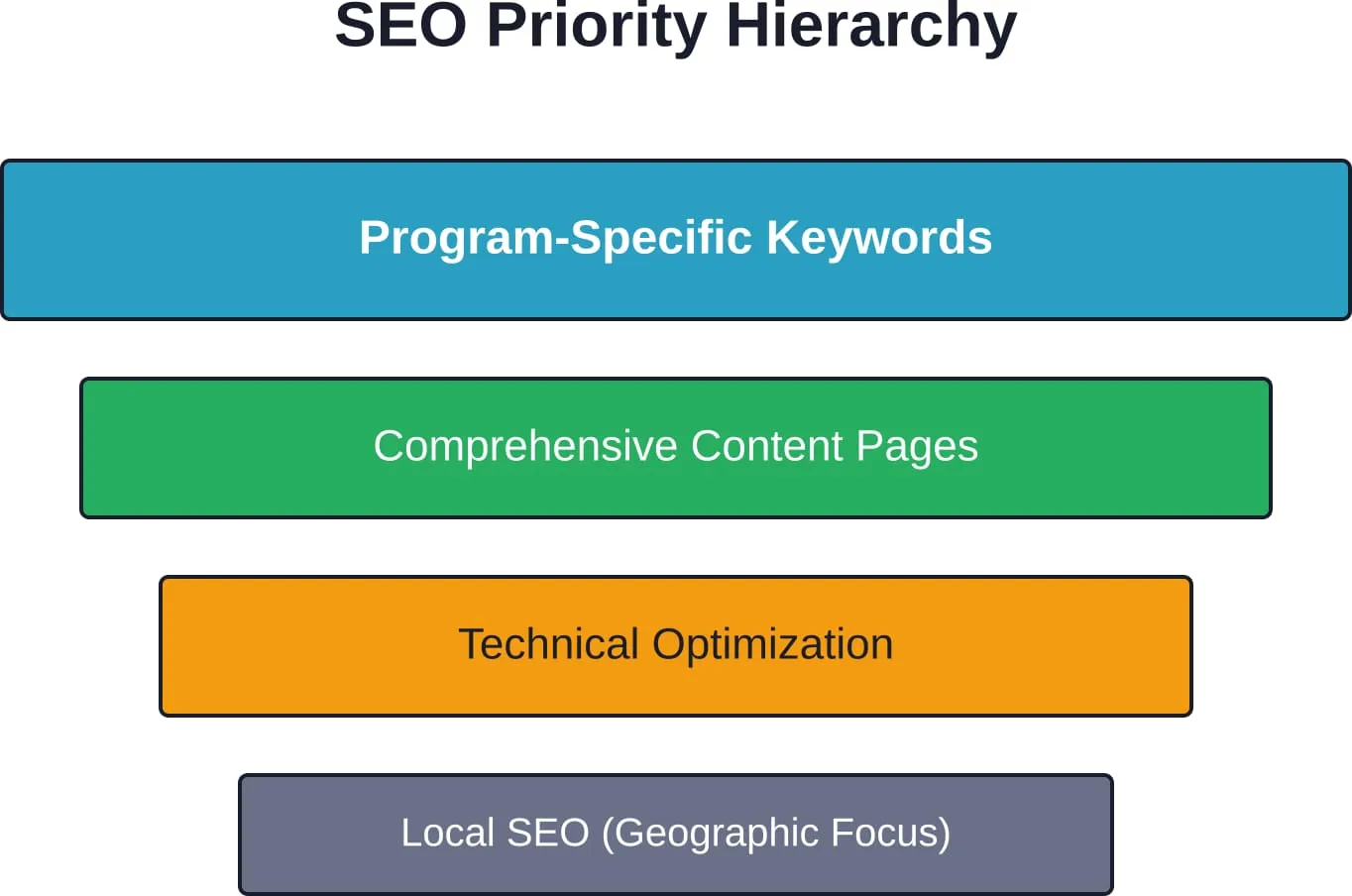
- Start with keyword research focused on program-specific terms. Generic phrases like “best college” generate traffic but rarely conversions. Instead, target specific queries: “biomedical engineering programs with co-op opportunities,” “online MBA for working professionals,” “nursing programs near [city name].” These longer-tail keywords attract prospects with genuine interest.
- Content depth matters more than ever. Create comprehensive program pages that answer common questions, address concerns, and demonstrate value. Include admission requirements, curriculum details, career outcomes, faculty expertise, and student testimonials. AI tools prioritize thorough, authoritative content that genuinely answers user queries.
- Technical optimization can’t be ignored. Page speed, mobile responsiveness, secure connections (HTTPS), and proper schema markup all impact search rankings. Many educational websites lose prospects due to slow loading times or poor mobile experiences—problems easily fixed but frequently overlooked.
- Local SEO deserves special attention for institutions serving specific geographic areas. Claim and optimize Google Business profiles, ensure consistent name-address-phone (NAP) information across directories, and generate positive reviews from current students and alumni. For community colleges and regional universities, local search visibility directly impacts enrollment.
Content Marketing That Converts Prospects Into Applicants
Content marketing remains one of the most effective strategies for educational institutions, but execution matters enormously. Generic blog posts about “5 study tips” won’t move the enrollment needle. Strategic content addresses specific prospect concerns at different stages of their decision journey.
Early-stage prospects need awareness content: industry trends, career outlooks, program comparisons, and educational pathways. Mid-stage prospects want evaluation content: curriculum details, faculty expertise, campus facilities, student support services. Late-stage prospects require conversion content: financial aid information, application guidance, success stories from current students.
Quality absolutely trumps quantity. One thoroughly researched, comprehensive article about career outcomes in specific programs generates more value than ten generic posts. Institutions that invest wisely in content marketing benefit from compounding returns—evergreen content continues attracting prospects years after publication.
Video Content: The Marketing Tool Educational Institutions Can’t Ignore
Video has become essential. According to competitor content, approximately 91% of companies using video marketing report it as an extremely powerful tool, and educational institutions see similar results. The e-learning market is expected to reach $458 billion in value by 2026, and video drives much of that growth.
But not all video content works equally well. Virtual campus tours generate engagement when they showcase authentic student experiences, not just buildings. Faculty interviews work when professors discuss research, teaching philosophy, and student mentorship—not when they recite scripted talking points. Student testimonials convert when they address specific concerns: “How did you afford this program?” “What surprised you most about campus culture?” “How did faculty support your career goals?”
Short-form video deserves particular attention. Platforms like TikTok and Instagram Reels reach younger prospects where they already spend time. Quick tips, day-in-the-life clips, and behind-the-scenes moments humanize institutions and build connection. These don’t require Hollywood production budgets—authenticity matters more than polish.
Video SEO amplifies reach. Optimize titles and descriptions with relevant keywords, add accurate transcripts for accessibility and searchability, and host videos on institutional websites (not just YouTube) to capture SEO value. Embed videos on program pages and blog posts to increase time on site, a metric search engines consider when ranking content.
Social Media Strategies That Actually Drive Enrollment
Social media marketing for educational institutions requires strategy beyond posting graduation photos and campus events. Effective social marketing identifies where target audiences spend time, delivers content that resonates, and guides prospects toward enrollment actions.
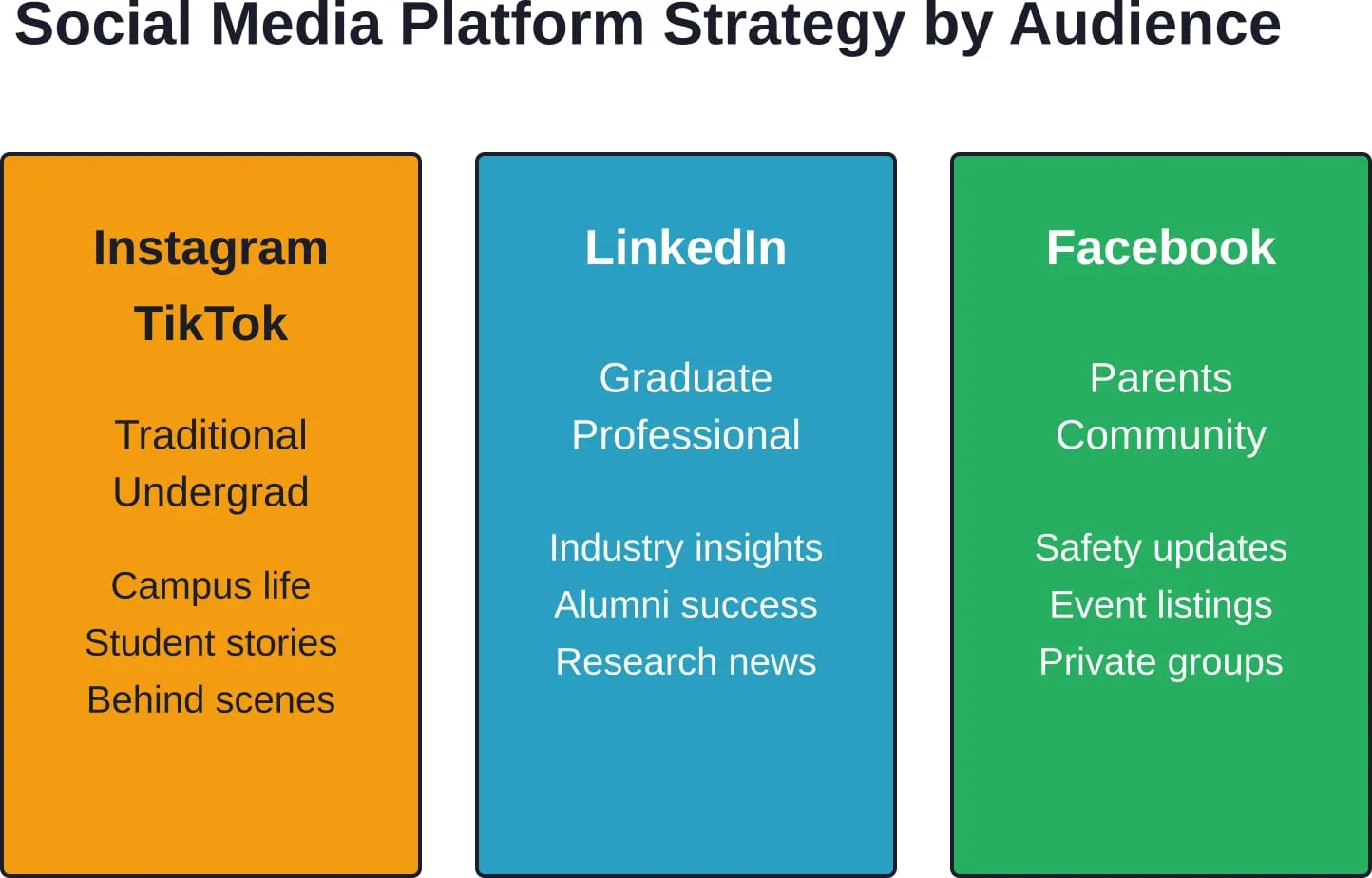
- Platform selection matters. LinkedIn works exceptionally well for graduate programs, professional certificates, and executive education. Instagram and TikTok reach traditional undergraduate prospects. Facebook still delivers results for parent audiences and community engagement. Spreading efforts too thin across every platform dilutes impact—focus where target audiences actually engage.
- Content strategy should balance promotional posts with value-driven content. Share student achievements, faculty research, industry partnerships, and alumni success stories. Respond to comments and messages promptly. Run live Q&A sessions addressing common admissions questions. Use hyper-local geo-tags and city-specific hashtags to reach students in target geographic areas.
- Paid social advertising allows precise targeting impossible with organic reach alone. Facebook and Instagram ads can target specific age ranges, geographic locations, education levels, interests, and behaviors. LinkedIn ads reach professionals with specific job titles, company sizes, and industries. This precision makes paid social particularly effective for specialized programs with clearly defined target audiences.
Building Community Through Social Engagement
Social media’s real power lies in community building, not broadcasting. Showcase current students, encourage user-generated content, and create opportunities for prospective students to interact with the institutional community before they even apply.
Student takeovers work remarkably well. Let current students run institutional social accounts for a day, sharing their authentic experiences. Feature different programs, student organizations, or campus subcultures to demonstrate diversity and vibrancy. These unscripted glimpses into student life build trust far more effectively than polished marketing materials.
Create private Facebook groups or Discord servers for admitted students before they start classes. These spaces let incoming students connect with peers, ask questions, and build excitement. They also reduce summer melt—when admitted students fail to enroll—by maintaining engagement between acceptance and move-in day.
Monitor conversations about the institution across platforms. Respond to questions, address concerns, and thank people for positive mentions. Social listening tools identify trends, common questions, and reputation issues that marketing strategies should address.
Data-Driven Personalization and AI-Powered Marketing
Personalization has shifted from being a competitive advantage to an expectation. Prospective students now anticipate communications tailored to their interests, program preferences, and stage in the enrollment journey. Generic mass emails often get deleted, while personalized outreach drives engagement.
Segment and Target Prospects
Marketing automation platforms make personalization scalable. Segment prospect lists by program interest, academic level, geographic location, and engagement behavior. Send targeted email sequences that address the unique concerns of each segment. For example, an engineering prospect receives content about lab facilities, research opportunities, and industry partnerships, while a nursing prospect sees information on clinical placements, NCLEX pass rates, and healthcare employer connections.
Trigger Timely Communications
Behavioral triggers create relevant touchpoints. When a prospect downloads a program brochure, send a follow-up email from a program director. If someone starts an application but doesn’t submit, send a helpful reminder with support resources. For admitted students who haven’t registered for orientation, provide encouragement and logistical information.
Leverage AI Tools for Enhanced Personalization
AI enhances personalization further. Chatbots can answer common questions instantly, 24/7, when admissions offices are closed. Predictive analytics identify which prospects are most likely to enroll, enabling recruitment teams to prioritize outreach. Natural language processing can analyze application essays and social media interactions to understand prospect motivations and concerns.
Combine Technology With Human Connection
Technology cannot replace human interaction. Use AI to handle routine tasks and surface insights, then deploy staff for high-value interactions. Personal phone calls from current students, one-on-one conversations with faculty, and campus visits remain critical in building trust and encouraging enrollment.
Building Brand Awareness and Institutional Reputation
Brand awareness determines whether prospective students consider an institution during their search. Strong brands attract applications; weak brands struggle to fill seats even with quality programs.
Brand building requires consistency across all touchpoints. Visual identity, messaging, tone of voice, and positioning must align whether someone encounters the institution on Instagram, through a direct mail piece, at a college fair, or on the website. Inconsistency creates confusion and erodes trust.
Mission-driven campaigns resonate particularly well for educational institutions. Students want to attend institutions that stand for something beyond just providing degrees. Highlight social impact initiatives, research addressing real-world problems, commitment to accessibility and inclusion, or unique pedagogical approaches. Authentic purpose differentiates institutions in crowded markets.
Demonstrate career value explicitly. The number one concern for most prospective students and their families is return on investment. Showcase employment outcomes, average starting salaries, graduate school acceptance rates, and employer partnerships. Concrete data about career results speaks louder than vague promises about quality education.
Leveraging Alumni Networks for Marketing Impact
Alumni represent an institution’s most powerful marketing asset, yet many schools underutilize these networks. Successful graduates provide living proof of institutional value, and their stories resonate with prospective students in ways that official marketing materials never can.
Create formal alumni ambassador programs. Recruit enthusiastic graduates willing to share their experiences on social media, speak at recruitment events, conduct informational interviews with prospects, or host regional receptions. Provide talking points, branded assets, and appreciation for their time.
Feature alumni prominently in marketing materials. Case studies showing career progression from admission through graduation to professional success tell compelling stories. Video testimonials from alumni describing how specific programs, faculty relationships, or campus experiences shaped their careers carry enormous credibility.
Make alumni easy to find and connect with. Create searchable online directories allowing prospects to find graduates in specific careers, industries, or locations. Facilitate networking between admitted students and alumni in their intended fields. These connections help prospects envision their own success.
Event Marketing: Virtual and In-Person Strategies
Events remain essential recruitment tools, but the mix of virtual and in-person has permanently shifted. Effective event marketing now requires hybrid strategies that maximize reach while providing meaningful engagement opportunities.
- Virtual open houses lower barriers to participation. Geographic distance, work schedules, and financial constraints no longer prevent interested prospects from learning about programs. Record sessions for on-demand viewing to extend value beyond the live event. Include interactive elements—live Q&A, breakout rooms by program, virtual campus tours—to maintain engagement.
- In-person campus visits still convert prospects at higher rates than any virtual experience. The intangible feel of campus, spontaneous conversations with current students, and visceral sense of fit can’t be fully replicated digitally. Make campus visits easy to schedule, highly personalized, and focused on prospect priorities rather than rehearsed scripts.
- College fairs and high school visits extend geographic reach for undergraduate recruitment. But quality matters more than quantity. Target schools with strong track records of sending students to similar institutions. Prepare engaging booth displays and train representatives to ask questions, listen actively, and have genuine conversations rather than delivering sales pitches.
- Host specialized events for specific audiences: admitted student days, transfer student workshops, adult learner information sessions, graduate program preview weekends. Tailored events address specific concerns and demonstrate understanding of diverse student needs.
| Event Type | Best For | Key Success Factors | Typical Conversion Rate |
|---|---|---|---|
| Virtual Open House | Initial awareness, wide reach | Interactive elements, recorded sessions | 5-8% to application |
| Campus Visit | Serious prospects, final decision | Personalization, student interaction | 40-60% to enrollment |
| College Fair | Building prospect pipeline | Engaging displays, active listening | 2-4% to application |
| Admitted Student Day | Yield conversion | Peer connections, program depth | 70-85% to enrollment |
Financial Aid Marketing and Affordability Messaging
Cost concerns rank among the top barriers to enrollment. Most public and private colleges have addressed affordability concerns by increasing spending on institutional grants and scholarships. According to NACUBO’s 2022 Tuition Discounting Study, 56.2% of tuition and fee revenue was institutional grant aid for first-time, full-time undergraduates, and the average tuition discount rate for first-time students reached 56.2%.
But many prospective students don’t understand financial aid basics. Terms like “net price,” “expected family contribution,” and “cost of attendance” confuse families. Marketing materials must explain financial aid clearly, using plain language and concrete examples.
Lead with net price, not sticker price. The published tuition rate scares many qualified prospects away before they explore financial aid opportunities. Prominently feature net price calculators on websites and in communications. Show examples of actual financial aid packages for students from different income brackets.
Communicate scholarship opportunities early and often. Many prospects assume they won’t qualify for merit aid or that the application process is too complex. Clearly explain eligibility criteria, application processes, and deadlines. Feature scholarship recipients in marketing materials to help prospects see themselves as potential award winners.
Measuring Marketing Effectiveness: Metrics That Matter
Marketing without measurement wastes resources. Educational institutions must track the right metrics to understand what’s working, what’s not, and where to allocate budgets for maximum impact.
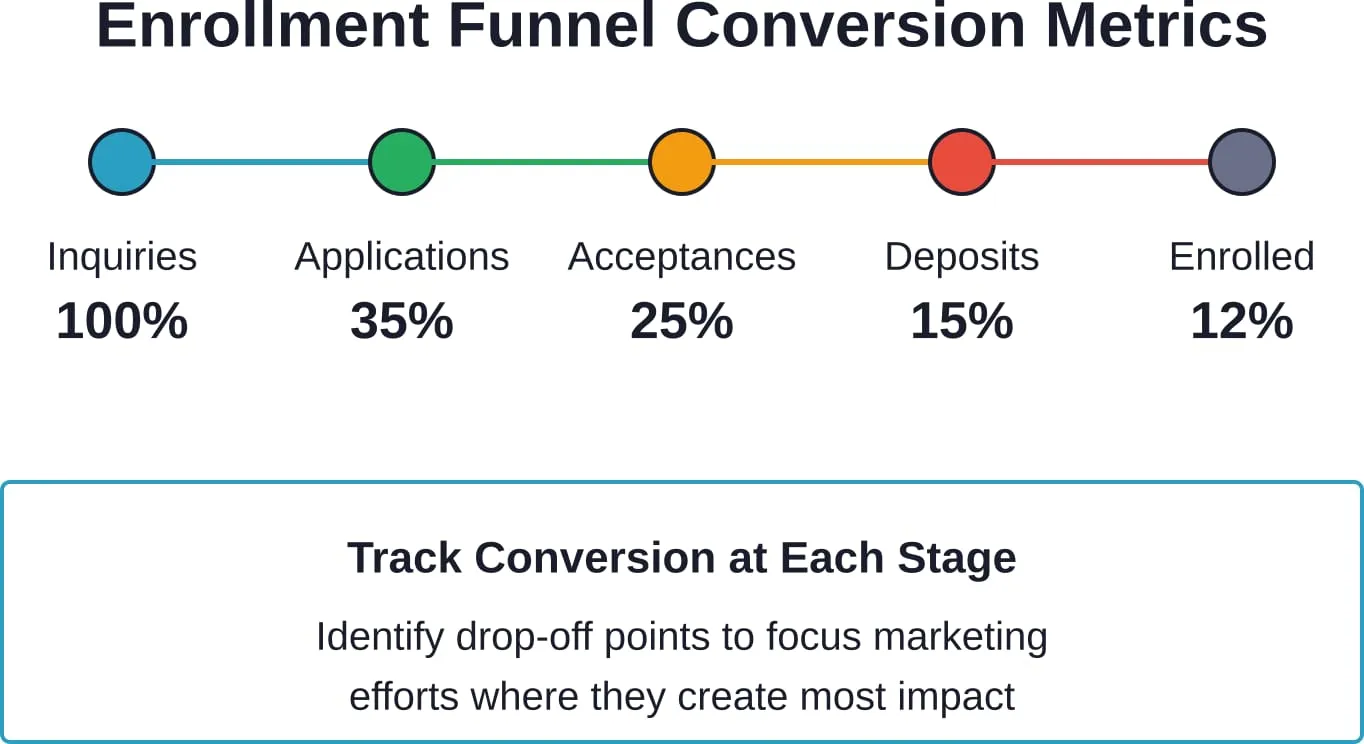
Enrollment funnel metrics provide the foundation. Track prospects at every stage: inquiries, applications started, applications submitted, acceptances, deposits, and final enrollment. Calculate conversion rates between stages to identify bottlenecks. If application-to-acceptance conversion is strong but acceptance-to-enrollment is weak, focus on yield strategies rather than generating more applications.
Digital marketing metrics reveal channel effectiveness. Website traffic, bounce rate, time on site, and pages per session indicate content quality and user experience. Email open rates, click-through rates, and conversion rates show message resonance. Social media engagement, reach, and follower growth demonstrate community building success.
Attribution modeling connects marketing activities to enrollment outcomes. Which touchpoints influenced students who eventually enrolled? Was it the campus visit, email campaign, social media ad, or alumni connection? Multi-touch attribution provides insights that last-touch or first-touch models miss.
Cost per acquisition remains the ultimate metric. Divide total marketing spend by number of enrolled students to calculate average recruitment cost. Compare across channels and campaigns to identify the most efficient strategies. But balance efficiency with effectiveness—the lowest cost per acquisition doesn’t help if those students fail to persist or succeed.
Common Marketing Mistakes Educational Institutions Make
Even well-intentioned marketing efforts fail when institutions make predictable mistakes. Recognizing these pitfalls helps avoid wasted resources and missed opportunities.
- Marketing in silos undermines effectiveness. When admissions, communications, academic departments, student services, and alumni relations operate independently, messaging becomes inconsistent, efforts duplicate unnecessarily, and opportunities for collaboration are missed. Cross-functional collaboration isn’t optional—it’s essential for coherent institutional marketing.
- Focusing on features instead of benefits loses prospect attention. Students don’t care that a campus has a new recreation center or state-of-the-art laboratory equipment. They care about what those facilities mean for their experience and outcomes. Frame every feature as a benefit: “The new recreation center offers stress relief and community building during demanding semesters” not “Our campus has a 50,000 square foot recreation facility.”
- Ignoring mobile experience alienates prospects. The majority of initial research happens on smartphones. Websites that don’t render properly on mobile devices, application processes requiring desktop computers, or video content that doesn’t stream smoothly on phones create frustration that sends prospects elsewhere.
- Neglecting current student and alumni experiences damages reputation. No marketing campaign can overcome poor student experiences or unhappy alumni. Word-of-mouth remains incredibly powerful—both positive and negative. Institutions must deliver on marketing promises or face reputation consequences that no amount of spending can repair.
Creating a Comprehensive Marketing Plan for Educational Institutions
Strategic marketing requires planning, not just tactics. A well-designed marketing plan provides direction, coordinates efforts, and ensures accountability for results.
Define Clear Enrollment Goals
Start with specific, measurable objectives. How many students need to enroll? In which programs? From which demographic or geographic segments? Goals should be SMART—specific, measurable, achievable, relevant, and time-bound. Vague aims like “increase enrollment” do not give sufficient guidance for strategy development.
Conduct Market Research
Understand your competitive positioning, target audience characteristics, market trends, and institutional strengths. Survey current students about why they chose your institution and interview admitted students who chose competitors. Research grounds strategy in reality rather than assumptions.
Develop Positioning and Messaging
Clearly define what makes the institution distinctive. Identify the value provided that competitors don’t offer and craft messaging that resonates with your target audience. Positioning should be truthful, relevant, and differentiating.
Allocate Budget Strategically
Focus resources on the channels and tactics most likely to reach your target audiences and drive desired actions. Balance ongoing presence (SEO, content creation, social media) with campaign bursts (paid advertising during peak recruitment seasons).
Establish Roles and Responsibilities
Assign ownership for every marketing initiative. Determine who creates content, manages social accounts, coordinates events, analyzes data, and communicates results. Clear accountability prevents missed deadlines and dropped tasks.
Build in Evaluation and Adjustment
Review key metrics monthly to catch issues early. Conduct quarterly strategy assessments to determine if adjustments are needed and an annual comprehensive evaluation to identify successes, challenges, and improvements for the next cycle.
Taking Action on Educational Institute Marketing
Effective marketing for educational institutions requires both strategic thinking and consistent execution. The institutions thriving in today’s competitive landscape share several characteristics: they understand their target audiences deeply, they communicate value clearly, they leverage digital channels strategically, and they measure results continuously.
Start with foundation building. Ensure the institutional website provides excellent user experience, loads quickly on mobile devices, and contains comprehensive information prospects need. Implement strong SEO practices so programs appear when students search. Create high-quality content addressing prospect questions and concerns at different stages of their decision journey.
Layer in engagement strategies. Develop authentic social media presence on platforms where target audiences spend time. Create compelling video content showcasing student experiences, faculty expertise, and program outcomes. Build email nurturing sequences that provide value and maintain connection with prospects over time.
Add personalization and sophistication. Segment audiences and tailor messaging to specific interests and concerns. Use marketing automation to deliver timely, relevant communications. Implement chatbots for instant responses to routine questions. Deploy predictive analytics to identify high-probability prospects deserving additional recruitment attention.
But remember—marketing is ultimately about people, not platforms. Technology enables reach and efficiency, but human connection drives enrollment decisions. Empower staff to build genuine relationships with prospects. Train faculty to communicate their passion for teaching and mentoring. Engage current students and alumni as authentic ambassadors sharing real experiences.
The education sector faces genuine challenges, from demographic shifts to affordability concerns to increased competition. But institutions that commit to strategic, data-driven, student-centered marketing will not just survive—they’ll position themselves for sustainable growth in the years ahead.
The question isn’t whether to invest in marketing. It’s whether to invest strategically in marketing that actually works. Start with the fundamentals, measure ruthlessly, adjust based on data, and stay focused on the mission: connecting students with educational opportunities that transform their lives.