


Quick Summary: Finance companies can stand out through targeted content marketing, personalized customer experiences, and compliant digital strategies. The most effective approaches combine educational content, data-driven personalization, and multi-channel engagement while navigating strict regulatory requirements. Successful financial marketing in 2026 requires balancing innovation with compliance, leveraging SEO and social media, and building trust through transparent communication.
Marketing in the financial services sector isn’t like marketing anything else. There’s regulatory scrutiny at every turn, trust barriers higher than most industries, and customers who expect both personalization and absolute security.
The 2023 Edelman Trust Barometer found that globally, just 59% of consumers trusted financial service providers, marking the industry as the second least-trusted after social media. That’s the challenge.
But here’s the opportunity: many banks pursuing digital transformation strategies face challenges in achieving expected outcomes, while the ones that do combine compliance-first thinking with genuine customer value creation. They don’t just push products—they educate, personalize, and meet customers where they are.
This guide breaks down marketing ideas that actually work for finance companies in 2026, from content strategies that build authority to digital campaigns that respect both regulations and customer intelligence.
Understanding the Financial Marketing Landscape
Financial services marketing operates under constraints most industries never face. The SEC’s modernized marketing rule, finalized in December 2020, fundamentally changed how investment advisers can advertise.
The rule permits testimonials and endorsements but requires written agreements with promoters—except where the promoter is an affiliate or receives de minimis compensation (specifically, $1,000 or less over the preceding twelve months). Every claim must be evidence-based, cannot be deceptive or unfair, and must withstand regulatory review.
That’s not a limitation—it’s a filter. The financial marketers who succeed treat compliance as a competitive advantage, not a burden.
Trust as the Foundation
Recent financial crises created lasting skepticism. Customers don’t just want better rates or sleek apps. They want to know their money is safe and their advisor isn’t hiding conflicts of interest.
Marketing that acknowledges this reality—that leads with transparency, education, and proof—cuts through where promotional fluff fails.
Build Finance Company Marketing With Lengreo
Finance companies need clear service pages, search visibility, and inquiry paths that make complex offers easier to understand.
Lengreo helps connect website development, SEO, paid ads, content, tracking, lead generation, appointment setting, and demand generation into one setup.
Need Marketing That Supports Real Finance Inquiries?
Lengreo can help with:
- improving service, trust, and contact pages
- setting up SEO and paid traffic campaigns
- tracking forms, calls, and lead sources
- supporting lead generation and appointment setting
👉 Contact Lengreo to discuss your marketing setup.
Content Marketing That Builds Authority
Content marketing for financial services has become essential, not optional. According to research mentioned in competitor content, decision-makers leverage news content in curated emails or as part of their blog strategy, making content an important component of modern financial marketing strategy.
The best financial content doesn’t sell products directly. It answers the questions prospects are already asking: “How do I reduce tax liability?” “What’s the real cost of early retirement?” “Should I refinance now or wait?”
Educational Content That Converts
Educational content works because it positions the firm as the expert customers turn to before making decisions. When someone reads five blog posts explaining retirement planning concepts on your site, they’re not comparison shopping anymore—they’re pre-sold.
Create content around:
- Tax planning strategies for specific demographics (small business owners, retirees, high earners)
- Step-by-step guides for financial processes (refinancing, estate planning, college savings)
- Market analysis that explains without predicting (what rate changes mean for borrowers)
- Regulatory updates translated into plain language (how new rules affect customers)
The key is specificity. Generic advice about “saving more” gets ignored. Detailed analysis of “how the 2026 contribution limit changes affect catch-up contributions for 55+ earners” gets bookmarked.
Content Distribution Channels
Creating great content matters little if no one sees it. Financial firms should distribute through:
- SEO-optimized blog posts (long-form, 1,800+ words, targeting specific search queries)
- Email newsletters segmented by customer type and lifecycle stage
- LinkedIn articles and posts (where financial decision-makers actually spend time)
- Video content breaking down complex concepts in 2-3 minutes
- Downloadable guides and calculators (with appropriate lead capture)
Research indicates that nearly 50% of millennials use mobile banking, and they’re accessing content on the same devices. Every piece needs to work perfectly on mobile—fast loading, readable text, no pinch-and-zoom PDF nightmares.
Personalization at Scale
Customers expect personalized experiences. 78% of customers expect personalized support from their bank. Yet only 44% of banking consumers say their bank provides that personalization.
That gap is your opportunity.
Personalization in financial marketing means more than inserting a first name in an email. It means:
- Showing relevant products based on life stage and account history
- Sending educational content matched to customer sophistication level
- Timing outreach around predictable financial events (tax season, retirement age, college enrollment)
- Adjusting communication channel preference (some want text alerts, others prefer email)
Data-Driven Segmentation
Effective personalization requires robust data integration. Customer information lives in multiple systems—core banking platforms, CRM tools, marketing automation software, analytics dashboards.
The firms winning at personalization have unified these data sources. When a customer interacts with any touchpoint, the system updates a single customer profile that informs every subsequent interaction.
Targeted outreach programs can improve ROI compared to generic mass marketing approaches. The same principle applies to financial services—personalized campaigns generate better returns than mass marketing strategies that fail to account for individual customer needs and preferences.
Lifecycle Marketing
Different customers need different messages at different times. A 25-year-old opening their first checking account needs education about building credit. A 55-year-old with $800,000 in retirement savings needs estate planning guidance.
Build marketing campaigns around life stages:
- Young professionals: Credit building, first-time home buying, student loan management
- Growing families: College savings, life insurance, budgeting for dependents
- Established earners: Tax optimization, investment diversification, wealth preservation
- Pre-retirees: Retirement income planning, healthcare costs, Social Security timing
- Retirees: Estate planning, required minimum distributions, legacy giving
Each stage has distinct concerns, questions, and product needs. Marketing that acknowledges where someone actually is in their financial journey feels helpful rather than intrusive.
SEO Strategies for Financial Services
Search engine optimization matters enormously for financial firms because customers research financial decisions thoroughly before acting. Someone searching “best mortgage rates for self-employed borrowers” is actively shopping—that’s high-intent traffic worth capturing.
Keyword Strategy
Financial services SEO requires targeting the right keywords. Generic terms like “financial advisor” have brutal competition. Specific long-tail queries like “fee-only financial advisor for teachers in Austin” have far less competition and much higher conversion rates.
Build keyword clusters around:
- Service + location combinations (“wealth management Denver,” “business lending Seattle”)
- Service + demographic (“retirement planning for federal employees,” “small business accounting for restaurants”)
- Problem + solution phrases (“how to reduce capital gains tax,” “refinance with low credit score”)
- Comparison queries (“traditional IRA vs Roth IRA,” “15-year vs 30-year mortgage”)
Create comprehensive content targeting each cluster. One 2,500-word guide answering every question about “Roth IRA conversions for high earners” will outperform ten 250-word shallow articles.
Technical SEO Requirements
Financial websites must load quickly and work flawlessly on mobile. Page speed directly impacts rankings, and slow-loading pages kill conversions.
Technical checklist:
- HTTPS encryption everywhere (non-negotiable for financial sites)
- Mobile-responsive design that adapts to any screen size
- Page load times under 2 seconds
- Structured data markup for local businesses, FAQs, and articles
- XML sitemap submission to search engines
- Clean URL structure with descriptive slugs
Local SEO for Branch-Based Firms
Banks, credit unions, and advisory firms with physical locations need local SEO. When someone searches “financial advisor near me,” you want to appear in the map pack.
Local SEO essentials:
- Claim and optimize Google Business Profile for every location
- Ensure NAP (name, address, phone) consistency across all directories
- Collect and respond to Google reviews
- Create location-specific pages with unique content for each branch
- Build local citations in financial directories and chamber of commerce listings
Social Media Strategy for Finance
Social media marketing for financial services requires careful navigation. Platforms want engaging, shareable content. Regulators want provable, compliant claims. The intersection of those demands is narrow but navigable.
Platform Selection
Not every platform deserves equal investment. Financial services firms should focus on:
- LinkedIn: Primary platform for B2B financial services and professional advisors. Decision-makers actually engage here.
- Facebook: Useful for community banks and credit unions with local focus. Good for event promotion and community engagement.
- YouTube: Excellent for educational video content that builds authority. Long-form explainer videos perform well.
- Twitter/X: Real-time market commentary and customer service. High effort, moderate return for most firms.
Instagram and TikTok work for firms targeting younger demographics but require consistent visual content production. Most traditional financial firms lack the internal capability to execute these platforms well.
Content That Works on Social
Financial firms often post boring content—rate announcements, corporate news, generic tips. That gets ignored.
Social content that generates engagement:
- Market analysis broken into simple visuals (charts, infographics, data visualizations)
- Client success stories (with permission and appropriate disclaimers)
- Behind-the-scenes content showing company culture
- Quick video tips (30-60 seconds) answering common questions
- Myth-busting posts correcting financial misconceptions
- Interactive content (polls, quizzes, question prompts)
Every post needs appropriate disclosures and disclaimers. Work with compliance teams to develop pre-approved content templates that marketers can use without individual review.
Email Marketing That Converts
Email remains one of the highest-converting channels for financial services. When someone gives you their email address, they’re granting permission to stay in touch—don’t waste it with generic blasts.
Segmentation Strategy
Send different messages to different segments. Basic segmentation includes:
- Prospects vs. existing customers
- Product ownership (checking only vs. full relationship)
- Life stage (young professional, family, retiree)
- Engagement level (opens every email vs. rarely engages)
- Geographic location (for branch-based offers)
Advanced segmentation adds behavioral triggers: someone who downloaded the retirement planning guide gets a follow-up email series about retirement topics, not generic product promotions.
Campaign Types
Successful financial services email programs include multiple campaign types:
- Educational newsletters: Monthly or bi-weekly content roundups with market insights and tips
- Product promotions: Targeted offers for specific products to relevant segments
- Lifecycle campaigns: Automated sequences triggered by customer actions or dates
- Re-engagement campaigns: Win-back sequences for dormant contacts
- Event invitations: Webinars, seminars, branch events
Balance promotional and educational content. A ratio of 70% educational to 30% promotional keeps engagement high without burning out the list.
Paid Advertising in Financial Services
Paid advertising accelerates results but requires careful execution in financial services. Compliance reviews, higher costs-per-click, and regulatory restrictions make paid media more challenging than in other industries.
Search Advertising
Google Ads work well for high-intent searches. Someone searching “apply for business loan” is ready to take action. The challenge is cost—competitive financial keywords can cost $20-50 per click or more.
Make search ads profitable by:
- Targeting long-tail, specific keywords instead of broad generic terms
- Using location targeting to avoid wasting budget on irrelevant geographies
- Creating dedicated landing pages for each ad group
- Implementing conversion tracking to measure actual ROI
- Testing ad copy continuously to improve click-through rates
Display and Retargeting
Display advertising builds awareness but rarely drives direct conversions for financial services. Retargeting—showing ads to people who visited the website but didn’t convert—performs better.
Retargeting works because financial decisions involve research. Someone comparing mortgage rates might visit ten sites before choosing one. Staying visible during that consideration period increases the chance they return to complete an application.
Social Media Advertising
Facebook and LinkedIn ads allow precise demographic and behavioral targeting. LinkedIn works well for B2B financial services (commercial lending, business banking, institutional investment). Facebook works for retail banking, insurance, and consumer lending.
Both platforms require extensive compliance review. Every ad variation needs approval before launch, which slows campaign deployment but prevents regulatory issues.
| Channel | Best For | Average CPC Range | Conversion Timeline |
|---|---|---|---|
| Google Search | High-intent keywords | $20-$60 | Days to weeks |
| LinkedIn Ads | B2B financial services | $8-$15 | Weeks to months |
| Facebook Ads | Consumer finance products | $2-$8 | Weeks |
| Display Retargeting | Consideration stage nurture | $1-$4 | Weeks to months |
Community Engagement and Events
Local financial institutions have an advantage digital-only competitors lack: physical presence and community connections. Leveraging that advantage requires active community engagement.
Educational Seminars and Webinars
Free financial education events position the firm as a trusted resource. Host seminars on topics like:
- First-time home buyer programs
- Small business financial management
- Medicare and retirement planning
- College savings strategies
- Estate planning basics
Virtual webinars expand reach beyond the local area and cost less to execute than in-person events. Record webinars and repurpose them as lead magnets.
Partnership Marketing
Partner with complementary businesses to reach new audiences. Real estate agents, CPAs, attorneys, insurance agents—all serve overlapping customer bases with financial institutions.
Partnership ideas include:
- Co-hosted educational events
- Referral arrangements with appropriate compensation structures
- Cross-promotion in newsletters and social media
- Joint content creation (co-authored guides, podcast interviews)
Structure partnership arrangements carefully to comply with anti-kickback and referral fee regulations. Legal and compliance review is essential.
Measuring Marketing Performance
Marketing without measurement is just spending money and hoping. Financial services firms need clear metrics connecting marketing activities to business outcomes.
Key Performance Indicators
Track metrics that matter:
- Cost per lead: Total marketing spend divided by leads generated
- Lead-to-customer conversion rate: Percentage of leads that become customers
- Customer acquisition cost: Total cost to acquire one new customer
- Customer lifetime value: Total revenue expected from one customer relationship
- Marketing ROI: Revenue attributed to marketing divided by marketing cost
Break these down by channel to identify which marketing activities generate positive returns and which waste budget.
Attribution Challenges
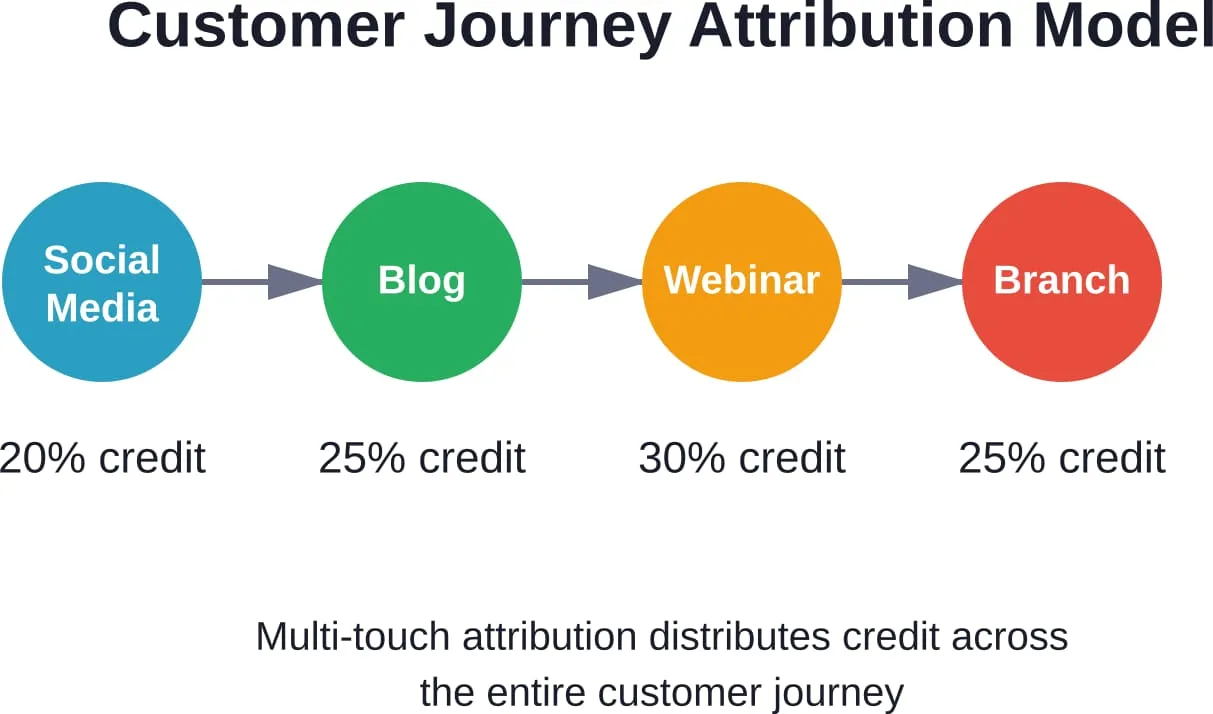
Financial services face attribution complexity. Someone might see a social media post, read three blog articles, attend a webinar, and then walk into a branch two months later. Which marketing activity deserves credit for that customer?
Multi-touch attribution models attempt to assign credit across multiple touchpoints. While imperfect, these models provide better insight than last-click attribution, which ignores all the marketing touches that happened before the final conversion.
Compliance-First Marketing Approach
Every marketing idea in this guide must pass compliance review. Rather than treating compliance as an afterthought, successful financial marketers build compliance into the creative process from the start.
Working with Compliance Teams
Compliance teams aren’t there to kill marketing ideas—they’re there to ensure marketing activities don’t expose the firm to regulatory risk. Build collaborative relationships by:
- Involving compliance early in campaign planning
- Providing context for why certain approaches matter
- Asking for guidance on acceptable alternatives when something gets rejected
- Creating pre-approved templates for routine marketing materials
- Documenting decisions for future reference
The SEC’s modernized marketing rule provides clearer guidance on testimonials, endorsements, and performance advertising. Understanding these rules helps marketers develop compliant campaigns without constant back-and-forth.
Documentation and Record-Keeping
Financial services regulations require maintaining records of marketing materials. Keep copies of:
- All advertisements and marketing materials
- Compliance approval documentation
- Performance claims and supporting data
- Testimonial and endorsement agreements
- Social media posts and engagement
Retention periods vary by regulation—some require seven years, others longer. Implement a system for archiving marketing materials with proper metadata for future retrieval.
Emerging Marketing Channels
Marketing channels continue evolving. What worked five years ago might be saturated today, while emerging channels offer first-mover advantages.
Podcast Sponsorships and Appearances
Financial podcasts have exploded in popularity. Sponsoring relevant podcasts or appearing as a guest expert builds awareness with highly engaged audiences.
Look for podcasts that reach the target demographic—business podcasts for commercial banking, personal finance shows for retail banking, investment podcasts for wealth management.
Video Content Beyond YouTube
Short-form video content on platforms like LinkedIn and even emerging platforms provides new ways to explain financial concepts. Three-minute explainer videos breaking down complex topics in simple terms generate engagement and shares.
The key is consistency. Posting one video per quarter accomplishes nothing. Committing to weekly or bi-weekly content builds an audience over time.
Financial Influencer Partnerships
Financial influencers—content creators focused on personal finance, investing, or business topics—reach audiences traditional advertising struggles to reach. Partnerships require careful structuring to comply with advertising rules.
The SEC requires written agreements with promoters, and influencer content must include appropriate disclosures. Work with legal counsel to structure compliant influencer partnerships.
Building Trust Through Transparency
Trust is the currency of financial services marketing. Every campaign, every piece of content, every customer interaction either builds or erodes trust.
Build trust through:
- Clear fee disclosure: Explain what things cost in plain language, not fine print
- Realistic expectations: Don’t promise guaranteed returns or oversimplify complex products
- Accessible expertise: Make it easy for customers to get questions answered
- Security transparency: Communicate clearly about data protection and fraud prevention
- Problem resolution: Handle complaints and errors quickly and fairly
Financial decisions carry significant consequences. Customers choosing a financial services provider want to know they’re making the right choice. Marketing that acknowledges the weight of those decisions—that treats customers as intelligent adults making important choices—stands out.
Moving Forward with Financial Marketing
Marketing for finance companies in 2026 means balancing multiple competing demands. Regulations constrain what marketers can say and how they can say it. Customer skepticism requires earning trust through transparency and education. Digital channels offer unprecedented targeting capabilities but also create new compliance challenges.
The financial marketers who succeed don’t fight these constraints—they use them as filters that force better, more substantive marketing. When you can’t rely on hype or exaggeration, you’re forced to provide genuine value. When every claim requires supporting evidence, you build content around provable facts and useful information.
Start with the fundamentals: know the target audience deeply, create genuinely helpful content, optimize for search visibility, personalize customer experiences, measure what matters, and never compromise on compliance. Master those basics before chasing the latest marketing trend.
The specific tactics will keep evolving—new platforms emerge, algorithms change, customer preferences shift. But the underlying principles remain constant: provide value, build trust, communicate clearly, and demonstrate expertise. Financial services marketing built on that foundation will generate results regardless of which channels dominate next year.