


Quick Summary: Staffing companies can accelerate growth through strategic marketing that combines digital presence optimization, multi-channel outreach, content-driven authority building, and data-backed client acquisition. The most effective approaches prioritize niche specialization, leverage AI-powered tools to streamline operations, and balance candidate attraction with client relationship development.
Staffing agencies face a unique marketing challenge in 2026. They’re selling to two audiences simultaneously—employers who need talent and candidates searching for opportunities. That dual focus demands precision.
The staffing market has shifted dramatically. According to the Bureau of Labor Statistics, total U.S. employment is projected to grow just 3.1% from 2024 to 2034, from 170.0 million to 175.2 million—a significant slowdown from the 13.0% growth seen in the previous decade. Slower employment growth means fiercer competition for both clients and candidates.
But here’s the thing: agencies that adapt their marketing strategies are thriving. AI adoption among staffing agencies reached 61% in 2025, according to the American Staffing Association. Conversational AI adoption reached 55% in 2025. These tools aren’t just buzzwords—they’re reshaping how agencies operate.
The fundamentals haven’t disappeared, though. Word-of-mouth, strategic partnerships, and brand authority still matter. What’s changed is how agencies execute those fundamentals at scale.
Define Your Market Niche Before Marketing Anything
Generic staffing agencies struggle. Specialized ones dominate.
The most successful agencies in 2026 don’t try to serve everyone. They carve out a specific niche—healthcare staffing, IT contractors, executive placement, light industrial, or specialized verticals like renewable energy or biotech.
Why does this matter for marketing? Because niche focus transforms vague messaging into laser-targeted value propositions. Instead of “We find great candidates,” specialized agencies can say “We place certified surgical techs within 48 hours” or “We supply Python developers with fintech experience.”
Start by analyzing historical client data. Which clients generated the highest margins? What industries did they represent? What hiring volume and frequency patterns emerged? The Bureau of Labor Statistics maintains detailed employment data by industry that can help identify growing sectors worth targeting.
Building an Ideal Client Profile
An ideal client profile should include company size, team structure, typical hiring volume, budget range, decision-making process, and cultural attitude toward recruitment partners.
Once that profile exists, every marketing dollar should target it. Content speaks to those specific pain points. Outreach focuses on companies matching that description. Digital advertising narrows to those demographics.
SHRM research found that 61% of recruiting professionals report a lack of qualified candidates. More than a quarter of unemployed people cannot be matched to job openings in their occupational group. That skills mismatch creates opportunity for agencies that specialize deeply enough to understand both the talent supply and employer demand in specific niches.
Organize Marketing System With Lengreo
Staffing companies need to speak to both employers and candidates without making the website or campaigns confusing. Lengreo helps align website pages, SEO, paid traffic, lead generation, appointment setting, and tracking around real business conversations.
Need Better Employer and Candidate Leads?
Lengreo can help with:
- improving employer, candidate, and service pages
- setting up SEO and paid campaigns
- supporting lead generation and appointment setting
- tracking inquiries and campaign results
👉 Contact Lengreo to discuss your marketing setup.
Optimize Digital Presence From the Ground Up
Every marketing initiative funnels back to digital properties. If those properties don’t convert, the marketing fails.
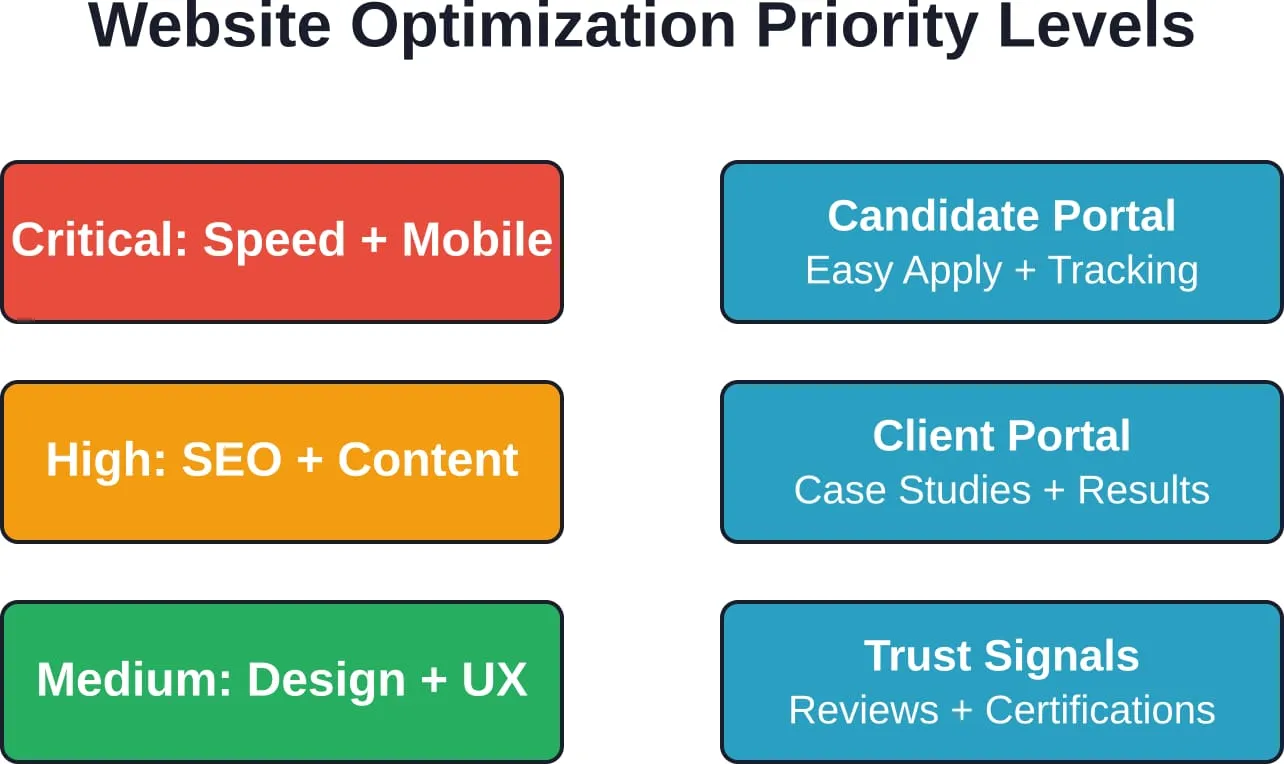
Website optimization starts with speed. Pages that load slowly lose candidates and clients before they even see the content. Mobile responsiveness is non-negotiable—most candidates browse opportunities on phones during breaks or commutes.
But technical performance is just the foundation. Content matters more.
Website Elements That Actually Convert
Landing pages should speak directly to the visitor’s intent. A candidate landing page looks completely different from a client landing page. Job listings need clear descriptions, transparent salary ranges when possible, and frictionless application processes.
Client-facing pages should showcase case studies, testimonials, placement speed metrics, and industry specialization. Vague promises don’t convert. Specific results do.
Search engine optimization determines whether anyone finds those pages. Staffing agencies should target both broad keywords (“IT staffing Boston”) and long-tail phrases (“contract-to-hire cloud architects Boston”). Local SEO matters enormously for agencies serving specific geographic markets.
Multi-Channel Outreach That Builds Familiarity
Cold calling alone doesn’t cut it anymore. Decision-makers respond to coordinated sequences that build familiarity before the ask.
Effective business development combines email, LinkedIn, and phone outreach in structured sequences. Someone might ignore a cold call but respond to an email three days later after seeing the LinkedIn connection request and remembering the company name.
The pattern looks like this: LinkedIn connection request with a personalized note, followed by valuable content sharing (not a sales pitch), then an email referencing a specific challenge the prospect’s industry faces, finally a phone call that references the previous touchpoints.
Cold Outreach Done Right
Structured outreach requires research. Generic spray-and-pray approaches waste time. Before contacting any prospect, staffing professionals should know the company’s recent hiring patterns (visible through job board data), growth indicators, industry challenges, and decision-maker names.
Email subject lines matter enormously. “Partnership opportunity” gets ignored. “Reducing your IT contractor time-to-fill from 30 to 12 days” gets opened.
LinkedIn outreach works when it provides value before asking for anything. Sharing relevant industry research, commenting thoughtfully on a prospect’s content, or introducing a useful contact builds goodwill. The sales conversation happens naturally after establishing credibility.
Content Marketing That Demonstrates Authority
Staffing agencies compete on expertise. Content marketing proves that expertise exists.
The most effective content answers questions that clients and candidates are actively searching for. For clients: “How much should I budget for contract developers?” “What’s the average time-to-fill for senior accountants?” “How do I evaluate staffing agency quality?”
For candidates: “What’s the difference between contract and contract-to-hire?” “How do staffing agencies get paid?” “Do temp jobs ever become permanent?”
Agencies that publish well-researched answers to those questions earn organic traffic, establish thought leadership, and create assets for outreach campaigns.
Content Formats That Work
Blog posts remain foundational, but video content increasingly drives engagement. Short videos explaining complex topics (“How we vet candidates” or “What happens after you apply”) build trust faster than text alone.
Salary guides position agencies as market experts. Publishing annual compensation data for specialized roles—even if the data set is small—creates a resource clients bookmark and reference.
Case studies convert better than almost any other content format. Specific results (“We filled 47 nursing positions in 30 days during their peak season”) carry more weight than generic promises.
A healthcare organization working with a recruitment partner optimized their employer brand and career website, which led to a 5% performance improvement of key buys representing over $500,000 of investment.
Social Media Strategy for Two Audiences
Social media serves dual purposes for staffing agencies—employer branding for candidates and thought leadership for clients.
According to industry research, 80% of small, mid-market, and enterprise businesses rate social media marketing as crucial. But many agencies struggle with measurement and strategy.
LinkedIn remains the primary platform for B2B client acquisition. Consistent posting of industry insights, market trends, and hiring advice builds credibility with decision-makers. Engagement matters more than follower count—meaningful conversations in the comments often lead to direct inquiries.
Platform-Specific Approaches
Instagram and Facebook work better for candidate attraction, especially in industries with visual appeal (hospitality, retail, light industrial). Behind-the-scenes content, employee spotlights, and day-in-the-life posts humanize the agency.
Video content performs consistently well across platforms. Short testimonials from placed candidates, quick hiring tips, or explanations of the staffing process require minimal production value but generate strong engagement.
Paid social advertising allows precise targeting. Agencies can reach hiring managers at specific company sizes in specific industries, or reach candidates with particular job titles in defined geographic areas. The targeting precision makes social ads more efficient than traditional advertising.
Email Marketing That Nurtures Relationships
Email remains one of the highest-ROI marketing channels when executed properly.
Staffing agencies should maintain separate email lists for clients, prospects, active candidates, and passive candidates. Sending the same message to all four groups wastes the opportunity.
Client newsletters should focus on market intelligence: hiring trends, salary benchmarks, labor market tightness, regulatory changes affecting employment. The goal is to become a trusted advisor, not just a vendor.
Candidate emails should highlight new opportunities, career advice, interview tips, and industry news. Frequency matters—too many emails annoy candidates, but quarterly newsletters let promising talent forget the agency exists.
Automated Sequences That Work
Email automation allows sophisticated nurture campaigns. When a prospect downloads a salary guide, an automated sequence can deliver related content over subsequent weeks, gradually moving from education to conversation.
Re-engagement campaigns bring dormant contacts back into play. A client who hasn’t used the agency in a year might respond to a “checking in” email that references industry changes or offers a fresh perspective on their hiring challenges.
Personalization increases response rates dramatically. Merge fields that insert the recipient’s name, company, or industry make emails feel individually crafted even when sent to hundreds of contacts.
Leveraging Technology and AI Effectively
Technology adoption separates growing agencies from stagnant ones in 2026.
As noted earlier, AI adoption among staffing agencies reached 61% in 2025, with conversational AI at 55% adoption and résumé parsing at 45% adoption. These tools handle repetitive tasks, allowing recruiters to focus on relationship-building.
Applicant tracking systems (ATS) have evolved beyond simple databases. Modern platforms integrate with job boards, parse résumés automatically, screen candidates based on configurable criteria, and even schedule interviews without human intervention.
AI-powered chatbots handle initial candidate inquiries, answer common questions about the application process, and pre-qualify applicants before a recruiter ever gets involved. That automation improves response time—a critical factor when competing for in-demand talent.
Data-Driven Decision Making
Marketing analytics determine which channels deliver ROI. Agencies should track metrics like cost-per-application for candidate marketing and cost-per-meeting for client acquisition.
Customer relationship management (CRM) systems track every client interaction, from initial outreach through placement and beyond. That historical data reveals patterns: which industries convert fastest, which outreach messages generate responses, which clients expand their usage over time.
The most sophisticated agencies use predictive analytics to identify which clients are likely to have upcoming needs based on historical hiring patterns, industry growth indicators, and seasonal trends.
Building Strategic Partnerships
Not all growth comes from direct marketing. Strategic partnerships multiply reach without proportionally increasing marketing spend.
Complementary service providers make natural partners. An IT staffing agency might partner with managed service providers who encounter clients needing additional headcount. A healthcare staffing firm might partner with medical practice consultants.
Professional associations and industry groups provide both networking opportunities and credibility. Active participation—speaking at events, serving on committees, contributing to publications—builds visibility within target markets.
Educational institutions represent untapped partnership potential, especially for entry-level and early-career staffing. Career services offices appreciate relationships with reputable agencies that genuinely help graduates find employment.
Measuring What Matters
Marketing without measurement is guesswork.
Key performance indicators (KPIs) should align with business objectives. If the goal is client acquisition, track metrics like prospect meetings booked, proposals sent, and conversion rate from proposal to contract. If the goal is candidate pipeline growth, track applications, qualified candidates, and time-to-engage.
Research indicates companies with comprehensive training programs see significant improvements in income per employee. That statistic applies internally—agencies that invest in training their own teams on marketing execution and relationship management outperform those that don’t.
| Marketing Channel | Primary Goal | Key Metrics | Typical ROI Timeline |
|---|---|---|---|
| Website/SEO | Inbound lead generation | Organic traffic, conversion rate, cost per lead | 6-12 months |
| LinkedIn Outreach | Client acquisition | Connection rate, response rate, meetings booked | 1-3 months |
| Content Marketing | Authority building | Traffic, engagement, backlinks, brand searches | 6-18 months |
| Email Campaigns | Nurture relationships | Open rate, click rate, replies, conversions | 3-6 months |
| Paid Advertising | Rapid visibility | Impressions, clicks, cost per acquisition | 1-2 months |
| Referral Program | Leverage existing network | Referrals generated, conversion rate, repeat referrers | Ongoing |
Client Retention as a Marketing Strategy
Acquiring new clients costs significantly more than retaining existing ones. Yet many agencies focus all marketing effort on acquisition.
Client retention starts with service delivery, but marketing plays a role. Regular communication keeps the agency top-of-mind when new needs arise. Quarterly business reviews demonstrate value beyond individual placements.
Research indicates employees are more likely to stay at companies that invest in career development. That same principle applies to client relationships—clients stay loyal to agencies that invest in understanding their evolving needs.
Upselling and cross-selling represent the highest-ROI business development activities. An agency that starts with temporary placements can gradually introduce temp-to-perm, direct hire, or managed service programs to satisfied clients.
Referral Programs That Generate Consistent Business
The best marketing is a satisfied client telling others about the experience.
Formal referral programs codify what often happens informally. Offering a placement discount or a finder’s fee for successful referrals incentivizes clients to actively recommend the agency rather than passively doing so.
Candidate referrals matter too. Placed candidates know others in their field. Incentivizing those referrals creates a self-perpetuating talent pipeline.
Adapting to Economic and Workforce Trends
The staffing industry doesn’t operate in a vacuum. External trends shape marketing strategy.
The American Staffing Association has identified several key trends for 2026, including increased AI and automation adoption, a shift toward skills-based hiring (with 45% of companies planning to eliminate degree requirements), and continued emphasis on internal talent marketplaces (which saw increased usage in 2025).
Economic uncertainty makes some companies hesitant to add permanent headcount, creating opportunity for contract staffing. Others seek cost certainty through managed service programs.
Workforce demographics shift continually. As of 2024, the Bureau of Labor Statistics reported employment at 170.0 million, but labor force participation varies by demographic. Agencies that understand which worker segments are growing versus shrinking can tailor recruitment marketing accordingly.
Common Marketing Mistakes to Avoid
Even well-intentioned marketing efforts fail when agencies make predictable mistakes.
- Trying to serve everyone dilutes messaging and wastes budget. As discussed earlier, niche specialization allows targeted, efficient marketing. Generalist agencies compete primarily on price, which erodes margins.
- Neglecting candidate experience damages employer brand. Candidates who have poor experiences—unreturned calls, lack of feedback, being ghosted after interviews—share those experiences publicly. Online reviews and social media amplify negative experiences.
- Inconsistent marketing produces inconsistent results. Posting on LinkedIn for two weeks, then going silent for months, fails to build momentum. Content marketing requires sustained effort over quarters and years.
- Ignoring data leads to repeated mistakes. If a particular outreach approach consistently fails to generate responses, continuing that approach is simply expensive. Regular analysis and willingness to pivot separate effective marketing from performative activity.
Taking Action on Marketing Strategy
Marketing ideas are worthless without execution.
The agencies that thrive in 2026 aren’t necessarily those with the biggest budgets. They’re the ones that execute consistently, measure relentlessly, and adapt quickly.
Start with the fundamentals: define the niche, optimize the digital presence, and establish multi-channel outreach systems. Those foundations enable everything else.
Layer in content marketing to build authority, social media to expand reach, and email campaigns to nurture relationships. Technology and AI amplify human effort—they don’t replace it.
Most importantly, remember that staffing is a relationship business. Marketing creates visibility and generates leads, but ultimately placements happen because people trust the agency to deliver. Every marketing touchpoint should reinforce that trust.
The staffing market will continue evolving. Agencies that build adaptable marketing systems—rather than relying on what worked five years ago—will capture disproportionate share of that evolution.