

Quick Summary: Website development for higher education requires a strategic, mobile-first approach focused on accessibility, user experience, and enrollment conversion. Modern institutional websites must integrate AI personalization, robust search functionality, and compliance with Section 508 accessibility standards while delivering content that prospective students can navigate seamlessly across devices.
College and university websites have evolved far beyond digital brochures. These platforms now serve as the primary recruitment tool, information hub, and first impression for prospective students researching their options.
The stakes have never been higher. More than 90% of students visit institutional websites during their search process, and their experience on that site directly influences application decisions. A slow, confusing, or mobile-unfriendly website doesn’t just frustrate visitors—it actively drives enrollment to competitors.
Mobile-First Design Has Become Non-Negotiable
Gen Z users spend an average of 7 hours and 22 minutes daily on their phones, with 75% identifying their phone as their go-to device. That behavioral shift has made mobile-first design an absolute requirement rather than a nice-to-have feature.
Nearly half of students—49%—report that a positive mobile experience improves their perception of an institution. The inverse holds equally true: a poor mobile experience drives prospective students away before they ever submit an inquiry form.
Responsive design that automatically adjusts layouts for different screen sizes represents the baseline expectation. Navigation must remain intuitive on smaller screens, forms need to function without excessive zooming or scrolling, and page load times must stay under three seconds across all devices.
Accessibility Standards Aren’t Optional
The Department of Education established Requirements for Accessible Electronic and Information Technology under Sections 504 and 508 of the Rehabilitation Act. These regulations mandate that institutional websites remain accessible to individuals with disabilities, including both employees and external users.
Compliance involves more than legal obligation—it expands reach to the broadest possible audience. Accessible design includes proper heading hierarchy for screen readers, sufficient color contrast ratios, alternative text for images, keyboard navigation support, and captions for video content.
Institutions that overlook accessibility requirements face potential legal action while simultaneously excluding qualified prospective students from their recruitment pipeline.
Search Functionality Makes or Breaks User Experience
Nearly 50% of high school students use site search to navigate college websites. That single statistic reveals how critical search functionality has become to the prospective student journey.
A powerful, visible search bar should appear on every page—not buried in a menu or accessible only from the homepage. The search engine itself needs intelligent indexing that understands common misspellings, synonyms, and natural language queries.
Search results should surface the most relevant content first, prioritizing program pages, admission requirements, and application deadlines over administrative policies or faculty directory entries when contextually appropriate.
Content Strategy Determines Enrollment Outcomes
Technical excellence means nothing if the content itself fails to engage prospective students. Institutional websites must answer the questions that matter most to applicants: program details, career outcomes, campus life, financial aid, and application processes.
Content should be organized around user intent rather than internal organizational structure. Students searching for information about psychology programs shouldn’t need to understand whether psychology falls under Arts & Sciences or Social Sciences in the institutional hierarchy—they should find program information through intuitive navigation paths.
Regular content audits identify outdated information, broken links, and gaps in coverage. Many institutions discover during these audits that critical information exists but remains effectively hidden due to poor information architecture.
AI-Powered Personalization Drives Engagement
Artificial intelligence has moved from experimental to mainstream in higher education web development. Career services professionals and other student-facing service providers have increasingly adopted AI tools for work tasks, reflecting broader institutional adoption trends across higher education.
Personalized content delivery based on user behavior, geographic location, or stated interests creates more relevant experiences. A prospective engineering student from California sees different featured programs and regional statistics than a nursing student from Texas browsing the same institutional website.
Chatbots powered by AI handle routine inquiries 24 hours per day, providing immediate responses about application deadlines, campus tours, and program requirements when human staff aren’t available.
Development Resources and Outsourcing Considerations
Small districts and schools face unique challenges when maintaining complex web presences. According to NCES guidance (2003), outsourcing to a local ISP offers significant advantages, including 24 hours per day operational availability without making demands on limited internal resources.
Larger institutions typically maintain in-house teams but still rely on specialized agencies for major redesign projects, CMS implementation, or ongoing optimization work. The decision between internal development and external partnerships depends on institutional size, technical capacity, budget constraints, and strategic priorities.
Regardless of the development approach chosen, clear governance structures prevent the fragmented, inconsistent experiences that plague many institutional websites when departments independently create and manage their own sections.
| Development Approach | Best For | Key Advantage | Primary Challenge |
|---|---|---|---|
| In-House Team | Large universities | Direct institutional control | Staffing and expertise gaps |
| Agency Partnership | Major redesigns | Specialized expertise | Higher upfront costs |
| ISP Outsourcing | Small institutions | 24/7 availability | Less customization |
| Hybrid Model | Medium institutions | Balanced resources | Coordination complexity |
Build an Education Website That Drives Enrollment
Higher education websites need to do more than look modern. Students expect fast access to programs, admissions information, and inquiry forms without friction. Lengreo develops websites and landing pages for organizations that need stronger structure, better usability, and a clearer path from visitor to inquiry. Their process includes discovery, prototyping, development, QA, and post-launch support, with websites built using JavaScript and WordPress.
Turn Website Visitors Into Student Inquiries
Lengreo helps higher education organizations improve how prospective students interact with their websites through:
- SEO-focused website structure
- Better inquiry and lead flow organization
- Front-end and back-end development
- QA testing before launch
- Post-launch support and maintenance
If your higher education website is outdated, difficult to manage, or not generating enough inquiries, contact Lengreo for a consultation.
Building Websites That Drive Institutional Success
Website development for higher education demands strategic thinking that balances technical excellence, user experience design, accessibility compliance, and enrollment marketing goals. The institutions that succeed treat their websites as dynamic platforms requiring continuous optimization rather than static projects completed and forgotten.
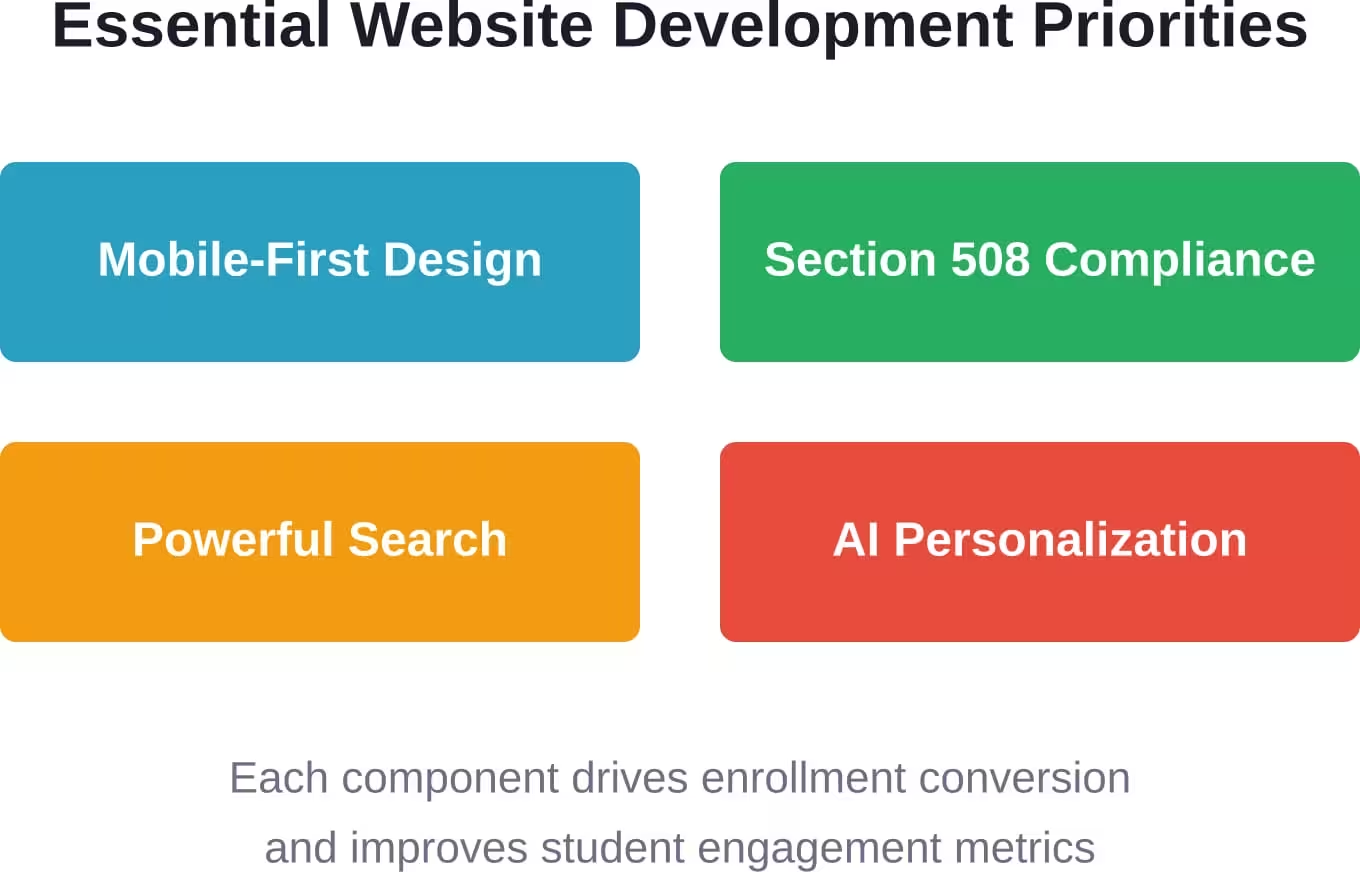
Mobile-first design, powerful search functionality, AI personalization, and Section 508 compliance represent foundational requirements. But technology alone doesn’t drive enrollment—content strategy, information architecture, and authentic institutional storytelling transform technical capabilities into competitive advantages.
The institutional website has become the most powerful tool in the enrollment marketing arsenal. Investing in strategic development, ongoing optimization, and user-centered design delivers measurable returns through increased applications, improved yield rates, and stronger institutional reputation.