Quick Summary: Website development for professional services demands a strategic approach that balances security, user experience, and client conversion. Modern professional services firms must prioritize robust cybersecurity measures, mobile-responsive design, and clear messaging that addresses specific client pain points. The right development approach combines technical excellence with trust-building elements while ensuring compliance with industry regulations and privacy standards.
Professional services firms face a unique challenge. The website needs to do more than look good — it has to establish credibility, demonstrate expertise, and convert high-value prospects into clients. And with cyberattacks becoming more sophisticated by the day, security can’t be an afterthought.
Here’s the thing: a generic website template won’t cut it. Not when potential clients are researching multiple firms before making contact. Not when data breaches can destroy a reputation overnight.
This guide covers the essential elements that make professional services websites work — from foundational strategy to technical implementation.
Why Professional Services Websites Require Different Development Approaches
Professional services firms sell expertise, not products. That fundamental difference shapes every development decision.
Traditional e-commerce sites optimize for transaction volume. Professional services sites optimize for trust and qualified leads. The client considering a law firm, accounting practice, or consulting engagement is making a high-stakes decision. They’re evaluating competence, compatibility, and confidence before they ever fill out a contact form.
The numbers back this up. According to SEC data, over 100 million people use investment apps, with 78% of investors aged 18-34 using these platforms. That shift toward digital-first engagement extends across all professional services — clients expect sophisticated online experiences.
But there’s a darker side to this digital transformation. Microsoft reports that its customers face 600 million cyberattacks daily. The FBI’s Internet Crime Complaint Center received over 880,000 complaints in 2023, with potential losses exceeding $12.5 billion.
For professional services firms handling confidential client data, these aren’t abstract statistics. They’re existential risks.
Security and Compliance: Non-Negotiable Foundations
Security needs to be baked into the development process from day one, not bolted on later.
The SEC’s enhanced Regulation S-P requirements, finalized in 2025, demand that financial services firms implement comprehensive information security programs. While these regulations specifically target investment advisers and broker-dealers, they set a baseline that all professional services should meet.
Essential Security Measures
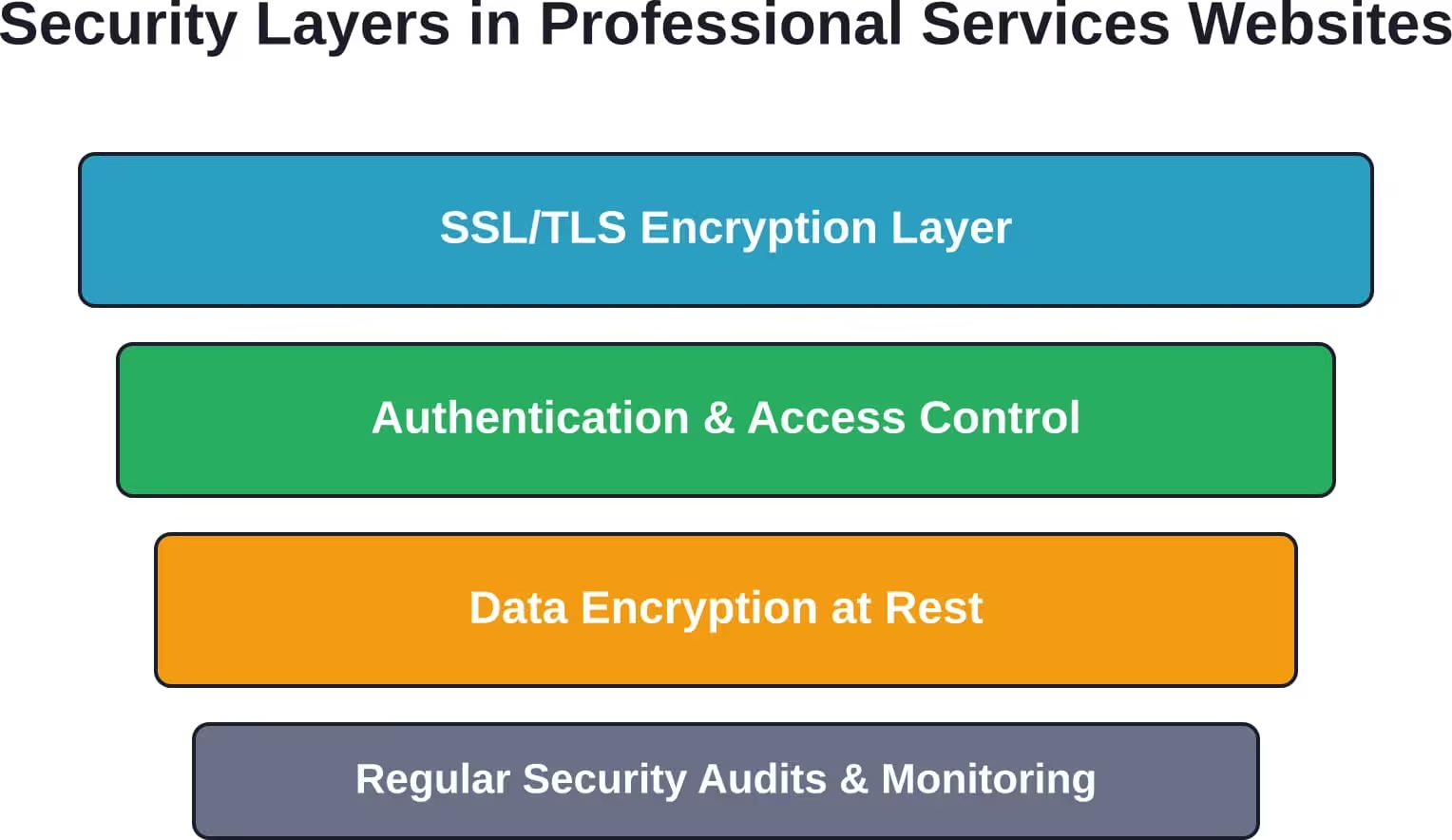
Every professional services website should implement these baseline protections:
- SSL/TLS encryption for all data transmission
- Regular security audits and penetration testing
- Multi-factor authentication for client portals
- Regular software updates and patch management
- Secure backup systems with encryption
- Privacy-by-design architecture
The ISO/IEC 27706:2025 standard provides requirements for bodies auditing and certifying privacy information management systems. IEEE standards for digital privacy offer additional frameworks worth considering, particularly IEEE P802E’s recommended practice for privacy considerations in IEEE 802 technologies.
Real talk: if the development team isn’t discussing security architecture in the first planning meeting, that’s a red flag.
Data Privacy Regulations
Professional services firms often handle sensitive personal information — financial records, health data, legal documents, business strategies. Compliance isn’t optional.
Development teams must account for applicable regulations: GDPR for European clients, CCPA for California residents, HIPAA for health information, and sector-specific requirements. The architecture should support granular consent management, data retention policies, and the right to be forgotten.
IEEE’s standards work on data privacy, recognized on Data Privacy Day 2026, emphasizes that trust in connected technologies depends on robust privacy protections. As IEEE SA noted, while technical advances bring powerful capabilities, user trust remains as important as the technology itself.
User Experience Design That Builds Credibility
User experience goes beyond making things look nice. According to Yale University’s usability research, UX is the overall feeling and satisfaction a person has when interacting with a product or service. It’s about how intuitive, efficient, and even enjoyable the experience is.
For professional services, UX design shapes every step of the journey — from the moment a prospect lands on the homepage to the completion of their goal, whether that’s downloading a whitepaper or scheduling a consultation.
What Professional Services UX Must Accomplish
Stanford’s User Experience Research Consulting service emphasizes understanding and assessing usability, user experience, and visual design. Their approach focuses on leading design discovery, evaluating issues users encounter, testing critical tasks, and performing research to understand unique user needs.
Professional services websites need to:
- Establish credibility within seconds
- Communicate specialization clearly
- Make expertise tangible and accessible
- Remove friction from the contact process
- Demonstrate understanding of client pain points
Here’s what separates effective professional services UX from generic business sites: specificity wins every time. A website that promises to “help businesses grow” gets ignored. One that states “We help manufacturing companies reduce operational waste by 40% in 90 days” captures attention.
The more specific the target, the more compelling the message becomes.
Mobile Responsiveness Is Mandatory
With 78% of younger investors using apps for financial services, mobile-first design isn’t a nice-to-have. Prospects research firms on their phones during commutes, between meetings, in waiting rooms.
The development approach must ensure that complex information — case studies, service descriptions, team bios — remains digestible on small screens. That means thoughtful content hierarchy, touch-friendly navigation, and performance optimization for variable network conditions.
Strategic Website Architecture
Architecture determines whether prospects can find what they need or bounce in frustration.
Professional services sites typically need these core sections:
| Section | Purpose | Key Elements |
|---|---|---|
| Homepage | Immediate credibility and clear positioning | Value proposition, specialization, trust signals |
| Services | Detail offerings and outcomes | Specific solutions, process overview, results |
| Expertise | Demonstrate thought leadership | Insights, case studies, publications |
| Team | Humanize the firm | Credentials, experience, expertise areas |
| Resources | Nurture prospects | Guides, tools, articles, videos |
| Contact | Enable easy engagement | Multiple contact methods, scheduling tools |
The key is keeping navigation intuitive. Three clicks to any important information is the goal. Seven clicks and the prospect has probably given up.
Content That Converts
The strongest professional services websites don’t talk about themselves — they talk about client problems and solutions.
Instead of “Our 25 years of experience in financial planning,” try “Executives approaching retirement face complex decisions about stock options, deferred compensation, and estate planning. We’ve guided 200+ senior leaders through this transition.”
See the difference? The second version acknowledges a specific pain point and demonstrates relevant experience.
Service-based business discussions online consistently highlight that websites need to clearly communicate value. Generic consultant sites get lost. Specialized experts who understand specific industries stand out.
Development Platform Selection
The platform choice affects everything: customization flexibility, ongoing costs, security maintenance, and scalability.
Custom Development vs. Website Builders
Custom development offers maximum flexibility and control. Development teams can architect exactly what the firm needs, integrate with existing systems, and optimize performance.
But custom sites require larger upfront investment and ongoing developer relationships for updates and maintenance.
Professional website builders have evolved significantly. Professional website builders like Squarespace offer templates designed for professional services, with some pricing starting around $12 per month. Features typically include scheduling tools, secure payments, client forms, SEO capabilities, and analytics.
Duda positions itself as an AI-ready platform built for professionals, emphasizing features like Connected Data and Global Themes that enable scaling. The platform includes white label capabilities for agencies managing multiple client sites.
WordPress remains popular for firms that want flexibility without full custom development. The platform supports extensive customization through themes and plugins, though security requires active management.
| Approach | Best For | Typical Investment | Maintenance Level |
|---|---|---|---|
| Custom Development | Large firms, complex requirements, system integration | $25,000–$150,000+ | Ongoing developer relationship required |
| Professional Builders | Small to mid-size firms, standard needs, quick launch | $200–$2,000/year | Low; platform handles updates |
| WordPress | Firms wanting flexibility and control | $3,000–$25,000 | Medium; requires updates and monitoring |
Integration Requirements
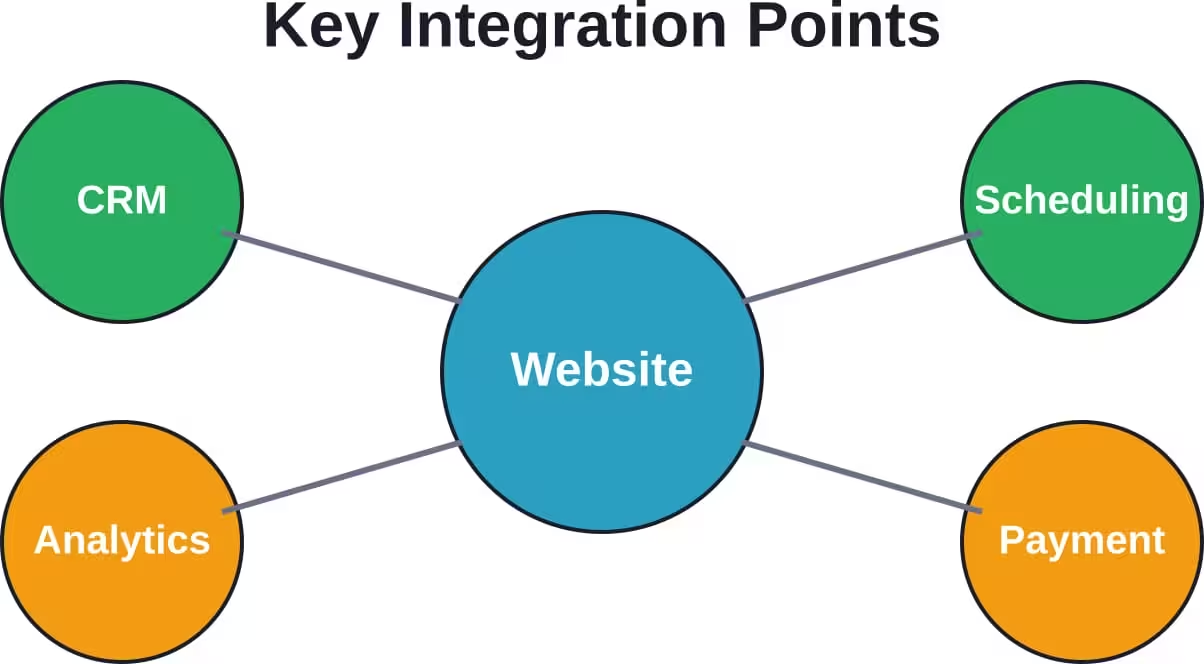
Professional services websites rarely operate in isolation. They need to connect with:
- CRM systems for lead management
- Scheduling platforms for consultations
- Email marketing tools
- Document management systems
- Payment processors
- Analytics and reporting tools
The development team should map these integrations early. API availability, data sync requirements, and authentication methods all affect the architecture.
Build a Website That Fits Your Services and Supports Growth
Platform choice defines what your website can and cannot do. Templates and builders can cover basic needs, but they often become restrictive when your firm needs more flexibility in structure and functionality. Lengreo approaches website development from a practical standpoint, not just how the site looks, but how it is planned and delivered. They focus on adapting the development process to the specific requirements of each project instead of relying only on pre-set solutions.
Develop a Website That Aligns With Your Tools and Processes
Lengreo focuses on delivering websites through a structured and flexible development process:
- Website development for business websites and landing pages
- Full cycle delivery from research and prototyping to launch
- Development using JavaScript and WordPress
- Flexible approach from template-based builds to custom solutions
- Quality assurance and post-launch support
If you need a website built around your requirements, contact Lengreo and start the process the right way.
The Role of AI in Website Development
AI capabilities have moved from experimental to operational. But implementation requires careful governance.
According to Forrester’s 2026 predictions for B2B leaders, ungoverned generative AI in commercial applications may result in losses exceeding $10 billion in enterprise value through declining stock prices, legal settlements, and fines.
That’s not an argument against AI — it’s a warning about ungoverned deployment.
Practical AI Applications
Professional services websites can leverage AI for:
- Intelligent chatbots that qualify leads and answer common questions
- Content personalization based on visitor behavior and industry
- Predictive analytics for understanding prospect intent
- Automated accessibility improvements
- Performance optimization and load time reduction
The key is implementing AI with clear guardrails. Chatbots should escalate to humans when queries exceed their knowledge. Personalization should respect privacy boundaries. Automated systems need human oversight.
SEO Strategy for Professional Services
Search visibility determines whether the website reaches prospects at the research stage.
Professional services SEO differs from product-based optimization. The goal isn’t ranking for broad terms like “consultant” — it’s capturing searches that indicate specific needs and intent.
Keyword Strategy
Effective professional services keyword targeting focuses on:
- Service + Industry combinations (“financial planning for tech executives”)
- Problem-focused queries (“how to reduce manufacturing waste”)
- Location-specific searches (“business attorney Chicago”)
- Question-based long-tail keywords
The content strategy should address questions prospects are actually asking. What are their pain points? What objections do they have? What information do they need before engaging a professional?
Technical SEO Essentials
Search engines evaluate technical factors that affect user experience:
| Factor | Why It Matters | Target |
|---|---|---|
| Page Load Speed | User experience and rankings | Under 3 seconds |
| Mobile Usability | Mobile-first indexing | Fully responsive |
| HTTPS | Security and trust signal | SSL certificate required |
| Structured Data | Rich snippets and understanding | Schema markup implemented |
| XML Sitemap | Crawl efficiency | Submitted and updated |
The development team should address these during build, not after launch. Retrofitting technical SEO is harder than building it in from the start.
Conversion Optimization
Traffic without conversion is just vanity metrics.
Professional services conversion optimization focuses on reducing friction and building confidence. Every element should either establish credibility or move the prospect toward engagement.
Trust Signals That Matter
Prospects evaluating professional services look for evidence of competence and reliability:
- Client results and case studies with specifics
- Professional credentials and certifications
- Industry recognition and awards
- Client testimonials with attribution
- Security certifications and compliance badges
- Thought leadership and publications
Generic claims don’t work. “We deliver results” means nothing. “We helped a regional manufacturing company reduce energy costs by $847,000 annually through operational efficiency improvements” demonstrates tangible value.
Call-to-Action Strategy
Not every visitor is ready for a sales conversation. The website should offer multiple engagement options at different commitment levels:
- Low commitment: Download a guide, subscribe to insights, watch a webinar
- Medium commitment: Take an assessment, attend a workshop, join a community
- High commitment: Schedule a consultation, request a proposal
The key is making each step clear and easy. Forms should ask only for essential information. Scheduling should show availability immediately. Downloads should deliver value without requiring a sales call.

Accessibility Standards
Accessibility isn’t just ethically important — it expands the audience and often improves overall usability.
Research from academic institutions including Harrisburg University and Wayne State University emphasizes that accessibility enhances user experience for everyone, not just those with disabilities. Features like clear navigation, readable typography, and logical content hierarchy benefit all users.
WCAG Compliance
The Web Content Accessibility Guidelines provide a framework for making digital content accessible:
- Perceivable: Information presented in ways all users can perceive
- Operable: Interface components and navigation that all users can operate
- Understandable: Information and interface operation that users can understand
- Robust: Content that works across different technologies and assistive devices
Development should target WCAG 2.1 Level AA compliance at minimum. This includes proper heading hierarchy, alt text for images, keyboard navigation support, sufficient color contrast, and forms with clear labels.
Performance and Reliability
Slow sites lose prospects. Period.
Users expect pages to load in under three seconds. Professional services prospects have even less patience — they’re often researching during limited time windows.
Performance Optimization
Key optimization strategies include:
- Image compression and modern formats (WebP, AVIF)
- Lazy loading for below-fold content
- Minification of CSS and JavaScript
- Content delivery network (CDN) implementation
- Database query optimization
- Caching strategies at multiple levels
The development team should establish performance budgets and monitor them. Tools like Google PageSpeed Insights, GTmetrix, and WebPageTest provide actionable data.
Uptime and Reliability
Professional services firms can’t afford website downtime during business hours. The hosting infrastructure needs to support:
- 99.9% uptime guarantees
- Automated backups with point-in-time recovery
- DDoS protection
- Geographic redundancy
- Scalability for traffic spikes
Managed hosting services specifically designed for professional applications often justify their premium pricing through reliability and support.
Analytics and Continuous Improvement
Launch isn’t the finish line — it’s the starting point for optimization.
Comprehensive analytics track both technical performance and user behavior. The goal is understanding what’s working and what needs adjustment.
Metrics That Matter
Professional services websites should monitor:
- Traffic sources and channel performance
- Behavior flow and common paths
- Conversion rates for different CTAs
- Time on key pages (services, case studies)
- Form completion and abandonment rates
- Lead quality from different sources
But here’s the critical part: data without action is useless. Establish a regular review cycle — monthly at minimum — to analyze performance and implement improvements.
A/B testing helps validate changes. Test different headlines, CTA placement, form lengths, and content approaches. Small improvements compound over time.
Conclusion
Website development for professional services is fundamentally about trust.
The technical elements — security, performance, accessibility — create the foundation. The strategic elements — positioning, messaging, conversion optimization — build the structure. Together, they create a digital presence that attracts ideal clients and demonstrates the expertise they’re looking for.
The firms that win online aren’t necessarily those with the flashiest designs or the biggest budgets. They’re the ones that understand their clients deeply, communicate their value clearly, and make engagement easy.
Start with strategy before technology. Define the ideal client. Articulate the specific value delivered. Then build a website that makes those elements clear from the first second a prospect lands on the homepage.
The investment in thoughtful website development pays dividends through qualified leads, stronger client relationships, and sustainable growth. In an environment where cyberattacks are constant and competition is fierce, getting this right isn’t optional — it’s essential.