


Highlights: Bing SEO works by evaluating relevance, quality, user engagement, freshness, location, and page load time to rank web pages. Unlike Google, Bing places stronger emphasis on exact-match keywords, social signals, and domain age while serving over 10% of desktop searches. Optimizing for Bing requires using Bing Webmaster Tools, creating high-quality content, and understanding its unique algorithmic preferences.
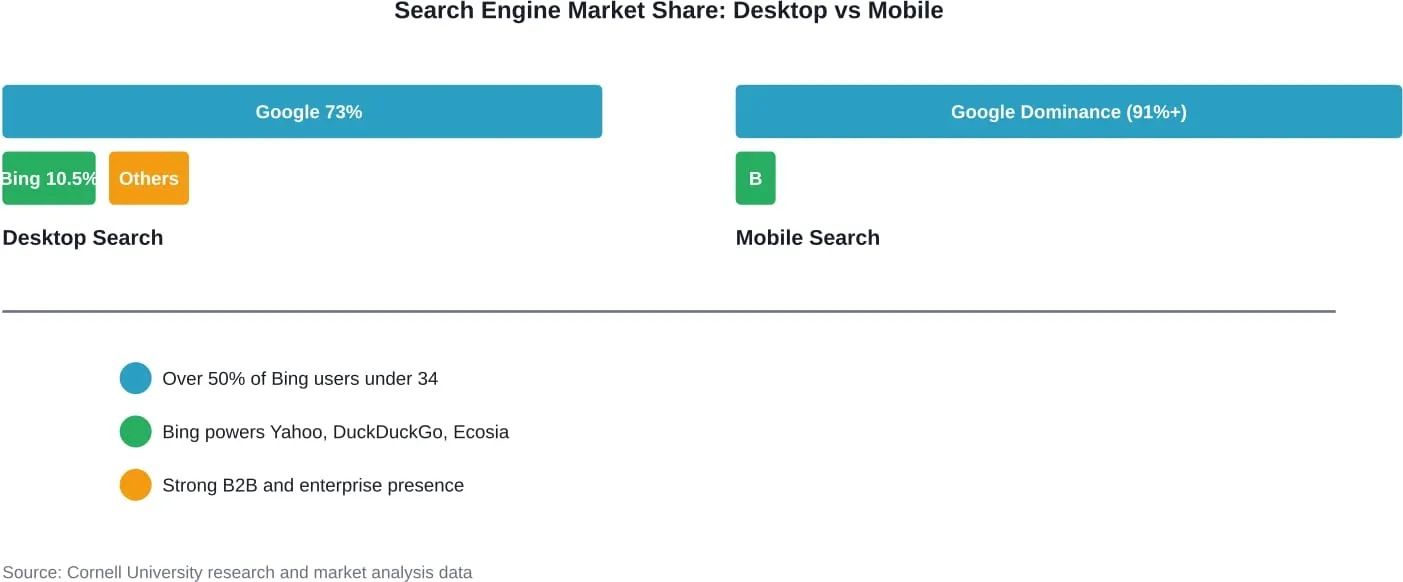
Most SEO professionals obsess over Google. And why wouldn’t they? Google dominates search with approximately 73% market share, according to data from Cornell University’s analysis.
But here’s what gets overlooked: Bing controls over 10% of desktop searches. That’s millions of potential visitors most websites completely ignore.
Bing isn’t just Microsoft’s quirky alternative anymore. With AI integration reshaping search and Bing powering multiple platforms, understanding how its algorithm works has become essential for comprehensive SEO strategy.
This guide breaks down exactly how Bing evaluates and ranks content, what makes it different from Google, and actionable steps to optimize for Microsoft’s search engine.
Why Bing SEO Actually Matters in 2026
The conversation around Bing usually starts with skepticism. Fair enough.
But look at the numbers. Bing controls over 10% of desktop searches. Over 50% of Bing users are younger than 34—a demographic many businesses desperately want to reach.
Here’s the thing though: Bing’s influence extends far beyond bing.com. The Bing algorithm powers Yahoo, DuckDuckGo, and Ecosia. When content ranks on Bing, it’s actually appearing across multiple search platforms simultaneously.
And the financial stakes? The global SEO services market was valued at approximately $65-70 billion in 2023-2024 and is projected to exceed $100 billion by 2028. While generative AI threatens to disrupt traditional search, Bing has positioned itself at the forefront of this transformation rather than fighting against it.
Desktop users particularly favor Bing. For B2B companies, professionals working from office computers, and enterprises with Microsoft integrations, Bing represents a substantial traffic source that competitors often neglect.
How Bing’s Search Algorithm Actually Works
Bing’s algorithm evaluates web pages using six primary components. According to Search Engine Roundtable’s analysis of Bing’s official documentation, these factors form the foundation of how content gets ranked.
Relevance
Bing analyzes how well content matches search queries. But unlike Google’s semantic understanding, Bing relies more heavily on exact-match keywords and their variations.
The algorithm examines title tags, meta descriptions, headers, and body content for keyword presence. This doesn’t mean keyword stuffing works—far from it. But strategic keyword placement matters significantly more on Bing than Google.
Quality and Credibility
Bing evaluates content authority through multiple signals. Domain age carries more weight on Bing than Google. Older, established domains receive preferential treatment.
Backlink quality matters, though Bing’s interpretation differs from Google’s PageRank-derivative algorithms. Bing places considerable emphasis on links from .edu and .gov domains—educational and government sites signal high credibility.
User Engagement
Click-through rates, dwell time, and bounce rates influence rankings. If users quickly return to search results after visiting a page, Bing interprets this as poor content quality.
Social signals play an outsized role here. Facebook shares, Twitter engagement, and LinkedIn interactions factor into Bing’s quality assessment far more explicitly than Google’s algorithm.
Freshness
Bing rewards recently updated content, particularly for time-sensitive queries. News articles, trending topics, and frequently changing information benefit from freshness signals.
Regular content updates signal active maintenance. Websites that consistently publish or refresh existing content receive algorithmic advantages.
Location
Geographic relevance determines local search rankings. Bing Places for Business—Microsoft’s equivalent to Google Business Profile—directly impacts local visibility.
IP addresses, location keywords, and business directory consistency all contribute to local ranking factors.
Page Load Time
Site speed affects rankings, though Bing’s threshold appears less stringent than Google’s Core Web Vitals. Still, slow-loading pages face ranking penalties.
Mobile responsiveness matters, but desktop performance receives proportionally more weight given Bing’s user base skews toward desktop searches.
| Ranking Factor | Bing’s Emphasis | Key Consideration |
|---|---|---|
| Relevance | Very High | Exact-match keywords carry more weight |
| Quality & Credibility | High | Domain age and .edu/.gov backlinks prioritized |
| User Engagement | High | Social signals significantly impact rankings |
| Freshness | Medium-High | Regular updates benefit rankings |
| Location | High (Local) | Bing Places critical for local businesses |
| Page Load Time | Medium | Important but less strict than Google |
Bing vs Google: Critical SEO Differences
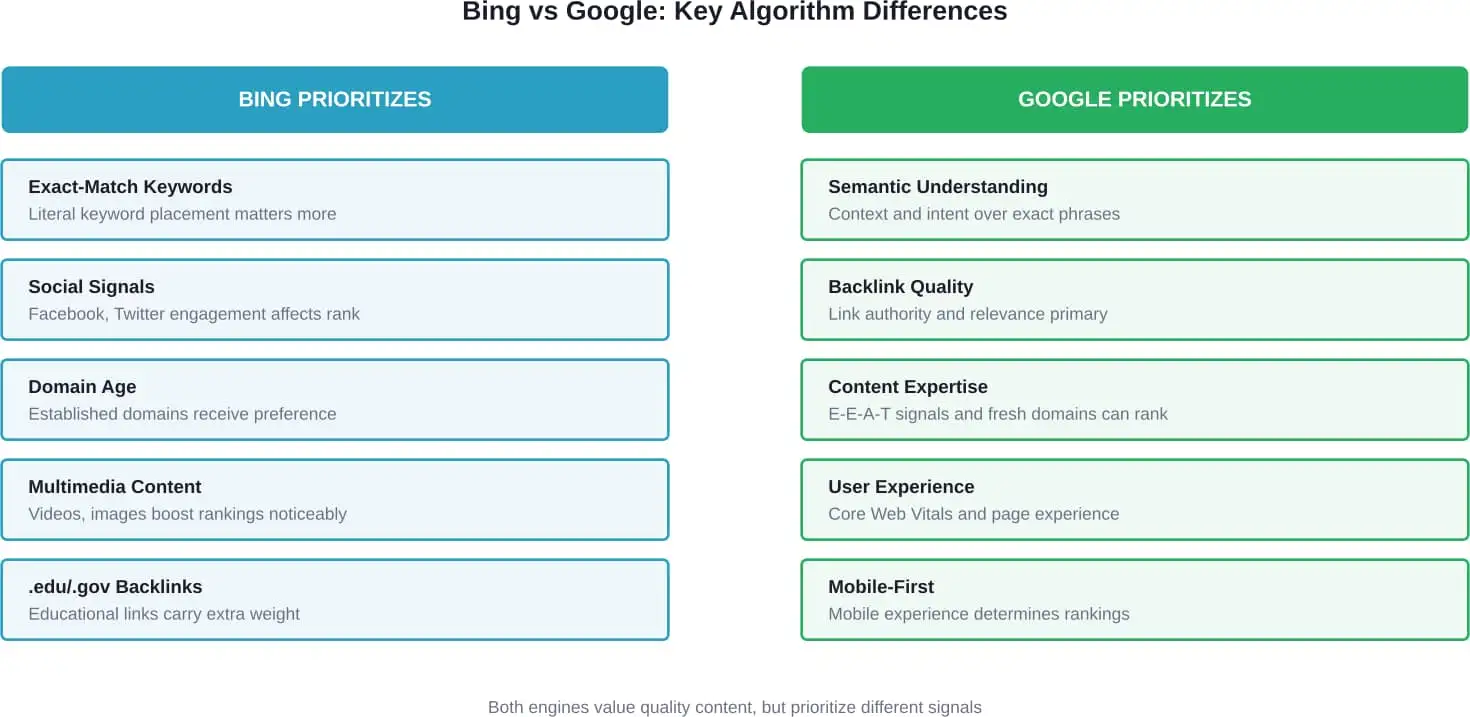
Optimizing for Bing isn’t just “Google SEO lite.” The algorithms have fundamental differences that require strategic adjustments.
Keyword Matching Philosophy
Google’s algorithm has evolved toward semantic search and natural language processing. It understands context, synonyms, and user intent beyond literal keyword matching.
Bing remains more literal. Exact-match keywords in titles, URLs, and headers carry substantial weight. This doesn’t mean writing awkwardly—natural language still matters—but precise keyword targeting produces better results on Bing.
Social Media Integration
Here’s where things get interesting. Google officially downplays social signals as direct ranking factors.
Bing doesn’t hide it: social engagement matters. Pages with strong social media presence—particularly on Facebook and Twitter—receive ranking boosts. LinkedIn shares particularly influence B2B content rankings.
Multimedia Content Preferences
Bing shows favoritism toward multimedia-rich content. Pages with videos, images, and interactive elements tend to rank better than text-only content, even when the text is comprehensive.
Flash content historically ranked better on Bing (before Flash deprecation). The underlying principle remains: Bing rewards diverse content formats.
Domain Authority Interpretation
Google’s algorithm has become increasingly sophisticated at evaluating new domains. A brand-new site with exceptional content can rank competitively.
Bing still favors established domains. Domain age functions as a trust signal. New websites face a longer proving period before achieving top rankings, regardless of content quality.
Backlink Evaluation
Both engines value quality backlinks, but Bing places exceptional weight on educational and government links. A single .edu backlink carries disproportionate authority compared to commercial links.
Bing also appears more tolerant of reciprocal linking arrangements, though mutual link exchanges should still look natural rather than manipulative.
Optimize for Bing With a Clear Plan
Bing has its own ranking factors and audience segments. Lengreo adjusts on-page and technical signals to match Bing requirements. The team reviews indexing, metadata, and structured data compatibility. This ensures you do not ignore an additional traffic source.
Ready to Improve Your Bing SEO?
Talk with Lengreo to:
- audit Bing visibility
- optimize technical and on-page factors
- align content with Bing search intent
👉 Request a multi engine SEO review from Lengreo.
Essential Bing Webmaster Tools Features
Bing Webmaster Tools provides the foundation for optimization. Setting up takes minutes and unlocks insights unavailable elsewhere.
Site Verification and Setup
Three verification methods exist: XML file upload, meta tag insertion, or CNAME record addition. The meta tag method works for most sites and requires simply adding a verification tag to the homepage.
After verification, submit XML sitemaps. According to Bing’s official documentation, well-managed sitemaps significantly increase Bing’s ability to locate and index URLs.
URL Inspection Tool
This feature shows exactly how Bing sees individual pages. It reveals crawl status, indexing issues, and mobile-friendliness problems.
When pages aren’t appearing in results, the URL Inspection tool typically identifies the cause—blocked by robots.txt, canonicalization issues, or crawl errors.
SEO Reports
Bing provides automated recommendations covering title optimization, meta description quality, and keyword analysis. These aren’t generic suggestions—they’re specific to detected issues on particular pages.
The keyword research tool reveals what terms actually drive traffic from Bing, often surfacing unexpected long-tail phrases.
Backlink Analysis
See which sites link to content and how Bing evaluates those links. This visibility helps identify link-building opportunities and detect potentially harmful backlinks.
IndexNow Integration
This is where Bing pulls ahead. IndexNow allows quick notification of content changes to search engines. Rather than waiting for crawlers, websites can ping Bing (and other participating search engines) immediately when publishing or updating content.
Implementation requires adding one line of code or using compatible CMS plugins. WordPress, Cloudflare, and major platforms support IndexNow natively.
Optimizing Content for Bing’s Algorithm
Strategic optimization requires understanding what Bing’s algorithm actually rewards.
Keyword Research and Placement
Use Bing Webmaster Tools’ keyword research feature alongside traditional tools. Bing users sometimes search differently than Google users—particularly for technical and business queries.
Place primary keywords in:
- Page title (preferably near the beginning)
- URL slug
- First paragraph
- At least one H2 heading
- Image alt text
- Meta description
This isn’t keyword stuffing. Natural integration remains essential. But precise keyword placement matters more on Bing than semantic variations.
Title Tag Optimization
Bing’s official documentation addresses title selection directly. Sometimes Bing chooses different titles than what’s specified in HTML.
The algorithm selects titles based on query relevance. To maximize control, create titles that clearly match target keywords while remaining compelling for click-through.
Keep titles between 50-60 characters for optimal display. Longer titles get truncated, potentially losing keyword visibility.
Content Quality Signals
Comprehensive content performs better, but depth matters more than length alone. Cover topics thoroughly rather than hitting arbitrary word counts.
Original research, unique insights, and expert perspectives signal quality. Duplicate content faces stricter penalties on Bing than Google.
According to Bing’s official guidance on duplicate content, consolidating variations using canonical tags helps the algorithm identify authoritative versions.
Multimedia Integration
Add relevant images with descriptive alt text. Bing Image Search drives substantial traffic—optimized images capture this channel.
Video content particularly boosts rankings. Embedding videos (even from platforms like YouTube) signals comprehensive content coverage.
Social Sharing Setup
Make content easily shareable. Include social sharing buttons prominently.
Open Graph tags ensure proper preview formatting when shared on Facebook and LinkedIn. Twitter Cards optimize how content appears on Twitter.
While these don’t directly affect Google rankings, they influence Bing’s quality assessment through social signal tracking.
Technical Foundation
Mobile responsiveness isn’t optional, even with Bing’s desktop-heavy user base. Use responsive design that adapts to all screen sizes.
HTTPS encryption matters. Secure sites receive preference over HTTP equivalents.
Clean URL structures help. Avoid excessive parameters and session IDs in URLs. According to Bing’s duplicate content guidance, parameter-heavy URLs often create indexing problems.
Structured Data Implementation
Schema markup helps Bing understand content context. Product schema, recipe markup, FAQ schema, and local business markup all enhance visibility.
Bing supports the same schema.org vocabulary as Google. Existing structured data implementations typically work without modification.
Local SEO for Bing
Local businesses can’t ignore Bing Places for Business. It functions similarly to Google Business Profile but with less competition.
Bing Places Setup
Claim business listings through Bing Places portal. Verification usually happens via phone or postcard.
Complete every field: business hours, categories, services, photos, and detailed descriptions. Incomplete profiles rank lower than fully populated listings.
NAP Consistency
Name, address, and phone number must match exactly across all directories. Inconsistencies confuse Bing’s local algorithm and dilute ranking signals.
Check citations on major directories: Yelp, Yellow Pages, industry-specific listings. Ensure information matches precisely.
Local Content Strategy
Create location-specific pages for multi-location businesses. Each location should have unique content—not templated descriptions with city names swapped.
Mention local landmarks, neighborhoods, and geographic references naturally within content. This helps Bing connect content to specific locations.
| Optimization Area | Priority Level | Implementation Difficulty |
|---|---|---|
| Bing Webmaster Tools Setup | Critical | Easy |
| Exact-Match Keywords | High | Easy |
| Social Media Integration | High | Medium |
| Multimedia Content | High | Medium |
| IndexNow Implementation | High | Easy |
| Bing Places Optimization | Critical (Local) | Easy |
| .edu/.gov Backlinks | Medium-High | Hard |
| Technical SEO Foundation | High | Medium-Hard |
Building Backlinks for Bing
Link building principles apply across search engines, but Bing’s preferences create specific opportunities.
Educational Institution Outreach
.edu links carry exceptional authority on Bing. Strategies for earning these links include:
- Creating scholarship programs (universities often list sponsors)
- Offering expert interviews to university publications
- Providing educational resources or tools that faculty reference
- Guest lecturing or sponsoring academic events
Government Resources
Government websites (.gov domains) similarly signal high credibility. These prove harder to acquire but provide substantial ranking benefits.
Industry-specific government resources, local government directories, and regulatory compliance sites occasionally offer link opportunities.
Quality Over Quantity
Bing’s backlink evaluation focuses heavily on link source authority. Ten links from established, relevant sites outperform one hundred directory spam links.
Reciprocal linking appears more acceptable on Bing, but links should still appear natural. Avoid obvious link exchange schemes.
Common Bing SEO Mistakes
Several optimization approaches that work on Google backfire on Bing.
Over-Relying on Semantic Search
Writing naturally without considering exact keywords works fine for Google. Bing still needs explicit keyword signals.
Balance natural writing with strategic keyword placement rather than assuming the algorithm will infer intent.
Ignoring Social Signals
Treating social media as separate from SEO misses Bing’s algorithmic reality. Social engagement directly influences rankings.
Integrate social sharing into content promotion strategies rather than treating it as an afterthought.
Neglecting Bing Webmaster Tools
Many sites verify with Google Search Console but never set up Bing Webmaster Tools. This leaves significant optimization opportunities untapped.
The tools provide insights unavailable elsewhere and enable features like IndexNow that dramatically improve crawl efficiency.
Duplicate Content Tolerance
Bing penalizes duplicate content more aggressively than Google. Canonicalization issues that Google handles gracefully cause ranking problems on Bing.
According to Bing’s official duplicate content guidance, proper canonical tag implementation helps consolidate ranking signals when multiple URLs exist.
Mobile-Only Optimization
Focusing exclusively on mobile performance while neglecting desktop experience hurts Bing rankings disproportionately.
Desktop users dominate Bing’s audience. Ensure excellent performance across device types.
Measuring Bing SEO Success
Tracking performance requires different metrics than Google-centric analytics.
Bing Webmaster Tools Analytics
The platform provides impression and click data specifically from Bing searches. This shows actual Bing traffic rather than estimates.
Monitor click-through rates by query. Low CTRs indicate title and description optimization opportunities.
Traffic Source Segmentation
In Google Analytics or other platforms, segment organic traffic by search engine. This isolates Bing performance from overall organic metrics.
Compare conversion rates between search engines. Bing traffic sometimes converts differently than Google traffic due to demographic differences.
Ranking Monitoring
Standard rank tracking tools often focus on Google. Ensure chosen tools specifically track Bing rankings or use Bing-specific tracking solutions.
Monitor rankings for exact-match keywords particularly, as these drive Bing visibility disproportionately.
Advanced Bing SEO Strategies
Beyond fundamentals, several advanced techniques maximize Bing visibility.
Leveraging Microsoft Ecosystem Integration
Bing integrates deeply with Windows, Microsoft Edge, and Office products. Content optimized for these environments receives additional exposure.
Cortana voice searches route through Bing. Optimizing for conversational queries and featured snippet positions captures this traffic.
Visual Search Optimization
Bing Visual Search allows users to search using images rather than text. Optimizing images with descriptive filenames, alt text, and surrounding context helps capture this channel.
Product images particularly benefit from visual search optimization—users can photograph items and find purchasing options.
Subscription Content Handling
For publishers with paywalled or subscription content, Bing provides specific guidance. According to official Bing documentation, allowing crawler access to full content while showing paywalls to users helps indexing.
Verify crawlers using proper identification methods. The genuine Bingbot crawler can access subscription content for indexing without compromising the business model.
International SEO Considerations
Bing handles international sites differently than Google. Use hreflang tags to indicate language and regional targeting.
For multi-regional sites, consider Bing’s market share in specific countries. In some regions, Bing commands larger market shares than global averages.
The Future of Bing SEO
AI integration fundamentally changes how Bing operates. The introduction of AI-powered search features creates new optimization considerations.
Generative AI threatens to disrupt traditional search. But Bing’s early AI adoption positions it as search evolution’s leader rather than victim.
Optimizing for AI-generated responses requires different strategies than traditional SEO. Content that directly answers questions, provides clear explanations, and demonstrates authority will likely surface in AI responses.
The fundamentals remain constant though: quality content, technical excellence, and user-focused design continue driving rankings regardless of AI integration.
Taking Action on Bing SEO
Bing represents untapped opportunity for most websites. While Google dominates overall search volume, Bing’s 10%+ desktop market share translates to millions of potential visitors.
The algorithmic differences aren’t obstacles—they’re advantages. Lower competition, clearer ranking signals, and integrated tools make Bing optimization remarkably efficient.
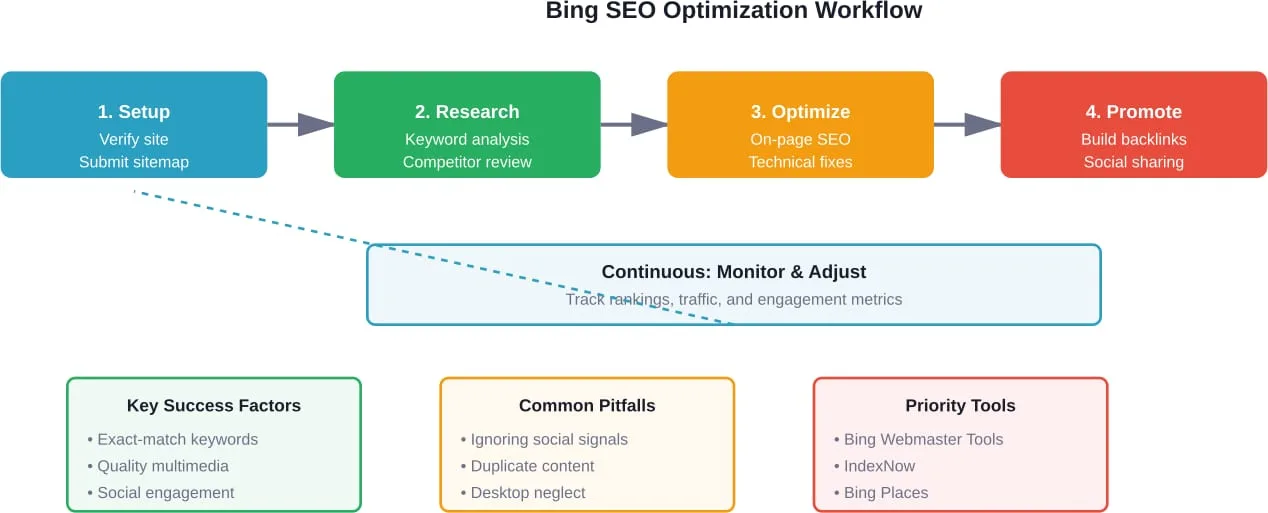
Start with the basics: verify the site in Bing Webmaster Tools, submit sitemaps, and implement IndexNow. These foundational steps require minimal effort but unlock substantial benefits.
Then refine content strategy: emphasize exact-match keywords, integrate multimedia elements, and build social sharing into promotion plans. These tactical adjustments align content with Bing’s algorithmic preferences.
For businesses targeting professional audiences, B2B customers, or desktop users, Bing optimization isn’t optional—it’s essential. The same effort invested in Google SEO applies to Bing with minor strategic adjustments.
The search landscape continues evolving. AI integration, voice search expansion, and visual search growth all favor early adopters who understand platform-specific optimization.
Bing SEO isn’t about choosing between search engines. It’s about maximizing visibility across all channels where potential customers search. And with millions of daily searches, Bing represents a channel that’s too valuable to ignore.