


Search engine optimization without measurement is just guesswork. Teams invest thousands of hours optimizing content, building links, and fixing technical issues—but without proper tracking, there’s no way to know what’s working.
The challenge isn’t just collecting data. It’s identifying which metrics actually matter and connecting SEO performance to business outcomes.
This guide breaks down the essential metrics for measuring SEO performance, the tools needed to track them, and how to build a measurement framework that drives real results.
Understanding SEO Performance vs. Results
Before diving into metrics, it’s worth distinguishing between SEO performance and SEO results. They sound similar but represent different measurement approaches.
SEO performance focuses on leading indicators—the activities and early signals that suggest progress. This includes metrics like page indexation rates, crawl efficiency, keyword position changes, and content production volume.
SEO results, on the other hand, track lagging indicators that reflect actual business impact. Organic traffic, conversion rates, revenue attribution, and qualified leads fall into this category.
Both matter. Performance metrics help diagnose issues and guide tactical decisions. Results metrics prove whether the strategy delivers value.
The best measurement frameworks combine both perspectives—tracking day-to-day performance while keeping business outcomes as the north star.
Essential Tools for Measuring SEO Performance
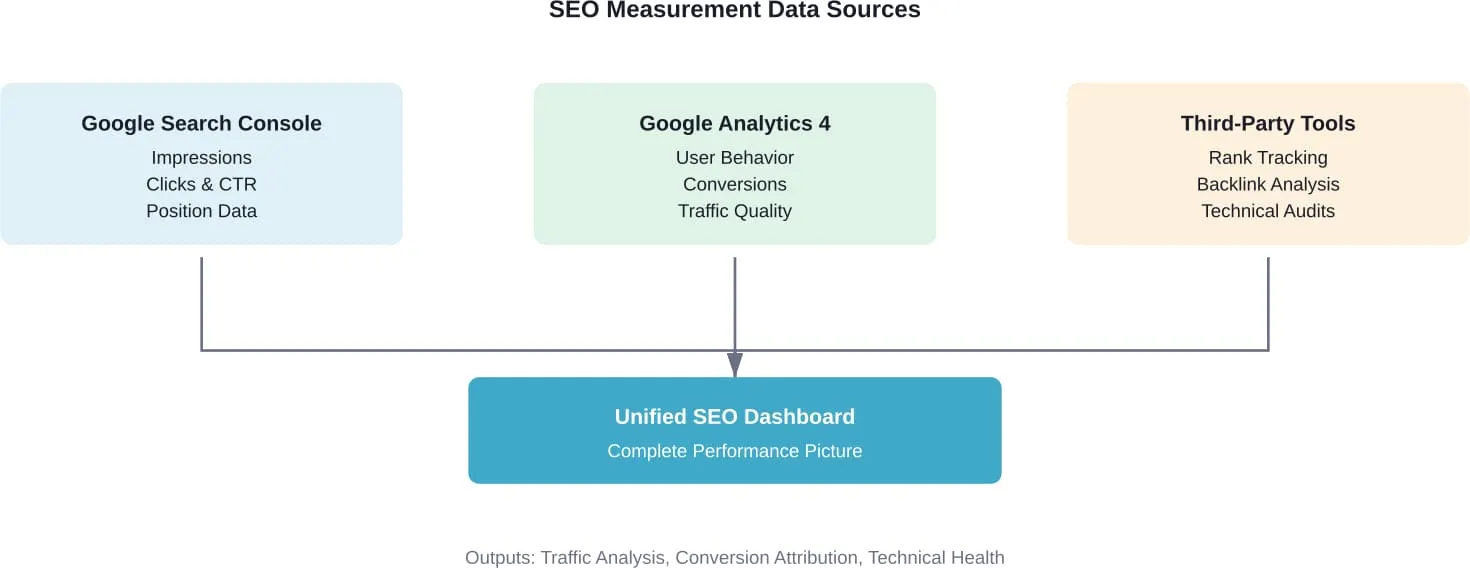
Effective SEO measurement requires multiple data sources. No single platform provides a complete picture.
Google Search Console
Search Console remains the most authoritative source for understanding how a site performs in Google Search. According to Google’s official documentation, the Performance report shows critical metrics about search traffic, including where it originates and what queries trigger site appearances.
The platform tracks four primary metrics: Impressions, Clicks, CTR, and Position (which is an average of the top-ranking URL for your site).
Search Console allows filtering and comparison across dimensions like device type, country, search appearance, and time periods. Google notes that users can compare performance between countries, time periods, pages, devices, or search appearance types.
For those new to the platform, Google offers Search Console Insights—a simplified version providing basic statistics and performance milestones. All that’s required is proving site ownership.
Google Analytics 4
While Search Console shows how sites perform in search results, Google Analytics reveals what happens after visitors arrive. GA4 tracks user behavior, engagement patterns, conversion paths, and traffic sources.
For SEO measurement, Analytics helps answer questions like: Which organic landing pages drive the most conversions? How does organic traffic engagement compare to other channels? What percentage of organic visitors complete key actions?
The platform’s exploration reports enable deeper analysis—examining scroll depth, behavior flow, load times, site searches, and engagement rates across segments.
Specialized SEO Platforms
Third-party platforms fill gaps that Google’s tools don’t address. These include keyword rank tracking at scale, backlink analysis, competitor monitoring, and technical audits.
These platforms aggregate data from multiple sources, providing centralized dashboards for tracking SEO health across dimensions.
Core SEO Metrics That Actually Matter
Not all metrics deserve equal attention. Some provide actionable insights. Others just look impressive in reports.
Here’s what matters.
Organic Traffic
Organic traffic represents visitors arriving from unpaid search results. This metric serves as the clearest indicator of overall SEO health. When organic traffic trends upward over time, it signals that content ranks well and attracts searchers. Declining traffic demands investigation.
But raw traffic numbers need context. A site might see traffic increase while conversions decline if the wrong keywords attract the wrong audience. Community discussions emphasize focusing on useful traffic rather than any traffic—10 clicks from high-intent queries often outperform 100 from informational ones.
Segment organic traffic by landing page, device type, geographic region, and user behavior to understand what’s actually working.
Keyword Rankings
Rankings show where pages appear in search results for target keywords. While not the end goal, they provide diagnostic value.
Rankings help diagnose sudden traffic changes. If analytics shows a 10% organic traffic increase, checking which pages improved rankings reveals what drove the boost.
Track rankings for a core set of priority keywords rather than exhaustive lists. Focus on keywords that align with business objectives.
Click-Through Rate
Click-through rate measures the ratio of impressions to clicks. If a page appears in search results 100 times and receives 50 clicks, the CTR is 50%. Typical organic CTR for position 1 is approximately 28-40%.
Low CTR despite good rankings suggests the snippet doesn’t resonate with searcher intent. Google’s guidance recommends examining titles and snippets for pages that should perform better, considering whether they accurately answer questions or how content updates might improve appeal.
High CTR with low conversion rates might indicate a mismatch between what the snippet promises and what the page delivers.
Search Visibility
Visibility metrics estimate how prominent a site appears across all tracked keywords. These indices account for both rankings and search volume.
Rather than tracking individual keyword positions, visibility provides a single number representing overall search presence. An increasing visibility score suggests a site gains prominence across its target keyword set.
Different platforms calculate visibility differently, so compare trends within the same tool rather than absolute numbers across tools.
Conversions and Goal Completions
Traffic means little without conversion. Conversions represent the actions that actually matter—form submissions, purchases, sign-ups, downloads, or other defined goals.
Set up conversion tracking in analytics for all meaningful actions. Then segment by traffic source to isolate organic performance. Compare organic conversion rates against other channels to assess traffic quality.
Advanced analysis examines assisted conversions—instances where organic search contributes to a conversion path without being the final touchpoint.
Engagement Metrics
Engagement metrics reveal how visitors interact with content after arriving.
Low engagement—high bounce rates, short session durations, minimal page views—suggests content doesn’t match searcher expectations or provides poor user experience.
User engagement signals (like bounce rate or dwell time) are not direct ranking factors in Google’s primary search algorithm, though they are used for evaluation and training.
Backlinks and Referring Domains
Backlinks represent external sites linking to content. These signals help search engines assess authority and relevance.
Referring domains matter more than total backlink count. The number of unique domains linking to a site provides a better authority signal than accumulating many links from the same sources.
Focus on referring domain growth over time. If that number increases, link building and content marketing efforts are working.
Core Web Vitals
Core Web Vitals measure user experience through technical performance metrics. According to Google’s official documentation, the Core Web Vitals report shows URL performance based on real-world usage data.
The report groups URLs by status—Poor, Need Improvement, or Good—across three metrics: LCP, INP, and CLS (and potentially new responsiveness signals).
Google notes that the report shows how 75% of page requests performed for each metric over the previous 28 days. Pages meeting “Good” thresholds provide better user experiences and may receive ranking benefits.
Technical performance directly impacts both user satisfaction and search visibility.
| Metric | What It Measures | Primary Tool | Why It Matters |
|---|---|---|---|
| Organic Traffic | Visitors from unpaid search | Google Analytics | Overall SEO health indicator |
| Keyword Rankings | Search result positions | Search Console, rank trackers | Diagnostic for traffic changes |
| Click-Through Rate | Clicks divided by impressions | Search Console | Snippet effectiveness feedback |
| Conversions | Completed goal actions | Google Analytics | Business impact measurement |
| Engagement Rate | User interaction depth | Google Analytics | Content quality signal |
| Referring Domains | Unique sites linking in | Third-party tools | Authority assessment |
| Core Web Vitals | Page experience metrics | Search Console | Technical UX and rankings |
Lengreo’s Proven SEO Strategy for Boosting Performance Tracking
At Lengreo, we bring a tailored, data-driven approach to SEO that extends to measuring and optimizing your performance across various platforms. With our expertise in keyword research, content strategy, and lead generation, we help brands optimize their digital presence to achieve clear, measurable results. Whether it’s improving conversion rates, driving organic traffic, or scaling B2B lead generation, we focus on results that directly impact your bottom line.
Our approach to SEO is comprehensive and aligned with your unique business goals. We don’t just track rankings—we focus on engagement metrics, click-through rates, and conversions that show the true effectiveness of your content strategy. Through a mix of strategic audits, competitor analysis, and high-quality content creation, we ensure that your digital marketing efforts not only perform well but also support your broader business objectives.
With a proven track record of driving traffic and boosting conversions for clients across multiple industries, including software development, architecture, and technology, we at Lengreo offer a full suite of services designed to support and elevate your digital presence. We provide continuous optimization, so your business remains competitive and visible in the ever-evolving digital landscape.
Building an SEO Measurement Framework
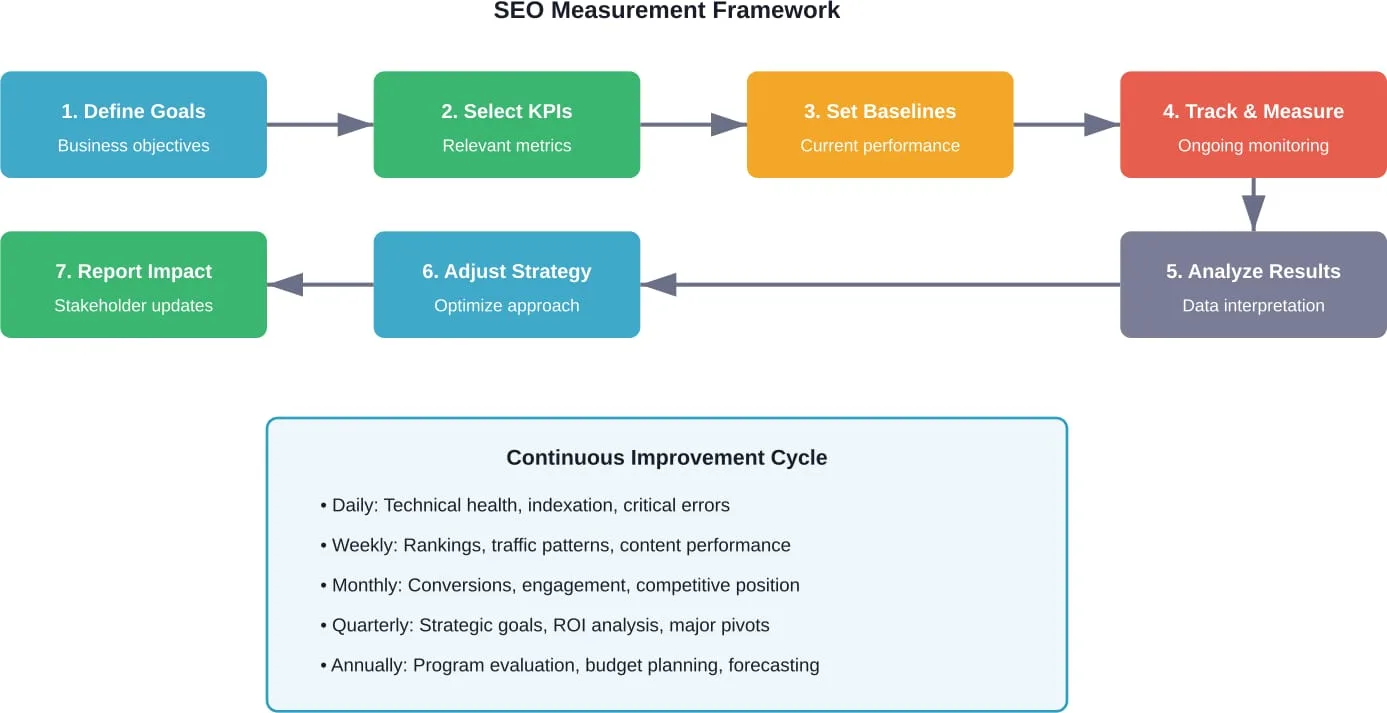
Random metric tracking leads to data overload without insights. Effective measurement requires a framework that aligns metrics with business objectives.
Define Clear SEO Goals
Start by identifying what SEO should accomplish. Different organizations have different priorities—brand awareness, lead generation, e-commerce sales, content engagement, or something else entirely.
According to academic guidance from Michigan State University’s Digital Experience Studio, effective SEO strategy needs to align with overall strategic plans and communications strategies before implementation begins.
Goals should be specific, measurable, and tied to business outcomes. “Increase organic traffic” is vague. “Increase qualified lead submissions from organic search by 25% in Q2” provides clear direction.
Identify Relevant KPIs
Once goals are clear, select the key performance indicators that track progress toward those goals.
Research from UPCEA highlights that looking at SEO success metrics helps evaluate strategy performance, while analyzing SEO health metrics informs strategy development. Both types matter.
For a lead generation goal, relevant KPIs might include organic landing page traffic, form submission rates, assisted conversions, and cost per lead compared to paid channels.
For an e-commerce goal, track product page rankings, organic revenue, average order value by traffic source, and shopping cart abandonment rates for organic visitors.
Establish Baselines and Benchmarks
Metrics need context. Is 5,000 monthly organic visits good or bad? That depends on the baseline and the industry.
Before implementing SEO changes, document current performance levels. This baseline enables measuring improvement and calculating ROI.
Compare performance against past periods, but also research industry benchmarks when available. Understanding typical performance ranges provides perspective.
Set Measurement Intervals
Different metrics require different monitoring frequencies. Some change daily; others show meaningful patterns only over months.
Daily monitoring makes sense for critical metrics like site availability, indexation issues, or algorithm update impacts. Weekly reviews work well for tracking ranking changes and traffic patterns. Monthly analysis suits strategic decisions about content performance and campaign effectiveness.
Quarterly deep dives should examine overall progress toward annual goals, competitive position changes, and strategic adjustments needed.
Leading indicators during early strategy phases may require executive pressure to forecast numbers. The approach should involve simple, transparent assumptions that acknowledge current uncertainty.
Create Audience-Appropriate Reports
Different stakeholders need different information. Technical teams want granular data. Executives want business impact summaries.
According to UPCEA’s research on higher education marketing, 62% of institutional leaders want SEO metric reporting, but just 31% receive regular updates. Building tiered reporting—detailed dashboards for daily operations, executive summaries highlighting goal progress and business impact, and specialized reports for specific questions or projects—addresses this visibility gap.
Common SEO Measurement Mistakes to Avoid
Even with the right tools and metrics, measurement efforts can derail. Watch for these pitfalls.
Tracking Vanity Metrics
Some metrics look impressive but don’t connect to business value. Total impressions sound great in reports—”Our pages appeared 10 million times this month!”—but mean nothing if they don’t generate clicks, engagement, or conversions.
According to Ahrefs’ analysis of SEO metrics, some measurements simply don’t matter despite appearing important. Focus on metrics that influence decisions and outcomes.
Ignoring Attribution Complexity
Users rarely convert on first visit. They might discover a brand through organic search, return via direct traffic, compare options, and finally convert through a paid ad.
Last-click attribution gives all credit to the final touchpoint, undervaluing SEO’s role in the discovery and consideration phases. Understanding assisted conversions provides a more complete picture of SEO contribution.
Making Decisions on Insufficient Data
SEO changes take time to show impact. Algorithm updates, ranking fluctuations, and seasonal patterns create noise in short-term data.
Making strategic decisions based on a week or two of data often leads to counterproductive changes. Wait for statistically significant patterns over appropriate time periods before drawing conclusions.
Comparing Incompatible Data
Different tools use different methodologies. Search Console counts clicks when users select a result. Analytics counts sessions, which can include multiple page views. Rank tracking tools check positions at specific times from specific locations.
These numbers won’t match exactly, and that’s expected. Compare trends within the same tool rather than absolute numbers across different platforms.
Neglecting Technical Issues
Traffic and ranking metrics can mask underlying technical problems. A site might maintain decent traffic despite broken internal links, duplicate content, or crawl errors—but it’s performing below potential.
Regular technical audits identify issues before they cause visible problems. Fixing technical debt often unlocks performance improvements that content optimization alone can’t achieve.
Advanced Measurement Techniques
Basic metric tracking forms the foundation. Advanced techniques provide deeper insights.
Cohort Analysis
Rather than examining all organic traffic as a monolith, cohort analysis segments visitors by shared characteristics—acquisition date, landing page category, geographic region, or device type.
This reveals whether specific content types or SEO initiatives drive better-quality traffic and higher conversion rates than others.
Forecasting and Projections
Historical data enables forecasting future performance under different scenarios. If current trends continue, where will traffic be in six months? How would ranking improvements for specific keywords impact overall traffic?
These projections support business planning and help secure resources for SEO initiatives by demonstrating potential returns.
Competitive Benchmarking
Measuring performance in isolation misses important context. How does organic growth compare to competitor trends? Are market share shifts due to SEO performance or broader industry changes?
Competitive analysis reveals whether declining metrics reflect personal issues or industry-wide challenges outside direct control.
Content Performance Scoring
Systematically scoring content based on multiple factors—traffic, engagement, conversions, backlinks, social shares—identifies what works and what doesn’t.
This scoring enables prioritizing content updates, identifying successful content patterns to replicate, and recognizing underperformers to improve or remove.
Connecting SEO Metrics to Business Outcomes
The ultimate measurement challenge is demonstrating how SEO contributes to organizational success. Rankings and traffic serve as means to an end, not the end itself.
Calculate SEO ROI
Return on investment compares value generated against resources invested. For SEO, this means quantifying organic traffic value and comparing it to program costs—salaries, tools, content creation, link building, technical work.
One approach assigns values to conversions based on average customer lifetime value or known lead values. Multiply organic conversions by these values to estimate revenue impact.
Compare this against total SEO investment over the same period to calculate ROI. According to recent market data, paid advertising CPC typically ranges from $2.00 to $5.00+ for competitive industries.
Document Case Studies
Specific success stories make abstract metrics tangible. Document situations where SEO initiatives directly influenced business outcomes.
For example: “After optimizing product category pages and improving internal linking, organic traffic to those pages increased 45% over three months, contributing to a 22% increase in online sales from organic visitors.”
These narratives demonstrate value more effectively than dashboards full of numbers.
Align With Organizational KPIs
Companies track specific key performance indicators tied to strategic priorities. Connect SEO metrics to these existing frameworks.
If leadership focuses on customer acquisition cost, show how organic acquisition compares to paid channels. If retention matters, demonstrate how educational content attracts and nurtures long-term customers.
Speaking the language of business KPIs ensures SEO measurement resonates with decision-makers.
SEO Measurement for Different Business Models
Measurement priorities vary based on what a business does and how it generates value.
E-commerce
E-commerce sites should track product page rankings, category page traffic, organic revenue, transaction rates, and average order value from organic traffic. Product-specific metrics reveal which inventory attracts search demand.
According to Backlinko’s e-commerce audit guidance, done properly, audits help identify improvement opportunities and detect issues affecting organic traffic and revenue before they spiral into significant losses.
Lead Generation
Businesses focused on lead generation prioritize form completions, contact requests, phone calls, and chat initiations from organic visitors. Lead quality matters as much as quantity—track how organic leads convert through sales funnels compared to other sources.
Content Publishers
Publishers and media sites emphasize engagement metrics—page views per session, time on page, return visitor rates, and social sharing. Advertising revenue models require demonstrating consistent traffic growth and audience engagement.
SaaS and Technology
Software companies often track free trial sign-ups, demo requests, product page engagement, and documentation usage from organic search. The customer journey typically involves multiple touchpoints, making assisted conversion tracking particularly important.
| Business Model | Primary SEO Metrics | Key Success Indicators |
|---|---|---|
| E-commerce | Product rankings, organic revenue, transaction rate | Revenue per session, cart value from organic traffic |
| Lead Generation | Form completions, contact requests, lead quality | Cost per lead, lead-to-customer conversion rate |
| Content Publishing | Page views, engagement time, return visitors | Ad revenue, subscription growth, audience loyalty |
| SaaS | Trial sign-ups, demo requests, feature page traffic | Trial-to-paid conversion, customer acquisition cost |
| Local Services | Local pack rankings, direction requests, phone calls | Appointment bookings, service area coverage |
Troubleshooting Common Measurement Issues
Data problems happen. Here’s how to address frequent issues.
Discrepancies Between Tools
Search Console shows 5,000 clicks last month. Analytics shows 4,200 organic sessions. Which is correct?
Both are correct within their measurement methodologies. Search Console counts clicks when users select a result, even if they immediately hit the back button. Analytics requires JavaScript execution and cookie acceptance to register sessions.
Expect some variance. If the gap seems unusually large, check for tracking implementation issues, but don’t obsess over perfect alignment.
Sudden Traffic Drops
Unexpected traffic declines require investigation. Check for algorithm updates, technical issues, indexation problems, or major competitor changes.
Use Search Console to identify which pages or queries lost visibility. Cross-reference with ranking tools to see position changes. Check for site-wide technical issues like accidentally blocking crawlers or broken canonical tags.
High Traffic, Low Conversions
Growing traffic without corresponding conversion growth suggests a mismatch between content and commercial intent.
Analyze which pages drive traffic and what keywords trigger those visits. The content might attract informational queries from users not ready to convert. Consider whether those pages effectively nurture visitors toward conversion or simply answer questions and send people away.
Flat Rankings Despite Optimization
Sometimes optimization efforts don’t move rankings. This might indicate the wrong problems are being solved.
Review search intent for target keywords. Does the content format match what’s ranking? Informational guides won’t rank for commercial queries. Product pages won’t rank for how-to searches.
Check technical barriers, content quality gaps, or insufficient authority signals relative to competitors.
Future of SEO Measurement
Measurement practices evolve alongside search technology and user behavior. Several trends shape where SEO measurement is heading.
AI-Generated Search Results
AI overviews and generated summaries change how users interact with search results. Community discussions note that traditional Analytics platforms don’t currently track AI search impressions or position data effectively.
Some approaches involve monitoring referral traffic from AI platforms or running automated queries to track brand mentions in AI-generated responses. As these features mature, measurement methodologies will adapt to capture this traffic source.
Enhanced Privacy and Data Limitations
Privacy regulations and browser changes increasingly limit data collection. Cookie deprecation, restricted tracking, and anonymized reporting affect measurement granularity.
SEO measurement will rely more on aggregated, privacy-compliant data and first-party tracking within owned properties. Less individual-level tracking means more emphasis on cohort analysis and statistical modeling.
Automated Insights and Smart KPIs
According to research from MIT Sloan Management Review on strategic measurement, sophisticated organizations now leverage AI and machine learning to create smarter KPIs that deliver better information and insights than traditional metrics.
The study notes that legacy KPIs increasingly fail to deliver necessary information for leaders, falling short in tracking progress, aligning people, prioritizing resources, and advancing accountability. Smart KPIs enhanced with AI address these limitations.
Automated anomaly detection, predictive analytics, and AI-assisted interpretation will make measurement more proactive and less reactive.
Multi-Platform Attribution
Users discover content across search engines, social platforms, AI assistants, and voice devices. Attribution becomes more complex when journeys span multiple platforms and devices.
Future measurement frameworks will need to aggregate data from diverse sources and model customer journeys that transcend any single platform.
Conclusion
Measuring SEO performance transforms optimization from guesswork into strategy. The metrics matter less than understanding what they reveal about user behavior, content effectiveness, and business impact.
Start with clear objectives tied to organizational goals. Select KPIs that track progress toward those objectives. Establish baselines, implement consistent tracking, and review data at appropriate intervals. Connect SEO metrics to business outcomes that resonate with stakeholders.
Avoid common pitfalls—vanity metrics, premature conclusions, and technical neglect. Focus on trends over time rather than day-to-day fluctuations. Remember that measurement exists to inform better decisions, not just to generate reports.
The organizations that excel at SEO measurement don’t necessarily track more data. They track the right data, interpret it accurately, and act on insights systematically.
What matters isn’t perfect measurement—it’s consistent improvement driven by data-informed decisions.
Ready to improve measurement practices? Start by auditing current tracking against business objectives, identifying gaps in data or interpretation, and implementing one enhancement this week. Small improvements compound into substantial competitive advantages over time.