


TikTok isn’t just a place where dance trends go viral anymore. It’s become a legitimate search engine—especially for younger audiences looking for product reviews, tutorials, and quick answers.
According to a 2024 U.S. survey, 64% of Gen Z said they’ve used TikTok to search for information, and 62% of U.S. adults who use TikTok are looking for product reviews and recommendations. That’s not background noise. That’s a fundamental shift in how people discover content.
But here’s where it gets tricky: unlike traditional SEO where Google Search Console hands everything over on a silver platter, TikTok’s search optimization landscape requires a different approach. The platform does offer tools for checking performance, but they’re scattered across different interfaces and analytics dashboards.
This guide breaks down exactly how to check SEO performance on TikTok, what metrics actually matter, and which tools give real visibility into search rankings.
What TikTok SEO Actually Means
TikTok SEO refers to optimizing video content so it appears in search results when users type queries into TikTok’s search bar. Simple enough, right?
The platform’s algorithm considers multiple factors: video captions, hashtags, sounds, on-screen text, spoken words, and engagement patterns. Unlike the For You Page algorithm (which pushes content to users who haven’t searched for anything), TikTok search requires intentional optimization.
Search Everywhere Optimization is the broader term that acknowledges social platforms as legitimate search destinations. TikTok ranks as a top search destination for Gen Z, but typically follows Google and Instagram (or YouTube) depending on the specific study.
Here’s the thing: TikTok’s search feature surfaces videos based on relevance to the query, recency, and engagement velocity. A video from three months ago can still rank if it’s authoritative and engaging. That persistence makes search optimization worth the effort.
Why Checking TikTok SEO Performance Matters
Tracking search performance isn’t just vanity metrics. It’s strategic intelligence.
When content ranks well for relevant search terms, it generates sustained traffic beyond the initial posting window. The For You Page gives videos a brief moment in the spotlight—maybe 24 to 48 hours of peak visibility. Search rankings can drive views for weeks or months.
Brands that ignore search optimization miss the opportunity to reach Gen Z women who look for brands on social media platforms (45% of Gen Z women look for brands on social media, while 47% look for them on traditional search engines). That percentage continues growing as search behavior evolves across demographics.
Real talk: measuring TikTok SEO helps identify which content types, keywords, and formats actually drive discoverability. Without tracking, optimization becomes guesswork. With proper measurement, patterns emerge that inform content strategy at scale.
According to TikTok’s official business blog, the platform drove 788% more conversions in Q1 than last click claims (according to independent research from Fospha). That means traditional analytics massively undercount TikTok’s contribution. Checking SEO performance reveals hidden influence in the customer journey.
TikTok’s Native Tools for Checking SEO
TikTok provides several built-in features for monitoring search performance. They’re not always obvious, and the interface doesn’t call them “SEO tools” explicitly, but they’re there.
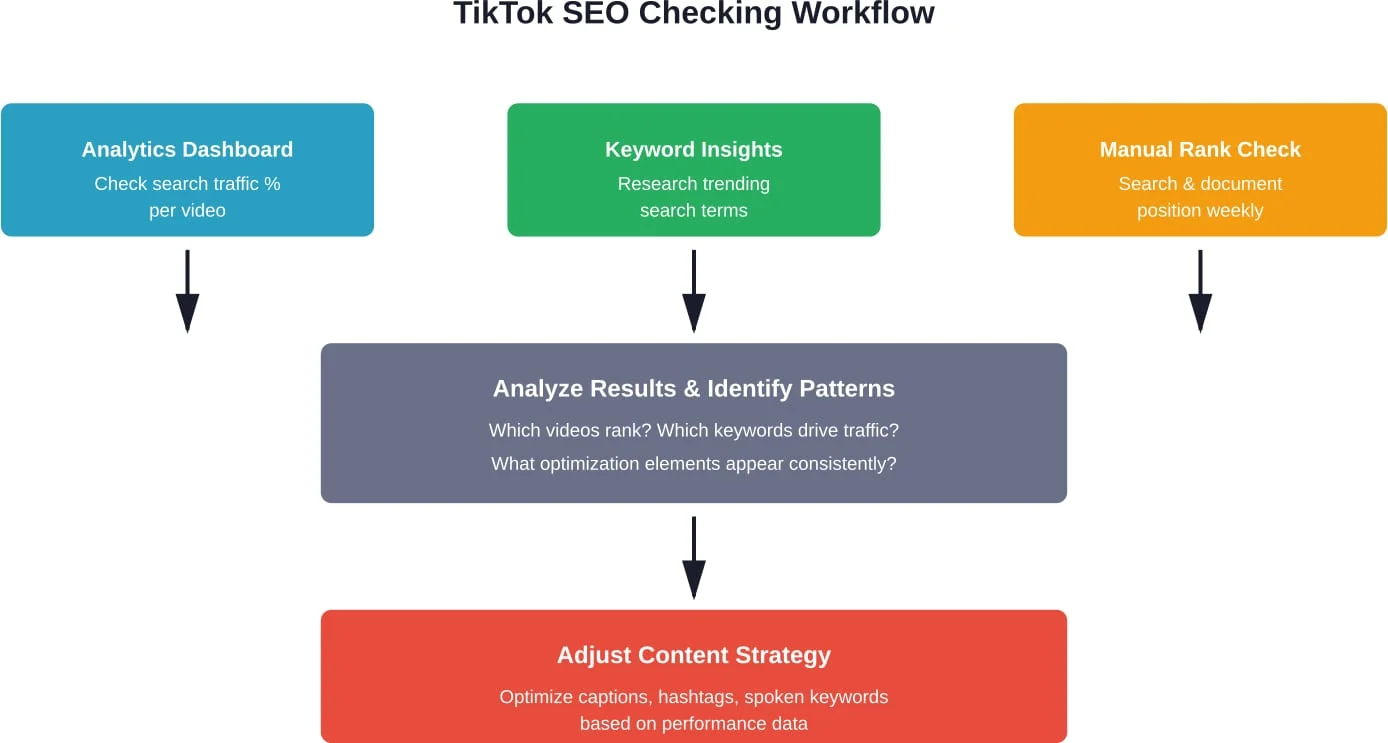
TikTok Analytics Dashboard
Business and Creator accounts get access to analytics showing video performance metrics. Navigate to Profile → Menu (three lines) → Analytics to access the dashboard.
The dashboard shows total video views, profile views, follower count, and trending videos. But the search-relevant metrics hide in individual video analytics.
Tap any video, then tap the three dots, and select “Analytics.” This reveals traffic source types including “Search.” That metric shows how many views came from users actively searching versus passive For You Page scrolling.
High search traffic percentages indicate strong keyword optimization. Low percentages suggest the content isn’t matching user queries—even if total views look decent.
Keyword Insights Tool
TikTok’s Creative Center includes a Keyword Insights feature specifically designed for advertisers but accessible to anyone. Navigate to ads.tiktok.com and explore the Creative Center section.
According to TikTok’s official resources, this tool reveals trending keywords, search volume indicators, and related terms. It shows which queries are gaining momentum and seasonal patterns in search behavior.
The tool doesn’t provide exact search volumes (TikTok keeps those numbers close to the vest), but it does indicate relative popularity with descriptors like “High” or “Growing.” That’s enough to prioritize keyword targeting.
Brands can use Keyword Insights to validate content ideas before filming. If a keyword shows declining interest, skip it. If it’s surging, create content immediately while demand peaks.
Search Ranking Position Check
There’s no official rank tracking dashboard—at least not one TikTok makes public. Manual checking remains the most reliable method.
The process: type a target keyword into TikTok’s search bar, scroll through results, and note where (or if) specific videos appear. Labor-intensive? Absolutely. But it’s accurate.
Third-party tools claim to track TikTok search rankings automatically, but results vary in reliability. The platform’s API doesn’t expose comprehensive search ranking data to external services.
Document ranking positions in a spreadsheet with date stamps. Track the same keywords weekly to identify trends. Videos that climb rankings indicate effective optimization. Videos that disappear signal algorithmic penalties or declining relevance.
Lengreo’s SEO Expertise for Elevating Your TikTok Search Visibility
At Lengreo, we pride ourselves on turning deep keyword insights into real results, whether it’s for websites or emerging platforms. You’ll see us apply that same SEO mindset — rooted in data, strategic research, and audience understanding — when optimizing any search-driven channel. Our experience boosting organic visibility for SaaS, cyber security, and other clients reflects a methodical approach to identifying what users are searching for and how best to meet that demand.
When checking SEO on TikTok, the underlying principle is the same as traditional search engine optimization: understand search intent and position your content in a way that aligns with how your audience is looking for it. That’s where our expertise in keyword research, competitor analysis, and content planning becomes valuable. We don’t chase vanity metrics — we help define the terms your audience actually uses and build a content strategy that aligns with those terms, whether the platform is Google or TikTok.
We also integrate these insights into broader demand generation and content marketing plans. If a TikTok search term shows strong interest and aligns with your business goals, our team would help you shape content that supports visibility and engagement while tracking performance so you can iterate and improve over time.
Key Metrics That Indicate SEO Performance
Not all metrics matter equally for search optimization. Some vanity numbers look impressive but don’t indicate search visibility.
Search Traffic Percentage
This metric appears in individual video analytics. It shows what portion of total views came from search versus other sources (For You Page, profile visits, shares).
Videos with 20%+ search traffic demonstrate strong keyword optimization. The content matches queries people actually type. Videos under 5% rely almost entirely on algorithmic recommendations rather than search intent.
Track this percentage across all content to identify which formats and topics attract search traffic. Educational content and tutorials typically score higher than entertainment or trending challenges.
Keyword Rankings
Where videos appear in search results for target keywords determines visibility. Top three positions capture the majority of clicks. Position 10+ might as well be invisible.
Rankings fluctuate based on recency, engagement velocity, and relevance signals. A video that ranks #1 today might drop to #8 next week if newer content generates stronger engagement.
Monitor rankings for primary keywords (the main topic) and secondary keywords (related concepts). Sometimes videos rank unexpectedly well for tangential terms—those represent opportunities for follow-up content.
Watch Time from Search
Average watch time indicates content quality and relevance. If users search, click a video, then immediately swipe away, that signals poor match quality. TikTok’s algorithm notices and adjusts rankings downward.
High watch time from search traffic (70%+ completion rate) tells the algorithm the content delivers on the search query’s promise. That reinforces rankings and increases visibility.
Compare watch time between search traffic and For You Page traffic. Search viewers often have higher intent and completion rates because they’re actively seeking information.
Engagement Rate on Search Traffic
Likes, comments, shares, and saves matter—but engagement rate matters more than raw numbers. A video with 1,000 search views and 200 likes (20% engagement) outperforms one with 10,000 views and 500 likes (5% engagement).
TikTok doesn’t explicitly show engagement rate segmented by traffic source in analytics, but the pattern becomes apparent when tracking consistently. Videos that rank well for search terms typically show above-average engagement.
Pay special attention to saves (the bookmark icon). High save rates indicate utility—users want to reference the content later. That’s a powerful relevance signal for search rankings.
| Metric | What It Measures | Strong Performance Benchmark | Why It Matters for SEO |
|---|---|---|---|
| Search Traffic % | Views from search vs. other sources | 20%+ | Indicates keyword relevance and discoverability |
| Keyword Ranking | Position in search results | Top 3 positions | Determines visibility and click-through rate |
| Watch Time | Percentage of video viewed | 70%+ completion | Signals content quality and query match |
| Engagement Rate | Likes, comments, shares per view | 15%+ on search traffic | Reinforces relevance signals to algorithm |
| Save Rate | Users bookmarking content | 5%+ | Indicates utility and long-term value |
Using TikTok Creative Center for SEO Intelligence
The Creative Center (ads.tiktok.com/business/creativecenter) deserves its own section. This free resource provides search intelligence most creators completely ignore.
Accessing Keyword Insights
No TikTok Ads account required—anyone can browse the Creative Center. Navigate to the Keyword Insights section to explore trending search terms by region and category.
The interface shows keywords organized by topic: Beauty, Food, Technology, Fitness, and dozens more. Each keyword displays a trend indicator (rising, stable, declining) and relative search popularity.
Filter by location to find region-specific opportunities. A keyword trending in the United States might show completely different patterns in the United Kingdom or Australia. Localized content strategy matters for multinational brands.
Interpreting Trend Data
Rising keywords represent immediate opportunities. Create content targeting those terms while search interest peaks. The window closes quickly—trending topics have short lifecycles on TikTok.
Stable keywords with high search volume indicate evergreen topics. These sustain traffic long-term but face more competition. The trade-off: slower growth but consistent performance.
Declining keywords should generally be avoided unless there’s a specific reason to target them (brand association, seasonal relevance). Resources spent on declining terms deliver diminishing returns.
Related Keywords Discovery
The Keyword Insights tool suggests related terms that searchers often combine. These combinations reveal long-tail opportunities with less competition.
For example, “meal prep” might show high competition, but “meal prep for beginners” or “meal prep without cooking” could offer easier ranking paths. Specific long-tail variations attract more qualified traffic anyway.
Use related keywords to expand content libraries systematically. Each related term represents a potential video topic with built-in search demand.
TikTok Research API for Advanced SEO Tracking
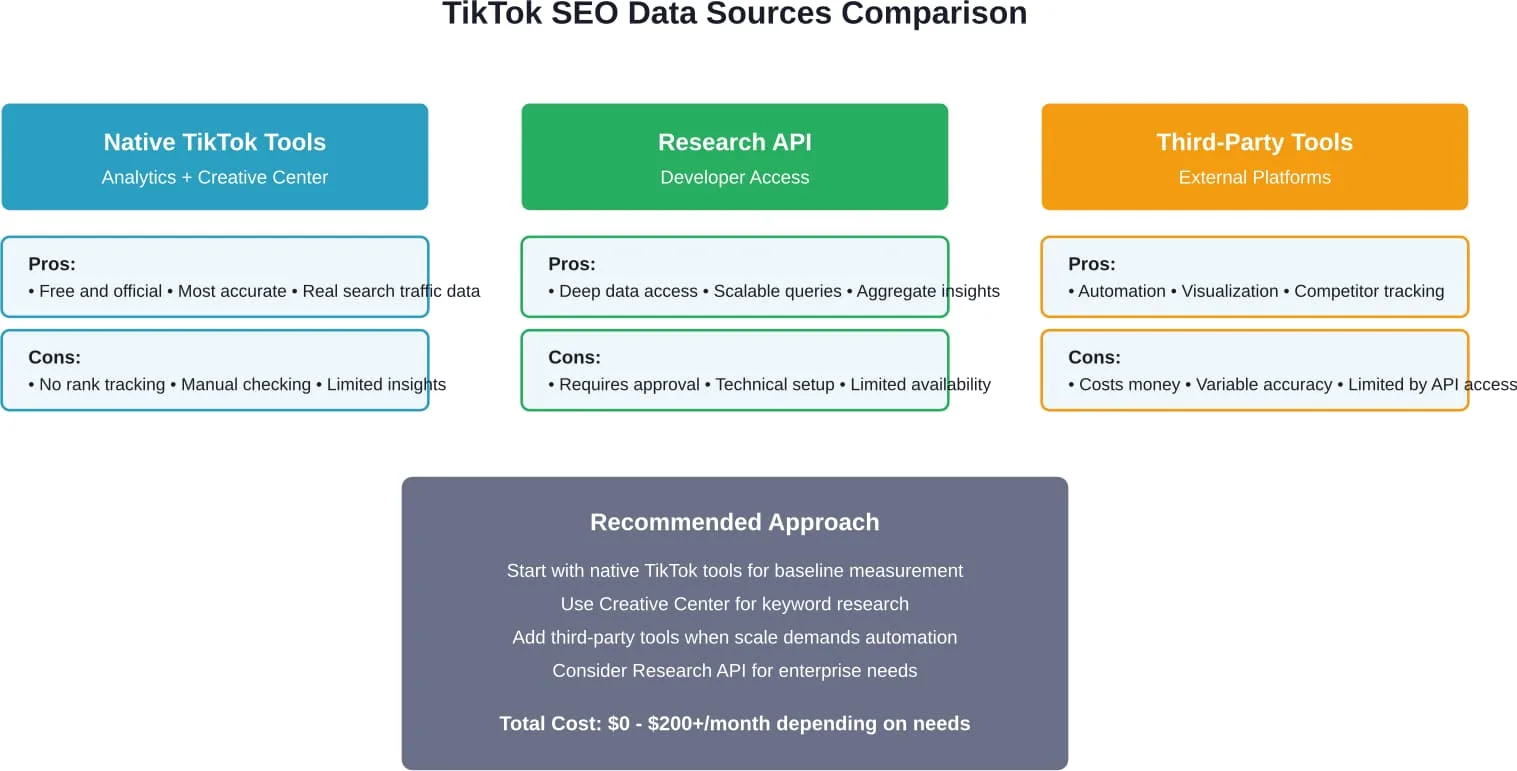
Developers and researchers can access deeper search data through TikTok’s Research API. This requires approval and technical implementation, but it unlocks capabilities unavailable in consumer interfaces.
TikTok’s Research API is currently available to non-profit academic researchers in specific regions (such as the US and EU).
The API returns structured data about videos, including creation date, engagement metrics, hashtags, and sounds. Query parameters allow filtering by region, date range, and keyword terms.
Real-world applications: competitive intelligence (tracking how competitor content performs for target keywords), trend forecasting (identifying emerging search patterns before they mainstream), and content gap analysis (finding high-volume keywords with limited existing content).
Limitations exist—the API doesn’t expose real-time ranking positions or individual user behavior. It’s designed for aggregate analysis rather than granular tracking. Still, for brands investing seriously in TikTok search, API access provides measurement capabilities that manual checking can’t match.
Third-Party Tools for TikTok SEO Monitoring
Several services offer TikTok SEO tracking features. Quality varies dramatically, and some make promises their technology can’t deliver.
What Third-Party Tools Actually Provide
Legitimate tools aggregate publicly visible data: video metadata, engagement metrics, trending hashtags, and sound popularity. They don’t have privileged API access that reveals hidden rankings.
The value proposition: automation and visualization. Instead of manually checking rankings and recording data in spreadsheets, these tools monitor continuously and present trends in dashboards.
Some platforms offer keyword research features that scrape TikTok’s autocomplete suggestions and trending pages. That’s useful for discovery, but it duplicates functionality available in TikTok’s own Creative Center.
Limitations to Understand
No third-party tool has perfect accuracy for TikTok search rankings. The platform’s algorithm personalizes results based on user history, location, and device. What ranks #1 for one user might appear at #5 for another.
Services that claim “guaranteed ranking tracking” overstate their capabilities. They typically show one perspective on rankings—useful directionally, but not definitive.
Historical data presents another challenge. TikTok doesn’t make historical search rankings publicly available, so tools can only track forward from the moment monitoring begins. Retroactive analysis isn’t possible.
Evaluation Criteria
When considering third-party tools, verify these capabilities: refresh frequency (daily tracking minimum), location targeting (rankings vary by region), competitor monitoring (not just owned content), and export functionality (raw data access for custom analysis).
Check the official website for current pricing—rates change frequently as the TikTok analytics space evolves. Free tiers typically offer limited tracking, while professional plans scale with the number of keywords and videos monitored.
Optimizing Content Based on SEO Insights
Checking SEO performance only matters if the data informs action. These optimization tactics translate insights into improved rankings.
Caption Optimization
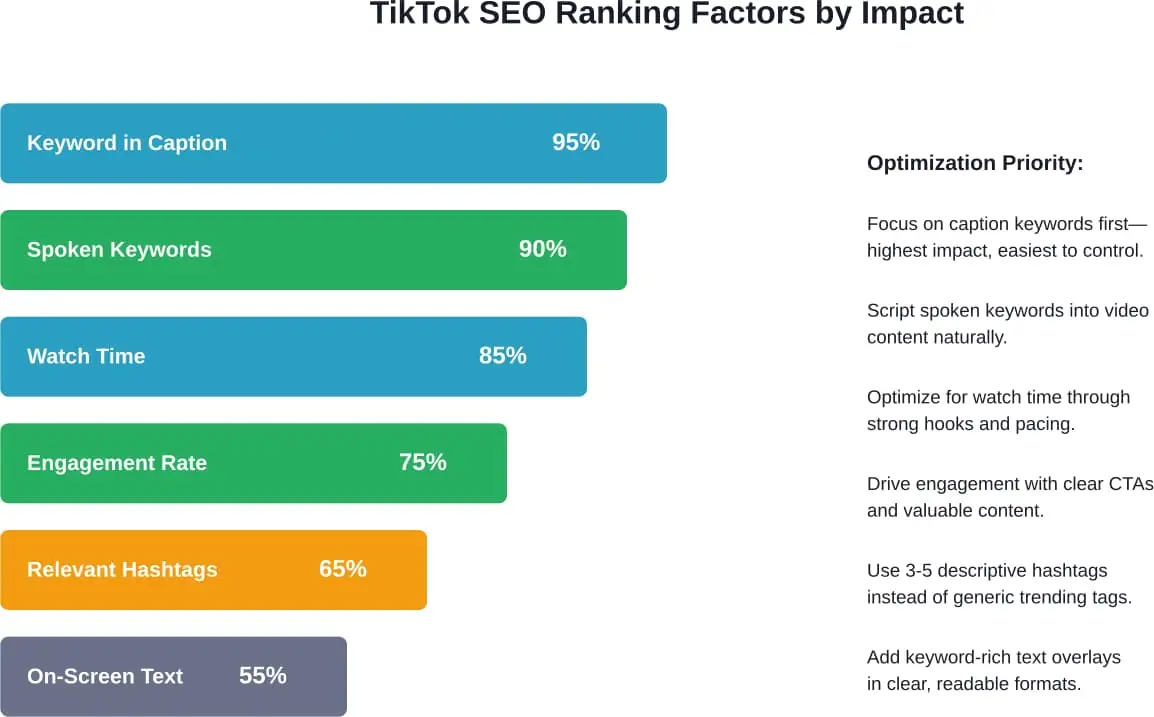
Captions function as metadata for TikTok’s search algorithm. Include target keywords naturally in the first sentence—that text carries more weight than keywords buried at the end.
Avoid keyword stuffing. Write captions that humans actually want to read. The algorithm detects spam patterns and penalizes content that prioritizes keywords over readability.
Structure captions with a hook (first sentence grabs attention), value proposition (what viewers will learn), and call-to-action (what to do next). Keywords fit naturally within that framework.
Hashtag Strategy
Community discussions suggest focusing on descriptive hashtags rather than generic trending tags. Instead of #fyp (which provides zero topical information), use #budgetmeals or #beginneryoga.
Limit hashtags to 3-5 relevant terms. TikTok’s algorithm doesn’t reward hashtag quantity—relevance matters more. Each hashtag should describe actual video content, not aspirational reach.
Monitor which hashtags drive search traffic in analytics. Double down on high-performers. Eliminate hashtags that generate impressions but low engagement—those indicate poor audience match.
Spoken Keywords
TikTok transcribes audio using speech recognition. Spoken words influence search rankings just like caption text.
Say target keywords clearly in the first three seconds of video. That optimizes for both search algorithms and human viewers (who need immediate context about video relevance).
Repeat keywords naturally throughout the video. Educational content makes this easy—explain concepts using consistent terminology. Entertainment content requires more creativity to work keywords in organically.
On-Screen Text
Text overlays function as additional metadata. TikTok’s computer vision systems read on-screen text and factor it into relevance scoring.
Display keywords prominently in title cards or key frames. Make text readable (high contrast, simple fonts, sufficient size). If TikTok’s AI can’t parse the text, it can’t use it for ranking.
Avoid generic text like “Wait for it…” or “Part 2.” Those phrases don’t communicate topical relevance. Use descriptive text that reinforces keyword themes.
Common TikTok SEO Mistakes That Kill Rankings
Even creators who understand SEO concepts make tactical errors that tank performance. These mistakes appear repeatedly across accounts with search visibility problems.
Optimizing for Trending Sounds Over Keywords
Trending sounds boost For You Page distribution, but they don’t necessarily improve search rankings. The sound needs thematic relevance to the search query.
A fitness video using a trending comedy audio might go viral through recommendations but rank poorly for “home workout” searches. The mismatch between audio and content confuses topical classification.
Choose sounds that reinforce content themes. Original audio with clear spoken keywords often outperforms trending sounds for search purposes.
Generic Captions Without Keywords
Captions like “Watch this!” or “Follow for more” provide zero context for search algorithms. The video might be about meal prep, but if the caption doesn’t mention food or cooking, rankings suffer.
Every caption should explicitly state the video’s topic. That feels redundant (the visual content already shows what it’s about), but search algorithms need textual confirmation.
Ignoring Search Traffic Metrics
Creators obsess over total views while ignoring traffic source breakdowns. A video with 100,000 views and 2% search traffic has weaker SEO than one with 10,000 views and 30% search traffic.
Check analytics for every published video. Identify patterns in what generates search traffic. Replicate successful elements in future content.
Posting Inconsistently
Search rankings favor accounts that publish regularly. Sporadic posting (nothing for weeks, then five videos in one day) signals lower authority than consistent schedules.
Establish sustainable posting frequency—whether daily, three times weekly, or whatever the content calendar supports long-term. Algorithm trust builds through reliability.
Measuring SEO Impact on Business Goals
Search optimization should connect to outcomes beyond vanity metrics. These frameworks link TikTok SEO to revenue and growth.
Attribution Modeling
According to Fospha research, TikTok creates a halo effect, driving 22% of sales credited to bottom-of-funnel (according to Fospha research). Direct attribution undercounts TikTok’s contribution because users discover products on TikTok but convert elsewhere.
Track assisted conversions, not just last-click attribution. Use campaign UTM parameters in profile links and video captions. Monitor how TikTok traffic behaves on owned websites—page depth, time on site, conversion rate.
Survey customers about discovery sources. “How did you first hear about us?” responses reveal TikTok’s influence even when analytics show minimal last-click traffic.
Brand Search Volume
Strong TikTok presence increases branded search volume on Google and within TikTok itself. Monitor brand name searches in TikTok’s search bar and through Google Trends.
Growing branded search indicates successful awareness building. That’s a leading indicator of future conversions—people research brands they’ve discovered through social content before purchasing.
Content ROI Calculation
Calculate cost per view from search traffic specifically. Divide content production costs by search-sourced views to determine efficiency.
Compare search traffic ROI against For You Page traffic ROI. Search traffic often delivers lower cost per qualified lead because viewers have explicit intent. That efficiency justifies optimization investment.
Advanced TikTok SEO Tactics for 2026
The basics cover most use cases, but competitive niches require sophisticated approaches.
Semantic Keyword Clustering
Instead of optimizing individual videos for isolated keywords, build content clusters around related search terms. Create a pillar video covering the broad topic, then supporting videos targeting specific subtopics.
Interlink content through captions (“See my video about…” directing to profile). TikTok’s algorithm recognizes topical authority when accounts consistently publish related content.
Seasonal Content Planning
Search demand fluctuates seasonally. “Meal prep” searches spike in January (New Year’s resolutions) and September (back to school). Plan content calendars around predictable search patterns.
Use TikTok’s Keyword Insights historical data to identify seasonal peaks. Publish optimized content 2-3 weeks before demand peaks to establish rankings before competition intensifies.
Competitor Gap Analysis
Identify keywords where competitors rank but owned content doesn’t. Those gaps represent opportunity areas—existing search demand with space for new content.
Manual research works: search target keywords, note which accounts consistently appear in top results, analyze their content approach, then create differentiated content targeting the same queries.
Series Development
Multi-part series build topical authority. When viewers watch three consecutive videos about the same subject, TikTok’s algorithm strengthens the account’s relevance score for that topic.
Structure series with clear numbering (“Part 1: Introduction”) and consistent hashtags. Each video should stand alone while contributing to comprehensive coverage.
TikTok SEO vs. Traditional SEO: Key Differences
Marketers trained in traditional search optimization need to unlearn some assumptions when approaching TikTok.
Content Format
Traditional SEO revolves around text-based content—articles, product pages, landing pages. TikTok SEO centers on short-form video with text as supporting metadata.
Visual storytelling replaces keyword-rich paragraphs. Entertainment value matters as much as information density. Users search on TikTok for different reasons than they search on Google.
Ranking Velocity
Google rankings change slowly—weeks or months to establish positions. TikTok rankings fluctuate rapidly based on recent engagement patterns.
A video can rank #1 for a keyword within hours of posting if initial engagement is strong. That same video can drop to page two within days if newer content generates more interaction.
Backlinks Don’t Exist
Traditional SEO prioritizes backlinks as authority signals. TikTok has no equivalent—external links don’t influence rankings.
Authority on TikTok comes from consistent posting, account follower count, historical engagement rates, and topical consistency. Different signals, similar concept.
Personalization Intensity
Google personalizes results but maintains significant overlap between users. TikTok’s search personalization is more aggressive—results vary substantially based on individual viewing history.
That makes absolute ranking positions less meaningful. Focus on appearing in results for target audiences rather than achieving universal #1 positions.
Taking Action on TikTok SEO
Understanding TikTok SEO theory matters less than implementing systematic optimization. Start with these immediate actions:
- Audit existing content for search performance.
- Export analytics for published videos and identify which ones generate search traffic.
- Look for patterns, like specific topics, caption structures, video lengths that correlate with higher search percentages.
- Research keywords using the Creative Center.
- Identify 10-15 relevant search terms with rising or stable high volume.
- Map those keywords to content topics.
- Create a production calendar that systematically covers priority keywords.
- Optimize new content from the start.
- Write captions with keywords in the first sentence.
- Script spoken keywords into video dialogue.
- Add text overlays that reinforce topical themes.
- Use descriptive hashtags rather than generic trending tags.
- Track performance weekly.
- Check rankings manually for priority keywords.
- Review analytics to see which videos generate search traffic.
- Document what works and replicate successful elements.
- Iterate based on data.
- Double down on content formats that attract search traffic.
- Experiment with different optimization approaches.
TikTok’s algorithm evolves constantly—what works today may need adjustment in three months.
The brands that win on TikTok search treat it as seriously as they treat Google SEO. That means dedicated resources, systematic processes, and measurement frameworks that connect optimization to business outcomes.
TikTok isn’t replacing traditional search engines—it’s fragmenting search behavior across multiple platforms. Visibility requires meeting audiences wherever they search, not just where optimization feels familiar.
Start checking TikTok SEO performance today. The data reveals opportunities invisible in traditional analytics. And in a landscape where Gen Z women look for brands on social media platforms, with 45% searching on social media while 47% look for them on traditional search engines, search optimization on TikTok isn’t optional—it’s a competitive necessity.
Wrapping Up: The Future of TikTok Search and SEO
TikTok’s evolution as a search platform accelerates as user behavior shifts away from traditional search engines for certain query types.
According to a 2024 U.S. survey, 64% of Gen Z said they’ve used TikTok to search for information—not just entertainment. That behavioral shift forces brands to rethink content distribution. Showing up in Google alone no longer captures the full addressable audience.
The platform continues developing search-specific features. Keyword Insights represents one iteration, but TikTok’s official business resources suggest more comprehensive search analytics tools are in development. Expect measurement capabilities to improve as advertiser demand grows.
Shopping integration will deepen the connection between search and commerce. TikTok Shop allows direct purchasing without leaving the app. As product discovery increasingly happens through TikTok search, optimization directly impacts revenue—not just brand awareness.
Search Everywhere Optimization becomes standard practice. Marketing teams need expertise in optimizing for multiple search environments: traditional search engines, social platforms, voice assistants, and AI chat interfaces. TikTok represents one part of that fragmented search landscape.