


Choosing an ecommerce platform isn’t just about checkout flows and design templates. The platform powering your online store directly affects how search engines crawl, index, and rank your pages. Pick the wrong one, and every SEO improvement becomes an uphill battle.
Here’s what makes this decision critical: according to recent data, organic search drives significant ecommerce traffic, though traffic trends vary by site size and industry. More importantly, SEO leads typically convert at higher rates than social media or display ads, with research indicating organic search users show higher purchase intent. When organic search drives significant traffic and converts at higher rates, platform choice stops being a backend detail—it becomes a revenue driver.
Some platforms lock URL structures, hide metadata controls, or limit schema markup support. Others offer extensive SEO capabilities but require technical expertise most store owners don’t possess. The gap between these platforms isn’t small—it’s the difference between ranking on page one or getting buried on page five.
This analysis breaks down which platforms actually deliver for search visibility, which ones make SEO harder than it should be, and what specific features separate top performers from the rest.
Why Platform Choice Matters More Than SEO Tactics
SEO tactics matter, but they can’t overcome platform limitations. A brilliant content strategy won’t save a site that generates duplicate content URLs. Link building can’t fix poor page speed architecture. On-page optimization hits a ceiling when metadata controls are restricted.
The platform establishes your SEO ceiling. Everything else determines how close you get to it.
According to academic research, link building consistently outperforms alternative approaches for long-term traffic and revenue generation. But that performance requires a platform that supports proper URL structures, allows custom redirects, and doesn’t create technical barriers to external linking.
Three platform characteristics determine SEO potential more than any other factors:
- Technical architecture: How the platform generates URLs, handles duplicate content, manages site speed, and structures navigation affects crawlability before any optimization begins.
- Control depth: Access to edit meta tags, customize URL structures, implement schema markup, and modify robots.txt files determines whether advanced SEO techniques are even possible.
- Scalability constraints: Some platforms perform well for 50 products but break down at 5,000. SEO issues that don’t appear at launch can emerge as inventory grows.
The SEO Features That Actually Move Rankings
Not all SEO features carry equal weight. Some directly impact how search engines evaluate pages. Others provide convenience but minimal ranking benefit. Understanding this distinction prevents wasting time on features that feel important but don’t affect visibility.
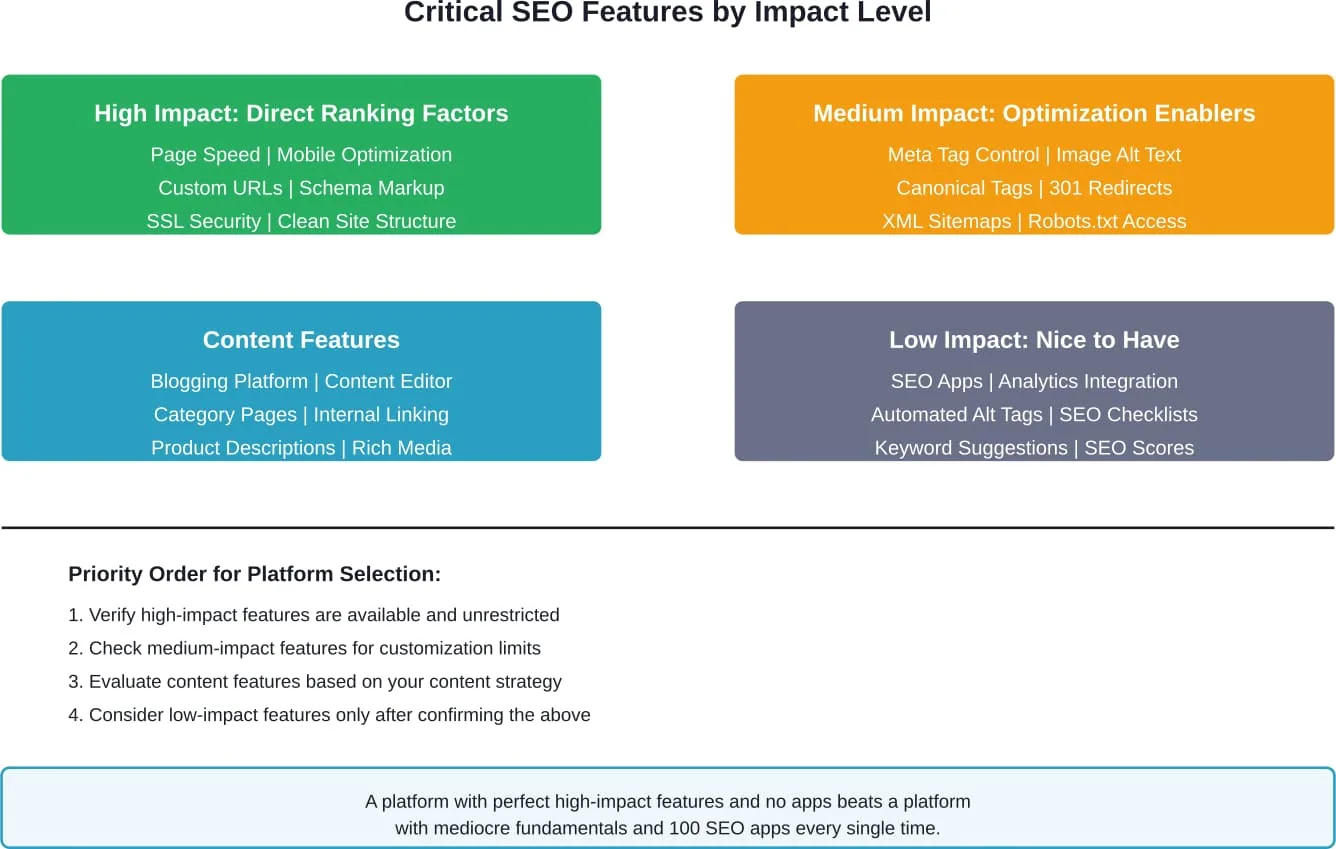
Page speed consistently ranks among the top factors. Google’s Core Web Vitals update made this explicit—slow sites get penalized regardless of content quality. Platforms that generate bloated code, load unnecessary scripts, or handle images poorly create speed problems that optimization tactics can’t fully resolve.
URL structure comes next. Clean, readable URLs that include relevant keywords perform better than auto-generated strings of numbers and parameters. Some platforms force URL patterns that can’t be changed. Others allow full customization. This difference compounds across hundreds or thousands of product pages.
Schema markup—structured data that helps search engines understand page content—has become increasingly important. Product schema, review schema, and breadcrumb schema can trigger rich results in search listings, dramatically improving click-through rates. Platforms that make schema implementation difficult or impossible leave this advantage on the table.
Mobile optimization isn’t optional. Mobile-first indexing means Google primarily uses the mobile version of content for ranking. Platforms that treat mobile as an afterthought or generate separate mobile URLs create technical SEO problems that require constant management.
Top Ecommerce Platforms for SEO: Detailed Rankings
Based on technical architecture, control depth, and real-world performance data, here’s how major ecommerce platforms stack up for SEO in 2026.
1. Shopify: Best Overall for SEO
Shopify consistently ranks as the top choice for ecommerce SEO, balancing strong technical fundamentals with ease of use. According to ratings tracked on the official Shopify App Store, top SEO apps like Booster SEO & IMAGE OPTIMIZER has a 4.8-star rating with 4,262 total reviews, with 91% of ratings being five stars, while Sherpas: Smart SEO holds a 4.9-star rating from 915 reviews with 97% of ratings being five stars.
The platform handles core technical requirements out of the box. Automatic SSL certificates, mobile-responsive themes, clean URL structures, and automatic sitemap generation work without configuration. Page speed performs well due to Shopify’s content delivery network and optimized hosting infrastructure.
What Shopify does particularly well:
- Speed and performance: Shopify’s hosted infrastructure delivers consistently fast load times. The platform handles traffic spikes without performance degradation, which prevents the ranking drops that can occur when sites slow during high-traffic periods.
- App ecosystem: Extensive SEO apps provide functionality for specific needs—advanced schema markup, image optimization, broken link monitoring, and automated meta tag generation. Apps like SEOWILL (formerly SEOAnt) offers AI-powered blog creation and SEO auditing with a 4.8-star rating from 1,455 reviews, with 90% rating five stars.
- Built-in features: Editable title tags, meta descriptions, URL handles, and image alt text come standard. H1 tags automatically pull from product titles but can be customized through theme editing.
Limitations exist. Shopify generates some URL patterns that can’t be fully customized—collection pages include /collections/ in the path, product pages include /products/, and blog posts include /blogs/. While these URLs remain clean and functional, stores seeking complete URL control will find restrictions.
Advanced technical users sometimes feel constrained. Access to robots.txt is limited, though not entirely blocked. Editing theme code requires Liquid template knowledge. Complex schema implementations may need developer assistance.
The Shopify Basic plan starts at $29 per month (billed yearly), making it accessible for stores at various scales.
| SEO Feature | Shopify Capability | Rating |
|---|---|---|
| Page Speed | Excellent CDN and hosting infrastructure | 9/10 |
| URL Control | Clean URLs with minor path restrictions | 7/10 |
| Schema Markup | Basic built-in, advanced via apps | 8/10 |
| Mobile Optimization | Responsive themes, mobile-first design | 9/10 |
| Content Features | Built-in blog, good editor | 8/10 |
| Technical Access | Theme code access, limited server control | 6/10 |
Best for: Growing stores that want strong SEO performance without managing technical infrastructure. Ideal for merchants who value speed and reliability over absolute customization control.
2. WooCommerce: Best for Advanced SEO Control
WooCommerce provides the deepest SEO customization available among major platforms. As a WordPress plugin rather than a standalone platform, it inherits WordPress’s extensive SEO capabilities and open-source flexibility.
According to comparison data from Codeless, WooCommerce holds an overall rating of 4.74 out of 5.
The WordPress foundation delivers SEO advantages that closed platforms can’t match. Complete control over URL structures, unrestricted access to robots.txt and .htaccess files, and the ability to modify any aspect of site architecture provides options that technical SEO specialists need.
WooCommerce’s SEO strengths include:
- Unlimited customization: Every technical element can be modified. URL structures follow any pattern. Custom taxonomies, advanced filtering, and complex site architectures are all possible without platform restrictions.
- Plugin ecosystem: WordPress SEO plugins like Yoast, Rank Math, and All in One SEO provide comprehensive optimization tools. These plugins offer more granular control than apps on hosted platforms.
- Content capabilities: WordPress’s content management system excels at creating and organizing content. Building content-rich category pages, detailed product descriptions, and extensive blog content is more natural than on platforms designed primarily for transactions.
The tradeoff is complexity. WooCommerce requires more technical knowledge than hosted platforms. Store owners must handle hosting selection, performance optimization, security updates, and plugin management. Poor hosting choices can create speed problems that negate SEO advantages.
Performance requires active management. WooCommerce sites can be extremely fast or painfully slow depending on hosting quality, plugin selection, and optimization efforts. Unlike Shopify’s consistent performance, WooCommerce sites vary widely.
Security and maintenance fall on the store owner. WordPress and WooCommerce release regular updates that must be applied. Plugin conflicts can break functionality. Database optimization becomes necessary as stores grow.
Best for: Technical users or stores with developer support who need maximum SEO control. Ideal for content-heavy stores where SEO is a primary growth channel and technical resources are available.
3. BigCommerce: Best for Enterprise-Scale SEO
BigCommerce positions itself between Shopify’s ease of use and WooCommerce’s flexibility, offering strong built-in SEO features without requiring extensive technical management.
BigCommerce starts at $29 per month (billed yearly), matching Shopify’s entry price point. According to comparison data from Codeless, BigCommerce holds an overall rating of 4.30 out of 5.
The platform includes advanced SEO features in its core offering. Editable URLs with no forced prefixes, built-in AMP support, comprehensive schema markup, and advanced redirect management come standard without requiring apps or plugins.
BigCommerce’s SEO advantages:
- Technical features: More technical control than Shopify without WooCommerce’s complexity. Custom URL structures, access to robots.txt editing, and advanced canonical tag management provide flexibility for technical optimization.
- Page speed: Optimized hosting infrastructure delivers fast load times. Built-in image optimization and lazy loading help maintain speed as product catalogs grow.
- Scalability: The platform handles large product catalogs better than many competitors. Stores with thousands of SKUs maintain performance and SEO capabilities that some platforms lose at scale.
Content management is less robust than WooCommerce. The built-in blog functions adequately but lacks WordPress’s content power. Creating complex content architectures requires more effort.
The learning curve sits between Shopify and WooCommerce. BigCommerce offers more features and settings than Shopify, which means more complexity. Store owners need moderate technical comfort to leverage advanced capabilities.
Best for: Mid-size to enterprise stores that need advanced SEO features without managing hosting infrastructure. Ideal for businesses outgrowing Shopify’s limitations but not wanting WooCommerce’s maintenance overhead.
4. Wix: Best for SEO Beginners
Wix has improved dramatically for SEO after years of criticism. While it doesn’t match Shopify or WooCommerce for serious ecommerce SEO, it provides sufficient capabilities for small stores with simple SEO needs.
The platform’s Wix SEO Wizard walks beginners through basic optimization—meta tags, site structure, and mobile optimization. This guidance helps non-technical users implement fundamental SEO practices correctly.
Wix’s improvements include automatic HTTPS, mobile optimization, structured data markup, and better URL handling. These technical upgrades resolved earlier SEO problems that made Wix unsuitable for search-focused stores.
Limitations remain significant. Advanced technical controls are restricted. Extensive product catalogs may face scaling issues. Switching away from Wix to another platform creates migration challenges since Wix uses proprietary technology.
Best for: Very small stores or beginners who prioritize ease of use over advanced SEO capabilities. Suitable when SEO is secondary to other marketing channels.
5. Squarespace: Balanced Design and Basic SEO
Squarespace delivers clean, design-focused templates with adequate built-in SEO features. The platform handles fundamentals well—mobile optimization, SSL certificates, clean URLs, and basic meta tag controls work out of the box.
The platform suits stores where visual design takes priority and SEO requirements remain straightforward. Built-in blogging tools support content marketing, though they lack the power of WordPress.
Technical limitations prevent advanced SEO implementations. Schema markup options are limited, URL customization is restricted, and access to technical settings is constrained compared to platforms built primarily for ecommerce.
Best for: Design-conscious brands with smaller product catalogs where visual presentation matters more than advanced SEO capabilities.
Critical SEO Features: Platform Comparison
Different platforms handle essential SEO features differently. Understanding these differences prevents choosing a platform that blocks techniques your SEO strategy requires.
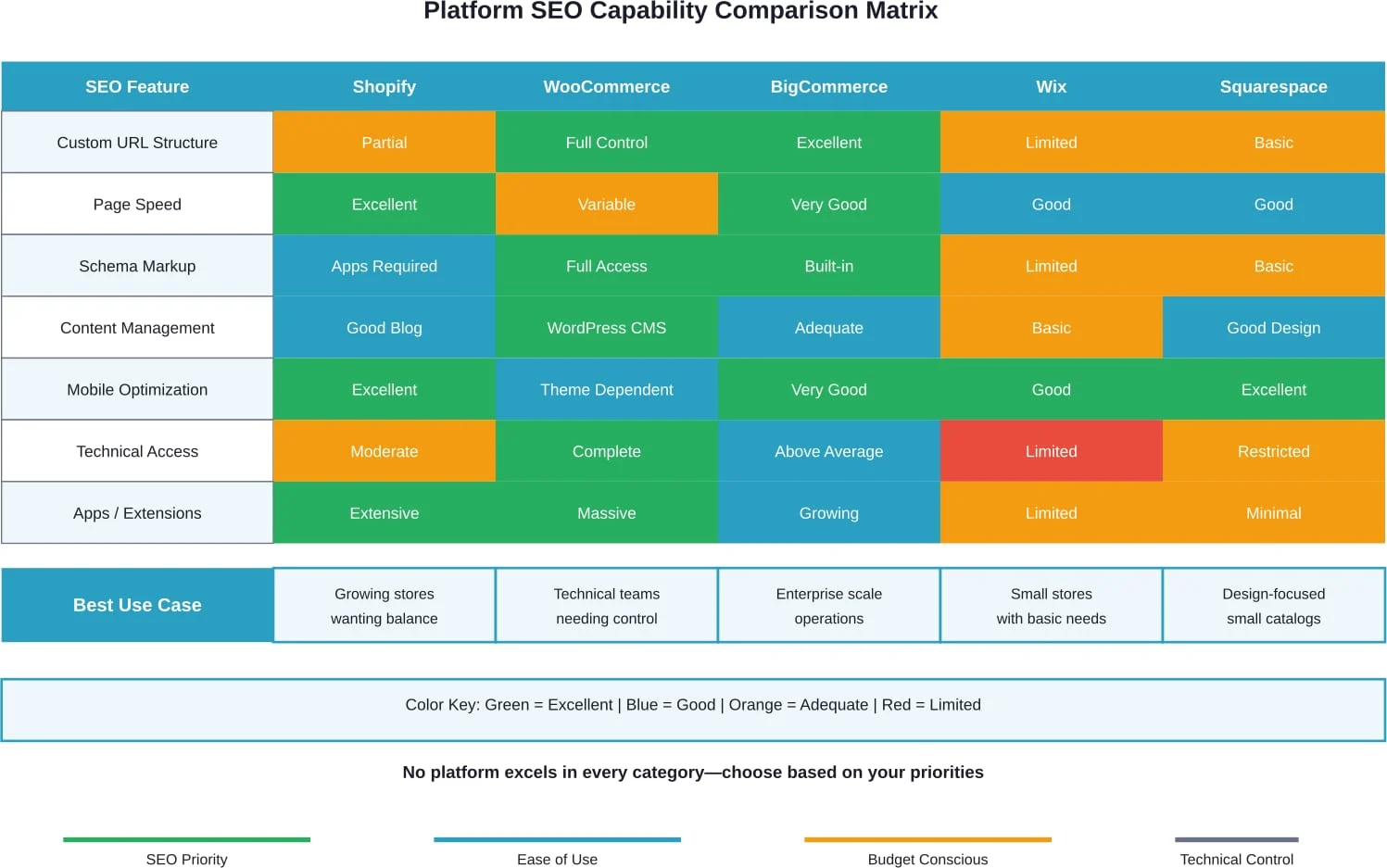
URL Structure and Customization
URL structure affects both search engine understanding and user experience. Clean, descriptive URLs perform better than auto-generated strings of parameters or ID numbers.
- WooCommerce offers complete URL control. Any URL pattern is possible—product URLs, category structures, and custom taxonomies can follow any naming convention. This flexibility supports advanced SEO strategies but requires technical knowledge to implement correctly.
- BigCommerce provides extensive URL customization without forced prefixes. Products can use URLs like example.com/product-name instead of being locked into paths like example.com/products/product-name. This clean structure improves both SEO and user experience.
- Shopify allows URL editing within constraints. The platform forces collection and product prefixes that can’t be removed through standard settings. While URLs remain clean and functional, stores seeking specific URL patterns may find limitations.
- Wix and Squarespace offer basic URL editing but with more restrictions than ecommerce-focused platforms. Customization options are sufficient for straightforward needs but limited for advanced implementations.
Schema Markup Implementation
Schema markup helps search engines understand product details, reviews, pricing, and availability. Rich results in search listings—star ratings, price displays, stock status—can significantly improve click-through rates.
- BigCommerce includes comprehensive schema markup by default. Product schema, breadcrumb schema, and organization schema generate automatically without requiring apps or coding. This built-in implementation ensures proper structured data from launch.
- WooCommerce relies on plugins for schema implementation, but those plugins provide complete control. Plugins like Schema Pro or Yoast SEO enable any schema type with granular customization. Technical users can implement custom schema through theme files.
- Shopify implements basic schema automatically but requires apps for advanced implementations. Review schema, FAQ schema, and specialized product markup typically need third-party apps. The app ecosystem provides solutions, though they add cost and complexity.
- Wix and Squarespace offer basic schema markup but with limited customization. These platforms handle fundamental structured data adequately but don’t support the advanced schema implementations that technical SEO strategies may require.
Content Management Capabilities
Content drives SEO. Product descriptions, category pages, blog posts, and educational content all contribute to organic visibility. Platform content management capabilities determine how effectively stores can execute content strategies.
- WooCommerce, built on WordPress, provides the strongest content management. Creating detailed category descriptions, building resource centers, publishing blog content, and organizing information hierarchies works naturally within WordPress’s CMS architecture.
- Shopify includes a functional blogging platform that handles most content needs. Creating blog posts, organizing content by tags and categories, and publishing updates works well. The editor is less powerful than WordPress but sufficient for ecommerce content marketing.
- BigCommerce offers adequate blogging tools that cover basic content needs. The content editor functions properly for straightforward blog posts and category descriptions, though complex content architectures require more effort than WordPress.
- Squarespace provides good content tools with a focus on visual presentation. The platform suits content that prioritizes design and layout, though organizational features are less extensive than WordPress.
- Wix’s content management works for simple needs but becomes limiting for extensive content strategies. Building large content libraries or complex information architectures is more challenging than on platforms designed for content-heavy sites.
Platform Selection Framework: Matching SEO Needs to Capabilities
Choosing the right platform requires matching SEO requirements to platform strengths. No platform excels at everything—understanding priorities prevents selecting based on features that don’t matter for specific business models.
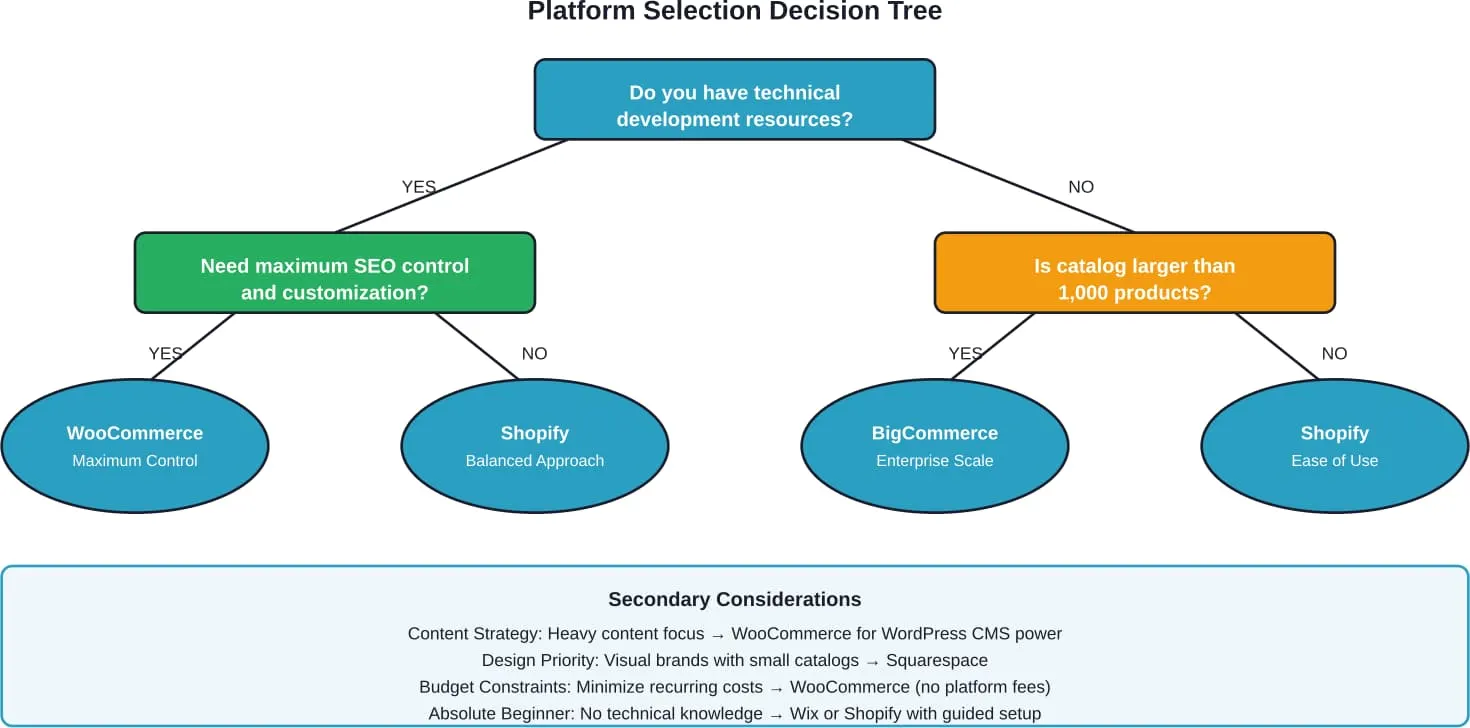
Start with honest assessment of technical resources. WooCommerce provides maximum control but requires technical capability or budget for developer support. Shopify balances strong performance with managed infrastructure. The wrong platform for available resources creates ongoing friction.
Consider catalog size and complexity. Platforms behave differently at scale. A platform that works perfectly for 50 products may struggle with 5,000. Product variations, filtering requirements, and category structures affect performance differently across platforms.
Evaluate content strategy importance. If content marketing drives growth, content management capabilities matter significantly. If products sell primarily through paid advertising with minimal content needs, platform content features become less critical.
| Business Profile | Recommended Platform | Reasoning |
|---|---|---|
| Growing store, balanced approach | Shopify | Strong fundamentals without technical overhead |
| Technical team available | WooCommerce | Maximum customization and control |
| Large catalog, enterprise scale | BigCommerce | Built-in features that scale without degradation |
| Content-heavy strategy | WooCommerce | WordPress content management power |
| Design-focused, small catalog | Squarespace | Visual presentation with adequate SEO |
| Minimal technical knowledge | Wix or Shopify | User-friendly with guided SEO setup |
| Budget-conscious startup | WooCommerce | No platform fees, pay only for hosting |
Questions to Guide Platform Selection
Answer these questions before committing to a platform:
- Technical capability: Does the team include developers or technical specialists? If not, is there budget to hire technical support when needed? Platforms requiring technical management create ongoing costs beyond subscription fees.
- Growth trajectory: What’s the expected product count in one year? Three years? Some platforms handle small catalogs well but struggle as inventory grows. Migration later is expensive and risky.
- SEO priority: How important is organic search compared to paid advertising or other channels? If SEO is the primary growth channel, technical SEO capabilities matter more than if organic search provides supplementary traffic.
- Content strategy: Does the business plan include extensive content creation—blog posts, guides, educational resources? Content-focused strategies need strong content management tools.
- Budget structure: Is ongoing monthly cost or upfront development investment preferred? Hosted platforms charge monthly fees but require minimal upfront investment. WooCommerce needs hosting and development but avoids platform fees.
Common Platform SEO Mistakes and How to Avoid Them
Certain mistakes appear repeatedly across platforms. Awareness of these issues prevents problems that damage SEO performance.
Mistake 1: Ignoring Page Speed Until It’s a Problem
Page speed affects rankings directly through Core Web Vitals and indirectly through user behavior. Slow sites lose rankings and conversions simultaneously.
On hosted platforms like Shopify and BigCommerce, avoid installing excessive apps. Each app loads additional code. Five or six apps rarely cause problems. Fifteen or twenty apps can significantly slow site performance.
For WooCommerce, hosting quality determines speed more than any other factor. Budget hosting creates persistent performance problems. Quality managed WordPress hosting designed for WooCommerce prevents most speed issues.
Test page speed before launching and monitor regularly. Google PageSpeed Insights, GTmetrix, and similar tools identify specific problems. Address speed issues during development—fixing speed problems after launch is more difficult and expensive.
Mistake 2: Accepting Default Settings Without Optimization
Default platform settings provide basic functionality but rarely optimize for SEO. Every platform requires configuration for optimal search performance.
Meta titles and descriptions need customization on every page. Auto-generated metadata is better than nothing but not as effective as carefully crafted titles and descriptions that target specific keywords and encourage clicks.
URL structures should be reviewed and optimized. Default URL patterns may include unnecessary words, dates, or parameters that can be removed. Cleaner URLs perform better.
Image optimization requires active management. Platforms don’t automatically compress images to optimal sizes. Large image files slow page loads. Image compression should be part of the content upload workflow.
Mistake 3: Neglecting Mobile Optimization
Mobile-first indexing means Google primarily uses mobile versions of content for ranking. Desktop optimization is secondary. Yet many stores still prioritize desktop appearance and treat mobile as an afterthought.
Test every page on actual mobile devices, not just responsive preview modes. Real devices reveal performance and usability issues that desktop previews miss.
Mobile page speed often differs from desktop speed. Test mobile performance separately. Mobile connections are typically slower, making optimization more critical.
Mobile usability affects conversions as much as rankings. Buttons that are hard to tap, text that’s difficult to read, and navigation that’s confusing on small screens hurt both SEO and revenue.
Mistake 4: Creating Thin Product and Category Pages
Product pages with minimal content struggle to rank. A product title, image, price, and short description provide insufficient information for search engines to understand page relevance.
Category pages drive long-term growth when built around buyer-intent keywords with clear site architecture and strong internal linking. Category pages with only product grids and no descriptive content miss significant SEO opportunities.
Add substantial content to product pages—detailed descriptions, specifications, use cases, and benefits. Unique content performs better than manufacturer descriptions copied across multiple sites.
Build content-rich category pages. Add category descriptions that explain what products the category includes, who they’re for, and how to choose between options. This content helps search engines understand category relevance and improves rankings for broader keywords.
Advanced SEO Considerations by Platform
Beyond basic features, advanced SEO implementations reveal deeper differences between platforms.
International SEO and Multi-Region Stores
Stores selling in multiple countries or languages need proper international SEO implementation. Hreflang tags, regional URL structures, and currency handling all affect search performance in different markets.
Shopify handles multi-currency and international markets through Shopify Markets. The system manages separate storefronts for different regions with proper technical implementation. Hreflang tags and regional targeting work correctly out of the box.
WooCommerce requires plugins for international functionality but offers more customization. WPML for multilingual content and WooCommerce multi-currency plugins provide extensive control over international implementations.
BigCommerce includes multi-storefront capabilities for international selling with proper SEO handling. Regional stores can share inventory while maintaining separate content and proper technical SEO setup.
Faceted Navigation and Filter SEO
Product filtering creates SEO challenges. Faceted navigation generates numerous URL variations—different combinations of color, size, price range, and other filters create potentially thousands of URLs with similar or identical content.
Without proper handling, faceted navigation causes duplicate content problems and wastes crawl budget as search engines index thousands of filter combinations.
BigCommerce and WooCommerce provide better control over faceted navigation SEO. Options to set noindex tags on filtered pages, use canonical tags to point to primary versions, or allow specific filter combinations to be indexed while blocking others give technical SEO specialists tools to manage these issues.
Shopify’s faceted navigation handling is adequate for most stores but more limited for complex implementations. Advanced filtering SEO may require custom development or compromise on technical perfectionism.
Blog and Content Hub Integration
Ecommerce sites increasingly build content hubs—extensive blog content, guides, tutorials, and resources that target informational keywords and establish topical authority.
WooCommerce excels here through WordPress’s content management capabilities. Building extensive content libraries with complex organization, custom post types, and advanced taxonomy structures works naturally.
Shopify’s blog handles content marketing for most stores. Limitations appear when building very large content hubs with complex organization. Stores publishing hundreds of blog posts with detailed categorization may find organizational features limiting.
BigCommerce’s blog works adequately for moderate content strategies. The platform suits stores where content supplements product pages rather than serving as a primary SEO strategy.
Platform Migration Considerations
Switching platforms after launch creates significant SEO risks. Understanding migration challenges helps either choose correctly initially or execute migrations carefully when necessary.
URL structure changes during migration cause ranking drops unless properly managed. Every URL that changes requires a 301 redirect from the old URL to the new URL. Missing redirects result in 404 errors that lose rankings and frustrate customers.
Large catalogs make migration complex. Manually creating redirects for thousands of products is impractical. Migration planning must include automated redirect generation and thorough testing.
Some platforms make exporting data easier than others. Shopify, WooCommerce, and BigCommerce all support data export, though formats and completeness vary. Proprietary platforms like Wix create migration challenges since they use non-standard technology.
Timing migrations carefully minimizes impact. Avoid migrating during peak sales periods. Allow time for testing before directing traffic to the new platform. Monitor rankings and traffic closely after migration to catch issues quickly.
The Real Cost of Platform SEO Capabilities
Platform pricing extends beyond subscription fees. SEO capabilities affect total cost of ownership significantly.
The Shopify Basic plan starts at $29 per month. That base cost increases with apps—SEO apps, speed optimization tools, and advanced features add monthly charges. Typical Shopify stores running several essential apps spend notably more than base pricing.
WooCommerce itself is free, but quality hosting designed for WooCommerce starts around $30-50 per month for smaller stores. Enterprise hosting for high-traffic stores costs more. Plugin licenses for advanced SEO features add to costs. Development costs for customization can be substantial.
BigCommerce starts at $29 per month matching Shopify’s entry price, but includes more features in base plans. Fewer apps are needed for comparable functionality, potentially reducing total monthly costs despite similar starting prices.
Hidden costs exist across platforms. Migration costs if switching platforms later can reach thousands or tens of thousands depending on store size. Poor SEO performance from platform limitations creates opportunity costs—lost revenue from rankings that could have been achieved on a better platform.
Development time represents real cost even for do-it-yourself store owners. Platforms requiring extensive configuration or technical troubleshooting consume time that could go toward marketing, product development, or customer service.
Emerging SEO Trends and Platform Readiness
SEO continues evolving. Platform choice affects readiness for emerging trends that will shape search visibility in coming years.
According to recent data, approximately 25% of marketers plan to adapt their SEO strategy to AI-powered search systems, while more than 92% of companies are already using methods that work for both traditional and AI-based search engines.
AI-powered search engines like ChatGPT, Google Gemini, and similar tools are changing how people find products. These systems pull information differently than traditional search. Structured data, clear product information, and well-organized content help these AI systems surface products accurately.
Platforms with strong schema markup implementation position stores better for AI search. BigCommerce’s built-in structured data and WooCommerce’s flexible schema implementation through plugins both support this trend. Shopify handles basic requirements but may need apps for comprehensive AI search optimization.
Voice search continues growing. Product information optimized for how people speak rather than type—natural language queries and question-based content—performs better in voice results. Content management capabilities determine how effectively stores can optimize for voice search.
Video content in product pages and category pages increasingly affects rankings. Platforms that handle video content well—fast loading, proper embedding, and mobile optimization—support this trend better than platforms where video implementation is challenging.
SEO Tools and Platform Integration
External SEO tools integrate differently with various platforms. Some platforms make tool integration seamless while others create friction.
Professional SEO platforms like SEMrush start at approximately $129.95 per month for the Pro plan, while specialized tools begin around $79 per month for 50 keywords, and enterprise tools like Ahrefs start at approximately $99 per month for the Lite plan.
Most major SEO tools integrate with Shopify, WooCommerce, and BigCommerce. Connecting Google Search Console, Google Analytics, and SEO platforms like SEMrush, Ahrefs, or Moz works smoothly on these platforms.
Shopify’s app ecosystem includes integrations with most major SEO tools. Many tools offer dedicated Shopify apps that simplify setup and provide platform-specific features.
WooCommerce’s WordPress foundation ensures compatibility with virtually all SEO tools. Most professional SEO software includes WordPress plugins or direct integration options.
BigCommerce supports integration with major SEO tools, though the app ecosystem is smaller than Shopify’s. Essential tools integrate properly, but niche specialized tools may lack native integration.
Smaller platforms like Wix and Squarespace have more limited tool integration. Basic tools like Google Analytics work fine, but advanced SEO platforms may not integrate as smoothly as with ecommerce-focused platforms.
Maximizing Organic Growth with Lengreo
Choosing the right platform is only the first step; the real challenge lies in executing a strategy that turns technical potential into measurable revenue. At Lengreo, we move beyond “pre-packaged” solutions by acting as your complete marketing and tech partner. Our team specializes in bridging the gap between platform architecture and search visibility, offering bespoke SEO audits, keyword research, and custom website development designed to push your business forward. We don’t just set up a store; we optimize every digital touchpoint to ensure your platform choice becomes a high-performing revenue driver.
Our results speak to the power of this tailored approach. We have successfully helped clients achieve significant milestones, such as boosting conversion rates by over 53% and increasing annually acquired clients by 400% through data-driven strategies. Whether you are scaling a massive catalog on BigCommerce or leveraging the flexibility of WooCommerce, our team provides the technical depth and content planning necessary to dominate your niche. By aligning your platform’s capabilities with our hyper-personalized outreach and demand generation tactics, we ensure your brand doesn’t just rank—it converts.
Making the Final Platform Decision
Platform selection shapes ecommerce SEO success more than any single tactical decision. The platform establishes technical capabilities, determines what optimizations are possible, and affects performance at scale.
Shopify delivers the best balance for most growing stores—strong technical fundamentals, consistent performance, and extensive apps without requiring technical management. The platform handles SEO essentials well enough that tactical optimization drives results rather than fighting technical limitations.
WooCommerce provides maximum control for stores with technical resources. Complete customization enables advanced SEO strategies that other platforms restrict. The tradeoff is complexity and responsibility for hosting, performance, and maintenance.
BigCommerce suits enterprise operations needing advanced features without WooCommerce’s management overhead. Built-in capabilities that require apps or plugins on other platforms make BigCommerce efficient for larger, more complex stores.
Smaller platforms like Wix and Squarespace work for specific situations—very small catalogs, design-focused brands, or cases where SEO is secondary to other channels. These platforms handle basic SEO adequately but lack capabilities for competitive organic search strategies.
The wrong platform creates ongoing friction and limits growth potential. The right platform makes SEO easier, supports scaling, and enables tactics that drive results. That difference compounds over months and years. Choose based on realistic assessment of technical resources, growth trajectory, and SEO priority rather than features that sound impressive but don’t affect actual rankings.
Ready to build an online store that ranks? Start by matching business needs to platform strengths, prioritize the SEO features that matter most for your specific situation, and choose the platform that supports long-term organic growth rather than short-term convenience.