


Search has changed dramatically. While backlinks remain important, search engines now evaluate brands through a wider lens—one that includes every mention of your name across the web, whether that mention includes a hyperlink or not.
Brand mentions are references to your business, product, or service anywhere online. They show up in blog posts, news articles, social media conversations, forum threads, podcasts, and increasingly, in AI-generated search results.
And here’s the thing: search engines are paying attention to all of it.
Understanding Brand Mentions in Modern Search
A brand mention happens whenever someone references your company name, product line, or even key executives in digital content. This can occur with or without a clickable link pointing back to your website.
Think of brand mentions as the digital equivalent of word-of-mouth. When multiple authoritative sources discuss your brand, search engines interpret this pattern as a signal of relevance, authority, and trustworthiness.
Google’s algorithms have evolved beyond simple link counting. The search giant now uses entity recognition—a way of understanding real-world things (people, places, brands) and the relationships between them—to evaluate content quality and relevance.
The Two Types of Brand Mentions
Not all mentions carry the same weight or serve the same purpose. Understanding the distinction helps when building a strategic approach.
| Type | Description | SEO Impact |
|---|---|---|
| Linked Mentions | Brand name appears with a hyperlink to your website | Direct authority transfer, referral traffic, traditional SEO value |
| Unlinked Mentions | Brand name appears as plain text without a link | Entity association, brand signal, reputation building, AI visibility |
Linked mentions function as traditional backlinks. They pass authority through PageRank-like mechanisms and generate referral traffic. But unlinked mentions matter too, especially now.
Search engines can identify your brand even without a hyperlink. When credible publications mention your business name in relevant contexts, algorithms note the association and factor it into ranking decisions.
Why Brand Mentions Matter for SEO in 2026
The SEO landscape continues shifting toward entity-based understanding and away from pure link metrics. Several factors drive this change.
AI Search Is Rewriting Visibility Rules
AI-powered search experiences like Google’s AI Overviews, Bing’s AI Mode, and standalone tools like ChatGPT now answer questions directly without requiring users to click through to websites.
According to research from Ahrefs, AI Overviews trigger on 21% of all keywords. For question-type queries specifically, that number jumps to 57.9%.
These AI systems cite brands they recognize as authoritative. Research analyzing 75,000 brands found strong correlations exist between brand mentions across different AI platforms, with research showing correlations ranging from 0.749 to 0.821 between platform pairs.
What does this mean practically? If AI systems don’t recognize your brand from repeated, credible mentions across the web, you won’t appear in these increasingly common search experiences.
The same Ahrefs research revealed that 26% of brands have zero mentions in AI Overviews. These brands effectively don’t exist in AI-powered search.
Search Engines Use Entity Recognition
Modern search algorithms build knowledge graphs—vast databases of entities and their relationships. When your brand gets mentioned alongside certain topics, competitors, or industry terms, search engines catalog these associations.
This entity-based understanding allows Google to answer complex queries, show relevant results even without exact keyword matches, and understand context in ways that pure keyword matching never could.
Each brand mention strengthens your entity profile. It teaches algorithms what your business does, who your audience is, and where you fit in your industry ecosystem.
The Link Quality Paradox
Google uses over 200 ranking factors in their algorithm, according to analysis by Backlinko. Links remain important, but not all links carry equal value.
The Penguin algorithm, announced in 2012 and integrated into Google’s core ranking systems in 2016, specifically targets manipulative link building. Low-quality, spammy, or purchased links can actively harm rankings.
Brand mentions offer a cleaner signal. When journalists, bloggers, industry experts, and customers naturally reference your brand, it’s harder to game and more reflective of genuine authority.
Some SEO practitioners now discuss the “brand-to-links ratio”—the balance between pure backlinks and broader brand visibility signals. Semrush, for example, improved their AI share of voice from 13% to 32% through strategic brand building efforts.
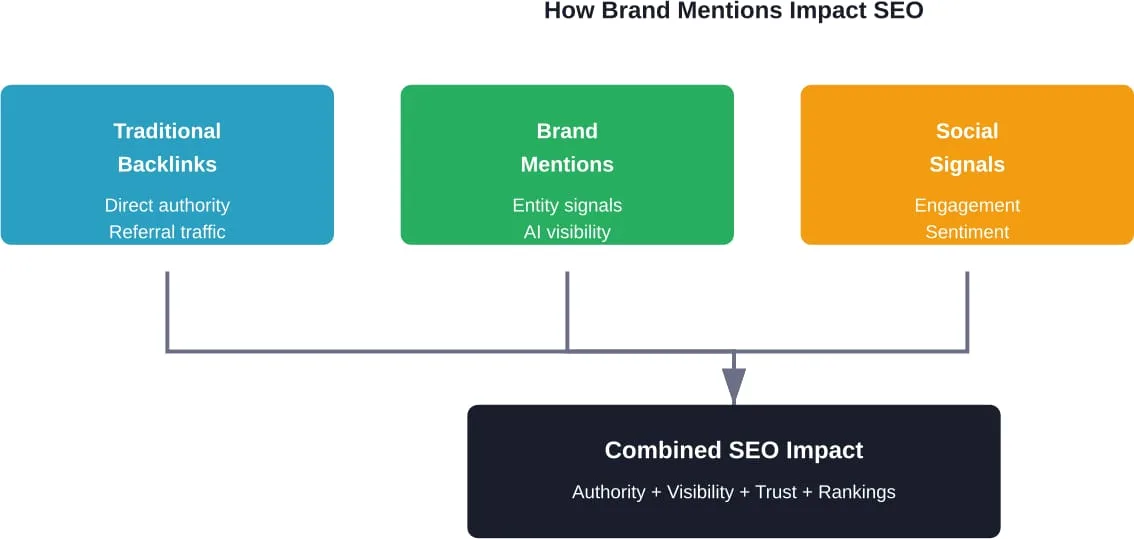
How Search Engines Detect and Interpret Brand Mentions
Understanding the technical side helps explain why mentions matter even without links.
Natural Language Processing at Scale
Search engines crawl billions of pages, analyzing not just individual keywords but the relationships between terms, the context surrounding them, and the sentiment expressed.
When your brand name appears near certain topics repeatedly, algorithms build associations. If tech publications consistently mention your software alongside terms like “project management” or “team collaboration,” search engines learn your brand’s relevance to those categories.
This co-occurrence data feeds into ranking decisions. Even without a direct link, the contextual association strengthens your relevance for related queries.
Source Authority Transfer
Not all mentions carry equal weight. A reference in a major publication like TechCrunch or The New York Times signals more authority than a mention on an unknown personal blog.
Academic research on TrustRank models shows how trust propagates through web structures. Primary authoritative sources (government sites, major news organizations, established institutions) transfer trust to sites they link to or mention. This trust decays as it spreads—in experimental models, trust decreases by 10% per hop from the original source.
When authoritative sources mention your brand, even without linking, they associate their credibility with your entity. Search algorithms factor this association into trust calculations.
Sentiment Analysis and Reputation
Modern algorithms can detect sentiment—whether mentions are positive, negative, or neutral. This matters for reputation management and indirectly affects search visibility.
Brands with consistently positive mention patterns may receive preferential treatment in search results, especially for branded queries. Conversely, patterns of negative coverage can impact visibility.
Google’s Search Quality Rater Guidelines, updated in December 2022 to include an additional “E” for Experience (expanding E-A-T to E-E-A-T), explicitly instruct human evaluators to research brand reputation when assessing page quality.
Real Impact: Case Studies and Data
Brand mention effects aren’t just theoretical. Real-world examples demonstrate measurable outcomes.
The Viral Mention Effect
According to Moz research on PR impact, Roman Originals experienced dramatic results when their dress went viral in 2015. The brand saw a 17.5K% increase in press mentions, nearly a 420% increase in US organic traffic, and a 2.3K% increase in new backlinks.
While this represents an extreme case, it illustrates how concentrated brand visibility translates to measurable SEO gains. The mentions created entity signals, built brand recognition, and generated both linked and unlinked references across thousands of sites.
Consistent Brand Building Wins
Less dramatic but more replicable, consistent brand building delivers cumulative benefits. Technical SEO improvements combined with brand awareness efforts can produce significant results.
One case study from Moz documented a site achieving approximately 33% session increases month-over-month and over 104% year-over-year growth through systematic technical optimization paired with content strategy focused on brand authority building.
Building a Strategic Approach to Brand Mentions
Okay, so brand mentions matter. How do you actually build them in ways that move the needle?
Create Genuinely Newsworthy Content
The most reliable way to earn mentions is giving publications and content creators something worth talking about.
This means:
- Original research and data that provides new insights
- Expert commentary on industry trends and news
- Innovative products or features that solve real problems
- Thought leadership that challenges conventional thinking
Publications need content. If what you create is legitimately valuable to their audiences, journalists and bloggers will reference your work and brand.
Strategic Digital PR
Digital PR has evolved beyond simple link building. The focus shifts to brand visibility across high-authority publications, industry blogs, and relevant platforms where your audience spends time.
This includes:
- Building relationships with journalists covering your industry
- Responding quickly to relevant news with expert quotes
- Pitching data-driven stories that tie to current trends
- Creating visual assets (infographics, charts) that others want to reference
Even when coverage doesn’t include a link, the brand mention strengthens your entity profile and AI search visibility.
Community Engagement and User-Generated Content
Platforms like Reddit, industry forums, social media, and review sites generate massive volumes of brand mentions. While these typically carry less individual authority than major publications, the aggregate signal matters.
Encourage authentic customer conversations by:
- Providing exceptional products and service worth discussing
- Participating authentically in community discussions
- Asking satisfied customers to share experiences
- Creating shareable content that sparks conversations
Don’t try to game these systems. Fake reviews and astroturfed mentions get detected and damage credibility.
Convert Unlinked Mentions to Links
Many brand mentions occur naturally without links simply because the author didn’t think to add one. This represents low-hanging fruit for link building.
The process:
- Identify unlinked brand mentions using monitoring tools
- Prioritize high-authority sources and recent publications
- Reach out politely to authors or editors
- Provide the relevant URL and explain why adding the link helps their readers
Conversion rates vary, but this outreach often succeeds because you’re not asking for something new—just completing a reference they already made.

Monitoring and Measuring Brand Mentions
Strategic brand mention building requires tracking what’s working. Several categories of tools help with this.
Mention Monitoring Platforms
Specialized tools track when and where your brand gets mentioned across the web. These platforms typically monitor news sites, blogs, forums, social media, and other public content.
Key capabilities include:
- Real-time alerts when new mentions appear
- Sentiment analysis to gauge mention tone
- Authority metrics for mentioning sources
- Link status tracking (linked vs. unlinked)
- Competitive tracking to monitor competitor mentions
Both free and paid tools exist in this category. Google Alerts provides basic free monitoring. Specialized platforms offer more comprehensive tracking with better filtering and analysis features.
SEO and Analytics Tools
Comprehensive SEO platforms increasingly include brand tracking features. These tools connect mention data with SEO metrics like rankings, traffic, and backlink profiles.
This integration helps answer crucial questions:
- How do mention volume changes correlate with ranking movements?
- Which types of mentions generate the most traffic?
- What’s our share of voice compared to competitors?
- How does our brand authority score trend over time?
Moz’s Brand Authority metric, provides a score from 1-100 measuring overall brand strength. This gives a single number to track as a proxy for brand SEO performance.
Manual Search and Verification
Automated tools miss things. Periodic manual searches help verify your monitoring setup catches important mentions.
Useful manual checks include:
- Searching your brand name in quotes on Google
- Checking major platforms manually (Reddit, Twitter, LinkedIn)
- Setting up saved searches on social platforms
- Reviewing competitor content for comparative mentions
Scaling Growth with LenGreo
Expanding your market reach requires more than just a standard marketing plan; it demands a partner that acts as a true extension of your team. At LenGreo, we move away from one-size-fits-all packages to build tailored B2B digital marketing strategies that focus on your unique strengths. Our team is dedicated to driving high-value results, whether that is through hyper-personalized outreach, SEO optimization, or advanced lead generation. We don’t just provide a service; we integrate into your workflow to ensure transparent communication and systematic growth.
Our commitment to excellence is backed by a track record of real-world success, such as helping a software development firm increase its annual client acquisition by 400%. We understand that scaling a business is about more than just numbers—it’s about building meaningful relationships with decision-makers and optimizing every stage of the sales funnel. By combining technical expertise with a proactive approach, we empower ambitious businesses to exceed their KPIs and achieve a sustainable competitive advantage in the digital landscape.
Brand Mentions and AI Search Visibility
The rise of AI-powered search makes brand mention strategy more critical than ever.
How AI Systems Choose Brands to Cite
Large language models underlying AI search experiences don’t browse the web in real-time. They rely on training data that includes vast amounts of web content—including brand mentions.
Brands that appear frequently in authoritative contexts during model training become more likely to surface in AI-generated responses. This creates a compounding effect: more mentions lead to better AI visibility, which can lead to more mentions as people discover and discuss your brand through AI search.
Research on AI Overview brand visibility factors analyzed 75,000 brands to identify what correlates with appearance in Google’s AI-generated results.
Key factors include:
- Overall mention volume across authoritative sources
- Wikipedia presence and quality of Wikipedia coverage
- Consistent brand information across major platforms
- Strong topical relevance signals in surrounding content
- Positive sentiment in user-generated content
The Zero-Click Search Challenge
AI Overviews and similar features often provide complete answers without requiring clicks. This fundamentally changes the value proposition of search visibility.
Traditional SEO focused on ranking to capture clicks. In AI search, the goal shifts to brand awareness and consideration. Getting mentioned in an AI-generated answer introduces your brand to potential customers even if they don’t click through immediately.
This makes brand recall and memorability crucial. If someone sees your brand name in an AI Overview today, they might search for you directly tomorrow when they’re ready to buy.
Optimizing for AI Discovery
While AI search algorithms remain somewhat opaque, certain strategies improve the chances of AI citation:
- Create comprehensive, authoritative content on topics relevant to your business
- Maintain accurate, detailed information on Wikipedia (if your brand meets notability criteria)
- Ensure consistent NAP (Name, Address, Phone) information across platforms
- Build structured data markup that helps AI systems understand your content
- Focus on informational and question-based content that AI systems commonly reference
According to Ahrefs research on ranking in AI Overviews, targeting informational and question-based queries significantly improves appearance chances, with question queries triggering AI Overviews at much higher rates than other query types.
Common Brand Mention Mistakes to Avoid
Strategic mention building can go wrong. Watch for these pitfalls.
Chasing Low-Quality Volume
Not all mentions help. Hundreds of mentions on spammy directories, low-quality blogs, or irrelevant sites don’t move the needle and might hurt if search engines view them as manipulative.
Quality beats quantity. Ten mentions in respected industry publications outweigh a thousand mentions on random, low-authority sites.
Ignoring Negative Mentions
Negative coverage requires response. Leaving criticism unanswered allows it to dominate your brand narrative in search results.
This doesn’t mean fighting every negative comment. But significant negative coverage, especially from authoritative sources, needs addressing through:
- Direct response to legitimate issues
- Reputation management content that provides context
- Proactive positive content creation to balance the narrative
Inconsistent Brand Information
Search engines and AI systems need consistency to build accurate entity profiles. If your business name, products, or key details vary across mentions, it confuses algorithms and dilutes signal strength.
Maintain consistency in:
- Official business name and common variations
- Product and service names
- Key executive names and titles
- Contact information and physical locations
- Brand messaging and positioning
Neglecting Internal Mention Optimization
Brand mentions aren’t just external. How you reference your brand, products, and services on your own site matters too.
Internal optimization includes:
- Using consistent brand terminology across your site
- Creating comprehensive brand and about pages
- Implementing structured data markup (Organization, LocalBusiness, Product schemas)
- Building internal linking with branded anchor text
The Future of Brand Mentions in SEO
Where is this trend heading? Several developments will likely accelerate the importance of brand mentions.
Continued AI Search Growth
Despite some misconceptions, traditional search isn’t disappearing. Large language models currently hold a small market share compared to traditional search engines. But that percentage will grow.
As AI search tools mature and users become more comfortable with them, brand visibility in these systems becomes non-negotiable for competitive businesses.
More Sophisticated Entity Understanding
Search algorithms will continue improving their ability to understand entities, relationships, and context. This means more nuanced evaluation of brand mentions—considering factors like:
- Relevance of the mentioning context
- Authority transfer from surrounding entities
- Temporal patterns (trending mentions vs. sustained presence)
- Cross-platform consistency signals
Integration with Other Ranking Signals
Brand signals won’t replace traditional factors like backlinks, content quality, and technical SEO. Instead, they’ll integrate more tightly into holistic ranking evaluation.
Think of it this way: backlinks show who trusts you enough to link. Brand mentions show who considers you relevant enough to discuss. Both signals matter, and algorithms will increasingly weigh them together rather than separately.
Taking Action on Brand Mentions
Brand mentions represent a shift in how search visibility works, but the underlying principle hasn’t changed: being recognized as authoritative and relevant matters.
The difference now is that this recognition extends beyond links to encompass the broader conversation about your brand across the entire web and into AI systems reshaping how people find information.
Start by assessing your current state. How often does your brand get mentioned? Where do these mentions occur? What’s the sentiment? How visible are you in AI search experiences?
Then build systematically. Create content worth mentioning. Engage authentically with your industry community. Build relationships with publications and influencers. Monitor what’s working and refine your approach.
Brand mention optimization isn’t a replacement for traditional SEO. It’s an evolution that accounts for how search engines and AI systems actually evaluate authority and relevance in modern contexts. The brands that recognize this shift and adapt their strategies accordingly will gain visibility advantages as AI search continues its inevitable growth.
The future of search visibility isn’t just about who links to you—it’s about who talks about you, where they talk about you, and what they say. Start building those brand signals now.