


Here’s the problem: most content teams treat SEO as something to sprinkle on after the writing’s done. A quick keyword check here, a meta description there, maybe some links if there’s time.
But that approach leaves massive opportunities on the table. According to Search Engine Land, organic search delivers 53% of all website traffic—more than any other channel. With more than 8.5 billion searches happening daily on Google Search alone, the stakes are high.
Real SEO integration means building search optimization into every stage of content creation. From initial keyword research through final publication, each decision considers both the audience and the algorithms that connect content to searchers.
This guide breaks down exactly how to integrate SEO into content strategy without compromising quality or turning every piece into keyword-stuffed nonsense.
Why SEO Integration Matters More Than Ever
Search behavior has evolved. Google owns 91% of the global search engine market, and its ranking systems have grown increasingly sophisticated. As Google Search Central explains, automated ranking systems now prioritize helpful, reliable, people-first content over material created solely to manipulate rankings.
The top three organic search results collectively receive 68.7% of all clicks. By the second page, visibility drops dramatically, with position 2 receiving 18.7% of clicks.
That’s not just about visibility—it’s about business impact.
The shift toward AI-powered search experiences adds another layer. According to Google Search Central’s guidance on AI-powered search experiences, content that performs well in traditional search also succeeds in AI Overviews and AI Mode. Pages with clear H2/H3/bullet point structures are 40% more likely to be cited by AI engines.
Start With Strategic Keyword Research
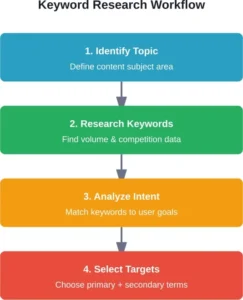
Everything begins with understanding what people actually search for. Not what sounds clever or what internal stakeholders prefer—what real users type into search boxes.
Understanding Search Intent
According to the University of Illinois SEO implementation guide, keywords fall into distinct categories based on user intent:
| Intent Type | User Goal | Example Keywords | Content Format |
|---|---|---|---|
| Informational | Learning or research | “how to integrate SEO”, “what is keyword research” | Guides, tutorials, explainers |
| Navigational | Finding specific site | “Google Search Console”, “Ahrefs login” | Homepage, product pages |
| Commercial | Comparing options | “best SEO tools”, “Semrush vs Moz” | Comparisons, reviews, lists |
| Transactional | Ready to purchase | “buy SEO audit”, “pricing plans” | Product pages, checkout flows |
Match content format to intent. Someone searching “how do you integrate SEO into your content” wants actionable steps, not a sales pitch.
Finding the Right Keywords
Look for keywords that balance search volume with competition. High-volume terms often come with intense competition from established sites. Mid-volume keywords with clear intent typically offer better opportunities.
Local searches deserve special attention. 46% of Google searches have local intent, making location-specific keywords valuable for businesses serving geographic markets.
Document keyword targets before writing begins. Each piece should have a primary keyword (the main focus) and 3-5 secondary keywords (related terms to incorporate naturally).
Build SEO Into Content Planning
Once keyword targets are clear, planning begins. This stage determines content structure, format, and approach—all informed by SEO requirements.
Create Content Outlines With SEO in Mind
Google’s ranking systems evaluate how well content addresses user needs. As stated in Google Search Central’s guidance on creating helpful content, automated systems are designed to prioritize information created to benefit people.
Build outlines that answer the actual questions searchers have. Check what’s currently ranking—those pages earned top positions for a reason. But don’t just copy existing content. Find gaps, add depth, or approach the topic from a fresh angle.
Structure matters for both users and search engines. According to Search Engine Land research from January 14, 2026, pages with clear H2/H3 headings and bullet points are 40% more likely to get cited by AI search engines.
Plan for Multiple Content Formats
Different keywords demand different formats. A comparison keyword needs a comparison format. A tutorial keyword needs step-by-step instructions.
Consider format options:
- Long-form guides for comprehensive “how to” queries
- List posts for “best” or “top” searches
- Comparison articles for “vs” or “versus” terms
- Case studies for proof-driven commercial searches
- Quick answers for definition or simple factual queries
Format influences structure, which affects both user experience and SEO performance.
Write Content That Serves Users and Search Engines
Here’s where theory meets practice. Writing SEO-integrated content means balancing natural language with strategic optimization.
Natural Keyword Integration
Google’s algorithms have evolved far beyond simple keyword matching. According to Search Engine Land analysis from February 23, 2026, Google’s first-stage retrieval still uses term frequency signals, but context matters enormously.
The first mention of a relevant term captures roughly 45% of the maximum possible score. Three mentions reach about 71%. Beyond that, returns diminish rapidly.
That means:
- Use primary keywords in the title, first paragraph, and 2-3 times naturally throughout
- Incorporate secondary keywords where they fit contextually
- Include related terms and synonyms to establish topical depth
- Never force keywords where they sound awkward or disrupt readability
Write for humans first. Search engines reward content that users find valuable, as emphasized in Google Search Central’s August 2022 helpful content update guidance.
Optimize Structural Elements
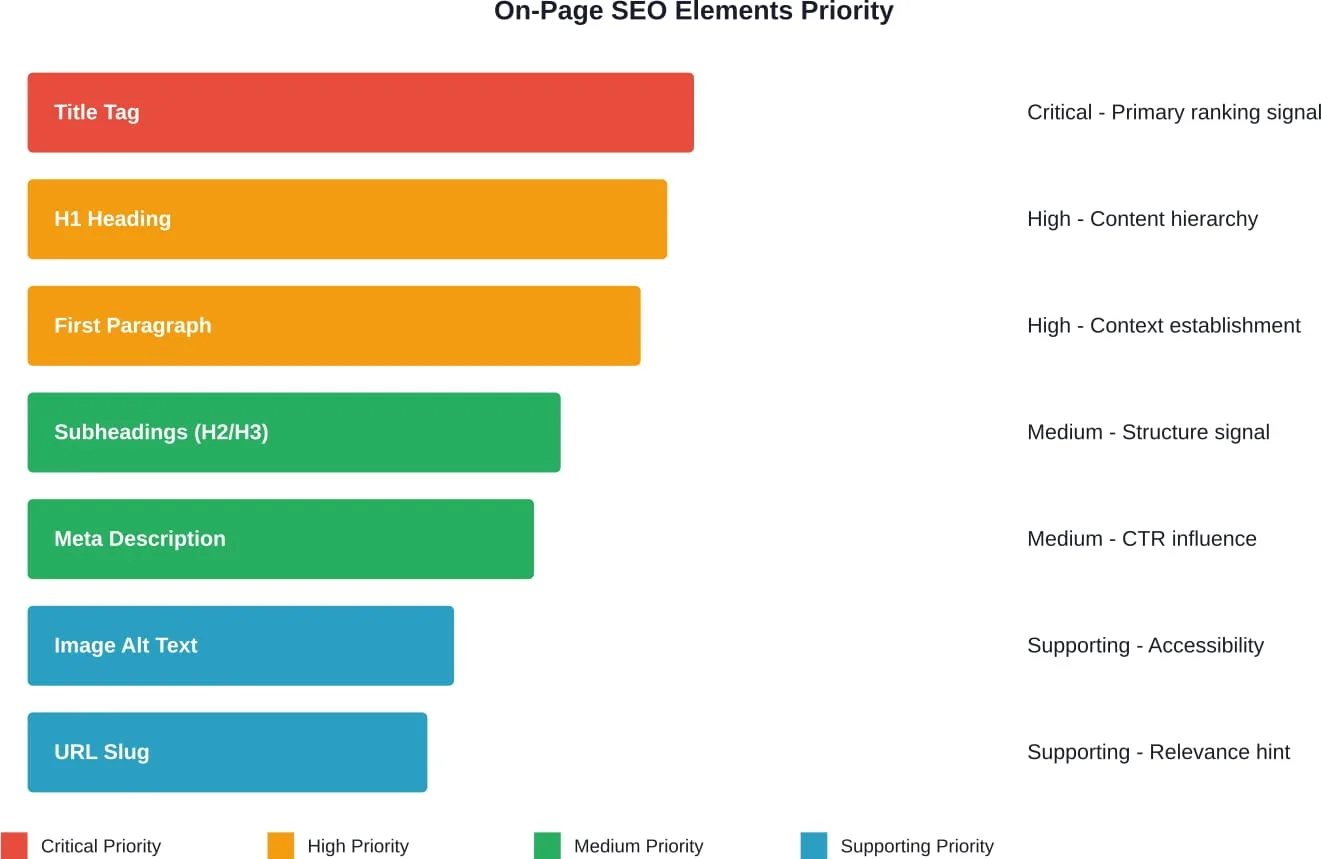
Certain page elements carry outsized SEO weight:
| Element | SEO Function | Best Practice |
|---|---|---|
| Title Tag | Primary ranking signal | Include primary keyword, keep under 60 characters |
| H1 Heading | Content hierarchy signal | Match or closely mirror title tag, one per page |
| Meta Description | Click-through influence | Compelling summary with keyword, 150-160 characters |
| H2/H3 Subheadings | Content structure signal | Descriptive labels with natural keyword variants |
| URL Slug | Relevance indicator | Short, descriptive, includes primary keyword |
| Image Alt Text | Accessibility and context | Accurate descriptions, natural keyword inclusion |
Each element serves dual purposes: helping users navigate content and signaling relevance to search engines.
Link Strategically
Links establish context and authority. Internal links connect related content on the same site. External links cite sources and provide additional resources.
For external links, choose authoritative sources. Citing well-researched statistics from trusted publications adds credibility. As one example, referencing that 46% of Google searches are local (from HubSpot research) demonstrates content is well-researched.
Internal links help search engines understand site structure and distribute ranking authority across pages. Link to related articles using descriptive anchor text that indicates what the linked page covers.
Handle Technical SEO Requirements
Content quality matters, but technical infrastructure determines whether search engines can access, understand, and rank that content.
Ensure Proper Indexing
According to Google Search Central’s technical requirements documentation, pages must be crawlable and indexable to appear in search results.
That means:
- No blocking robots.txt directives on important pages
- Proper XML sitemaps submitted through Google Search Console
- Clean URL structures without excessive parameters
- Appropriate use of canonical tags to prevent duplicate content issues
Technical barriers are invisible to users but devastating for SEO. A perfectly optimized article won’t rank if search engines can’t crawl it.
Optimize Page Speed and Mobile Experience
Page experience signals influence rankings. According to Michigan Tech University’s SEO guidance, mobile optimization has become non-negotiable as mobile searches dominate overall search volume.
Key technical factors:
- Load speed: Compress images, minimize JavaScript, use browser caching
- Mobile responsiveness: Ensure content adapts to all screen sizes
- Core Web Vitals: Meet Google’s thresholds for loading, interactivity, and visual stability
- HTTPS security: SSL certificates are table stakes for ranking
These factors affect both user experience and search performance. Slow pages frustrate users and get demoted in rankings.
Implement Structured Data
Structured data markup helps search engines understand content context. According to Google Search Central’s image SEO documentation, proper markup enables rich results like featured snippets, knowledge panels, and enhanced listings.
Common schema types for content include:
- Article schema: For blog posts and news articles
- FAQ schema: For question-and-answer sections
- HowTo schema: For step-by-step guides
- Organization schema: For company and brand information
Structured data doesn’t directly boost rankings, but it can increase visibility and click-through rates by enabling enhanced search features.
Optimize for AI Search Experiences
AI-powered search features have changed how content gets discovered. Google’s AI Overviews, ChatGPT, Perplexity, and similar tools surface information differently than traditional search results.
Structure Content for AI Citation
According to Google Search Central’s guidance on AI-powered search experiences, content that performs well in traditional search also succeeds in AI experiences. The key is clear structure and authoritative information.
AI systems parse content by breaking it into segments and analyzing connections. Research from Search Engine Land indicates that pages with clear H2/H3 structures and bullet points are 40% more likely to get cited by AI engines.
Q&A formats perform especially well because they directly match how users phrase queries to AI assistants.
Establish Topical Authority
AI systems evaluate source credibility when deciding what to cite.
Building topical authority requires:
- Publishing comprehensive coverage across related subtopics
- Earning backlinks from authoritative sources in the field
- Demonstrating expertise through detailed, accurate information
- Maintaining consistency in domain focus rather than scattered topics
As outlined in Google Search Central’s guidance on ranking systems, expertise and authoritativeness are core evaluation factors across both traditional and AI-powered search.
Measure and Refine SEO Performance
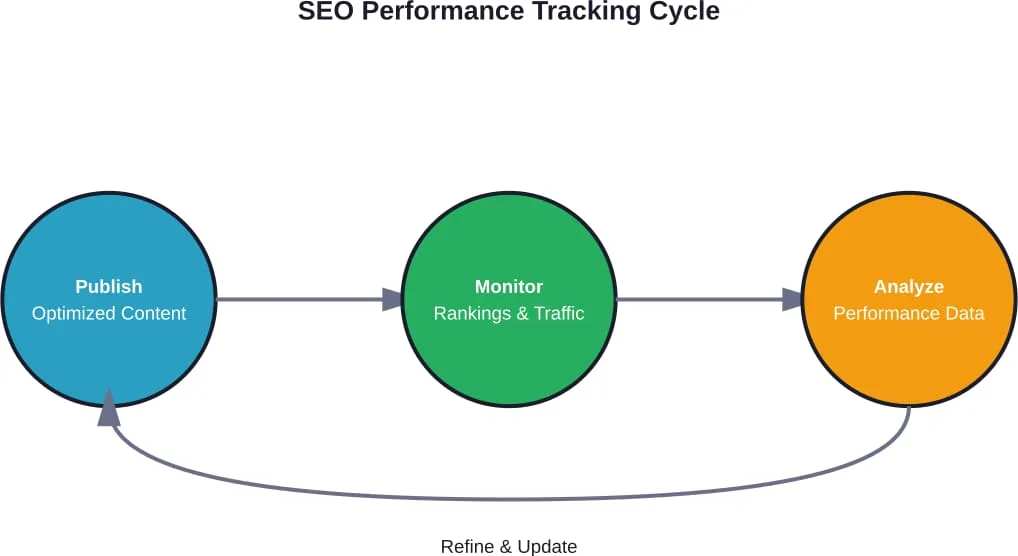
Integration doesn’t end at publication. Ongoing measurement reveals what’s working and what needs adjustment.
Track Key SEO Metrics
Focus on metrics that indicate search performance:
| Metric | What It Measures | Why It Matters |
|---|---|---|
| Organic Traffic | Visitors from search engines | Primary indicator of SEO success |
| Keyword Rankings | Position in search results | Shows visibility for target terms |
| Click-Through Rate | Percentage who click from search | Indicates title/meta effectiveness |
| Bounce Rate | Visitors who leave immediately | Signals content relevance issues |
| Time on Page | Average visit duration | Reflects content engagement |
| Backlinks | Links from other sites | Authority and discovery signal |
Google Search Console provides direct insight into how Google sees and ranks content. Use it to identify ranking opportunities, technical issues, and search appearance.
Refresh and Update Content
Search rankings aren’t permanent. As Search Engine Land explains, content ages—information becomes outdated, competitors publish better resources, search intent shifts.
Regular content audits identify refresh opportunities. Look for:
- Pages that once ranked well but have declined
- Content with outdated information or broken links
- Topics where competitors have published superior resources
- High-potential keywords where ranking sits just outside the top positions
Updating existing content often delivers better ROI than creating new pieces. A refreshed article retains its existing backlinks and authority while gaining relevance.
Scaling Growth with LenGreo
Navigating these evolving search landscapes requires more than just following a checklist; it demands a partner who integrates deeply with your team to turn data into revenue. At LenGreo, we move beyond pre-packaged solutions by tailoring content strategies to your unique strengths, ensuring every guide or landing page serves as a high-performance lead generation tool. Our approach has delivered transformative results, such as a 22X increase in organic traffic and a 17X boost in keyword rankings for our partners, proving that strategic integration is the key to sustainable visibility.
Our team focuses on the intersection of technical precision and human-centric value, specializing in advanced SEO and AI-ready content planning. Whether we are conducting deep-dive website audits or implementing “Answer Engine Optimization” (AEO) to capture AI snippets, our goal remains the same: driving qualified leads and optimizing your digital presence for the search engines of 2026. We treat your business goals as our own, providing the transparent communication and leadership necessary to scale your reach in a crowded market.
Common SEO Integration Mistakes to Avoid
Even experienced teams make predictable errors when integrating SEO into content workflows.
Keyword Stuffing
Overusing keywords damages readability and triggers spam filters. Google’s algorithms have grown sophisticated enough to penalize obvious over-optimization.
Natural language always wins. Use keywords where they fit contextually, not wherever they can be crammed.
Ignoring Search Intent
Ranking for the wrong intent wastes effort. A user searching “SEO tools” wants a list or comparison, not a 3,000-word guide on SEO theory.
Check what’s currently ranking for target keywords. Format and approach should match what search engines are already rewarding for that query.
Neglecting Mobile Users
Mobile devices generate the majority of searches. Content that looks great on desktop but breaks on mobile alienates the largest audience segment.
Test content on actual mobile devices, not just responsive design preview tools. Real-world performance reveals issues that simulators miss.
Publishing and Forgetting
SEO requires ongoing attention. Content that ranks well today can slip without maintenance as competitors improve, information ages, and algorithms evolve.
Build content audits into regular workflows. Quarterly reviews identify refresh opportunities before rankings collapse.
Building an SEO-First Content Culture
True integration means making SEO a default consideration, not an optional add-on.
Train Content Teams on SEO Fundamentals
Writers and editors don’t need to become technical SEO experts, but understanding basics helps. When teams grasp why title tags matter or how search intent works, they make better decisions without needing constant guidance.
Regular training sessions keep teams current as search algorithms evolve. The SEO landscape shifts—what worked last year may underperform today.
Integrate SEO Into Workflow Tools
Build SEO checkpoints into content management systems. Automated reminders about meta descriptions, heading structure, and keyword usage catch issues before publication.
Templates and checklists standardize optimization across teams. When everyone follows the same framework, quality stays consistent regardless of who writes.
Align SEO With Broader Business Goals
According to Search Engine Land guidance from February 2025, SEO alone isn’t enough—it must integrate into full-funnel marketing strategy to reach, engage, and convert audiences.
Connect SEO metrics to business outcomes. Organic traffic matters, but conversions, revenue, and customer acquisition cost matter more. Track how SEO-driven traffic performs compared to other channels.
Conclusion: Making SEO Integration Automatic
Integrating SEO into content doesn’t require complicated processes or expensive tools. It demands a shift in thinking—treating search optimization as foundational rather than supplementary.
Start with keyword research that identifies what audiences actually search for. Build content plans around those insights. Write naturally while incorporating strategic keywords. Optimize technical elements that help search engines access and understand content. Monitor performance and refine based on results.
The data supports this approach. Organic search delivers 53% of all website traffic, making it the most valuable traffic source for most sites. With more than 8.5 billion daily searches on Google alone, opportunities are massive for content that integrates SEO effectively.
Real results follow: a 50% increase in page views, climbing from 991 to 1,552 organic visits in a single month, as documented in HubSpot case studies. Those gains come from treating SEO as integral to content creation, not as an afterthought.
The search landscape continues evolving. AI-powered search experiences, entity-based understanding, and helpful content updates all shift how content gets discovered and ranked. But core principles remain: create valuable content that serves user needs, structure it clearly for both humans and algorithms, and optimize technical foundations that enable discovery.
Ready to integrate SEO into your content strategy? Start with a single piece—research keywords, optimize structure, track results. Build from there. Each optimized article compounds, driving more traffic, establishing more authority, and creating more opportunities for audience connection.
Search engines connect content to audiences. SEO integration ensures that connection happens.