


Google processes around 16.4 billion searches per day. That’s billions of opportunities for potential customers to discover your Shopify store.
But here’s the reality: The top organic result on a search engine results page gets approximately 39.8% of all user clicks. Second place captures 18.7%, and third gets 10.2%. After that? The traffic drops dramatically.
For the over 5.5 million sellers using Shopify, this creates intense competition. Your store could have incredible products, competitive prices, and excellent customer service—but if customers can’t find it through search, none of that matters.
Search contributes around 68% of all trackable website traffic. That makes SEO the most reliable channel for sustainable, long-term growth. Unlike paid advertising that stops the moment budgets run dry, organic search traffic compounds over time.
The good news? Shopify takes care of around 80% of technical SEO automatically. The platform handles crucial backend elements that would otherwise require developer expertise.
That means store owners can focus on the remaining 20%—the strategic optimizations that separate thriving stores from those buried on page ten of Google.
Understanding Shopify SEO Fundamentals
SEO on Shopify isn’t fundamentally different from SEO on any other platform. Search engines still crawl pages, index content, and rank results based on relevance, authority, and user experience.
What changes is the execution. Shopify’s closed ecosystem means certain optimizations happen automatically, while others require workarounds through apps or theme customization.
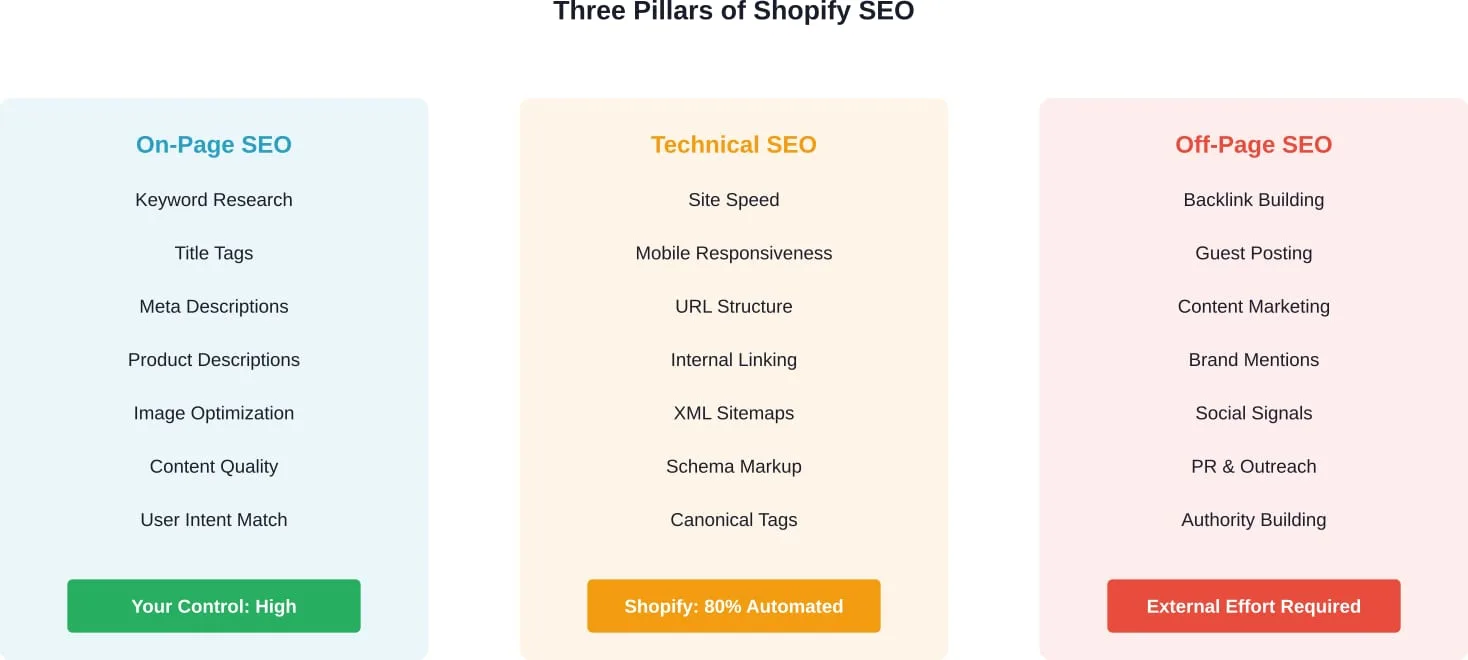
Three pillars support effective Shopify SEO: on-page optimization, technical SEO, and off-page authority building. Each pillar reinforces the others.
On-Page SEO: Content and Keywords
On-page SEO encompasses everything directly visible on product pages, collections, and blog posts. This includes title tags, meta descriptions, headings, product descriptions, and image optimization.
Search engines analyze this content to determine what each page is about and whether it deserves to rank for specific queries.
Technical SEO: Site Architecture and Performance
Technical SEO covers the structural elements that help search engines crawl and index a site efficiently. This includes site speed, mobile responsiveness, URL structure, XML sitemaps, and internal linking.
Shopify automates many technical elements—generating sitemaps, implementing canonical tags, and creating mobile-responsive themes. Store owners handle internal linking strategy and performance optimization.
Off-Page SEO: Authority and Trust Signals
Off-page SEO involves actions taken outside the website to improve rankings. The primary focus is building high-quality backlinks from reputable websites.
When authoritative sites link to a Shopify store, search engines interpret this as a vote of confidence. More quality backlinks typically correlate with higher rankings.
Keyword Research for Shopify Stores
Everything starts with understanding what potential customers are actually searching for. Without proper keyword research, even the best content strategy becomes guesswork.
Keyword research for ecommerce differs from content-focused SEO. The goal isn’t just traffic—it’s converting traffic. That means prioritizing transactional keywords over purely informational ones.
Finding Product Keywords
Product keywords are search terms potential customers use when actively looking to purchase. These typically include product names, categories, and modifiers like “buy,” “shop,” “best,” or “online.”
Start with seed keywords—basic product terms like “leather wallet” or “yoga mat.” Then expand using keyword research tools to find variations customers actually use.
Look for keywords with commercial intent. Terms like “best leather wallet for men” or “durable yoga mat for hot yoga” signal purchase readiness. These convert better than generic terms like “wallet” or “yoga.”
Analyzing Search Volume and Competition
Search volume indicates how many monthly searches a keyword receives. Competition measures how difficult it is to rank.
New Shopify stores should target lower-competition, long-tail keywords initially. A term like “handmade Italian leather wallet with RFID blocking” has less competition than “leather wallet,” making it more achievable.
As domain authority grows through consistent content creation and backlink acquisition, gradually target higher-volume, more competitive terms.
Understanding User Intent
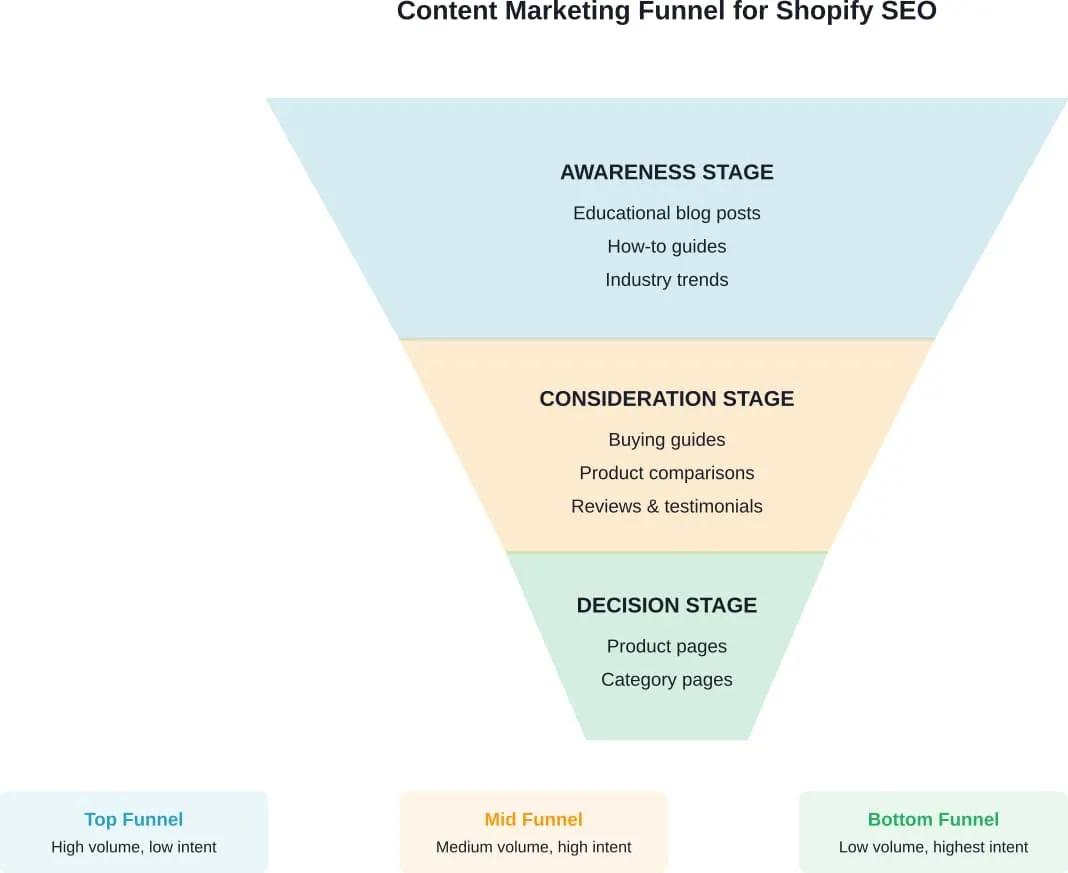
Search intent reveals what users want to accomplish. Four primary intent types exist: informational (learning), navigational (finding a specific site), transactional (buying), and commercial investigation (researching before buying).
Product pages should target transactional and commercial investigation keywords. Blog content handles informational queries, building awareness and authority.
Match content format to intent. Someone searching “how to choose a yoga mat” wants a comprehensive guide, not a product page. Someone searching “buy Manduka yoga mat online” wants to purchase immediately.
Tools for Keyword Research
Several tools help identify valuable keywords. Google Keyword Planner provides baseline data directly from Google’s search database.
Paid tools like Ahrefs offer deeper analysis, including keyword difficulty scores, click-through rate estimates, and competitive analysis. Ahrefs pricing starts at $99 per month for annual billing.
Surfer SEO focuses specifically on content optimization. Their paid plans start at $49 per month (Discovery plan). The Standard plan, which allows optimizing 360 documents and collaborating with 3 team seats, costs $99 per month (billed annually). The ability to track 200 pages is only available on the Pro plan for $182 per month..
Optimizing On-Page Elements
Once target keywords are identified, strategic placement throughout on-page elements signals relevance to search engines.
Crafting Effective Title Tags
The title tag appears in search results as the clickable headline. It’s one of the most influential on-page ranking factors.
Keep titles under 60 characters to prevent truncation in search results. Include the primary keyword naturally, preferably toward the beginning.
For product pages, format titles as: [Product Name] – [Key Benefit or Feature] | [Brand Name]. Example: “Organic Cotton Yoga Mat – Extra Thick Non-Slip | ZenFlow.”
For collection pages: [Category] – [Modifier] | [Brand Name]. Example: “Women’s Running Shoes – Lightweight & Durable | FitStride.”
Avoid keyword stuffing. “Buy Cheap Leather Wallet Men’s Leather Wallet Sale Wallets” reads terribly and triggers spam filters. Write for humans first, search engines second.
Writing Compelling Meta Descriptions
Meta descriptions don’t directly impact rankings, but they dramatically affect click-through rates. A well-written description can outperform higher-ranking competitors by attracting more clicks.
Keep descriptions between 150-160 characters. Include the primary keyword and a clear value proposition or call to action.
For product pages, highlight the main benefit and create urgency: “Discover our handcrafted Italian leather wallets with RFID protection. Free shipping on orders over $50. Shop now.”
For category pages, emphasize selection and value: “Browse 200+ women’s running shoes from top brands. Find your perfect fit with free returns and expert sizing guides.”
Optimizing Product Descriptions
Product descriptions serve dual purposes: converting visitors and signaling relevance to search engines.
Write unique descriptions for every product. Duplicate content—even from manufacturer specifications—weakens SEO performance.
Structure descriptions with the primary keyword in the first 100 words. Use related keywords and synonyms naturally throughout. Include product specifications, dimensions, materials, and use cases.
Format for readability. Short paragraphs, bullet points for key features, and subheadings for longer descriptions improve user experience.
Aim for at least 300 words on main product pages. More content provides more context for search engines and more persuasive information for customers.
Image Optimization
Images impact both SEO and site performance. Proper optimization improves rankings while maintaining fast load times.
Use descriptive, keyword-rich filenames before uploading. Instead of “IMG_3847.jpg,” use “handmade-leather-wallet-brown.jpg.”
Add alt text to every image. Alt text describes images for screen readers and search engines. Format as: “[Product Name] showing [specific feature].” Example: “Organic cotton yoga mat showing non-slip textured surface.”
Compress images to reduce file size without sacrificing quality. Large images slow page load speed, which negatively impacts rankings and conversions.
Use modern formats like WebP when possible. WebP-formatted images save more than 30% in file size over traditional formats.
URL Structure Best Practices
Clean, descriptive URLs help search engines understand page content and improve click-through rates in search results.
Shopify automatically generates URLs based on product and collection names. Customize these during initial setup to remove unnecessary words.
Keep URLs short and keyword-focused. Use hyphens to separate words: “/products/leather-wallet-rfid” not “/products/leather_wallet_with_rfid_protection_brown.”
Avoid changing URLs after pages are indexed and ranking. URL changes break backlinks and lose accumulated ranking authority unless proper redirects are implemented.
| Element | Best Practice | Character Limit | Primary Goal |
|---|---|---|---|
| Title Tag | Include primary keyword near beginning | 50-60 characters | Search ranking signal |
| Meta Description | Add keyword and call-to-action | 150-160 characters | Improve click-through rate |
| H1 Heading | Match or closely mirror title tag | 60-70 characters | Content hierarchy |
| Product Description | Unique content, keyword in first 100 words | 300+ words | Conversions and relevance |
| Image Alt Text | Descriptive with keyword | 125 characters | Accessibility and image SEO |
| URL Slug | Short, keyword-focused, hyphenated | 3-5 words | Clarity and ranking signal |
Technical SEO Optimization
Technical SEO ensures search engines can crawl, index, and understand site content efficiently. While Shopify automates most technical elements, strategic improvements still matter.
Site Speed Optimization
Page speed directly impacts rankings and conversions. Google explicitly includes Core Web Vitals—metrics measuring speed, interactivity, and visual stability—in ranking algorithms.
Test current performance using Google PageSpeed Insights or GTmetrix. These tools identify specific bottlenecks and improvement opportunities.
Common speed improvements include:
- Compressing images before uploading
- Minimizing custom code in theme files
- Limiting the number of apps (each app adds external scripts)
- Using lazy loading for images below the fold
- Enabling Shopify’s built-in CDN for asset delivery
Remove unused apps completely rather than just disabling them. Disabled apps often leave code fragments that still load on every page.
Mobile Responsiveness
Most ecommerce traffic now comes from mobile devices. Google uses mobile-first indexing, meaning the mobile version of a site determines rankings.
All modern Shopify themes are responsive by default. Test mobile experience regularly on actual devices, not just browser developer tools.
Check that buttons are easily tappable, text is readable without zooming, and navigation works smoothly. Mobile usability problems reduce conversions and increase bounce rates, indirectly harming SEO.
Internal Linking Strategy
Internal links distribute page authority throughout a site and help search engines discover and understand content relationships.
- Link from high-authority pages (usually the homepage and popular blog posts) to important product and collection pages. This passes authority to pages that need ranking power.
- Use descriptive anchor text that includes keywords. Instead of “click here,” use “browse our collection of handmade leather wallets.”
- Create a logical site hierarchy. Homepage links to main collections. Collections link to subcategories and individual products. Products link to related items.
- Add contextual links within blog content pointing to relevant product pages. This drives traffic and signals topical relevance.
Structured Data and Schema Markup
Structured data helps search engines understand specific content types—products, reviews, prices, availability. This enables rich results in search, like star ratings and price information.
Shopify automatically adds product schema markup to product pages. Verify implementation using Google’s Rich Results Test.
Consider adding additional schema types manually or through apps: Organization schema for brand information, FAQ schema for question pages, and Article schema for blog posts.
Rich results don’t directly improve rankings, but they increase click-through rates by making listings more prominent and informative.
XML Sitemap and Robots.txt
Shopify automatically generates and updates XML sitemaps at yourstore.com/sitemap.xml. This file tells search engines which pages exist and how they’re organized.
Submit the sitemap through Google Search Console and Bing Webmaster Tools. This ensures search engines discover new content quickly.
The robots.txt file controls which pages search engines can crawl. Shopify’s default robots.txt is generally optimal, blocking admin areas and checkout pages while allowing product and content pages.
Content Strategy for SEO
Product pages alone rarely generate sufficient organic traffic. A comprehensive content strategy attracts visitors at different stages of the customer journey.
Starting a Shopify Blog
Blogging provides opportunities to target informational keywords that product pages can’t address. These keywords attract potential customers early in their research phase.
Focus blog content on topics related to products. A store selling hiking gear might create guides about trail selection, gear maintenance, or destination recommendations.
Each blog post should target a primary keyword with decent search volume. Use keyword research tools to identify topics customers actively search for.
Aim for comprehensive coverage. Longer, in-depth articles (1,500+ words) typically outrank shorter ones by providing more value and naturally incorporating more keywords.
Creating Buying Guides and Comparisons
Buying guides target commercial investigation keywords—searches from people close to purchasing but still comparing options.
Create guides like “Best Yoga Mats for Beginners” or “How to Choose Running Shoes for Flat Feet.” These attract ready-to-buy traffic.
Include products from the store naturally within the content. Link directly to product pages. This converts blog traffic into sales.
Comparison content works especially well. “Cotton vs. Cork Yoga Mats: Which is Better?” targets people making final decisions.
Content Consistency and Freshness
Publishing frequency matters more than perfection. Consistent posting signals active site maintenance to search engines.
Start with one quality blog post per week. Increase frequency as resources allow, but never sacrifice quality for quantity.
Update older content periodically. Refreshing posts with new information, updated statistics, and additional keywords can restore lost rankings and capture new search trends.
Google’s algorithm favors fresh, current content—especially for time-sensitive topics.
Video Content Integration
Video content increasingly appears in search results. Product videos can rank in both standard results and video carousels.
Create product demonstration videos, unboxing content, and how-to guides. Host videos on YouTube (which is owned by Google and heavily favored in search) and embed them on product pages.
Optimize video titles, descriptions, and tags with relevant keywords. Add transcripts to make video content crawlable by search engines.
Building Off-Page Authority
Off-page SEO primarily revolves around acquiring high-quality backlinks. These external endorsements signal trustworthiness and authority to search engines.
Link Building Fundamentals
Not all backlinks carry equal weight. One link from an authoritative, relevant site outweighs dozens from low-quality directories or spam sites.
Quality indicators include: domain authority of the linking site, topical relevance, editorial context (links within content versus footers), and whether the link is followed or nofollow.
Focus on acquiring natural, editorial links from real websites—not link exchanges, paid links, or automated schemes that violate search engine guidelines.
Content Marketing for Links
The most effective link building strategy is creating content worth linking to. Comprehensive guides, original research, infographics, and tools naturally attract backlinks.
Create ultimate guides on topics related to products. “The Complete Guide to Sustainable Fashion” or “Everything You Need to Know About Home Coffee Roasting” become reference resources other sites link to.
Original research and data studies earn particularly strong links. Survey customers, compile industry statistics, or analyze trends—then publish findings publicly.
Guest Posting Strategy
Contributing articles to relevant industry publications builds backlinks and brand visibility simultaneously.
Identify blogs and publications in the niche that accept guest contributions. Pitch unique, valuable article ideas—not thinly veiled product promotions.
Include a natural link back to the Shopify store within the author bio or contextually within the article where relevant.
Quality matters more than quantity. One guest post on an authoritative industry site delivers more value than ten posts on low-quality blogs.
Digital PR and Outreach
Digital PR involves getting mentioned or featured in online publications, news sites, and industry blogs.
Create newsworthy angles: launching innovative products, partnering with influencers or charities, publishing significant research, or commenting on industry trends.
Build relationships with journalists and bloggers who cover the industry. Tools like HARO (Help a Reporter Out) connect sources with journalists seeking expert quotes.
Product seeding—sending products to reviewers and influencers—can generate organic mentions and links from review articles and roundup posts.
Local SEO for Physical Stores
Shopify stores with physical locations should optimize for local search alongside broader ecommerce SEO.
Create and optimize Google Business Profile listings. Include accurate business information, operating hours, photos, and respond to customer reviews.
Build local citations—mentions of business name, address, and phone number—across relevant directories and local business sites.
Earn links from local organizations, chambers of commerce, and community websites.
Measuring SEO Performance
Tracking results determines what’s working and where to focus optimization efforts.
Google Search Console Setup
Google Search Console provides direct insights from Google about site performance, indexing issues, and search appearance.
Connect Shopify stores to Search Console by verifying ownership through DNS records or HTML tag verification.
Monitor key metrics: total impressions (how often the site appears in search), total clicks, average position for key queries, and click-through rate.
The Performance report shows which queries drive traffic and how rankings change over time. The Coverage report identifies indexing errors preventing pages from appearing in search.
Google Analytics Configuration
Google Analytics tracks visitor behavior—how people find the site, which pages they visit, and whether they convert into customers.
Install Google Analytics 4 on Shopify stores through the analytics settings or a dedicated app.
Create custom reports tracking organic search traffic specifically. Monitor metrics like organic sessions, bounce rate, pages per session, and ecommerce conversion rate for organic traffic.
Set up goal tracking for key conversions beyond purchases: newsletter signups, account creation, or wishlist additions.
Tracking Keyword Rankings
Monitoring rankings for target keywords reveals SEO progress over time.
Use rank tracking tools to automatically check positions for priority keywords daily or weekly. Many SEO platforms include rank tracking: Ahrefs, SEMrush, and Moz all offer this functionality.
Track both main category keywords and long-tail product-specific terms. Rankings fluctuate daily—focus on long-term trends rather than day-to-day changes.
Backlink Profile Monitoring
Regularly audit the backlink profile to identify new links, lost links, and potentially harmful spam links.
Tools like Ahrefs, Moz, and Majestic provide comprehensive backlink analysis. Monitor referring domains (unique sites linking in), total backlinks, and domain authority trends.
Identify and disavow toxic backlinks—spammy or manipulative links that could trigger penalties. Use Google’s Disavow Tool to tell Google to ignore specific harmful links.
| Metric | Tool | What It Measures | Target Trend |
|---|---|---|---|
| Organic Traffic | Google Analytics | Visitors from search engines | Increasing month-over-month |
| Keyword Rankings | Ahrefs, SEMrush | Position in search results | Moving toward top 3 positions |
| Impressions | Google Search Console | How often site appears in search | Growing with keyword expansion |
| Click-Through Rate | Google Search Console | % of impressions that get clicked | Above 3% average, improving |
| Backlinks | Ahrefs, Moz | External sites linking to store | Steady growth from quality domains |
| Organic Conversion Rate | Google Analytics | % of organic visitors who purchase | Matching or exceeding site average |
| Core Web Vitals | PageSpeed Insights | Page speed and user experience | All metrics in “Good” range |
Scaling Your Store with LenGreo
While Shopify provides a solid technical foundation, bridging the gap between a functional store and a market leader requires a specialized, results-driven approach. Our team at LenGreo acts as your dedicated marketing and tech partner, moving beyond generic checklists to implement data-backed SEO strategies. We specialize in deep-dive website audits, competitive keyword research, and high-authority link building designed to help Shopify sellers capture that critical top-three ranking in search results.
Our proactive approach has consistently delivered measurable success for our partners, such as boosting conversion rates by over 53% and significantly reducing the cost per lead through optimized digital campaigns. Instead of providing pre-packaged solutions, we focus on the unique architecture of your business to ensure your content strategy and technical performance align perfectly with search engine algorithms. Whether you are looking to refine your local visibility or dominate a global niche, we provide the professional assistance needed to turn organic search into your most reliable growth engine.
Common Shopify SEO Mistakes to Avoid
Certain practices undermine SEO efforts or actively harm rankings.
Duplicate Content Issues
Publishing identical or near-identical content across multiple pages confuses search engines and dilutes ranking power.
Common causes include: using manufacturer descriptions verbatim, creating similar product variations with identical descriptions, or auto-generating category page content.
Write unique descriptions for every product. For similar variants, change at least 30% of the content. Use canonical tags to specify preferred versions when duplicates are unavoidable.
Keyword Stuffing
Repeatedly cramming keywords into content unnaturally harms readability and triggers spam filters.
Google’s algorithms now prioritize natural language and semantic understanding over keyword density. Content should flow naturally while incorporating keywords where relevant.
Focus on variations and related terms. If targeting “leather wallet,” also use “genuine leather billfold,” “cowhide wallet,” and “leather card holder.”
Neglecting Mobile Experience
With mobile-first indexing, poor mobile experience directly damages rankings—even for desktop searches.
Test the complete mobile checkout process regularly. Ensure product images are viewable, buttons are easily clickable, and forms are simple to complete on small screens.
Ignoring Page Speed
Slow-loading stores lose both rankings and customers. Studies consistently show conversion rates drop as load time increases.
Regularly audit site speed after adding new apps, themes, or features. Each addition potentially degrades performance.
Overlooking Internal Linking
Many Shopify stores focus exclusively on external backlinks while ignoring internal link structure.
Strategic internal linking distributes authority, helps search engines discover content, and keeps visitors engaged longer.
Setting Unrealistic Timeline Expectations
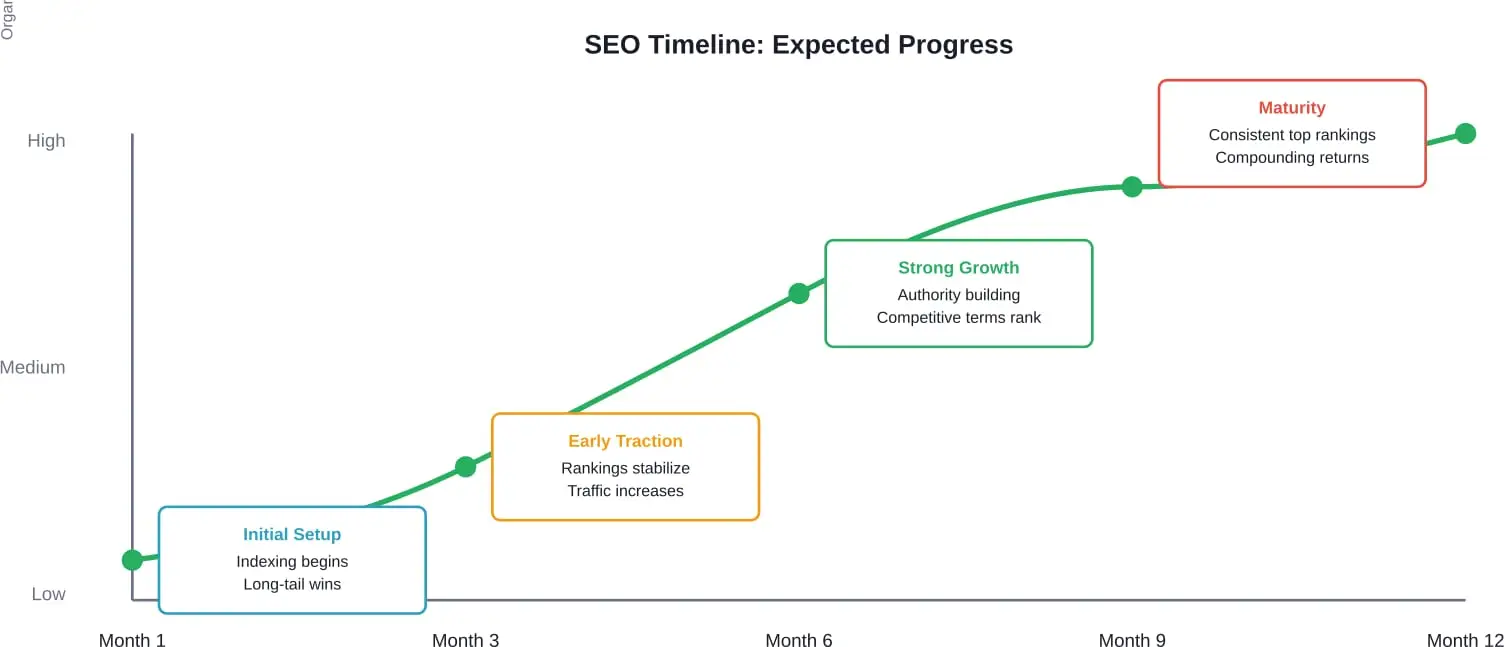
SEO delivers compounding returns over time, not overnight results. Most sites need 3-6 months of consistent effort before seeing significant traffic increases.
New domains and stores typically need longer. Established sites with existing authority see faster results from optimization.
Advanced Shopify SEO Tactics
Once foundational elements are solid, advanced techniques push performance further.
Collection Page Optimization
Collection pages often receive less optimization attention than product pages, yet they target valuable category keywords with commercial intent.
Write unique, keyword-rich descriptions for every collection. Include 300-500 words explaining the category, benefits of products within it, and buying considerations.
Add breadcrumb navigation to help search engines understand site structure and improve user navigation.
Create subcollections for more specific targeting. Instead of one “Shoes” collection, create “Running Shoes,” “Hiking Boots,” “Casual Sneakers”—each targeting distinct keywords.
FAQ Schema Implementation
Adding FAQ schema markup to pages with common questions can trigger rich results in search—expanding real estate and attracting clicks.
Implement FAQ schema through Shopify apps or by adding JSON-LD code to page templates.
Include genuinely helpful questions and answers. Google may remove rich results for manipulative or promotional content disguised as FAQs.
Blog Category Optimization
Organize blog content into specific categories that align with keyword themes.
Create category pages with introductory content explaining the theme. Link from relevant product pages to related blog categories.
This creates topical authority—demonstrating comprehensive coverage of specific subjects.
User-Generated Content Leverage
Customer reviews, questions, and photos create fresh, unique content that benefits SEO.
Encourage reviews through post-purchase emails. Reviews add keyword-rich content to product pages and build trust that improves conversion rates.
Implement question-and-answer functionality allowing customers to ask and answer product questions. This addresses long-tail informational queries.
International SEO Considerations
Stores selling to multiple countries should implement hreflang tags indicating language and regional targeting.
Shopify Markets handles much of this automatically, but verify implementation in Search Console.
Create country-specific content where appropriate. Don’t simply translate—adapt content for regional preferences, terminology, and search behavior.
Shopify Apps for SEO
While Shopify handles core SEO functions, apps can extend capabilities and simplify optimization tasks.
SEO Manager by Plug in SEO
This app scans stores for common SEO issues—missing meta descriptions, broken links, image alt text gaps, and duplicate content.
It provides actionable recommendations with step-by-step fixes. The dashboard tracks optimization progress over time.
Smart SEO by Booster Apps
Smart SEO automatically adds meta tags, generates alt text for images, and creates structured data markup for products.
It saves time on repetitive optimization tasks, though manual review ensures quality.
JSON-LD for SEO
This app implements structured data markup across the store—product schema, organization schema, breadcrumbs, and more.
Proper schema implementation can trigger rich results in search, improving visibility and click-through rates.
Image Optimizer by Booster Apps
Automatically compresses product images to improve page load speed without visible quality loss.
Also adds alt text to images and renames image files to include keywords.
Blog Studio
Enhances Shopify’s basic blogging functionality with better organization, scheduling, and SEO tools.
Allows creating content calendars, organizing posts into detailed taxonomies, and optimizing posts for specific keywords.
Conclusion: Building Long-Term Shopify SEO Success
SEO isn’t a one-time project. It’s an ongoing strategy that compounds over time.
The stores that win in search results share common characteristics: They consistently create valuable content. They obsess over user experience. They build genuine authority through quality backlinks and industry expertise.
Start with the fundamentals. Conduct thorough keyword research. Optimize product pages with unique, compelling descriptions. Ensure technical elements are solid—fast load times, mobile responsiveness, proper site structure.
Then build systematically. Publish blog content targeting informational keywords. Earn backlinks through outreach, guest posting, and creating genuinely link-worthy resources. Monitor performance and adjust strategy based on data.
The competitive advantage of SEO is durability. Paid advertising stops generating traffic the moment budgets are exhausted. SEO traffic continues flowing from work done months or years earlier.
With over 6.87 million live websites using Shopify, competition is fierce. But search engines reward quality, relevance, and authority—not just market share.
Smaller stores can outrank larger competitors by targeting more specific keywords, creating superior content, and building authority in focused niches.
The question isn’t whether to invest in Shopify SEO. With search contributing around 68% of all trackable website traffic, the question is how quickly to start and how consistently to execute.
Begin today. Pick one improvement—optimize five product descriptions, publish one comprehensive blog post, reach out to three potential link partners. Then tomorrow, do it again.
That’s how stores move from page ten to page one. Not overnight breakthroughs, but consistent, strategic optimization that compounds into sustainable organic traffic and revenue growth.