Selling SaaS to enterprises is a long-cycle game – complex deals, multiple decision-makers, and slow, deliberate evaluation. Your SEO strategy needs to reflect that. It’s not about chasing keywords or flooding the blog. It’s about building structure, aligning with intent at each stage, and supporting how real buyers move through complex funnels.
Most teams don’t need more content, they need the right content, mapped to how prospects search and how sales actually close. When done right, SEO becomes a compounding growth engine running in the background, while you stay focused on product, roadmap, and delivery.
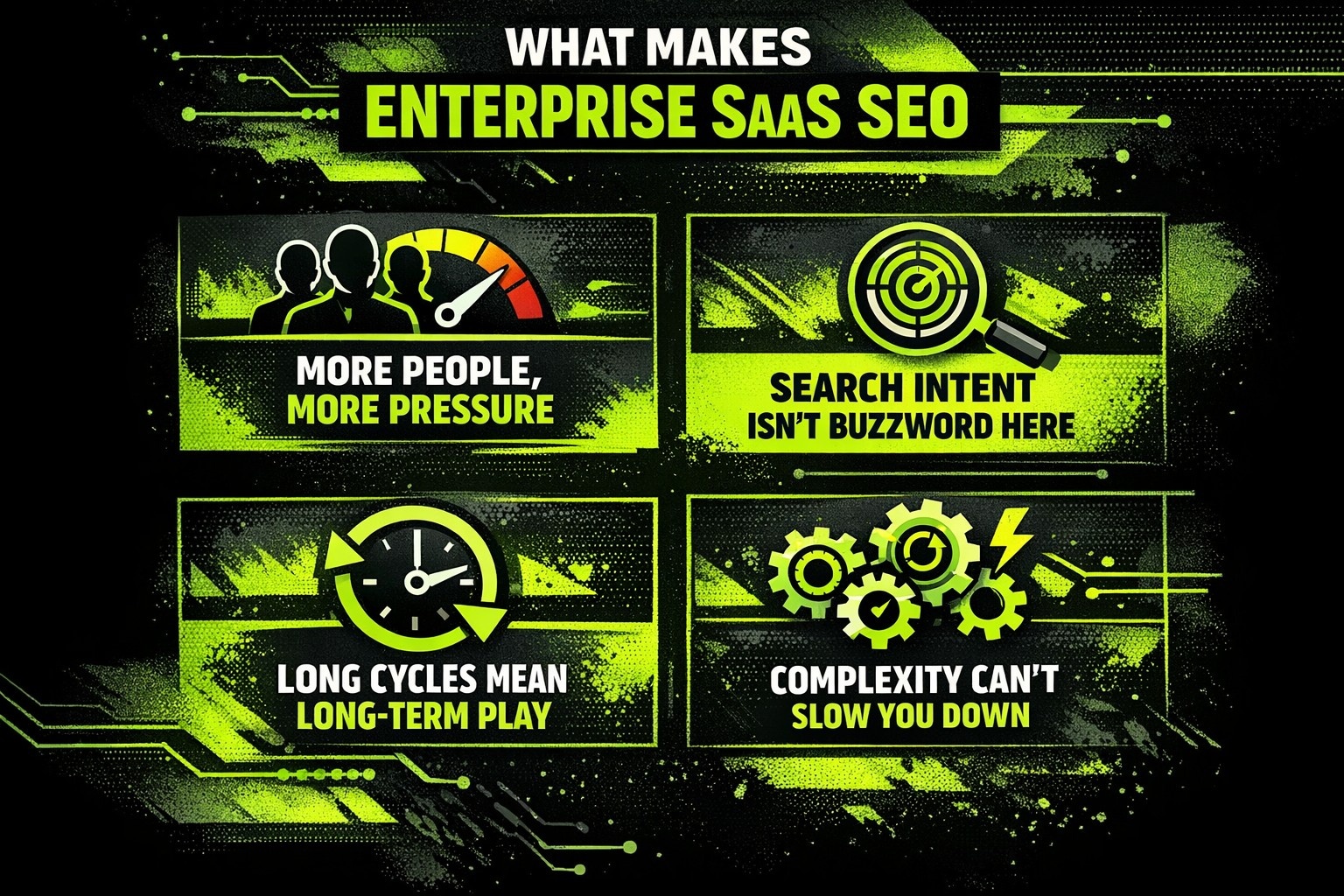
What Makes Enterprise SaaS SEO Its Own Kind of Challenge
Getting visibility for enterprise SaaS is not the same as ranking for a trendy blog topic or pushing out landing pages for a simple tool. You’re not selling a $20/month subscription to a solo user – you’re navigating complex buying cycles, big budgets, and entire decision committees. SEO here works differently. And it has to be built that way from the ground up.
1. More People, More Pressure
In enterprise sales, you’re not convincing one person – you’re convincing five or six, minimum. Security wants documentation. Finance wants pricing clarity. Operations wants to know if this thing will break anything downstream.
Your SEO has to account for that. It means creating content that speaks to different roles, not just one ideal persona. The closer your content comes to answering their specific questions, the faster your deal moves forward.
2. Search Intent Isn’t Just a Buzzword Here
A CMO looking for “marketing automation software” is not searching with the same intent as someone Googling “best email tools.” You need to build content that lines up with actual buying signals – comparison pages, integration walkthroughs, pricing breakdowns. This isn’t top-of-funnel fluff. It’s decision-stage clarity. That’s where SEO actually earns its keep.
3. Long Cycles Mean Long-Term Play
Enterprise deals don’t close in a week. Sometimes not even in a quarter. So your SEO strategy needs to hold up over time. That means evergreen content, strong internal linking, and technical foundations that don’t fall apart when you publish your 500th product update.
It also means tracking the full journey – from that first organic visit to a demo, to a contract, to renewal. You can’t fake the compounding effect.
4. Complexity Can’t Slow You Down
Big SaaS sites get messy fast. Product pages, integrations, changelogs, knowledge bases – it all adds up. If you don’t have a handle on site structure and crawlability, your strongest content will get buried. And if your Core Web Vitals are lagging, no one’s sticking around to read it anyway. Enterprise SEO has to be both smart and fast.
Build the Right SEO System from Day One
Before chasing tactics, we focus on the process. This is the foundation that makes every next step actually work.
| Step | What It Covers | Why It Matters |
| Audit | Review of current SEO performance, content inventory, and technical structure | Identifies what’s working, what’s broken, and where the gaps are |
| ICP & Journey | Defining key buyer roles and mapping their decision-making process | Ensures SEO supports the full B2B buying committee across the funnel |
| Goal Alignment | Setting measurable, outcome-driven KPIs linked to marketing and sales | Helps SEO prove its value beyond traffic – through leads, pipeline, or revenue |
| Role Ownership | Clarifying responsibilities across SEO, content, dev, and product teams | Prevents blockers and avoids execution gaps in complex stakeholder environments |
| Prioritization | Selecting and sequencing SEO initiatives based on impact and effort | Focuses resources where they’ll create the highest business return |
How Lengreo Drives Enterprise SaaS SEO That Converts
At Lengreo, we don’t treat SEO like a siloed service. For enterprise SaaS, it’s tightly integrated into demand generation, lead nurturing, and long-cycle sales strategy. Our focus is always on qualified pipeline – not just rankings. That’s why we start with how your buyers actually search, how your team sells, and where SEO can close the gap between awareness and action.
We build strategies around intent, not traffic. Comparison pages, role-specific solutions, and product-led content are mapped to real buying moments. Performance is tracked beyond visibility, with close attention to how SEO supports conversion and sales momentum.
We also think about reach. LinkedIn and Instagram play a role in how enterprise audiences discover and engage with content, so we support SEO with consistent, relevant distribution there. It’s all part of staying visible where decisions start, not just where searches end.
10 Real-World SEO Tactics for Enterprise SaaS Growth
Effective enterprise SaaS SEO isn’t about guesswork – it’s about applying focused, repeatable tactics that align with how your buyers search, evaluate, and convert. These 10 strategies are grounded in actual workflows, not generic best practices. Use them to build a system that scales with your product, supports long sales cycles, and drives qualified pipeline – not just traffic.
1. Map SEO to Actual Buyer Journeys
Traditional keyword mapping skips context. We go deeper – starting from how buyers think, not how search engines index. That means identifying friction points in long sales cycles and aligning content with them. Think less “optimize this term” and more “support this decision stage.” This approach turns your content into a sales enabler, not just a traffic magnet.
Start by mapping real conversations – what buyers ask on calls, what blockers come up in procurement, what questions resurface at renewal. Then match those with search behavior at each step: awareness, evaluation, validation. Build pages that help people move forward, not just pages that match a query. It’s not about covering more ground – it’s about covering the right ground at the right time.
2. Structure Your Site Like a Product Catalog
If your site has more than 100 pages, structure isn’t a UX detail – it’s an SEO strategy. Use a layout that mirrors how buyers mentally group information:
- Product
- Solutions
- Industries
- Resources
Inside each, use a hub-and-spoke pattern – one clear landing page with linked subpages. This builds topical authority, makes internal linking scalable, and keeps search engines happy even as the site scales to 500+ URLs. Plan for scale. Architect for clarity. Maintain it like product infrastructure.
3. Treat Integrations as High-Value Assets
Your integrations aren’t just product features – they’re conversion levers and backlink magnets. Instead of burying them in technical documentation or low-traffic directories, elevate them with dedicated, SEO-friendly pages that reflect their true value in the sales process.
Each integration page should explain what it does, how it works, and why it matters – from both a technical and business angle. Add setup instructions, compatibility notes, and clear joint use cases. These pages build trust with evaluators and often attract organic links from partners and ecosystems you’re part of.
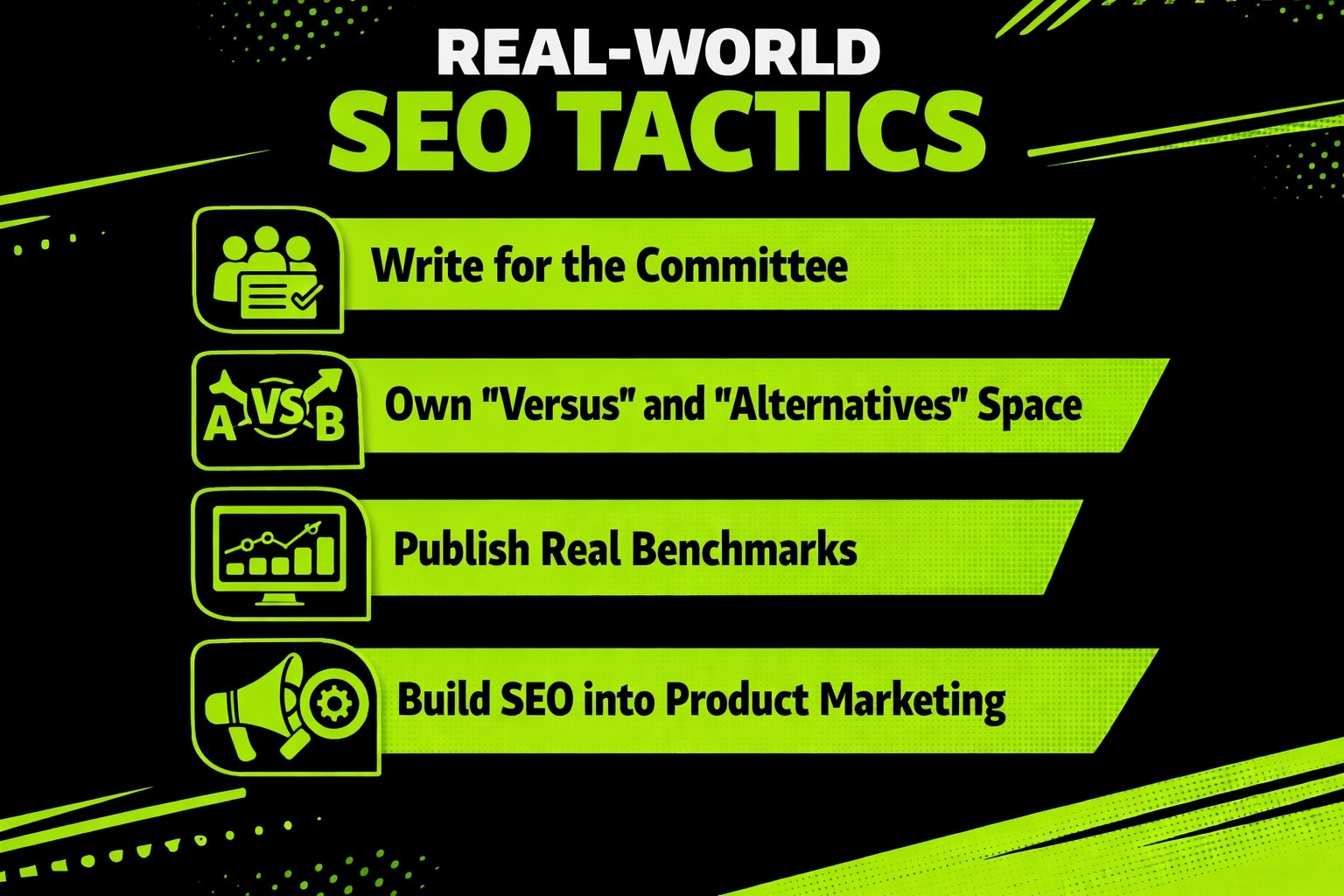
4. Write for the Committee
In enterprise SaaS, you’re not selling to one person – you’re selling to a room full of stakeholders, each with different concerns. Your SEO strategy should reflect that reality. One-size-fits-all messaging doesn’t cut it when security, finance, product, and operations are all part of the buying journey.
Create content that speaks to each role directly. Make it easy for every decision-maker to find the answers they need to say “yes” – or at least stop saying “not yet.” Some high-impact formats include:
- Compliance checklists and infrastructure docs for IT and security teams.
- Transparent pricing breakdowns and procurement-ready pages for finance.
- Integration overviews and technical walkthroughs for product leads.
- ROI case studies and strategic POVs that align with executive goals.
If any of these voices are left out, your deal risks stalling. Good SEO removes blockers, not just barriers to ranking.
5. Own the “Versus” and “Alternatives” Space
Buyers compare. Help them do it well. Enterprise buyers almost never make a purchase in a vacuum. They build comparison spreadsheets, gather team input, and Google things like “Product A vs Product B” or “Alternative to [your biggest competitor]”. If you’re not part of that moment, you’re ceding ground to someone else. What to build:
- “Versus” pages that stack your product against specific competitors across use cases, pricing, UX, and support models. Use tables. Be clear. Avoid fluff.
- “Alternatives to…” pages that capture people exiting competitor ecosystems. Offer nuanced reasons why switching makes sense – and when it doesn’t.
- Customer migration stories showing how teams replaced competitor tools and what outcomes improved.
Don’t be afraid to show gaps – just explain why they exist. Buyers appreciate honesty more than spin. These pages aren’t about picking fights – they’re about helping teams make confident decisions with fewer calls and less friction.
6. Publish Real Benchmarks and Research
Buyers trust numbers more than they trust your brand voice – especially in enterprise SaaS, where claims are easy to make and hard to verify. Data-backed content cuts through skepticism and builds authority in a way no fluff piece ever will.
Go beyond surface stats. Share real-world implementation timelines, measurable ROI, or time-to-value metrics across different customer segments. Run your own industry surveys or publish anonymized usage trends. Bonus if it’s packaged as a downloadable report or interactive asset. Content like this doesn’t just rank – it gets cited, bookmarked, and used in internal buying discussions. That makes it powerful for both SEO and sales enablement.
7. Build SEO into Your Product Marketing
Turn every feature launch into organic reach. Most SaaS teams ship features – and forget to make them discoverable. If your updates live only in changelogs or emails, you’re missing a compounding SEO opportunity. Bake in search-focused content with every release:
- Feature-specific landing pages targeting real search terms.
- Tutorials and guides that solve problems users actually use Google.
- Update-themed blog posts tied to use cases, not just functionality.
- Refreshed docs and FAQs optimized for long-tail queries.
When SEO and product marketing move in sync, your roadmap drives both visibility and trust – without doubling the work.
8. Optimize for Conversion, Not Just Visibility
Ranking well means nothing if visitors don’t take the next step. Your high-traffic pages should actively move buyers forward – not just inform them. That means shaping each page around a specific conversion intent. Include CTAs that match where the reader is in their journey, not just a generic “Talk to Sales” button. Pair that with real proof: testimonials, usage stats, ROI figures, anything that builds trust without fluff.
Design matters too. If your pages load slowly or break on mobile, momentum dies fast. Frictionless performance and mobile-first layouts aren’t just UX wins, they’re conversion tools. Think of SEO pages as part of your sales engine. If they don’t engage, convince, and convert, they’re not pulling their weight.
9. Align SEO with Paid Campaign Learnings
Too often, SEO and paid search teams operate in silos – but they’re targeting the same buyers, on the same platforms, with similar intent. Paid campaigns provide a rapid feedback loop on what messaging actually resonates, which calls to action generate clicks, and which landing pages convert. Ignoring that data means missing out on proven insights.
Use successful PPC results to shape your organic content strategy. Headlines that drive engagement in ads are likely to work well in meta titles and H1s. Landing page formats that convert in paid should be mirrored in SEO templates. Even low-performing ad copy can reveal positioning gaps in your content. When SEO is guided by paid insights, it gets sharper, faster – and much closer to what your audience already responds to.
10. Build a Publishing Rhythm That Doesn’t Stall
Enterprise SEO success rarely comes from one-off spikes – it comes from steady, deliberate output over time. The goal isn’t to flood search with content. It’s to ship reliably. What that looks like:
- One solid asset per sprint – polished, purposeful, and mapped to buyer needs.
- Repeat what works – glossaries, comparison pages, case studies, use cases.
- Operationalize SEO – bake it into your marketing ops, not just the content calendar.
Consistency compounds. A predictable publishing cadence feeds authority, improves iteration, and makes SEO a real engine – not a side project.
Get the Technical Foundations Right Before You Scale Anything
Enterprise SEO isn’t just content and keywords – it’s infrastructure. If your technical setup is messy, no amount of optimization will fix it. And when your site has hundreds (or thousands) of pages, small issues become expensive fast.
Start with performance. Every page that loads slowly chips away at your credibility – with both users and Google. That means fixing lazy Core Web Vitals, cleaning up bloated scripts, and keeping third-party tools on a short leash. Make it a habit, not a one-off audit. Good tech SEO is ongoing maintenance, not a one-time checklist.
Beyond speed, focus on crawlability and structure. Use clean sitemaps. Keep canonical tags tight. Control what gets indexed. And don’t let docs, changelogs, or filterable pages flood your crawl budget. It’s not flashy work – but if this part breaks, everything else becomes harder than it needs to be.
Treat SEO Like a Product, Not a Project
If your SEO still lives in a to-do list or quarterly “content sprint,” it’s not going to drive results that matter. Enterprise SaaS SEO needs to be run the same way you’d run a product: with a roadmap, owners, sprint cycles, metrics, and feedback loops that actually get used.
Start by assigning real roles. Who owns the strategy? Who handles implementation? Who signs off on legal, design, or dev constraints? Without clear lines, SEO moves slow and gets diluted. Build a process once, then refine it – don’t reinvent it every time a new page goes live.
And most importantly, ship regularly. One sprint, one template, one small win at a time. Maybe it’s a new comparison page. Maybe it’s a cleaned-up sitemap. Point is, SEO doesn’t need to be loud – it needs to be consistent. The teams that treat it like product work are the ones that see it compound. Everyone else is just publishing and hoping.
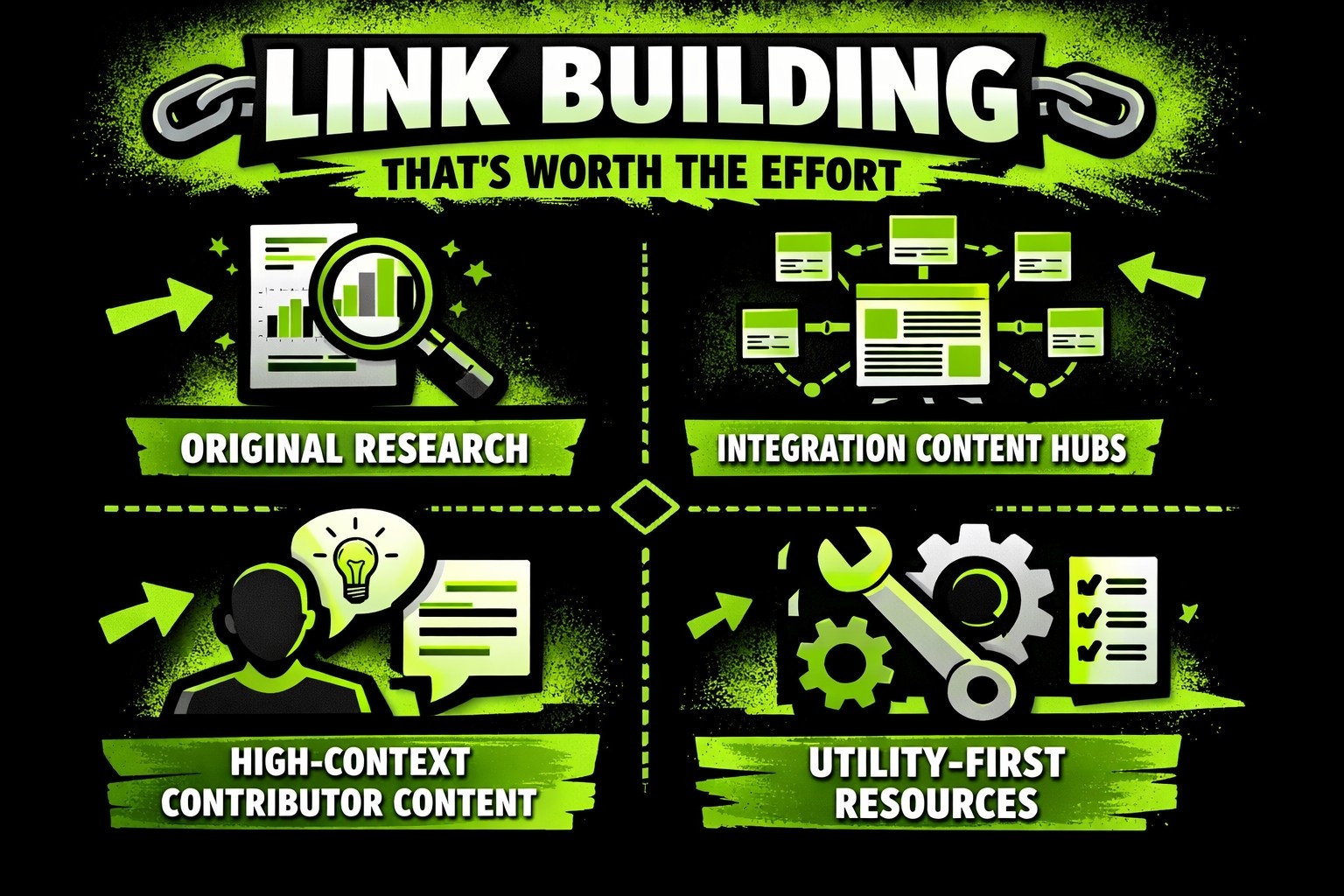
Link Building That’s Worth the Effort
Link building in enterprise SaaS isn’t about volume – it’s about relevance, authority, and lasting value. You don’t earn links by chasing domain ratings or spamming inboxes. You earn them by creating something worth citing and making it easy to do so.
Smart strategies focus on quality over quantity. Instead of asking for links, focus on building assets that naturally attract them:
- Original research and benchmarks: Publish data no one else has – industry surveys, platform usage trends, performance benchmarks. Make the data easy to cite and include charts or downloadable assets that editors love referencing.
- Integration content hubs: Create detailed, structured pages showing how your product connects with key platforms. These pages often earn links from partners, marketplaces, and solution directories without manual outreach.
- High-context contributor content: Instead of chasing guest post quotas, write for the outlets your actual buyers read. Focus on relevance, specificity, and actionable POVs. Domain authority helps but resonance matters more.
- Utility-first resources: Templates, frameworks, checklists, onboarding guides – anything that simplifies a real task or decision will be bookmarked, shared, and linked to over time.
- Credible PR assets: When you launch content or features, think beyond the press release. Include visuals, quotes, and insight worth citing. Target the right people with a clear hook – not a mass email.
Great link building feels less like SEO and more like distribution. It’s not about tricking the algorithm. It’s about showing up in the places your audience already trusts so that Google eventually follows.
Track What Moves Revenue, Not Just Rankings
A jump in traffic means nothing if your pipeline doesn’t budge. Enterprise SaaS SEO needs to be measured like any other serious channel – with actual revenue signals, not vanity metrics. If your reports still lead with impressions and keyword count, you’re missing the point.
Start by connecting the dots between search and sales. Track how organic traffic turns into demo requests, how those turn into qualified opportunities, and what actually closes. Layer that with cost-per-acquisition and compare it to paid – not to compete, but to understand the full picture. When SEO starts showing up in CRM data, leadership stops seeing it as a nice-to-have.
It’s also about looking past surface-level wins. Instead of celebrating a blog post that ranks, ask what role it played in closed deals. Which pages appear in won opportunities? Which ones moved the conversation forward? Once you know that, your roadmap isn’t driven by guesswork – it’s driven by what’s already working.
Conclusion
Enterprise SaaS SEO isn’t about chasing trends or stuffing keywords. It’s about building something that holds under pressure – something that aligns with how your buyers think, how your product is sold, and how your revenue team measures progress. When done right, it becomes an engine that feeds your pipeline without shouting for attention. Quiet, compounding, and tied directly to growth.
Most companies don’t need more content. They need structure. Better targeting. Cleaner execution. And SEO that plays the long game without getting lost in the weeds. If that’s where you’re heading, you’re already ahead of most.