


Patients aren’t flipping through directories – they’re typing “dentist near me” into Google. If your clinic doesn’t show up where it matters, you’re handing business to someone else. This guide breaks down how dental SEO actually works, what sets it apart from general SEO, and how to make sure your practice is visible, credible, and ready to convert searchers into booked appointments.
Why Search Visibility Decides Who Gets the Patient
Being a great dentist doesn’t guarantee bookings. Patients don’t scroll past page one – they pick the clinic that shows up, looks trustworthy, and makes it easy to take action. That’s what SEO fixes. It’s not about chasing clicks – it’s about building digital visibility that works as hard as your front desk. Here’s why dental SEO isn’t optional anymore:
- Patients search before they call: Most people Google symptoms, services, or “dentist near me” before reaching out. If you’re not showing up there, someone else is.
- Local rankings drive real-world visits: Appearing in the Google Map Pack can mean the difference between an empty chair and a booked calendar.
- Trust is tied to visibility: Sites that rank high look more legit – even if the care is identical. SEO helps build that perception.
- Good SEO compounds over time: Unlike paid ads that stop when the budget runs dry, organic visibility keeps working in the background.
- Healthcare websites face stricter standards: Dental content falls under Google’s YMYL (Your Money or Your Life) category. You need the right structure, credentials, and accuracy to compete.
SEO isn’t about gaming algorithms. It’s about earning your spot – then making sure patients land on something worth their time.
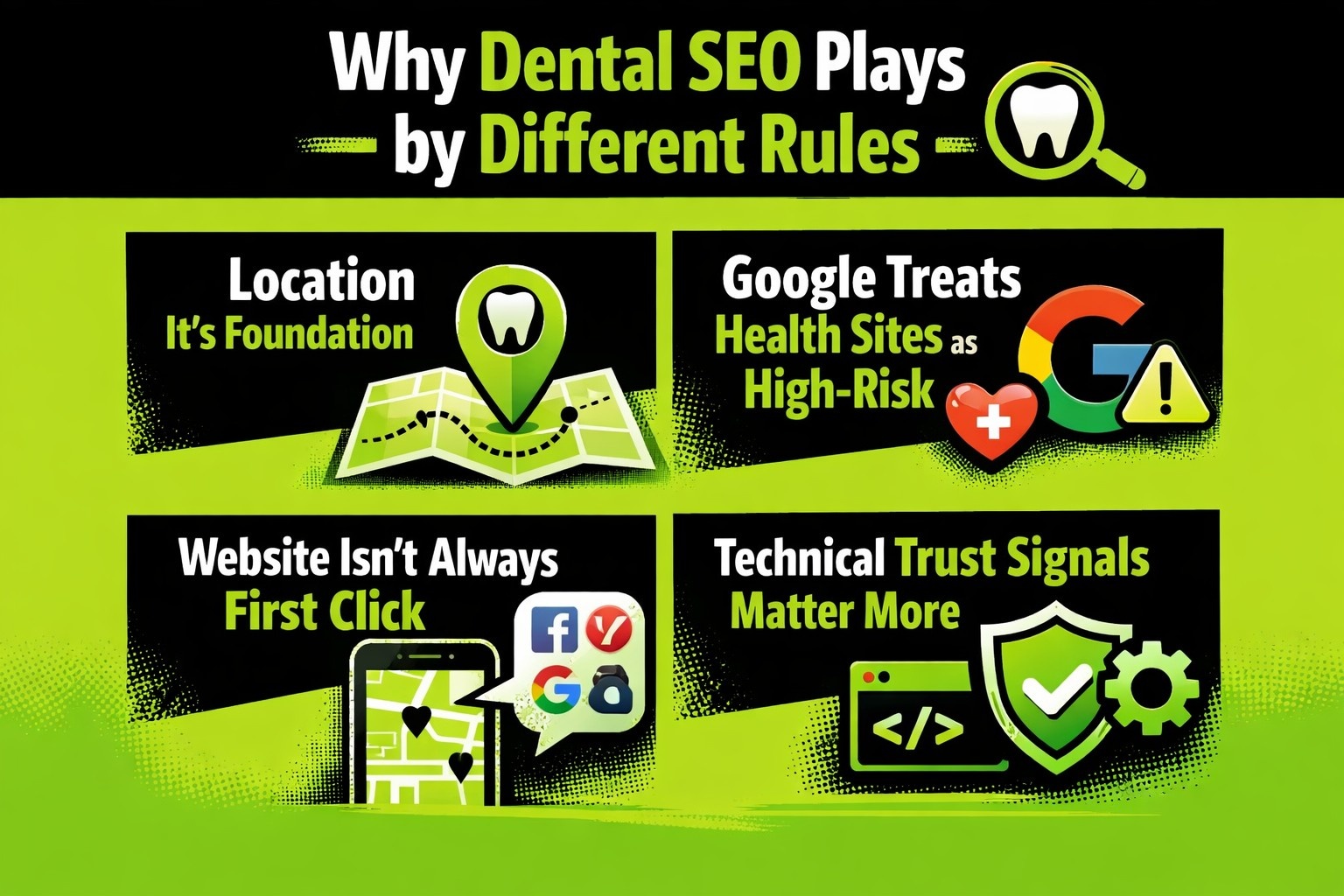
Why Dental SEO Plays by Different Rules
You can’t treat a dental clinic like a retail site or a local café when it comes to SEO. The search behavior is different. The risks are higher. And Google expects a lot more from anything remotely tied to health. If your strategy doesn’t account for that, it’s probably not working.
Location Isn’t a Feature – It’s the Foundation
Most dental searches come with local intent baked in. People don’t want advice – they want an appointment. “Pediatric dentist near me” isn’t a research query, it’s a booking moment. If your site doesn’t show up in that context, it might as well not exist.
General SEO can chase national traffic. Dental SEO only works when it connects with nearby patients ready to act.
Google Treats Health Sites as High-Risk
Dental websites fall under Google’s YMYL (Your Money or Your Life) category. That puts them under extra scrutiny. Content needs to be accurate, written or reviewed by professionals, and based on real medical guidance. If your site looks vague or unverified, it doesn’t just rank lower – it may get ignored entirely.
This is where credentials, citations, and real-world expertise make or break visibility.
Your Website Isn’t Always the First Click
In dental SEO, your Google Business Profile often outranks your homepage. It’s what shows up in maps, local packs, and mobile searches. It needs to be complete, active, and optimized – with real photos, services listed, and reviews managed.
For a dental clinic, that profile isn’t a nice extra. It’s where first impressions happen.
How Patients Actually Decide and Why Your Content Needs to Match
Not every patient makes a decision in five minutes. For routine care like cleanings or whitening, they’ll often book the first clinic that looks reliable. But when it comes to implants or root canals, the journey gets more complicated.
People take their time. They jump between websites, compare providers, scan reviews, and search for things like “is a root canal painful” or “dental implant vs bridge” over several days. If your content is too thin or generic, they’ll move on. Clear, helpful pages that answer real questions without fluff – make it easier for patients to stop searching and start trusting.
Technical Trust Signals Matter More
HTTPS, visible contact info, privacy policies – all of it plays into how trustworthy your site feels. For health-related services, these aren’t just UX best practices. They directly affect how Google treats your site. If your site doesn’t feel safe or professional, it’s less likely to appear at all.
Treating dental SEO like a generic local strategy misses the point. The stakes are higher, the expectations are tighter, and the margin for error is smaller. And that’s exactly why it needs a tailored, clinic-specific approach.
Lengreo’s Approach to Dental SEO: Built for Real Clinics
At Lengreo, we don’t hand out recycled SEO roadmaps. Every clinic operates in a different market, with different service lines, review footprints, and visibility gaps. Our role is to look at where you are now, what’s getting in the way of growth, and build a practical, data-led strategy that gets you where you need to be – without wasting cycles on tactics that don’t move the needle.
We don’t just consult from the sidelines – we become part of your team. That means clear deliverables, consistent check-ins, and full transparency into what’s happening and why. Whether it’s reinforcing your technical SEO or creating local content that actually brings in patients, the focus stays on outcomes that drive bookings, not vanity metrics.
Want a closer look at how we operate? We stay active on LinkedIn and Instagram, sharing real stories, strategic insights, and behind-the-scenes progress. Dental SEO isn’t guesswork. It’s structure, execution, and steady momentum. That’s what gets delivered.
Why Dental SEO Isn’t Just “Local SEO with a Logo”
If you’ve worked with SEO before or even dabbled in it yourself – it’s tempting to assume a dental clinic just needs the basics: keywords, some backlinks, a fast site. But medical-related SEO plays by its own rules, and dentistry falls right in the middle of Google’s highest-scrutiny zone. Here’s what makes dental SEO its own category:
- Google holds dental sites to a higher standard: Anything related to health or finances falls under Google’s YMYL (Your Money or Your Life) framework. That means you need accurate, peer-aligned content – not vague service blurbs. Credentials, citations, and privacy policies aren’t optional.
- Local signals matter more than global reach: Most dental searches have immediate location intent – “emergency dentist near me,” “Invisalign [city].” Ranking for general terms doesn’t matter if you’re invisible in the local pack.
- Trust indicators carry more weight: Healthcare consumers want reassurance. Secure sites, patient reviews, visible contact details, and a complete Google Business Profile aren’t just UX features – they’re ranking signals too.
- The content must balance clarity with medical accuracy: You’re not just selling a product. You’re helping someone make a health decision. That means content should be written or reviewed by professionals, reflect clinical standards, and avoid misinformation at all costs.
- The risk of “getting it wrong” is bigger: A poorly optimized blog post about teeth whitening may not just rank poorly – it could get flagged for misleading advice. Penalties or de-ranking are more common in medical SEO when content doesn’t meet quality expectations.
If you’re applying a general SEO checklist to a dental site, you’re likely missing the point. The rules are different – and so is the level of responsibility.
10 Tactical Steps to Improve Your Dental SEO
Ranking well as a dental clinic isn’t about doing one thing right – it’s about stacking the fundamentals. If you’ve ever wondered why a smaller competitor outranks you, it probably comes down to execution across these ten areas. This isn’t a theory. These are the tactical moves that shift real numbers.
1. Claim and Fully Optimize Your Google Business Profile
Your Google Business Profile (GBP) is often the first thing people see. It’s also the one they’ll judge your clinic by – consciously or not. If it’s incomplete or outdated, it doesn’t matter how great your website is. Make sure your GBP includes:
- Full business name, address, and phone number (NAP)
- Business categories like “Dentist,” “Emergency Dental Service,” “Cosmetic Dentistry”
- Opening hours and holiday updates
- Real clinic photos (not stock images)
- Active review management: respond to every single one
If you’re not showing up in the local pack, start here.
2. Create Dedicated Pages for Every Service
Bundling everything into one Services page might seem tidy, but it kills your SEO. Each core treatment should have its own page:
- Dental implants
- Root canal treatment
- Invisalign
- Pediatric dentistry
- Emergency care
On each page, aim for focus and clarity. Don’t try to cover everything – make it obvious what the page is about and who it’s for. Each service page should:
- Focus on one main keyword (e.g. “teeth whitening [city]”)
- Add clear explanations and common questions
- Mention the location to boost local signals
- Use a strong CTA (book now, call today)
It’s easier to rank when you give Google a clear signal on what each page is about – and easier for patients to find exactly what they need.
3. Go Deep With Informational Content
Most patients don’t land on your site ready to book. They start with a question like:
- “Why do my gums bleed when brushing?”
- “How painful is a root canal?”
- “What’s better: veneers or bonding?”
Writing helpful, medically accurate blog posts builds trust. More importantly, it gets your site in front of people before they even choose a provider. Make sure your content:
- Answers real search queries
- Links back to service pages where relevant
- Reflects your actual experience as a practitioner
- Is kept up to date – dental advice changes, and old info kills trust
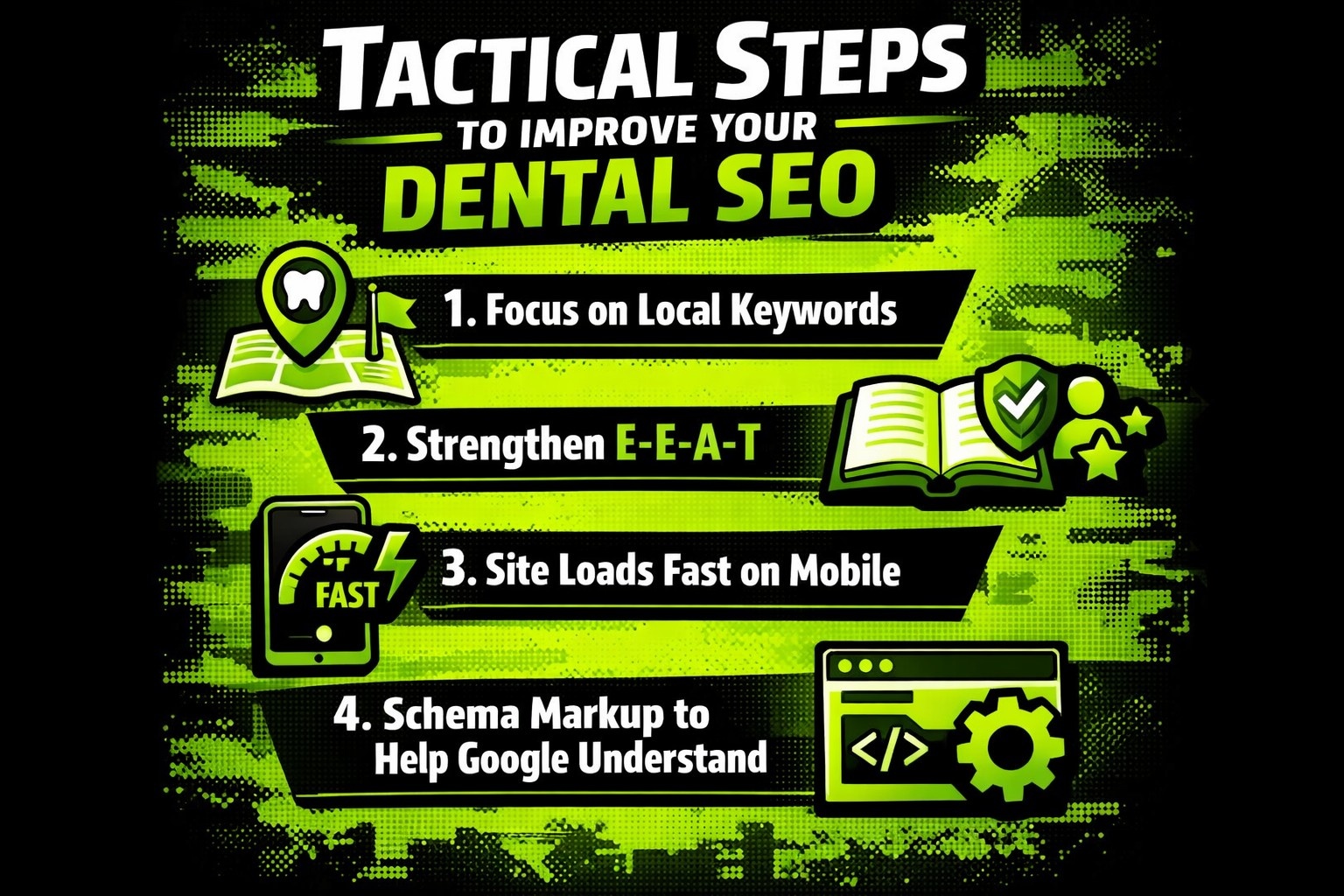
4. Focus on Local Keywords, Not Just Industry Terms
You’re not trying to rank for “dentist” globally. You want patients in your city to find you – fast. Use tools like LowFruits or Semrush to target specific combinations like:
- “Emergency dentist in Pasadena”
- “Affordable dental implants Chicago”
- “Same day crown appointment NYC”
You’ll want to include these naturally across:
- Title tags
- Meta descriptions
- H1s and subheadings
- Body content
- Alt text on images
And don’t forget to mention nearby neighborhoods or landmarks. These subtle local signals stack up.
5. Strengthen E-E-A-T on Every Page
Google wants to know that your site is safe, accurate, and run by qualified professionals. That’s where E-E-A-T (Experience, Expertise, Authoritativeness, Trustworthiness) comes in. Here’s how to boost those signals:
- Add author bios with dental credentials (DDS, DMD)
- Link to clinical sources or professional associations
- Mention years in practice, number of patients served, or awards
- Include privacy policies and contact info in the footer
The more you look like a real clinic (not a copy-paste site), the more trust you build – with both Google and users.
6. Make Sure Your Site Loads Fast on Mobile
Patients won’t wait. Especially not someone searching for emergency dental help on their phone. Run your site through PageSpeed Insights and fix what’s slowing it down. Usually it’s:
- Bloated images
- Unused scripts
- Clunky design themes
Also, don’t stop at speed – focus on the overall mobile experience. That includes layout, navigation, and how quickly someone can take action. Make sure your site:
- Uses responsive design (no pinch-zooming)
- Keeps navigation clean and simple
- Makes contact buttons immediately visible
Fast, clean, and mobile-first is the standard now – not a bonus.
7. Use Schema Markup to Help Google Understand You
Structured data (schema) helps search engines interpret your content. It also makes your listings more attractive in the search results (think stars, FAQs, hours, etc.). For a dental site, consider adding:
- Local Business schema
- Dentist schema
- Review schema
- FAQ schema on key pages
If you’re using WordPress, tools like AIOSEO make it easy without touching code. Otherwise, generate your schema manually and test it in Google’s Rich Results tool.
8. Get Listed in Medical and Local Directories
Directory links help two ways: they improve your authority and help Google confirm your location. Start with:
- Healthgrades
- Zocdoc
- WebMD
- Yelp
- Local Chamber of Commerce
- Industry-specific associations
Make sure your NAP (Name, Address, Phone) is consistent across all listings – identical formatting, spelling, everything. Inconsistencies can hurt your local rankings.
9. Encourage and Manage Patient Reviews
Google treats real reviews as a trust signal. Potential patients do too. How to build them up:
- Send a follow-up SMS or email after visits with a direct review link
- Reply to every review (even short replies count)
- Display top reviews on your website
- Don’t panic over a few negatives – how you respond matters more
Volume + consistency > perfection.
10. Fix the Technical SEO Basics
You don’t need to be a developer to handle this, but you do need to care. Technical issues quietly sabotage rankings – even if your content is great. Make sure:
- The site is secure (HTTPS)
- Broken links are fixed
- URLs are readable (no random strings or symbols)
- Your sitemap is submitted to Google Search Console
- Images have alt tags
- The site doesn’t block crawlers
If you’re not sure where to start, a basic SEO audit will reveal what’s holding you back.
If your clinic’s site is only doing half of the above, that’s likely why traffic’s flat or appointments aren’t coming in through search. Dental SEO isn’t about shortcuts – it’s about stacking smart decisions that compound over time. No single trick moves the needle, but together? They absolutely do.
How Long Does Dental SEO Take and What Actually Happens Along the Way
If you’re expecting results in a few weeks, SEO will disappoint you. That’s not because it doesn’t work – it’s because it works differently. Dental SEO isn’t a switch. It’s more like compounding interest: slow at first, then faster once the pieces fall into place.
In the first 1-2 months, most of the work is foundational – audits, keyword mapping, technical fixes, and content planning. Early signs of progress, like improved impressions or minor ranking shifts, may appear around months 3 to 6. For most dental practices, meaningful momentum – better local visibility, Map Pack presence, and search-driven calls – builds between 6 and 12 months, with stronger ROI often showing after a full year.
Could you run ads for faster results? Sure. But SEO builds something you actually own. No daily spend, no disappearing traffic when the budget pauses. Just a system that keeps delivering, even when you’re not actively pushing it. That’s the long game. And for clinics that play it right, it pays off.
Conclusion
Most dental clinics aren’t losing patients because of pricing or quality. They’re losing them at the search bar. People are ready to book, but they never make it to your site or worse, never hear of you at all. SEO is how you fix that gap.
The good news? It’s fixable. With the right structure, consistent effort, and content that actually answers patient questions, your site can start pulling in leads without needing a monthly ad spend. Whether you’re rebuilding from scratch or just need to tighten up what’s already there, the opportunity is the same: show up, build trust fast, and make it easy to say yes.