


Financial services don’t win on volume – they win on credibility, timing, and showing up when the stakes are high. Whether someone’s researching loan options or comparing retirement advisors, your visibility in that moment is everything. But ranking for competitive financial terms isn’t simple. You’re not just competing with other firms – you’re going up against publishers, aggregators, and regulation-heavy content filters.
That’s why financial SEO isn’t about quick tricks. It’s about system-level strategy: structured content, airtight compliance, domain-level trust, and smart keyword targeting mapped to how real people search when money’s on the line. This guide walks through exactly how that strategy should be built – and what most companies get wrong.
Why Financial Services Need SEO in 2026
The way people search for financial advice, products, and providers has shifted. Today, most trust-building happens before anyone fills out a form or schedules a consultation. People Google first, compare second, and only then consider making contact. If your brand isn’t visible at that critical early stage – when someone’s researching loan options, investment firms, or tax advice – you’re not even in the running. And no, paid ads can’t fully cover that gap anymore, especially with CPCs in finance continuing to climb.
SEO isn’t just about ranking – it’s about showing up in the right moment with the right content. That means building layered pages that match how clients actually search and decide. It means addressing compliance, demonstrating real expertise, and keeping your content aligned with fast-changing regulations. When done right, SEO becomes a scalable inbound engine that lowers acquisition costs, increases trust, and positions you as a credible choice – before a word is even exchanged.
Lengreo and Financial Services SEO: Building Visibility Where Trust Matters
At Lengreo, we don’t treat finance SEO as just another campaign. It’s a high‑trust, highly structured process that balances performance, accuracy, and compliance. We’ve worked with regulated industries long enough to know that shortcuts don’t scale, and that sustainable results come from systems built to last.
We integrate early with marketing, legal, and product teams to avoid friction later. From there, we build search strategies around real user intent, clear conversion paths, and content that supports decision‑making – not just rankings. SEO also ties into LinkedIn and Instagram, helping financial brands stay visible and credible beyond search results.
What keeps it working is consistency and clear communication. We stay aligned through every shift – regulatory or strategic – and keep our focus on results that actually move the needle. For a closer look at how we work, check us out on LinkedIn and Instagram.
Step-by-Step SEO Strategy for Financial Services
Financial SEO isn’t just about ranking. It’s about being visible at the exact moment someone’s evaluating what you offer – and having the right content and structure in place to earn their trust. Here’s how to approach it step by step.
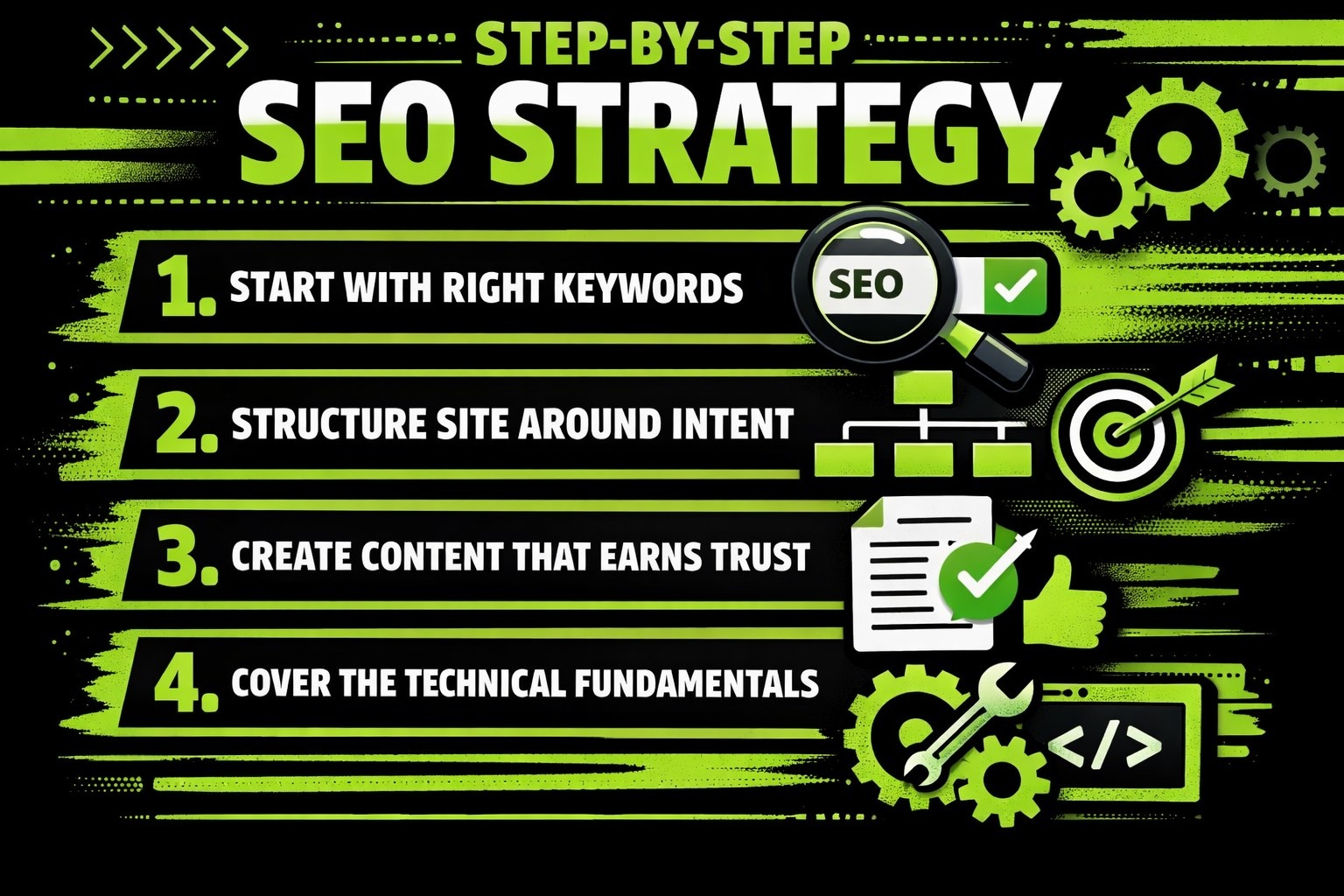
1. Start With the Right Keywords – But Don’t Stop There
Keyword research is still the starting point, but in financial SEO, intent matters more than volume.
You’re not just targeting “loans” or “wealth management.” You’re figuring out what someone actually wants when they search “best mortgage option for self-employed” or “how to retire early without penalty.”
Use a layered approach:
- Service keywords (“business loans for startups”)
- Problem-based queries (“how to avoid tax penalties on withdrawals”)
- Location-specific searches (“retirement planner in Boston”)
- Trust indicators (e.g., ‘SEC registered advisors’ or ‘FINRA member firms’)
Group your findings into keyword clusters based on intent. These clusters will drive how your content and pages are structured.
2. Structure the Site Around Intent, Not Departments
Most financial sites are organized like a filing cabinet – one tab for loans, another for savings, another for “insights.” But users don’t search that way. They ask questions, look for comparisons, and jump around.
Restructure with this in mind:
- Build dedicated landing pages for each keyword cluster
- Don’t overload a single “Services” page – break it out by product or use case
- Use internal links to create logical, guided navigation across related topics
Think of your website like a conversation funnel. Each page should help someone move one step closer to clarity or action.
3. Create Content That Earns Trust Before Contact
This is where most financial SEO strategies fall apart. Thin blogs and vague service pages won’t cut it in a YMYL category.
Content needs to be:
- Authored or reviewed by actual experts
- Specific about processes, risks, and trade-offs
- Supported by real data, citations, or tools
- Structured for readability – headings, bullets, table comparisons
If your audience is trusting you with their money, the least you can do is write like someone who’s done the homework. Bonus points for offering calculators, checklists, or explainer videos – anything that solves problems directly.
4. Cover the Technical Fundamentals
Search performance isn’t just about content – it depends on what’s under the hood.
Here’s what needs regular attention:
- Page speed (especially on mobile)
- Secure HTTPS across the site
- Clean sitemap and crawl-friendly structure
- Schema markup for financial organizations, products, and reviews
- Clear URL logic that maps to service or content hierarchy
Use tools like Google Search Console, Ahrefs, and Sitebulb to audit everything from indexing issues to broken links.
5. Optimize for Local Search If You Operate in Specific Markets
Even digital-first financial firms benefit from local SEO. People still want to work with someone nearby – or at least know where you’re based.
Tactical local moves:
- Set up and regularly update Google Business Profiles
- Create location-specific landing pages (city, region, neighborhood)
- Add local keywords naturally into meta tags and headings
- Collect and respond to reviews, especially on industry directories
Local search isn’t about ranking everywhere. It’s about owning your footprint where it matters most.
6. Build Authority With Targeted Backlinks
Finance is a high-trust industry, and search engines know it. If reputable sites link to you, that’s a strong endorsement.
High-value link-building tactics:
- Contribute expert content to financial publications
- Offer original research, surveys, or data sets worth citing
- Develop linkable assets (mortgage calculators, tax calendars, investment checklists)
- Collaborate with associations, universities, or fintech platforms
Avoid shortcuts. Bought or irrelevant backlinks can do more harm than good, especially in financial SEO.
7. Maintain and Refresh – Don’t Set and Forget
Content ages. Regulations change. Interest rates shift. What ranked last year might not make the cut today.
Build a review and update cycle:
- Quarterly content audits for accuracy and keyword alignment
- Updating old posts with fresh stats and links
- Redirecting outdated or redundant pages
- Expanding thin content into deeper guides
Search engines reward freshness – but so do readers who need real answers.

8. Track the Metrics That Actually Matter
SEO for finance should drive business outcomes, not just traffic spikes.
Set up proper tracking to monitor:
- Organic traffic by page and category
- Keyword positions by intent cluster
- Conversion rates (form fills, calls, tool usage)
- Local search impressions and map clicks
- ROI compared to paid channels
Use the data to adapt – not just report. If one page is converting 5x higher, figure out why and replicate that pattern across the site.
9. Align SEO With Sales and Customer Journeys
SEO shouldn’t live in a silo. Especially in finance, where decisions take time, multiple touchpoints matter, and content often supports both sales and support conversations.
Here’s how to align:
- Interview your sales and support teams to understand recurring client questions
- Create content that preempts objections or confusion
- Match content to funnel stages: awareness, evaluation, decision
- Use CTAs that reflect where the user is – not just “Contact Us” everywhere
When SEO reflects how people actually buy financial services, results compound.
10. Layer in Conversion Rate Optimization (CRO)
Traffic doesn’t equal revenue. If your pages don’t convert, your SEO effort leaks value.
Basic CRO for finance sites:
- Use clear, jargon-free CTAs that feel safe (e.g. “Book a free intro call” > “Apply now”)
- Minimize form fields, especially on first contact
- Test trust signals: awards, reviews, partner logos, security badges
- Add dynamic elements like calculators or “check eligibility” widgets
You don’t need a redesign – just small changes based on real user behavior.
11. Adapt to Algorithm Updates Without Overreacting
Finance sites often get spooked when Google rolls out changes, especially around YMYL or core updates. But the goal isn’t to chase every shift – it’s to stay resilient.
Build resilience by:
- Prioritizing original, expert-led content
- Avoiding manipulative tactics like over-optimization or low-quality link buys
- Watching performance trends over weeks, not hours
- Having a backlog of updates and audits ready for when rankings dip
Stable SEO strategy > reactive sprints.
12. Keep SEO and Compliance in the Same Room
Too often, SEO teams push for performance and legal pushes back. In financial services, both need to be part of the same process from day one.
Practical ways to sync:
- Loop compliance into the content briefing stage, not just final approval
- Maintain a library of approved disclaimers, risk language, and formats
- Track regulatory shifts (e.g., advertising guidelines for financial promotions) and reflect them in SEO workflows
- Build in review cycles for outdated content or changing legal definitions
SEO that ignores compliance doesn’t last. SEO that embraces it becomes a long-term growth channel.
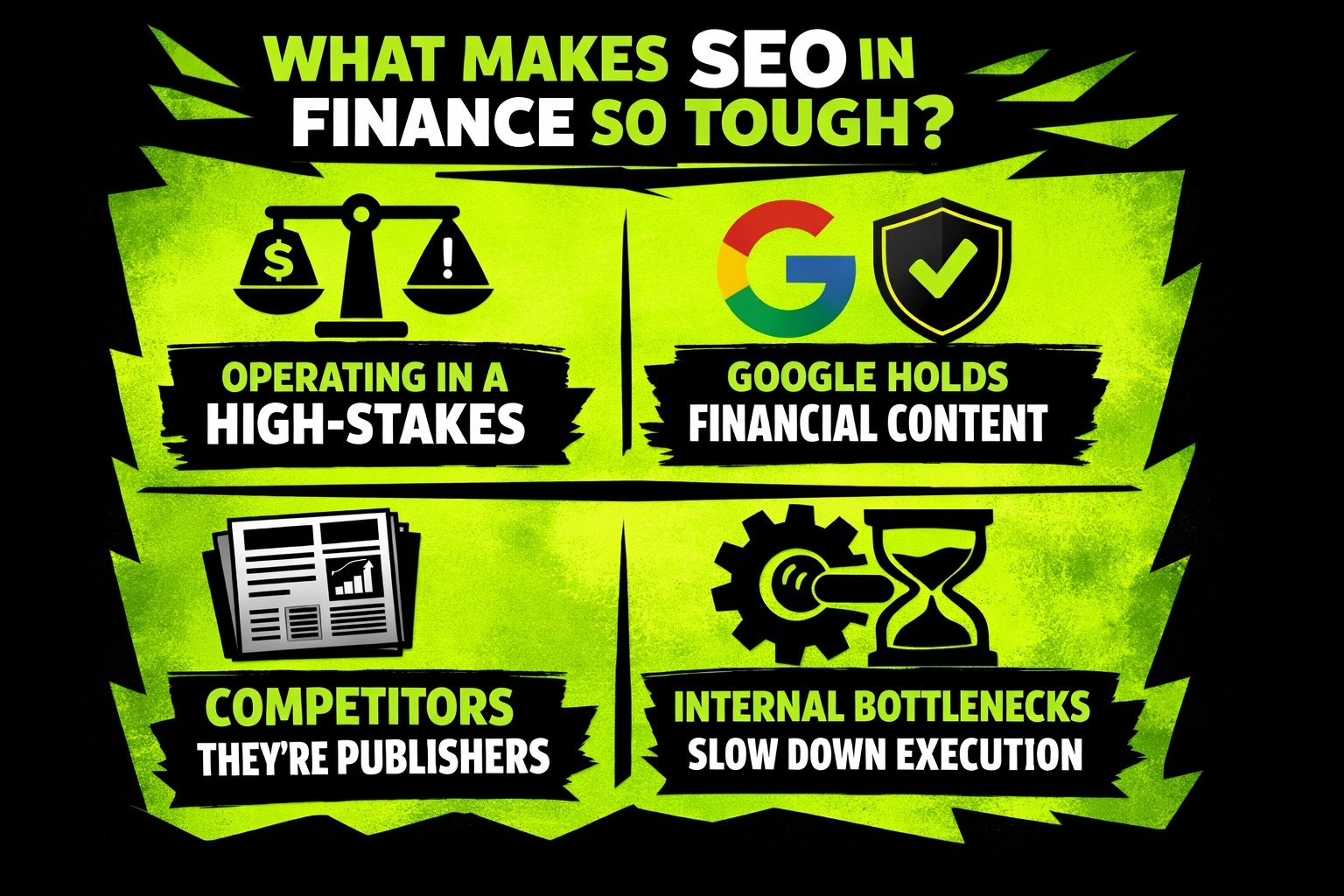
What Makes SEO in Finance So Tough (and Why It’s Worth Doing Anyway)
There’s a reason financial SEO isn’t something most agencies handle well. It’s not just about keywords or content volume – it’s about navigating real-world constraints like legal risk, slow decision cycles, and an unusually high bar for trust. Here’s where things get tricky:
You’re Operating in a High-Stakes, High-Regulation Space
Finance isn’t like SaaS or ecommerce. Every sentence can be audited. Every offer needs a disclaimer. Compliance teams are often gatekeepers, and for good reason. But that also means your SEO strategy needs to work with regulation, not around it.
You can’t publish fluff. You can’t promise outcomes. You have to speak clearly, be transparent, and still rank – without triggering red flags.
Google Holds Financial Content to a Higher Standard
If your website touches anything related to money, loans, taxes, or investments, Google puts it in the YMYL (Your Money or Your Life) category. Translation: your content must show expertise, authoritativeness, and trust. No exceptions.
Thin pages, anonymous blogs, or keyword stuffing? You’ll be filtered out fast. SEO in finance requires depth, credentials, and signals that you know what you’re talking about – and that you’re legally allowed to say it.
Most Competitors Aren’t Other Firms – They’re Publishers
You’re not just fighting for keywords with other banks or advisors. You’re competing with NerdWallet, Investopedia, bankrate.com, and news sites with domain authority that’s off the charts.
That doesn’t mean you give up – it means you go specific. You focus on underserved niches, local intent, and long-tail queries that generic content can’t answer well. You lean into what makes your firm or platform uniquely useful.
Internal Bottlenecks Slow Down Execution
Even with a strong SEO plan, financial companies often get stuck in approval loops. Legal reviews drag. Content takes weeks to clear. And by the time it’s live, the algorithm – or the market – has already shifted.
That’s why process matters. Building a streamlined SEO workflow that includes compliance, sales, and content from the start keeps momentum alive and stops you from shipping content two quarters too late.
Most Sites Aren’t Built to Rank or Convert
Many financial websites are still built like brochures. They’re sleek on the surface but hollow underneath – no clear keyword targeting, weak internal linking, and too much generic language.
Good SEO in finance isn’t about just looking polished. It’s about content architecture, speed, mobile UX, trust signals, and guiding people to real decisions – not just “learn more.”
How to Scale SEO in a Financial Organization
Scaling SEO in finance isn’t about producing more content – it’s about creating a system that works across departments, markets, and legal reviews. That means getting alignment early. Marketing, product, legal, and sales should work from the same roadmap, not separate silos. Build a workflow where keyword planning, approvals, and compliance happen side by side, not in a slow chain of handoffs. Keep everything – from research to publishing – in one shared process to avoid stalling momentum.
It’s also about switching focus from quantity to structure. Most financial sites don’t need hundreds of pages – they need a small number of high-performing assets that stay relevant and drive actual results. Start with core service pages, layer in explainers, and build evergreen tools that support real decision-making. Track what converts, not just what ranks. Once that foundation’s working, you can scale with clarity instead of chaos.
Conclusion
If you’re in finance, you’re in the business of trust. And trust starts long before someone fills out a form or schedules a call – it starts when they Google a question and see your name. That’s where SEO comes in. Not just to rank, but to be found when it actually matters.
The firms getting ahead aren’t chasing trends. They’re building search visibility around real customer intent, layered content strategies, and systems that hold up under regulation. That doesn’t happen overnight, but it scales – if you build it right.