


SEO pricing in 2026 varies widely. Businesses pay anywhere from a few hundred dollars per month for basic local SEO to tens of thousands for enterprise-level national or global campaigns.
The final cost depends on the scope of work, industry competition, website condition, and provider type.
Most outsourced campaigns fall into three main monthly ranges: low, mid-range, or high-end. Lower budgets focus on foundational fixes, while higher ones cover deep technical work, scaled content production, aggressive link building, and optimization for both traditional SERPs and AI-generated answers.
The growing influence of AI search adds another layer of complexity. Providers now spend more time on structured data, semantic clarity, entity signals, and tracking visibility in LLM responses – all of which increase overall costs, especially for brands targeting zero-click features, featured snippets, or AI summaries.
Can You Do SEO for Free?
Yes, in theory – you can handle basic SEO entirely for free using tools like Google Search Console, Google Analytics, free tiers of Ahrefs or Semrush, Google Keyword Planner, and various open-source checkers.
This DIY approach can work for very low-competition local sites, personal blogs, or early idea testing with simple on-page tweaks and manual monitoring.
However, for any serious business goal in 2026 – especially in competitive B2B niches – free SEO quickly hits hard limits. Data is shallow, there’s no capacity for scalable content production or proper link building, AI-search optimization (entities, structured data, LLM visibility) remains weak, and your own time becomes a massive hidden cost. Most projects see quick stagnation after the initial easy wins.
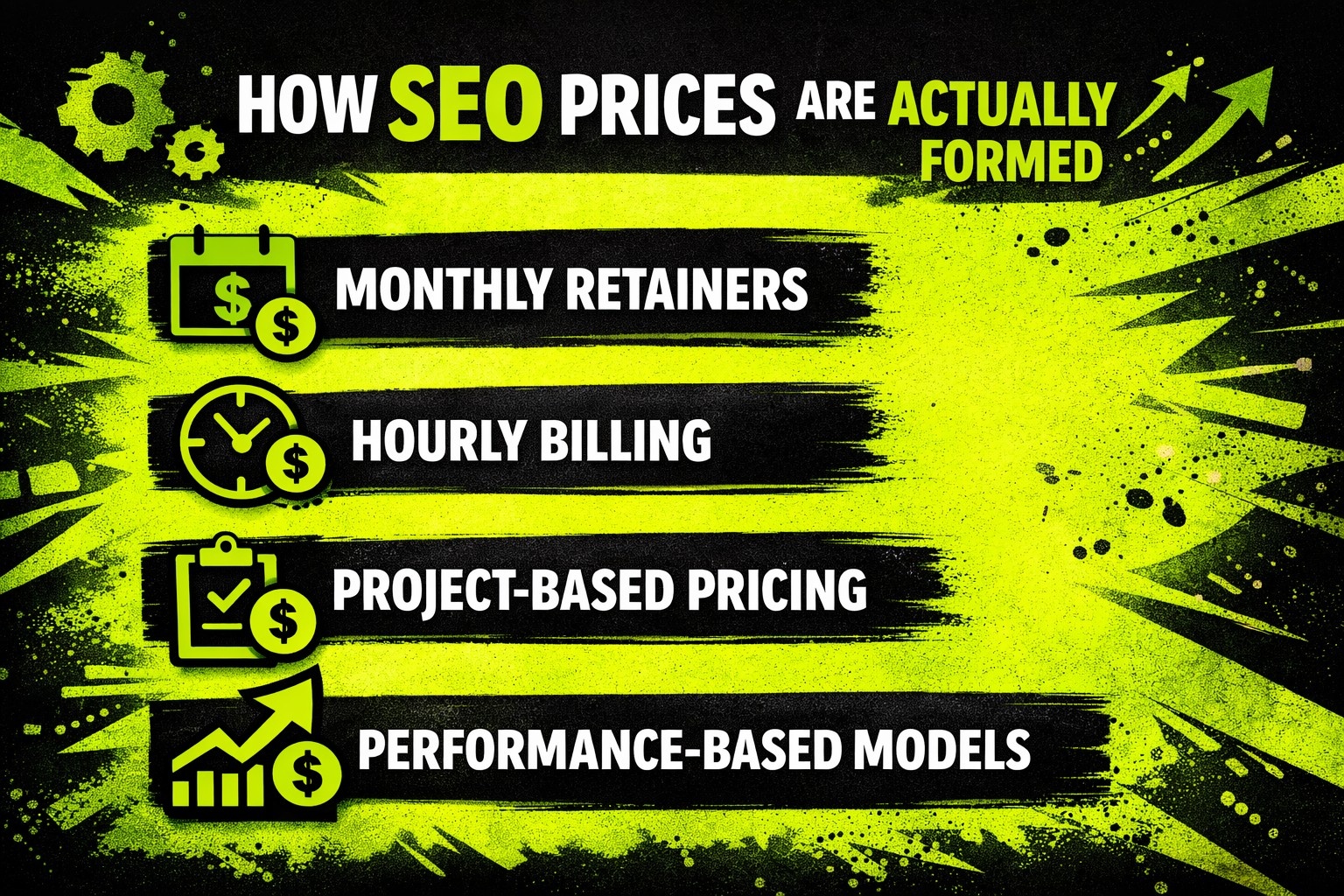
How SEO Prices Are Actually Formed
SEO prices swing widely because every project is different. The same model can cost 3-5× more depending on your niche, site size, competition, goals, and how much senior expertise is involved. Here’s a clearer breakdown of what drives the numbers in each pricing model.
Monthly Retainers ($1,500-$8,000+)
This is the standard ongoing model. The wide range reflects service level:
- Lower end ($1,500-$3,000): basic local work – GBP optimization, citations, simple on-page tweaks, 1-4 articles/month, basic reports. Suits small local businesses or low-competition niches.
- Mid-range ($3,000-$5,000): full technical audit + fixes, content strategy, 4-10 optimized pieces/month, internal linking, quality links (5-15/month), competitive tracking, SERP + AI visibility monitoring.
- Higher end ($5,000-$8,000+): scaled content (10-30+ pieces/month), advanced schema/entity work, aggressive link outreach, CRO testing, multi-channel attribution, dedicated AI answer optimization. Common for e-commerce, SaaS, national B2B.
Hourly Billing ($100-$300/hour, up to $600)
Rates depend on who does the work and how specialized it is:
- $100-$200/hour: junior/mid-level tasks – routine on-page edits, basic audits, citation cleanup, simple content optimization.
- $200-$300/hour: senior strategists or technical experts – Core Web Vitals fixes, crawl budget issues, JavaScript rendering, site migrations.
- $400-$600/hour: top consultants or niche specialists – YMYL industries, international SEO, programmatic setups, AI visibility optimization, high-profile experience.
Project-Based Pricing ($5,000-$30,000)
Fees vary by project size, site complexity, and deliverables:
- $5,000-$10,000: smaller jobs – technical audit + recommendations, on-page for 50-200 pages, basic content overhaul, one-time link audit.
- $10,000-$20,000: medium projects – full migration, large on-page + linking for 500+ pages, content strategy + 10-20 initial pieces, detailed audit with plan.
- $20,000-$30,000+: enterprise work – complete technical overhaul for large e-commerce (thousands of pages), programmatic SEO, deep schema, multilingual audit, full content foundation.
Performance-Based Models
No fixed range – usually lower base retainer ($1,000-$3,000/month) + bonuses or percentage tied to results (traffic, leads, conversions). Effective cost lands in mid-to-high retainer territory, but you pay more only when results show. Requires good analytics and trust, so it’s mostly used in higher-budget setups.
In short, lower prices cover basic, low-competition work with junior time. Higher prices fund full teams, senior specialists, large-scale content, advanced technical fixes, and aggressive growth in competitive spaces. If a quote feels confusing, always ask exactly what deliverables, hours, and seniority are included – it clears things up quickly.
Lengreo: Powerful SEO at Great Value Pricing
At Lengreo we see businesses getting quoted everything from rock-bottom prices to enterprise-level fees for what often sounds like the same services. The catch? Results rarely match the spend when the approach isn’t tailored to the actual business.
We specialize in B2B – software development, IT services, architecture & design, biotech, cybersecurity, sports tech – where leads are expensive and sales cycles long. In these niches cheap, generic packages usually lead to months of flatlining traffic and zero pipeline movement. We’ve watched clients come to us after wasting time and money on low-end providers, then finally start seeing traction once they switched to a properly resourced strategy. Realistic mid-to-upper range budgets have delivered strong outcomes for our clients – more qualified leads, shorter sales cycles, lower cost per acquisition. Those gains came from deep keyword work, high-quality content at scale, clean technical fixes, white-hat links, and AI-visibility optimizations – not shortcuts.
For serious B2B SEO in 2026, the effective price range tends to sit in the mid-to-upper band. That’s enough monthly commitment to fund meaningful progress without paying for unnecessary bloat. We keep our pricing straightforward and competitive for the depth we deliver: transparent, no hidden upsells, focused only on metrics that matter (qualified leads, pipeline growth, real business impact).
If you’re tired of vague quotes and want clarity on what SEO would realistically cost – and deliver – for your specific company, just message us. We’ll review your site, niche, and goals, then give you a straight answer with no sales spin.
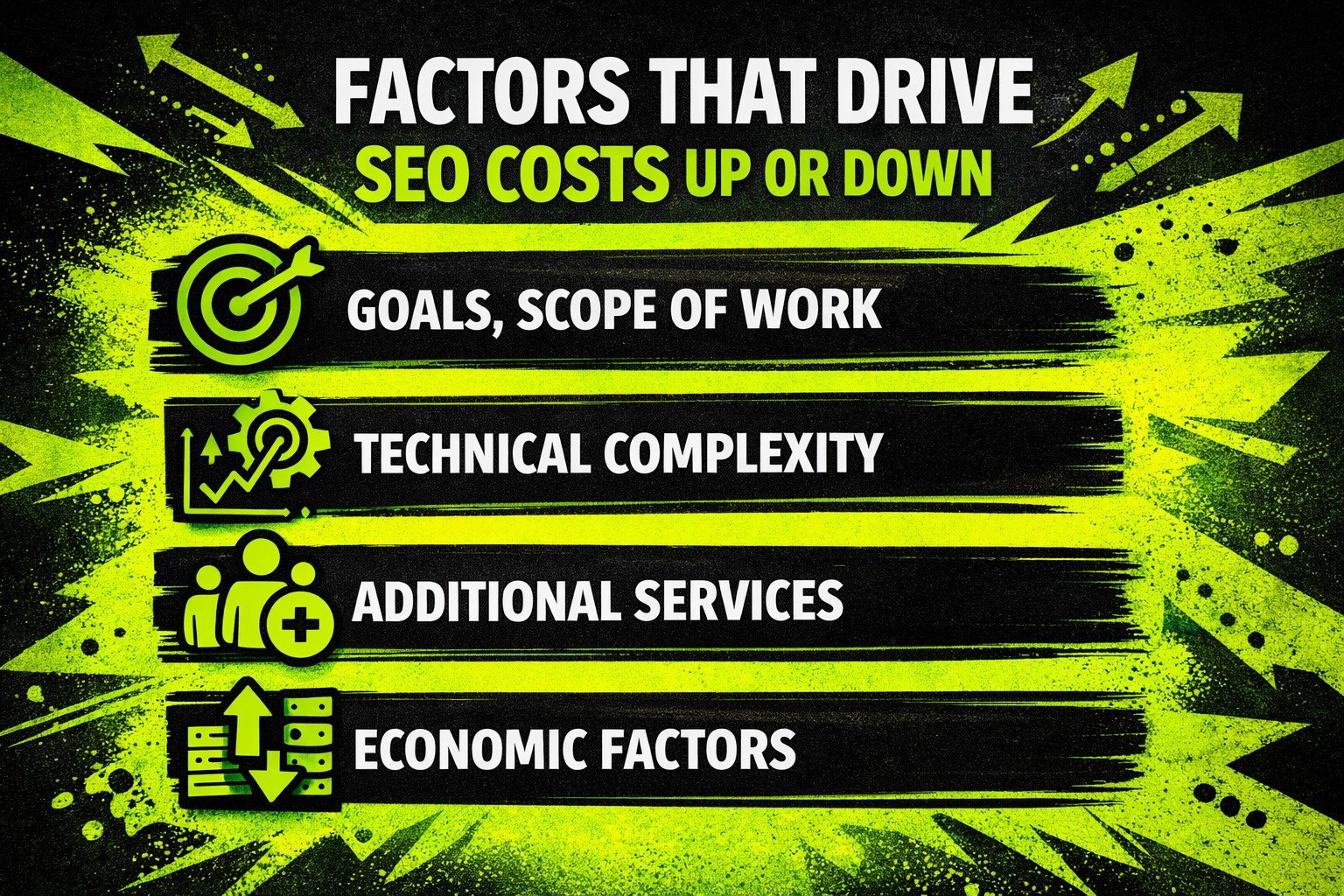
Factors That Drive SEO Costs Up or Down
Several variables determine where a campaign lands on the pricing spectrum. Understanding these factors helps explain why two businesses with similar revenue can receive quotes that differ by tens of thousands of dollars per month.
1. Competition Level in Your Industry
High-commercial-intent sectors (finance, legal, health, insurance, real estate, e-commerce) need more resources: deeper technical work, lots of content, strong backlinks. Ranking takes sustained effort on many terms with constant monitoring. Lower-competition niches allow lighter work and lower costs.
2. Current Technical and Content Condition of the Website
Website condition affects early costs a lot. Modern, fast sites with good crawlability, Core Web Vitals, and solid on-page setup need few fixes. Providers can quickly move to content and links. Sites with technical debt (slow speeds, duplicate/thin content, poor mobile usability, bad schema) require heavy upfront fixes before progress starts.
3. Business Scale and Geographic Targeting
Scale and geography shape the scope. Local campaigns for one city or region have lower keyword volume and simple optimizations (Google Business Profile, citations). National or global strategies need thousands of terms, complex architecture, multilingual elements, strong backlinks. Multi-location businesses add per-location management.
4. Provider Expertise, Experience, and Operational Overhead
Provider expertise impacts rates directly. Specialized agencies with proven results, industry experience, and big teams charge more for lower risk and faster results. High-cost-city agencies have higher overhead than regional ones. Freelancers and overseas providers are cheaper but often have communication or reliability issues.
5. Urgency and Desired Speed of Results
Urgency raises costs. Fast timelines (launches, seasonal peaks, competitive pressure) require parallel work and more hours. Standard 9-18 month timelines allow moderate pacing and lower prices.
6. Goals, Scope of Work, and Keyword Volume
Goals and scope matter a lot. Basic local visibility or few keywords costs less than full strategies with content at scale, link building, CRO, and AI monitoring. More keywords (especially commercial ones) mean more time, content, and optimization – higher fees.
7. Site Size and Technical Complexity
Larger sites cost more. E-commerce with thousands of pages, faceted navigation, or multilingual setups needs programmatic work, crawl budget fixes, duplicate handling. Small brochure sites or blogs require much less effort.
8. Additional Services and Integrations
Extras increase price. High-quality content creation, video SEO, CRO tests, custom dashboards, CRM/GA4 integrations, AI visibility tracking often add separate fees. Premium link building and expert-level articles usually go beyond base retainers.
9. Market and Economic Factors
Market conditions play a role. Rising salaries, tool costs (Ahrefs, Semrush), inflation, and AI infrastructure expenses push average rates higher each year. Providers adjust pricing to cover these while keeping quality.
Local SEO vs E-commerce SEO Pricing Differences
Local and e-commerce campaigns follow different cost patterns because their goals and technical demands diverge.
| Aspect | Local SEO | E-commerce SEO |
| Primary Focus | Proximity-based searches (near me, local intent) | Product visibility, category rankings, large-scale site optimization |
| Typical Monthly Costs | $500 – $3,000 (single-location businesses) | $2,500 – $10,000 (mid-sized stores) $15,000+ (enterprise shops with tens of thousands of SKUs) |
| Scaling Factor | Increases with number of locations (each additional location adds management time) | Increases dramatically with site size, SKU count, and complexity of navigation/filters |
| Main Cost Drivers | Citations, reviews, GBP, local keyword volume | Technical scale, content volume, crawl budget, duplicate issues, programmatic implementation |
Key Optimization Activities
Local SEO providers primarily focus on proximity-based searches: optimizing Google Business Profiles, building and maintaining consistent NAP (Name, Address, Phone) citations across directories, managing and encouraging customer reviews, and targeting location-specific keywords.
E-commerce SEO, in contrast, demands much heavier technical and content investment: optimizing individual product pages, structuring category pages and faceted navigation, implementing large-scale internal linking, resolving thin or duplicate content issues, applying programmatic SEO approaches for large inventories, and continuously monitoring crawl budget and indexation status.
Hidden Costs and Pricing Traps to Watch For
Certain expenses and structural issues catch businesses off guard even after signing a contract.
Here are the most common hidden costs and traps:
- Separate content creation fees: often excluded from the base retainer and charged per word or piece.
- Low-quality link building: cheap providers promise high volumes but use risky networks that can trigger penalties.
- Recurring SEO tool subscriptions: professional platforms add $100-$500+ monthly for tracking and analysis.
- One-time audits without implementation: recommendations stay unused unless follow-up work is budgeted.
- Templated cheap packages under $500/month: deliver generic work with minimal customization and quick stagnation.
- Poor communication overhead: revisions and delays with low-rate providers inflate effective costs.
- Penalty recovery expenses: cleaning up spammy tactics from previous providers can cost $5,000-$20,000+ extra.
Recognizing these early helps set realistic budgets and avoid misleadingly low headline prices.
Conclusion
SEO pricing reflects the complexity of modern search. No universal number fits every business because goals, competition, website condition, and execution quality vary widely. Monthly retainers between $1,500 and $7,500 cover the needs of most small-to-medium companies, while enterprise campaigns regularly climb above $15,000 when scale and aggressiveness increase.
The key lies in matching investment to realistic objectives. Underfunding critical areas such as technical health or content depth produces slow or stalled progress. Overpaying for templated work wastes capital without delivering proportional returns.
Businesses that define clear KPIs, choose providers with relevant experience, and commit to consistent effort over at least 12-18 months generally see the strongest results. Costs fluctuate with market conditions, but the fundamentals – quality execution tied to measurable business outcomes – remain constant.