

Starting an SEO business sounds simple on paper. You learn SEO, build a site, find clients, and grow. In reality, most people get stuck somewhere between “I know how SEO works” and “someone is willing to pay me for it.”
The gap isn’t talent. It’s structure.
SEO businesses fail early not because SEO is dead, but because founders underestimate how much clarity, positioning, and client acquisition matter from day one. Knowing how to rank pages is only part of the job. Knowing who you help, what you sell, and how clients find you is what turns SEO skills into a real business.
This guide breaks down how to start an SEO business step by step, without hype or shortcuts. It focuses on what actually works today: choosing a niche that sells, packaging services clearly, landing your first clients, and building a setup that doesn’t collapse once you’re busy.
Why an SEO Business Still Makes Sense Today
Every few years, someone declares SEO dead. The reasons change, but the prediction stays the same. AI content, zero-click searches, new platforms, changing algorithms. And yet, businesses still fight for visibility where buying intent exists.
Search has not disappeared. It has fragmented.
People still search on Google. They search on YouTube, marketplaces, local maps, and now AI interfaces. That does not reduce the value of SEO. It raises the bar. Businesses no longer want generic optimization. They want clarity, strategy, and results they can tie back to revenue.
This is where opportunity still exists.
Most companies do not want to become SEO experts. They want someone who understands how search connects to traffic, leads, and sales. If you can provide that bridge, there is room for a serious business.
The Difference Between Knowing SEO and Running an SEO Business
This is where many beginners get stuck.
Knowing SEO means you can research keywords, optimize pages, fix technical issues, and build links. Running an SEO business means you can package those skills into something clients understand and value.
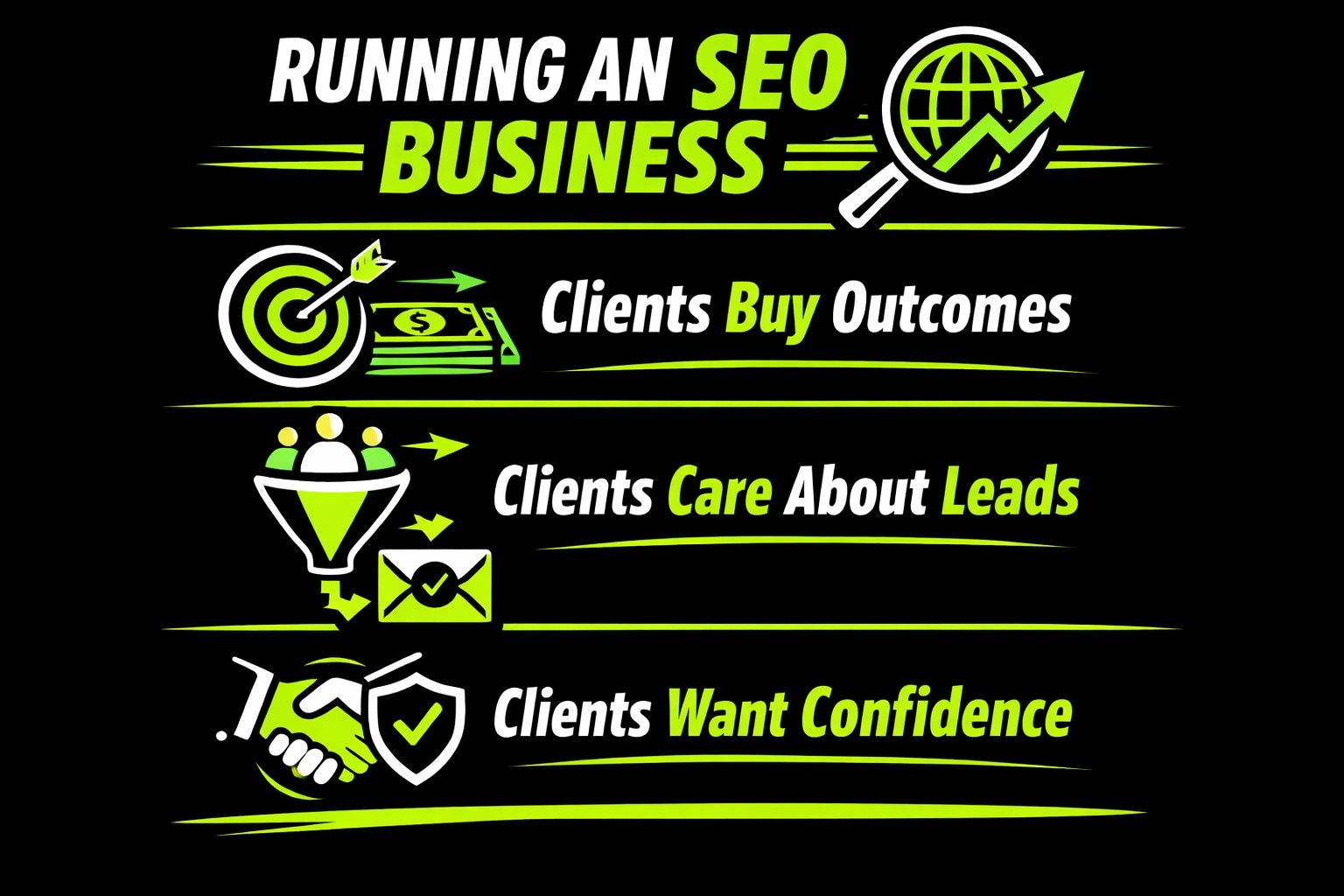
- Clients do not buy audits. They buy outcomes.
- Clients do not care about rankings in isolation. They care about leads, sales, and visibility in the right places.
- Clients do not want complexity. They want confidence.
If you treat SEO as a technical service only, you compete on price. If you treat it as a growth function, you compete on trust.
The goal is not to prove how smart you are. The goal is to remove uncertainty for the client.
How We at Lengreo Turn SEO Into a Scalable Growth Engine
At Lengreo, we approach SEO as part of a wider growth system, not a standalone service. Sustainable results come from connecting search visibility with demand generation, lead qualification, and conversion, not from chasing rankings in isolation. That mindset shapes how we design strategies, choose channels, and measure success for every client we work with.
Instead of relying on pre-built packages, we focus on clarity and execution. We help businesses define where qualified demand comes from, build authority through SEO, and support growth with paid ads, outbound, and conversion-focused improvements when needed. The goal is always the same: predictable pipelines, not vanity metrics.
This approach has allowed us to work as a long-term partner for companies across B2B, SaaS, software development, biotech, and other competitive industries. By integrating into our clients’ teams and taking ownership of outcomes, we turn SEO into a system that compounds over time rather than a set of disconnected tasks.
Building a Sustainable SEO Business: From Positioning to Long-Term Growth
Before tools, branding, or websites, an SEO business lives or dies by clarity. The decisions you make early around focus, services, and delivery shape how easy it is to sell, deliver, and scale later. This framework breaks down the core building blocks that turn SEO skills into a business that lasts.
Step One: Decide What Kind of SEO Business You Are Building
Before tools, branding, or websites, you need a clear decision about your model. This decision shapes everything else.
Full-service or Focused
A full-service SEO agency offers everything. Technical SEO, content, links, reporting, strategy, maybe even CRO.
A focused SEO business does one or two things extremely well.
For beginners, focus wins. It is easier to sell, easier to deliver, and easier to systemize. You can always expand later.
Horizontal or Vertical Specialization
There are two clean ways to specialize.
Horizontal specialization means doing one type of SEO work across many industries. Examples include technical audits, link building, or content strategy.
Vertical specialization means serving one industry or client type with broader SEO support. Examples include SaaS companies, local service businesses, or regulated industries like healthcare.
Both work. What matters is choosing one. Trying to do everything for everyone usually leads to unclear messaging and weak positioning.
Strategy-led or Execution-led
Some SEO businesses sell execution. They do the work efficiently and consistently.
Others sell thinking. They guide strategy, structure, and decision-making, often working closely with internal teams.
You do not have to pick one forever, but you do need to know where you start. Early-stage businesses often benefit from execution-heavy offers because results are easier to demonstrate.
Step Two: Choose Services People Are Willing to Pay For
Not all SEO services are equal in demand or perceived value.
In 2026, businesses actively pay for SEO services that reduce uncertainty or fix problems they do not understand.
High-demand areas include:
- Technical SEO for modern websites and migrations
- Content strategy tied to topical authority
- Local SEO for service businesses
- SEO cleanup after poor AI content usage
- E-E-A-T alignment for regulated niches
- Programmatic SEO for large content sites
Avoid vague service descriptions. Saying you offer on-page SEO means very little to a non-expert.
Clear beats clever every time.
Instead of listing tasks, frame services around outcomes and use cases. Clients want to recognize their own problems in your offer.
Step Three: Package Your Services Clearly
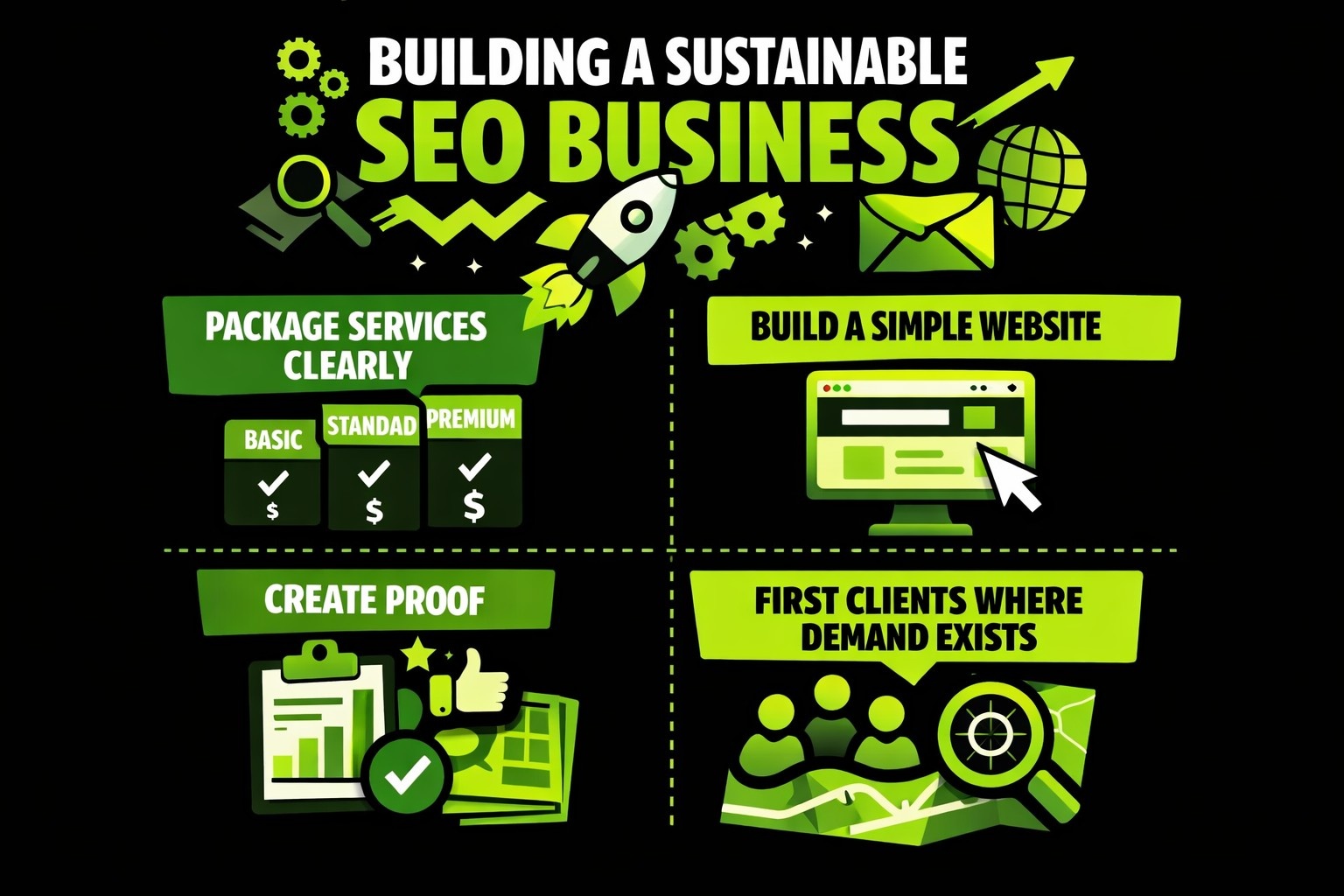
One of the fastest ways to lose a potential client is to overwhelm them with options. SEO businesses often struggle not because their services are weak, but because their offers are hard to understand.
Clear packages make the buying decision easier. They set expectations upfront, simplify sales conversations, protect your time, and make delivery repeatable instead of chaotic. When a client understands exactly what they are getting, why it matters, and how long it takes, trust builds much faster.
A strong package has a defined scope, a clear goal, and a fixed price. It should answer one simple question: what actually happens if we work together over the next few months?
If possible, avoid hourly pricing early on. It pushes clients to judge value based on time spent rather than outcomes achieved and often traps you in constant explanations instead of focusing on results.
Step Four: Build a Simple Website That Sells One Thing
Your website does not need to be perfect. It needs to be understandable.
Early-stage SEO business websites fail because they try to impress other SEOs instead of clients.
Your site should answer five questions clearly:
- Who do you help
- What problem you solve
- How you solve it
- What results look like
- How to start a conversation
You do not need dozens of pages. One strong landing page can outperform a complex site if the message is right.
Social proof matters more than design. Even one real case study or testimonial carries more weight than polished copy with no proof.
Step Five: Create Proof Before You Feel Ready
This step is uncomfortable, but unavoidable. Clients trust results, not promises, and without proof, even strong SEO skills are hard to sell.
If you do not have case studies yet, you need to create them intentionally. That might mean working with early clients at a discounted rate, helping a business in your network, improving your own website, or running small pilot projects with clear goals and timelines. What matters is not how impressive the project looks, but that it shows real work and real outcomes.
Documentation is critical. Track what you did, why you made those decisions, and what changed as a result. This documentation becomes the foundation of your sales process and gives prospects confidence that you know what you are doing.
The goal is not to impress with big claims. It is to remove doubt and make the decision to work with you feel safe.
Step Six: Get Your First Clients Where Demand Already Exists
Many SEO businesses stall because founders wait to be discovered.
Waiting does not work at the beginning.
Your first clients should come from places where people are already looking for help. Platforms, communities, and direct outreach outperform passive strategies early on.
Freelance platforms, professional networks, and direct outreach all work if used intentionally. The mistake is treating them as volume games.
Applying to everything leads to burnout. Targeted outreach with clear positioning leads to conversations.
The goal is not traffic. The goal is dialogue with people who already know they need SEO.
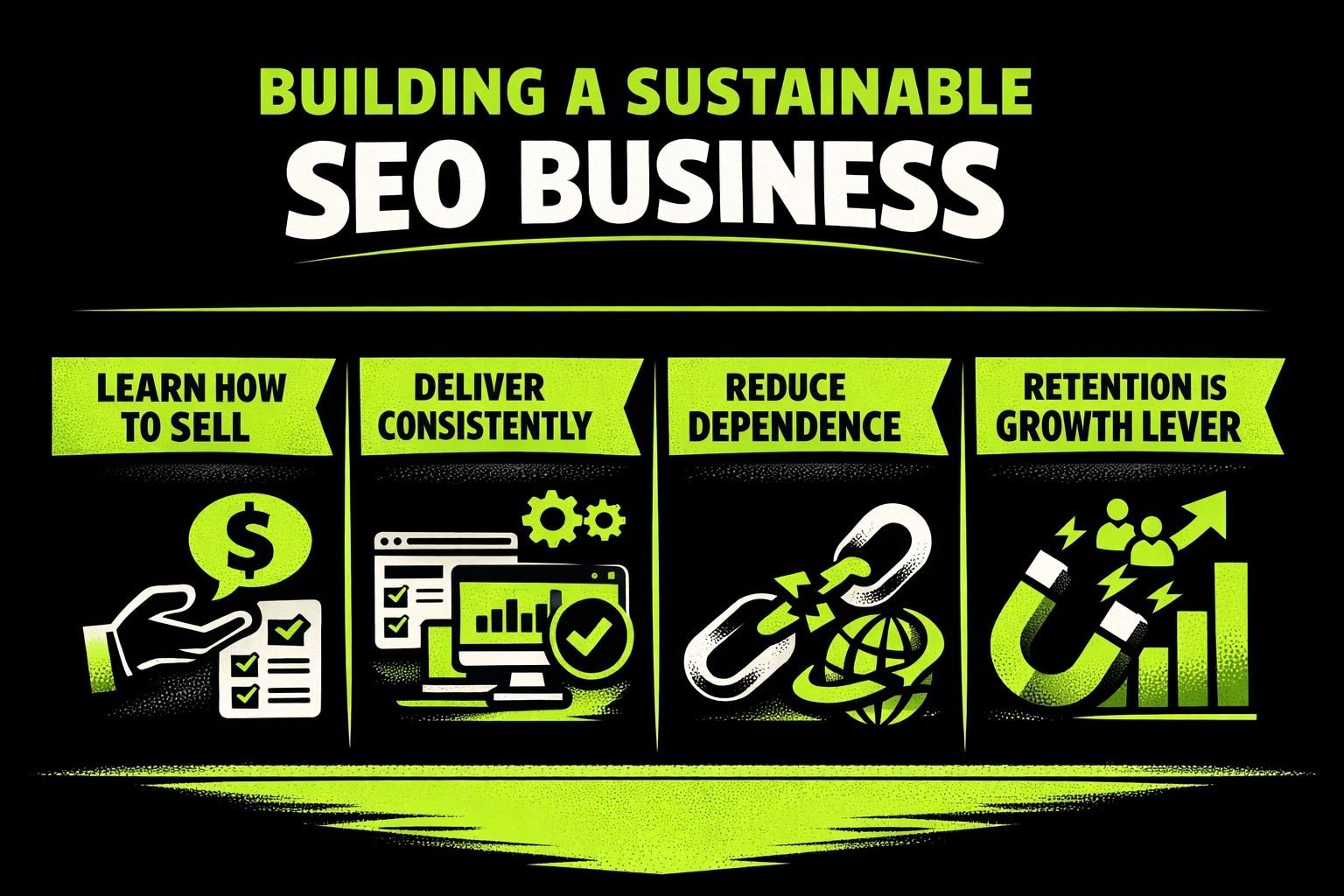
Step Seven: Learn How to Sell Without Sounding Like a Salesperson
Clarity Builds Trust Faster Than Persuasion
Selling SEO is not about convincing someone to believe in search. It is about helping them understand what actually happens when they invest in it. Most prospects are not skeptical because they dislike SEO. They are skeptical because they have tried it before and were disappointed by vague promises or unclear work.
Your role is to replace uncertainty with clarity, not to push for a yes.
Set Expectations Before You Talk About Tactics
Strong SEO sales conversations start with boundaries. Instead of promising outcomes you cannot control, explain what is realistic, what takes time, what can be influenced, and where risk exists. When prospects understand these limits early, they are far more likely to trust you long term.
Overly aggressive forecasts may close a deal faster, but they usually shorten the relationship. Clear expectations do the opposite.
Shift the Conversation From SEO Tasks to Business Impact
Most clients do not care about tactics in isolation. They care about what those tactics change in their business. A good sales conversation focuses less on keyword lists and audits and more on how SEO connects to leads, revenue, and visibility in the right places.
Ask better questions. Listen more than you speak. Treat the conversation like problem-solving, not pitching. When clients feel understood, selling becomes a natural outcome rather than a forced one.
Step Eight: Deliver Consistently Before You Scale
Growth too early can destroy a young SEO business.
Before hiring, outsourcing, or expanding services, you need repeatable delivery. That means doing the same type of work multiple times and refining the process.
Standardize what can be standardized. Templates, checklists, reporting formats, workflows.
Consistency builds confidence. Confidence builds referrals.
Do not scale chaos.
Step Nine: Build Systems That Reduce Dependence on You
Sustainability is not about working harder. It is about reducing friction.
If everything depends on you, growth becomes a threat instead of an opportunity.
Systems to focus on early:
- Project management
- Reporting
- Communication cadence
- Lead intake and qualification
- Documentation
Even simple systems outperform none at all. The goal is not perfection. The goal is predictability.
Step Ten: Retention Is the Real Growth Lever
Most SEO businesses focus too heavily on acquisition and not enough on retention. That imbalance creates constant pressure to replace clients instead of building momentum.
Long-term clients change everything. They smooth cash flow, reduce sales stress, and generate referrals that are far easier to close than cold leads. Retention improves when expectations are set early, progress is communicated clearly, and wins are framed in business terms rather than technical metrics. Clients stay when they understand what is happening and why it matters.
SEO moves slowly by nature. Clear, consistent communication fills the gap between action and results and keeps trust intact while the work compounds.
Common Mistakes That Kill SEO Businesses Early
Some mistakes show up again and again in early-stage SEO businesses. On their own, they may seem manageable. Together, they often create problems that are hard to recover from.
- Overpromising results you cannot guarantee. Promising specific rankings or timelines might win a deal, but it usually destroys trust when reality sets in. SEO is influenced by many factors outside your control, and honest expectations matter more than bold claims.
- Underpricing out of fear. Many founders charge too little because they worry about losing deals. Low pricing attracts the wrong clients, leaves no room for proper delivery, and makes scaling nearly impossible.
- Trying to serve everyone. Broad positioning feels safe, but it often leads to weak messaging and constant context switching. Clear focus makes selling easier and delivery stronger.
- Ignoring sales skills. SEO expertise alone does not bring clients. Without learning how to communicate value, qualify prospects, and run clear sales conversations, even great work goes unseen.
- Neglecting documentation. Without documented processes, reporting, and decisions, delivery becomes inconsistent and hard to explain. Documentation is what turns individual effort into a repeatable business.
- Scaling delivery before stabilizing quality. Hiring or outsourcing too early magnifies problems instead of solving them. Growth should come after consistency, not before it.
None of these mistakes are fatal in isolation. When several happen at the same time, they usually are.
Final Thoughts
Starting an SEO business is not about being the best SEO in the room. It is about being the most useful partner for a specific group of clients.
If you focus on clarity over cleverness, systems over shortcuts, and trust over hype, SEO can become more than a service. It can become a durable business.
The work is real. The learning curve is steep. But the opportunity is still very much alive for those willing to build it properly.