


When someone types “cafe near me” or asks their phone where to get a haircut in town, they’re not browsing – they’re ready to act. Local SEO is what puts one business in front of that intent, while others disappear from the radar. It connects the dots between online search and real-world action, whether that means a visit, a phone call, or a new booking. For any business that operates in a specific location – or wants to be discovered by people nearby – local visibility isn’t optional anymore. It’s a channel that directly ties digital presence to physical outcomes.
What Local SEO Actually Impacts (with Data)
Local SEO has a direct line to real-world behavior. It’s what determines whether someone sees a business when they search “best sushi near me” or scrolls past entirely. According to Google, nearly half of all searches have local intent – and 76% of people who run a local search on their phone end up visiting a business within a day. For service providers, restaurants, clinics, studios – anything with a physical or regional footprint – that window is everything.
But visibility alone doesn’t close the loop. Local SEO also shapes perception. A complete and regularly updated Google Business Profile makes users almost three times more likely to view a business as reputable. That means photos, hours, reviews, and even the tone of responses all feed into whether someone picks up the phone or walks through the door. And because most users don’t scroll past the first page, local ranking isn’t just nice to have – it’s how the decision gets made.
The feedback loop is clear: stronger visibility leads to more actions, which leads to more signals (calls, reviews, visits) that reinforce trust and improve rankings further. But it only works if a business shows up in the right places to begin with. That’s where the real weight of local SEO lives – not in theory, but in actual movement.
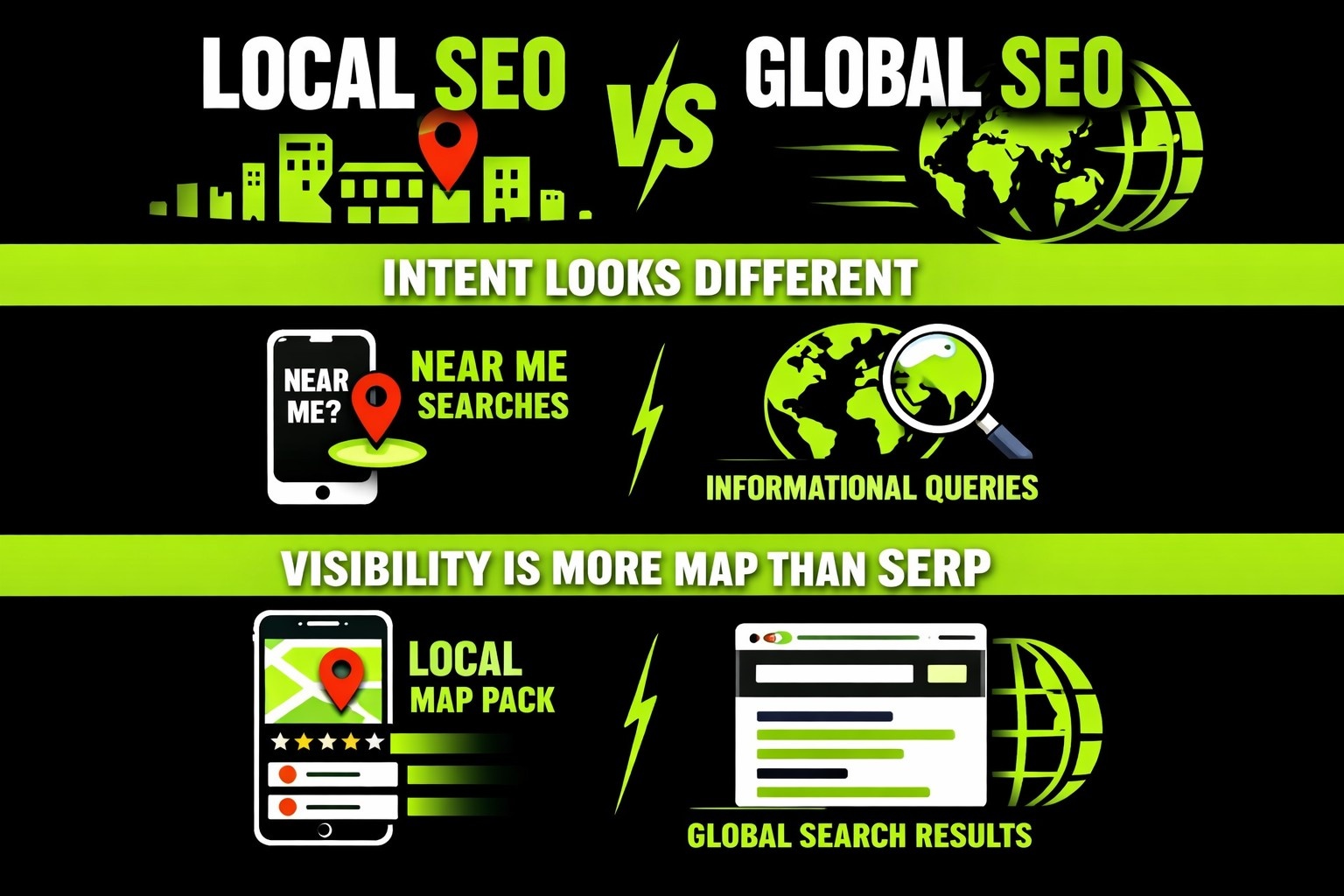
Local SEO vs Global SEO – Different Game, Different Rules
Not all SEO works the same way. Ranking nationally and ranking in your neighborhood are two very different conversations. One’s about reach. The other’s about timing and proximity. And if the goal is to be found by people nearby who are ready to act, global tactics won’t get the job done.
Intent Looks Different
Global SEO often casts a wide net. It goes after traffic at scale – informational keywords, long-form content, top-of-funnel plays. That works for SaaS platforms, online marketplaces, and brands selling across borders. But local searches carry different intent. When someone types “electrician in Dublin” or “urgent care near me,” they’re not reading blog posts. They’re trying to make a decision, fast.
That shift in intent changes everything. The searcher isn’t browsing – they’re choosing. Local SEO responds to that by prioritizing proximity, relevance, and availability, not just domain authority or backlink volume.
Visibility Is More Map Than SERP
In global SEO, page one is the main prize. In local SEO, it’s the map pack. Showing up in that cluster of three results (with ratings, hours, location) puts a business directly in the user’s line of sight. That kind of placement doesn’t come from generic blog traffic or a solid DR score – it comes from local signals that actually match how people search:
- A complete and active Google Business Profile
- Recent reviews that show ongoing customer interaction
- Clean and consistent NAP data across the web
- Location-specific relevance based on the searcher’s proximity
Local visibility is shaped by these practical inputs – not abstract ranking formulas. And when they’re missing, businesses get filtered out before they even have a chance to compete.
Inside Lengreo’s Approach to Scalable, Location-Focused SEO
At Lengreo, we don’t just advise on local SEO – we take ownership of it. Our team builds and runs location-focused strategies that drive real visibility and lead quality. From keywords to content to GBP optimization, everything is based on how people actually search – not just what the tools recommend.
Our team starts by looking at what’s already visible and where it breaks down. That usually includes location-level audits, search intent analysis, and cleaning up gaps between pages, listings, and reviews. For businesses operating in multiple regions, each location is handled as its own entity, with separate pages and signals instead of a single generic setup.
We also share how this work comes together on LinkedIn and Instagram, where Lengreo publishes case studies, performance outcomes, and practical insights from ongoing projects. Local SEO is never treated in isolation – it’s built to support the wider growth strategy clients rely on us for.
Key Components of a Strong Local SEO Strategy
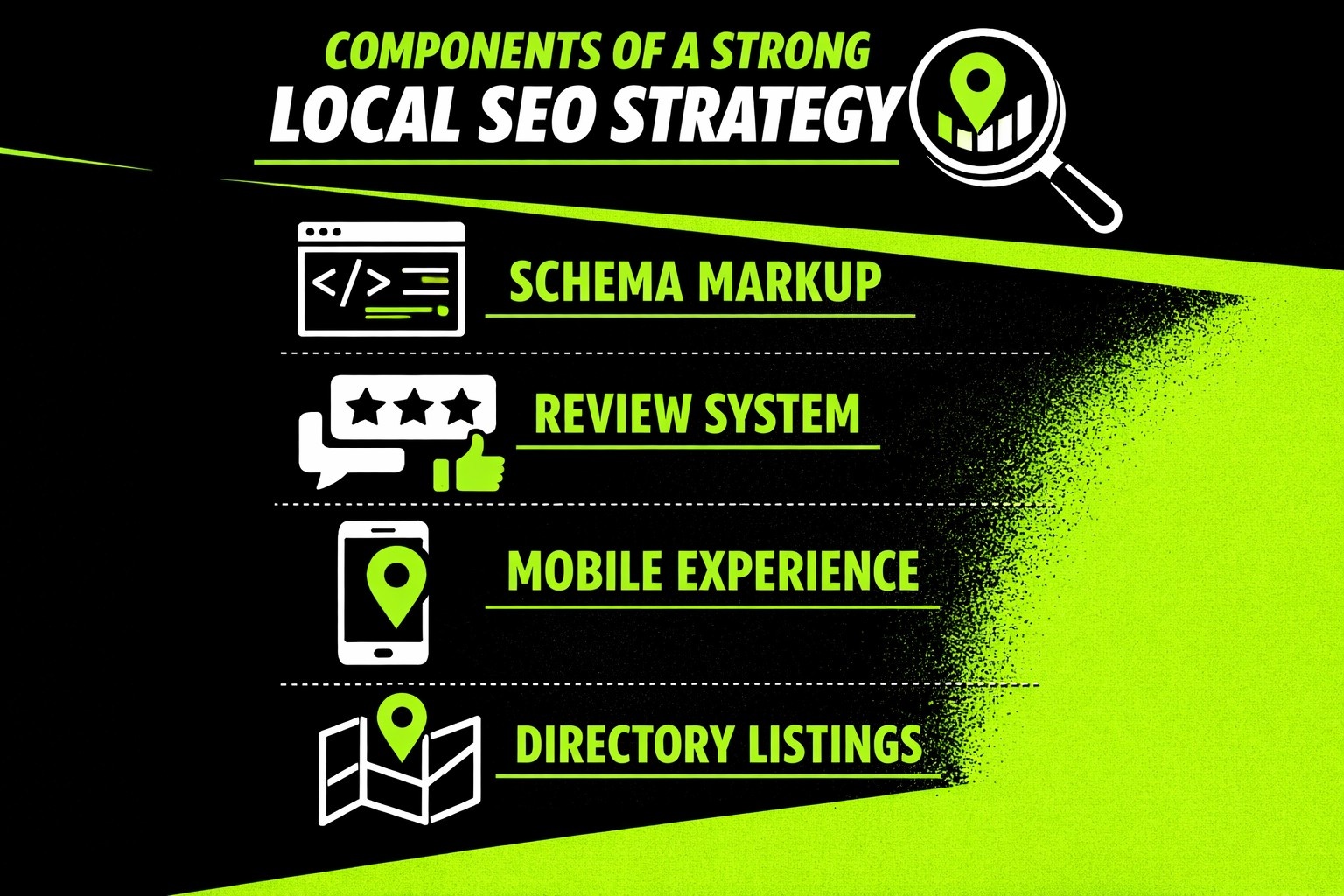
There’s no magic switch for local SEO. It’s a mix of visibility, consistency, and user trust – built up through a few specific layers that work together. Here’s what those layers actually look like when done right.
1. A Properly Set Up Google Business Profile
Most local journeys begin (and end) with a Google Business Profile. If the listing is incomplete, outdated, or inactive, it’s game over. A solid GBP includes accurate hours, location, contact info, services, and recent photos. Posts help too – Google sees them as signals of a live, responsive business. So do customers.
2. Location Pages That Actually Speak to the Area
If the business operates in more than one city or region, each location deserves its own page. That page shouldn’t be a copy-paste job either – it should mention local landmarks, include customer reviews from that area, and reflect services available at that location. This helps Google understand where the business operates, and it gives potential customers something they can actually relate to.
3. Clean, Consistent NAP Signals
Name, address, phone. It sounds basic, but inconsistent NAP data across directories and platforms is still one of the most common problems holding back local rankings. If the footer says one thing, Yelp says another, and Apple Maps says something else – Google isn’t going to reward that confusion.
4. Hyperlocal Keyword Strategy
It’s not just about ranking for “coffee shop.” It’s about showing up for “coffee shop near Lafayette Square” or “coffee open late in Kreuzberg.” That’s where conversion happens – at the intersection of intent and location. This requires ongoing keyword research, not one-time guesses.
5. Schema Markup That Helps Google Understand the Basics
Structured data isn’t exciting, but it matters. Schema markup makes it easier for search engines to pull out key details – business hours, location, reviews – and display them in rich results. It won’t drive rankings on its own, but it does reduce friction.
6. A Review System That’s Actively Managed
Reviews influence both rankings and decision-making. A profile with 40 reviews from last month will almost always outperform one with a handful from two years ago. Ask for reviews after purchases or visits, respond to them publicly (even the tough ones), and treat it like part of the marketing process – not an afterthought.
7. Mobile Experience That Doesn’t Drop the Ball
Most local searches happen on phones. If the site loads slowly, is hard to navigate, or doesn’t clearly show how to get in touch, users bounce and Google factors that into its ranking signals. Responsive design and page speed aren’t optional anymore.
8. Directory Listings That Are Worth the Time
Being listed on Yelp, Apple Maps, Bing Places, and relevant industry directories still matters – if it’s done with care. It’s not about dumping info across hundreds of platforms. It’s about being findable, accurate, and consistent on the ones that count.
Local SEO doesn’t reward shortcuts. It rewards businesses that show up where people look, with the right info, at the right moment. The brands that treat these components as part of their core infrastructure – not just marketing extras – tend to be the ones that stay ahead.
Measuring Local SEO Success
Visibility is good. But without some way to gauge what’s actually working, it’s easy to waste time chasing the wrong signals. Local SEO success isn’t just about rankings – it’s about actions tied to real-world outcomes. Here’s what’s worth watching.
- Search visibility in local pack and Google Maps: If the business isn’t showing up in the map results for its priority keywords, that’s a clear gap. These top spots drive the bulk of local clicks – everything below gets filtered out fast.
- Clicks and actions from the Google Business Profile: Things like “call now,” “get directions,” or clicks to the website show real user intent. Rising numbers here usually point to stronger presence and better positioning.
- Quality of local traffic in Google Analytics: Traffic volume matters, but engagement tells the deeper story. If local users are bouncing, not converting, or dropping off early, something’s misaligned – either the message or the targeting.
- Steady review activity: A healthy flow of recent reviews shows that customers are finding the business and engaging. Long gaps or sudden drop-offs might signal a visibility issue – or just a missed opportunity to ask.
Track those, and you’ll start to see what’s actually moving the needle. Everything else is just background noise.
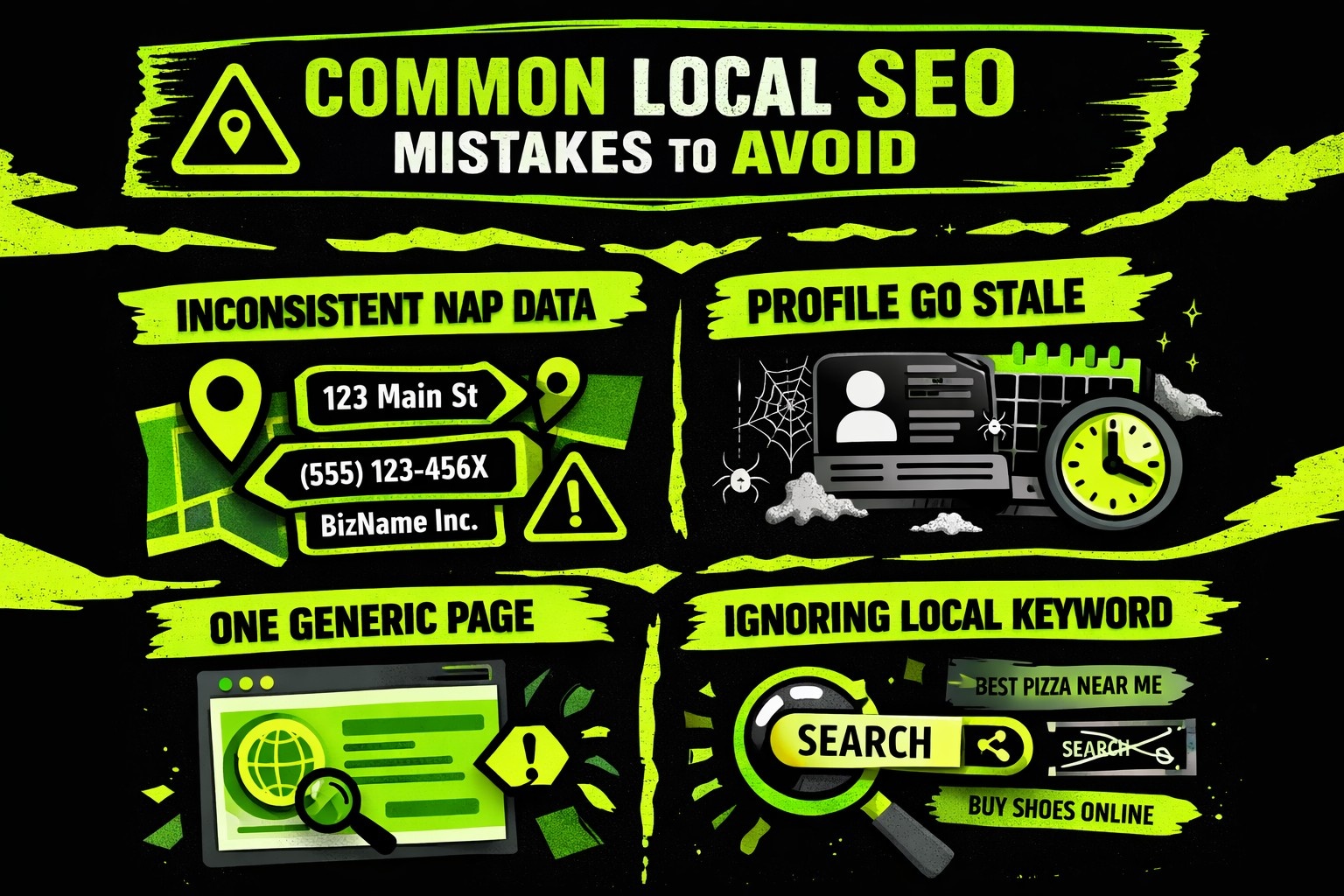
Common Local SEO Mistakes to Avoid
Most local SEO issues aren’t technical. They usually come from inconsistent execution or things getting overlooked along the way. These are the areas where businesses most often lose visibility without realizing it.
1. Inconsistent NAP Data Across Platforms
Search engines rely heavily on trust signals. When a business lists its name, address, or phone number differently on the website, Google Business Profile, and directories, that trust erodes. Even small mismatches can hold rankings back. NAP data needs to be identical everywhere.
2. Letting the Google Business Profile Go Stale
Claiming a profile is only the starting point. Profiles that aren’t updated slowly lose ground. Regular posts, fresh photos, updated hours, and timely responses to reviews all signal that the business is active. When those signals disappear, visibility usually follows.
3. Using One Generic Page for Multiple Locations
A single catch-all locations page rarely works for businesses with more than one address. Each location needs its own page with real, location-specific content. Without that clarity, search engines struggle to match the business with local searches.
4. Ignoring Local Keyword Variations
Broad keywords might look attractive, but they rarely convert at the local level. People search with geography in mind – cities, neighborhoods, even landmarks. If the site doesn’t reflect how users phrase those searches, it won’t show up when it matters.
5. Only Responding to Negative Reviews
Silence on positive reviews sends the wrong message. Consistent engagement – thanking customers, addressing concerns, staying present – builds trust with both users and search engines. Review activity plays a larger role in local visibility than many expect.
Who Actually Benefits Most From Local SEO
Local SEO isn’t for everyone. But for businesses that depend on being found by nearby customers or clients, it’s one of the few digital channels that directly maps to real-world outcomes. These are the kinds of businesses that tend to see the biggest impact:
- Service providers tied to geography: Think plumbers, electricians, dental clinics, physiotherapists. If someone needs help and wants it fast, they’re typing “near me” or “[city] + service.” That’s exactly where local SEO delivers.
- Brick-and-mortar locations that rely on foot traffic: Cafés, hair salons, gyms, mechanics – any business that needs people to show up in person. Getting found on Google Maps isn’t just visibility here, it’s the literal route to the door.
- Multi-location businesses: Chains or franchises that operate in more than one city or neighborhood benefit from location-specific pages, GBP listings, and targeted reviews. Each branch needs its own presence, not just a shared homepage.
- Specialized local retailers competing with larger brands: Independent bookstores, niche fashion shops, boutique liquor stores – these don’t win on volume, they win on relevance. Local SEO helps them show up when someone nearby wants what they offer, right now.
- B2B companies with defined service areas: Agencies, consultants, or tech providers that don’t serve “everyone, everywhere” but do work with clients in specific cities or regions. Showing up in local intent searches builds trust faster than cold outreach ever could.
Local SEO isn’t a traffic play – it’s a relevance play. And for businesses with a local footprint, it’s often the shortest line between online discovery and a real customer.
Conclusion
Local SEO isn’t just another marketing lever. It’s one of the few areas where small businesses, niche providers, and local operators can compete head-to-head with big players – and win. When someone pulls out their phone and searches for a service nearby, that’s not curiosity. That’s intent. Showing up in that moment is what drives real leads, real bookings, and real conversations.
The strategies themselves aren’t complicated – but they do require consistency, attention to detail, and a clear understanding of how search behavior works on a local level. Businesses that treat local SEO as an ongoing system, not a one-off checklist, tend to rise above the noise. Because in the end, it’s not about traffic. It’s about showing up where people are already looking – and giving them a reason to act.