


If you’ve been looking into SEO in the UK, you’ve probably noticed something odd. Everyone talks about results, rankings, and long-term growth, but when it comes to price, the answers get vague fast. One agency says it starts at a few hundred pounds. Another won’t even talk numbers until after a call.
That’s not because SEO pricing is secret. It’s because it’s messy.
SEO isn’t a fixed service you can price off a menu. The cost depends on what shape your website is in, how competitive your market is, and how ambitious your goals really are. A local service business and a national SaaS company might both “need SEO,” but they won’t need the same amount of work, or budget.
This article breaks down what SEO actually costs in the UK, why the numbers vary so much, and what those prices usually include. No sales pitch. Just a realistic look at what businesses are paying today and why.
The Short Answer: Typical SEO Costs in the UK
Let’s start with real-world ranges. These are not promises or packages. They are averages based on how UK SEO services are commonly priced.
For most businesses, monthly SEO costs fall into these broad brackets:
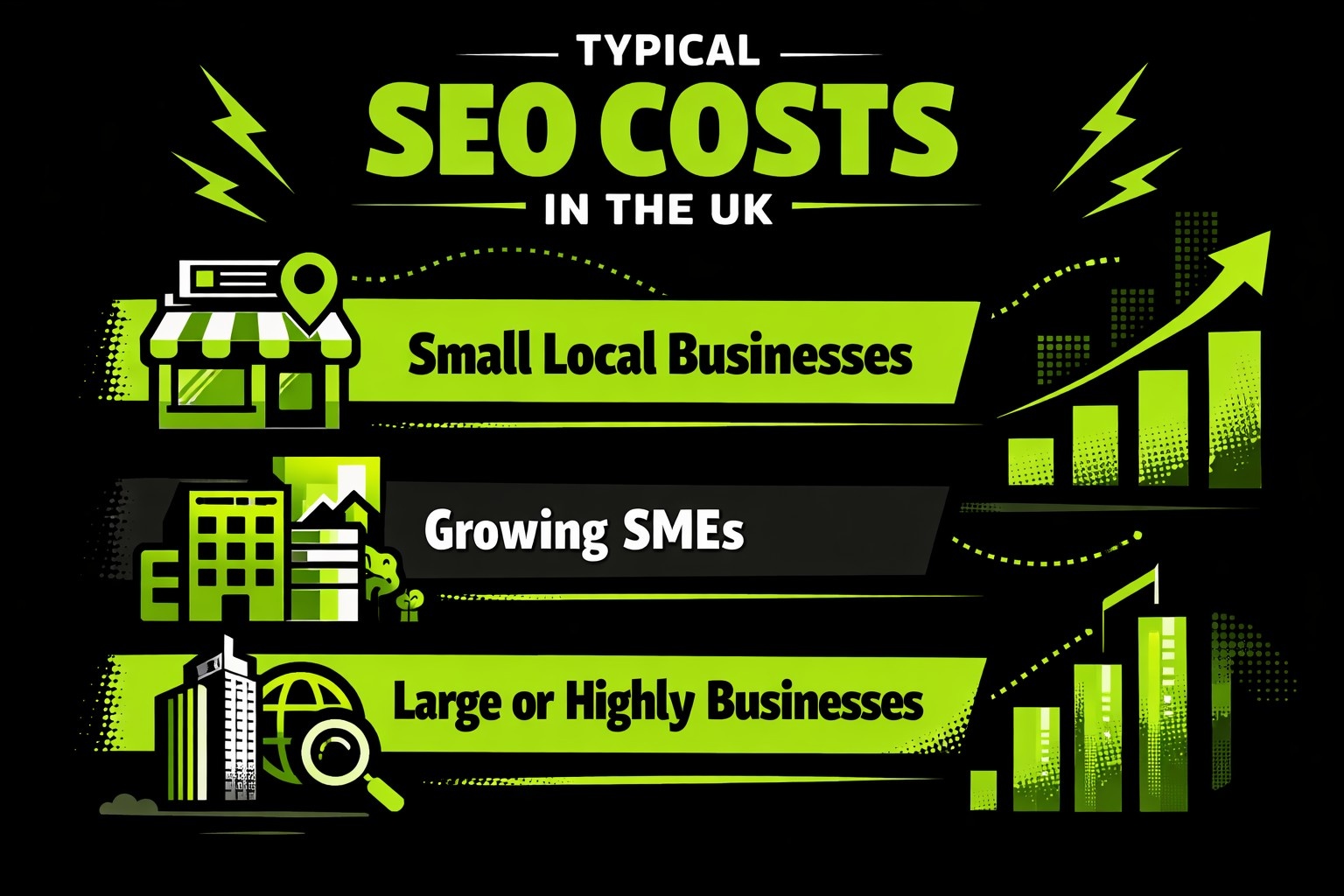
- Small local businesses: £500 to £1,500 per month
- Growing SMEs: £1,500 to £5,000 per month
- Large or highly competitive businesses: £5,000 to £10,000+ per month
You will see cheaper offers and more expensive retainers, but these ranges cover the majority of legitimate SEO engagements in the UK.
If someone quotes far below this and promises big results, caution is justified. If someone quotes far above it, they should be able to clearly explain why.
Why SEO Has No Fixed Price
SEO pricing is variable because the work itself is variable. There is no single checklist that applies to every business, and no two websites start from the same place.
Two companies can both say they need SEO and mean entirely different things. A five-page brochure site trying to attract customers in one town is solving a very different problem than a thousand-page ecommerce store competing nationally or internationally. The first might need basic optimisation and local visibility. The second needs ongoing technical work, large-scale content, and authority building just to stay competitive.
The scope also changes over time. Early SEO work often focuses on fixing issues and building foundations. Later, the effort shifts toward expansion, refinement, and defending positions against competitors who are actively investing as well. That evolving workload makes fixed pricing unrealistic.
Several factors shape the cost, including the current state of the website, how competitive the industry is, how wide the target market is, and how fast the business expects results. SEO pricing reflects that reality. It is not about selling a standard service, but about matching effort to ambition.
Your Website’s Current State
The starting point matters more than many people expect.
If your website is technically sound, loads quickly, and already has some search visibility, SEO work can focus on refinement and growth. If your site is slow, poorly structured, or built on outdated templates, a large part of the budget may go into fixing foundations before growth is even possible.
Older websites often come with technical debt. Broken links, duplicate content, bloated plugins, and messy page structures all take time to untangle. That time translates directly into cost.
Industry Competition
Competition is one of the biggest cost drivers.
Ranking for a local service in a small town is usually cheaper than ranking nationally for finance, legal services, SaaS, or ecommerce products. In competitive industries, your competitors are already investing heavily. Matching or outperforming them requires consistent work over time.
This is why SEO costs are not evenly distributed across industries. It is not about fairness. It is about effort.
Geographic Scope
SEO pricing changes depending on where you want visibility.
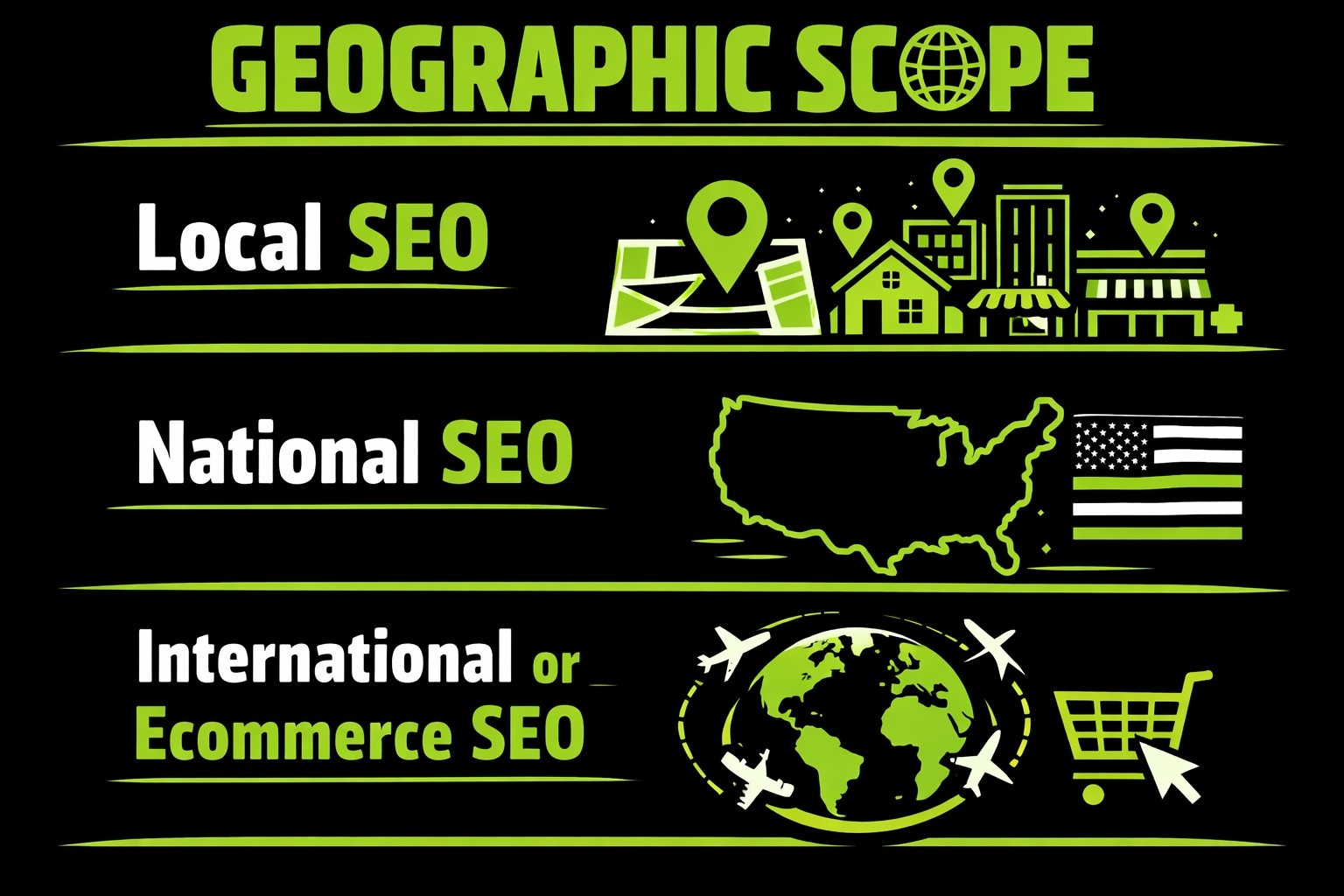
- Local SEO typically costs less because the scope is smaller
- National SEO requires more content, stronger authority, and broader coverage
- International or ecommerce SEO demands even more resources
Trying to target too much too early is one of the most common mistakes businesses make. It often inflates costs without delivering results.
Business Goals and Expectations
What you want from SEO matters just as much as where your website is starting from. Two businesses with similar sites can end up with very different SEO costs simply because they expect different outcomes.
Some businesses are comfortable with steady, incremental growth. They want consistent improvements in visibility, more qualified traffic over time, and results that compound gradually. This approach usually allows for more controlled spending and lower risk.
Others want to dominate search results as quickly as possible. They may be entering a competitive market, launching a new product, or trying to overtake established competitors. That level of ambition demands more aggressive strategies, more content, and more ongoing work, which naturally pushes costs higher. It also comes with greater uncertainty, because SEO does not move in straight lines.
Clear, realistic goals help align effort with budget. When expectations are grounded in how SEO actually works, pricing tends to be more transparent, strategies are easier to prioritise, and results are more sustainable in the long run.
Common SEO Pricing Models in the UK
SEO providers in the UK usually charge using one of several models. Each has strengths and limitations.
Monthly Retainers
This is the most common approach.
A monthly retainer covers ongoing SEO work such as technical improvements, content creation, optimisation, reporting, and strategy updates. Prices typically range from £1,000 to £5,000+ per month depending on scope.
Retainers work well because SEO is not a one-time task. It requires continuity. Results tend to improve as momentum builds.
One-Time SEO Projects
Some businesses prefer a defined project.
This could include an SEO audit, a technical overhaul, or a content restructure. One-off projects usually cost between £1,000 and £20,000 depending on complexity.
They can be useful as a starting point, but on their own they rarely deliver long-term growth.
Hourly SEO Work
Hourly pricing is less common but still used by consultants and freelancers.
Rates vary widely, often from £75 to £200+ per hour. Hourly work can make sense for short-term advice or specific issues, but it is harder to budget and rarely ideal for sustained SEO growth.
Performance-Based Pricing
This model sounds attractive but is rare for good reason.
SEO performance is influenced by many factors outside a provider’s control, including competitors, algorithm updates, and market changes. True performance-based SEO often relies on narrow definitions of success that do not align with business value.
What SEO Costs Include in Practice
SEO is often misunderstood as a single activity. In reality, it is a collection of ongoing tasks.
A typical SEO engagement may include:
- Technical SEO fixes
- Keyword and intent research
- On-page optimisation
- Content planning and creation
- Internal linking improvements
- Link acquisition and digital PR
- Local SEO management
- Reporting and analysis
Not every business needs all of these at once. Good SEO work prioritises based on impact.

SEO Costs by Business Size and Growth Stage
Small Businesses and Local Services
Small businesses often assume SEO is out of reach, but that is not always true. For local companies, SEO budgets in the range of £500 to £1,500 per month can be effective when expectations are realistic and the scope is focused.
Local search relies less on raw authority and more on relevance, consistency, and proximity. A well-optimised site, accurate business listings, and locally relevant content can go a long way without massive spending. For many service-based businesses, this level of SEO is enough to generate steady enquiries.
That said, extremely low budgets tend to slow progress to a crawl. SEO takes time and expertise, even at a local level. There is a minimum level of effort below which results become sporadic or negligible, regardless of how small the business is.
SMEs and Growing Companies
This is where SEO often delivers its strongest returns. As businesses move beyond basic visibility and start competing more actively, the scope of work naturally expands.
Budgets between £1,500 and £5,000 per month usually allow for consistent content creation, ongoing technical maintenance, and deliberate authority building. For many SMEs, this supports predictable lead generation, stronger brand presence, and measurable growth over time.
At this stage, SEO shifts from fixing issues to scaling what already works. The focus becomes expansion, optimisation, and staying ahead of competitors who are also investing in search.
Enterprise and Highly Competitive SEO
For large organisations, SEO is rarely inexpensive. Enterprise-level SEO often involves complex websites, multiple decision-makers, legacy systems, and intense competition across many keywords and markets.
Budgets of £5,000 to £10,000+ per month are common and, in many cases, necessary to maintain and grow visibility. The work is broader, more strategic, and often more defensive, protecting hard-won rankings while continuing to expand.
At this level, SEO stops being a marketing experiment and becomes a long-term strategic function tied directly to revenue, brand strength, and market position.
How SEO Work Is Delivered at Lengreo
At Lengreo, we approach SEO as an ongoing service, not a predefined package. When companies ask us how SEO works in practice, the conversation quickly moves beyond rankings and into execution. We start by understanding the business itself, the role search plays in its growth, and the constraints that shape what is realistically achievable.
Our SEO services are built around three core pillars: technical performance, content relevance, and authority. Depending on the situation, that might mean cleaning up a site that is holding itself back, building content around real search demand, or strengthening visibility in competitive categories where search presence is already contested. For local businesses, SEO is often about consistency and clarity. For B2B and international companies, it becomes a coordinated effort that supports demand generation, paid acquisition, and outbound activity.
What matters most is how the work is carried out. We do not operate as a detached supplier delivering monthly reports. We work closely with internal teams, adapt quickly when priorities change, and stay accountable for progress over time. SEO services only create value when they are transparent, measurable, and aligned with how the business actually grows. That is the standard we apply across all projects.
The Real Risk of Cheap SEO
Low-cost SEO is one of the most persistent traps in digital marketing, especially for businesses under pressure to see results quickly. When budgets are tight, it can be tempting to choose the cheapest option and hope for the best. Unfortunately, SEO does not work that way.
Promises of fast rankings, guaranteed positions, or instant traffic usually rely on shortcuts. These might include low-quality link schemes, automated content, or tactics designed to game search engines rather than serve users. Some of these methods can produce short-term movement, which is how they stay attractive, but they rarely hold up once algorithms adjust or competitors respond.
The bigger risk is what happens afterward. Cleaning up poor SEO work often costs more than doing things properly in the first place. Penalties, lost trust, and damaged site structure can take months to recover from, and some losses are difficult to reverse completely.
SEO rewards patience, consistency, and informed decision-making. Any offer that ignores those realities, or tries to bypass them with unrealistic guarantees, deserves careful scrutiny.
How Long SEO Takes to Show Results
SEO timelines matter just as much as SEO costs, yet they are often misunderstood. Search visibility does not improve overnight, and progress rarely follows a straight line.
In most cases, early signals appear within three to six months. These might include improved rankings for less competitive keywords, better indexing, or gradual increases in relevant traffic. At this stage, the groundwork is being laid rather than fully realised.
Meaningful growth usually takes six to twelve months. This is when sustained content, technical improvements, and authority building start to reinforce each other. Traffic becomes more consistent, and leads or sales begin to follow.
Strong authority, the kind that protects rankings and supports long-term growth, is built over years. This does not mean SEO is slow by default. It means that durable results compound over time, becoming more valuable the longer they are maintained.
Early progress still matters, but SEO works best when it is treated as a long-term investment rather than a quick win.
Final Thoughts
SEO costs in the UK vary because businesses vary.
There is no universal price, no standard package, and no shortcut that works for everyone. But there are patterns, and understanding them makes pricing far less mysterious.
If you treat SEO as a long-term strategy rather than a quick fix, the numbers start to make sense.
That clarity alone is often worth the time it takes to get there.