Whether you’re a beginner breaking into digital marketing or a seasoned SEO looking for a new gig, interviews can still throw curveballs. SEO is one of those fields where the rules shift constantly, and hiring managers want to know you can adapt, not just recite terminology. In this guide, we’ll walk through the kinds of SEO interview questions that actually come up – from the basic to the technical – and how to answer them without sounding like you pulled your response straight from a blog.
What Is an SEO Interview Question?
An SEO interview question is exactly what it sounds like: a question meant to test your knowledge, experience, and thinking around search engine optimization. But it’s not always a quiz. Sometimes it’s technical (“How do you handle duplicate content?”), sometimes strategic (“How do you build a content plan for a niche site?”), and sometimes personal (“Tell us about a campaign that didn’t go as planned”).
The goal isn’t to stump you with trivia. It’s to understand how you approach SEO problems, how you stay up to date, and how you’d fit into the team’s workflow. In other words, it’s about how you think, not just what you know.
What SEO Means in Our Day-to-Day Work at Lengreo
At Lengreo, SEO isn’t a side service – it’s one of our core growth drivers. We work across industries, helping clients climb search rankings and turn traffic into real business opportunities. That includes everything from in-depth keyword research and competitor analysis to structured content strategies, technical audits, and link building that actually earns trust.
When we develop an SEO strategy, it’s tailored to each client’s goals. We’ve helped businesses increase their lead efficiency, scale organic traffic from zero, and break into new markets through localized and international SEO. Our team handles both the creative side, like content planning and optimization, and the technical details, like schema markup and crawlability fixes.
This hands-on work is what shapes our view of SEO talent. If you’re preparing for an interview with us or any results-driven agency, think about how your experience connects to services like these. Show us how you solve real problems, not just how you describe algorithms.

What Interviewers Are Really Looking For
You don’t need to know every Google update by name. You do need to show that you think critically, test things, stay curious, and make decisions based on evidence. When they ask you about your favorite SEO tool or how you handle a content audit, it’s not just about the toolset – it’s about your process.
Qualities they’re evaluating:
- How well you adapt to change.
- Your ability to simplify complex topics.
- Problem-solving under uncertainty.
- Team collaboration and communication.
- Long-term vs short-term thinking.
Questions Across SEO Roles and Industries
No two SEO interviews are the same. A SaaS company might dig into technical audits, while a content-heavy brand wants to know how you plan editorial strategy. Agencies could ask about juggling multiple clients, while startups focus on growth wins. Below, we’ve grouped common SEO interview questions by theme, so you can prepare based on the kinds of challenges each role may throw your way.
Technical SEO: Show That You Understand the Machine
Some interviewers want to go straight into crawlability, indexing, and site architecture. And fair enough, if you’re applying for a mid- to senior-level role, you should be able to talk about these without breaking a sweat.
Sample Questions You Might Hear:
- How do you approach a technical SEO audit?
- What’s your process for identifying crawl issues?
- How do you handle canonical issues in large eCommerce sites?
- What role does structured data play in SEO today?
- What do you do when you see a drop in indexed pages?
How to Approach These
Don’t try to sound like a Google bot. Be real. Talk through your workflow. Mention specific tools (e.g., Screaming Frog, GSC, Sitebulb, etc.) but focus more on what you’re looking for and why. Also, talk about how you’d work with devs to fix issues – SEO is collaborative now.
Content SEO: It’s More Than Keywords
Content-focused SEO interviews are increasingly common, especially in companies with active blogs or educational hubs. But expect them to ask questions that go beyond keyword density or “how many times should the keyword appear.”
Smart Questions to Prepare For:
- How do you identify content gaps in a site?
- What does ‘search intent’ mean to you and how do you use it?
- How would you improve an underperforming blog post?
- Do you optimize content for featured snippets or voice search?
What Makes a Strong Answer
Interviewers love candidates who can break down messy content situations and turn them into structured plans. Talk about how you analyze SERPs, look at competing formats (video, listicle, long-form), and restructure pages to match intent. Bonus points if you’ve worked with AI-generated content and can explain how you edited it for quality.
Link Building and Outreach: Relevance Over Volume
If link building is part of the job, expect this section to go beyond “what is a backlink.”
Expect Questions Like:
- What’s your favorite method for earning backlinks?
- How do you measure the success of a link-building campaign?
- Have you ever used digital PR for SEO?
- Do you think nofollow links still matter?
Notes from the Real World
Good candidates highlight relationship building. Not just cold emails. Talk about HARO, industry outreach, co-marketing opportunities, and content that naturally earns links. Relevance always beats volume now – make that clear in your responses.
Strategy & Cross-Team Work: The Real Differentiator
Especially for roles in agencies or fast-moving startups, your ability to think strategically and work across teams makes a huge difference.
They May Ask:
- How would you build an SEO strategy for a B2B SaaS company?
- How do you balance short-term wins with long-term traffic growth?
- Tell me about a time you convinced a dev or content team to change direction.
Here, use stories. Talk about a challenge, what you proposed, how it played out, and what you learned. They’re not just hiring skills – they’re hiring a communicator.
AI, Voice Search, and SEO in 2026: Prove You’re Current
With the rise of generative AI and tools like Google SGE, ChatGPT, and Perplexity, interviewers want to know that you’re not stuck in 2015.
Questions May Include:
- How do you optimize content for AI-generated answers?
- What do you know about AEO or geo-targeted SEO?
- Have you adapted your strategy for zero-click or no-click searches?
Practical Tips:
- Mention schema types like FAQPage and HowTo.
- Avoid deprecated types like Speakable, which are no longer supported by Google.
- Talk about writing answers that fit into 40-60 word snippets.
Behavioral Questions: Don’t Underestimate These
These questions are less about SEO and more about how you operate as a person. And they can catch you off guard if you’re only prepping technical answers.
Common Behavioral Prompts:
- Tell me about a time an SEO project failed. What happened?
- Describe a disagreement you had with a teammate.
- What do you do when a strategy isn’t working?
What to Remember
Be honest, but reflective. Show you can admit when something didn’t work and explain how you pivoted or learned from it. It builds trust.
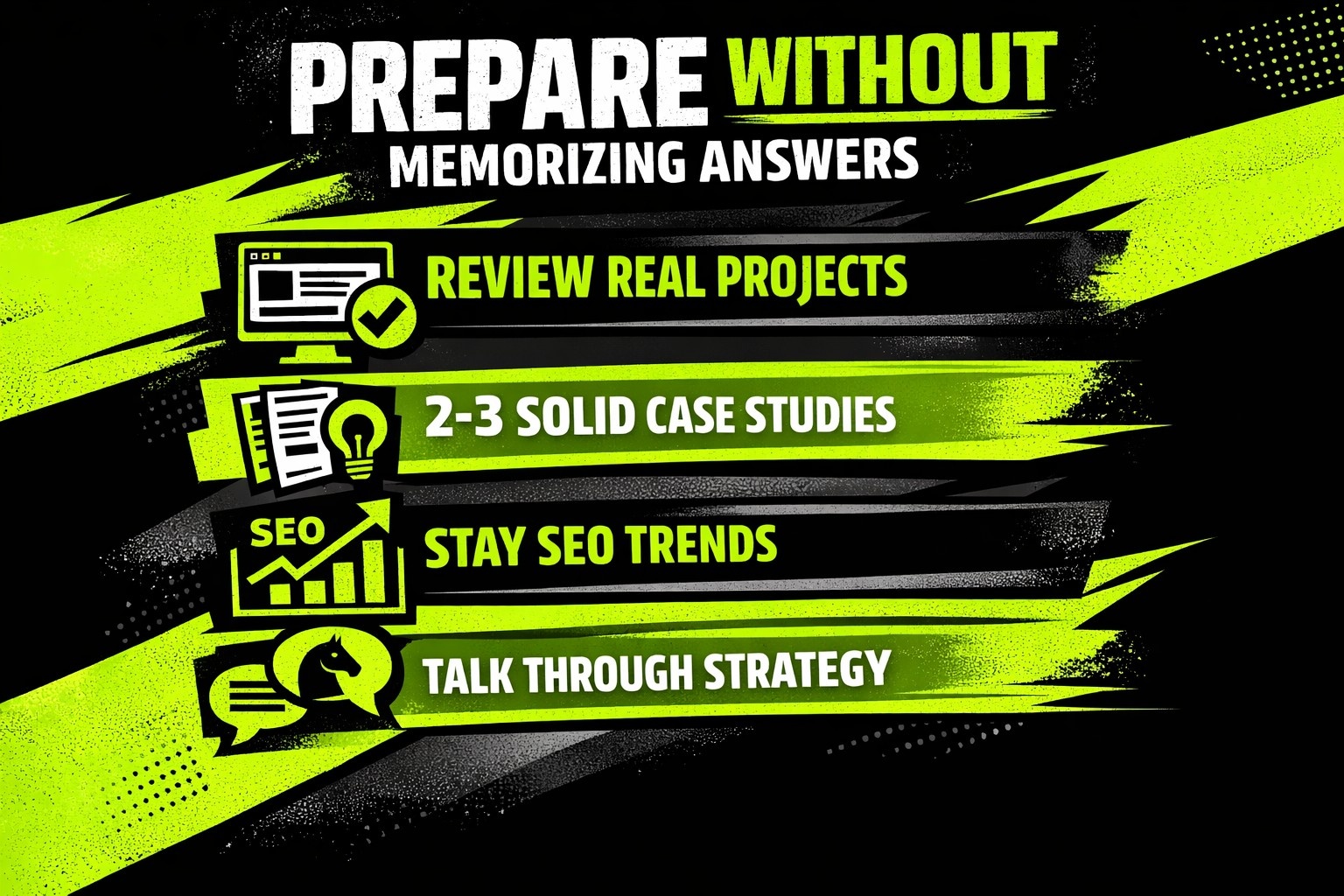
How to Prepare Without Memorizing Answers
The best interviews feel like conversations. You’re not there to impress with jargon or throw a list of tools at the wall. You’re there to show how you think.
Review Real Projects You’ve Worked On
Don’t rely on theory. Go back through your actual SEO work and get comfortable explaining what you did and why it mattered.
Pull 2-3 Solid Case Studies
Have a few specific examples ready where you can walk through the challenge, your approach, and the results. Keep it honest and relatable.
Stay Current on SEO Trends
Brush up on the latest changes like AI integration, Google’s SGE, or recent core updates. You don’t need to memorize release notes, just understand what’s changed and why it matters.
Talk Through a Strategy Out Loud
Whether it’s a content audit or link plan, practice walking someone through your process. It helps you sound clear and confident when it counts.
Know When to Bend the Rules
Best practices are helpful, but interviewers care more about your judgment. Be ready to explain why you prioritized one tactic over another, especially when strict best practices weren’t a perfect fit.
Final Thoughts
What makes someone good at SEO isn’t just technical know-how. It’s judgment. Knowing what to fix first. Knowing when to let something go. Knowing how to explain things clearly to a client or content writer.
So when you walk into your next SEO interview, don’t stress over sounding perfect. Be real. Be curious. And above all, be ready to think out loud.